Steve and the boozy ice cream

My blender died last summer.

I’m not sure what I asked it to do — scramble a couple of eggs, maybe? — but it made a sound like a dying frog, and slowly ground to a halt.

Oddly, I took this as a good omen. I had been dropping 25-pound hints to my wife about how great it would be to have an upscale, professional-grade blender. I’m not 100 percent sure if these thoughtless, insulting references to ambitious blending are what broke my old blender’s will to live, but I feel guilty about it anyway.

But not too guilty — I had that particularly dangerous gleam in my eyes that only 16-year-old boys and middle-aged men get. I really, really wanted a new blender, which my wife was fine with.

Until she found out how much it would cost.

At which point she gave me an ice-cold, steel-spined glare that the above-mentioned 16-year-old boys and middle-aged men are extremely familiar with.

A little more research on my part revealed that there is such a thing as reconditioned, high-end, professional blenders, that are slightly cheaper.

This revelation relaxed my wife’s glare by about 12 percent.

I suggested that I could put a little bit of cash aside each week and save up for one of these almost-new über-blenders, and got cautious, provisional permission to move ahead with this plan. Frankly, I’m pretty sure she thought that I didn’t have the attention span to follow through with it and would forget about it eventually.

Except that I found a loophole.

I had been throwing all my spare change in a large jar on my bedroom dresser for the past year or two — by definition saving up money, bit by bit. I made an appointment, then went to our bank to get the change counted.

When I got back, my wife asked, “How’d it go?”

I responded that unfortunately we’d need to go to the post office and get a change-of-address form.

Another confused but cautious look. “And why is that?” she asked.

“Because we’re moving to BLENDER TOWN, BABY!,” I responded, fluttering a handful of cash in her face.

Which is how I got Steve.

Steve is not a patient appliance. Every time I blend something, he urges me to use his highest setting — “C’mon, boss! Let me loose!” I quickly learned that while I could probably use Steve to grind a broomstick into sawdust, that much power isn’t all that useful for many of the things I actually want to blend. He is so powerful that on the highest settings, cavitation from the blades will lead to an air pocket that keeps the food from getting as blended as you’d think.

All of which is more or less beside the point, except to say that your blender — OK, my blender — is your (my) new best friend when you make this week’s recipe: boozy ice cream.

Rum Cheesecake Ice Cream

Put the canister of your blender on a kitchen scale and zero it out.

Add the following ingredients to the blender jar, taring the weight each time:

• 1 block / 8 ounces / 230 grams cream cheese

• Zest of 1 lemon

• 1 cup / 8 fl. ounces / 240 grams sour cream

• ½ cup / 125 ml sugar

• Pinch of salt

• 3 Tablespoons / 1½ ounces dark rum – I like Myers’

Blend. (At this point Steve chuckled evilly, and I indulged him. I turned the dial up to 8. Steve had a Very Good Afternoon.)

Put the blender jar in the refrigerator and chill thoroughly.

Blend again, briefly, then pour into your ice cream maker and turn it into ice cream.

Harden in your freezer.

So, here’s the thing about using alcohol in ice cream:

Sugar and alcohol have very important roles in ice cream, apart from tasting good. They affect the freezing/melting point and texture of the finished product in extremely weird ways. You are extremely limited in how much you can or cannot use. Do not try adding more rum to this recipe. Don’t try to find a loophole (yes, I’m aware of the irony here) and use a higher-proof rum – the amount of alcohol will seriously mess up your texture, and possibly your ability to make ice cream at all. Even the fairly modest amount of rum in this recipe dramatically altered my ice cream maker’s ability to freeze it. Normally it takes me about 20 minutes to freeze a batch of ice cream. This took close to an hour. (Steve did not help the situation by shouting disrespectful comments to the ice cream maker, across the kitchen, implying that if it was better at its job, it would have a name.)

This cheesecake ice cream is really delicious — it tastes spot-on like actual cheesecake — but the rum is definitely a subtle, background flavor.

That’s where the topping comes in.

A Possibly Misguidedly Boozy Blueberry Topping

Ingredients:

• 2 cups frozen wild blueberries

• 1/2 cup water

• 1/2 cup sugar

• 2 Tablespoons fresh-squeezed lemon juice

• 2 Tablespoons cornstarch, mixed with 2 Tablespoons cold water

• 8 Tablespoons / 4 ounces Golden Rum

• Zest of 1 lemon (about 1 tablespoon), optional

In a small saucepan, over medium heat, stir the blueberries, water, sugar and lemon juice, until it comes to a gentle boil. Let it boil for another 10-15 seconds, to make sure the sugar is completely dissolved.

Stir in the cornstarch/water slurry, and keep stirring, until the mixture thickens noticeably – about three minutes.

Remove from heat, then add the rum and lemon zest. Let the mixture cool slightly before topping your ice cream.

Blueberries and lemon go together extremely well. This is a fantastic topping. Yes, you can make it without the rum for the kids – sub in a tablespoon of vanilla for the alcohol – but this is a really, really good Thursday night, bracing-yourself-for-one more-day, grownup sundae. The rum is deceptive. You’ll taste a spoonful by itself – this is inevitable – and say, “Yup, that’s a good sauce,” then go to put the spoon in the sink, only to be stopped in your tracks by a hands-on-hips, steely glared reaction from the sauce.

“Good? That’s what you have to say? Good?”

The ice cream maker might not have a name, but I call this sauce Frida.

Featured photo: Boozy ice cream. Photo by John Fladd.

Little Pink Houses

I have a theory that the greater the classic rock anthem, the less objective sense it makes.

Remember in seventh or eighth grade? That school dance? It was probably the third or fourth one that you had gone to, but this was the first time you were brave enough to dance with someone. And, of course, you waited until the very last song, which was — obviously — “Stairway to Heaven.”

It doesn’t matter if you are a man or a woman. Or whether you were a boy or a girl at the time. Even if you haven’t thought about that moment in years, it is etched in your memory. As are a series of questions you had at the time:

Geez, how long is this song? (Just over eight minutes.)

Is there something special I’m supposed to do with my feet? (No. You’re 13. Just stay upright.)

Can this person see how much I’m sweating? (Yes.)

What’s with this weird bit at the end, where the music goes from slow, to fast, then back to slow, just long enough to make dancing incredibly awkward? (Art.)

And most importantly:

What does that whole line about a bustle in your hedgerow and the May Queen mean? (Nobody knows.)

Great song.

No objective sense, whatsoever.

While this isn’t universal, I refer you to the entire catalog of Paul Simon — or for that matter, Toto.

All of which is pretty irrelevant, except to say that this week, when I saw a little pink house, it seemed important to memorialize it. And my faded youth.

Little Pink Houses

100 grams strawberries — fresh are good, but frozen might be even better; they break down better in a drink.

4 grinds black pepper

2 ounces gin

5 to 6 ice cubes

¼ ounce white balsamic vinegar — regular balsamic will work too, but your drink will end up looking a lot like root beer.

1 ounce strawberry syrup or 2 Tablespoons strawberry jam

~3 ounces plain seltzer

Muddle the strawberries and pepper in the bottom of a cocktail shaker. If you are using frozen strawberries, you might want to let them thaw slightly first.

Add gin, stir, then walk away for five minutes. This will give the gin time to extract some of the flavors from the berries and pepper.

Add ice, vinegar and syrup/jam.

Shake thoroughly.

Pour, unstrained, into a tall glass.

Top with seltzer, and stir gently.

Garnish with songs from your playlist that will drive your children from the house.

This is a refreshing, spring-like drink. It’s not too sweet, and the notes of black pepper and balsamic vinegar keep it from tasting domesticated. It’s an outstanding Zoom meeting book club drink, but also excellent for sitting on the porch and watching the bird bath. As John (still “Cougar” then) Mellencamp would say:

Aw, but ain’t that America for you and me

Ain’t that America, somethin’ to see, baby

Ain’t that America, home of the free, yeah

Little pink houses for you and me

Oh yeah, for you and me, oh

Great song. No objective sense.

Featured photo: Little Pink Houses. Photo by John Fladd.

Mother’s Day Cocktails

In my experience, it is unwise to make broad generalizations about any group of women, but that said, it’s probably a good bet that this year, perhaps more than any other year, the moms of America could use a drink.

Let’s look at two hypothetical mothers, Jasmine and Kimberly:

Jasmine is a divorced mom of two young children, ages 5 and 3. She works full-time but has been “lucky” enough to be able to work from home for the past year or so. She gets up at 5 each morning to try to get some work done before Bruno, the 5-year-old, wakes up and wants breakfast prepared to very exact specifications. Failure to meet these specifications will result in angry denunciations, which will wake Pearl, the 3-year-old.

Jasmine needs a drink.

She needs something refreshing that will give her a brief moment of calm and grace.

A brief moment of calm

Ingredients:

1½ ounces very cold vodka

1 ounce rhubarb syrup (see below)

1 ounce fresh squeezed lime juice

5 drops rose water

4 ounces aggressively bubbly seltzer, like Topo Chico Mineral Water

Shake all ingredients except the seltzer over ice until very cold.

Strain into a delicate 8-ounce glass.

Top with seltzer.

Admire, maybe take a picture, stir, then drink.

This is a light, not-too-boozy cocktail that tastes pretty much how it looks — pink. The rhubarb syrup gives the drink a decisively pink color that blends with the seltzer to give it an ombre coloring. The rhubarb is delicately sour. The lime juice is citrusy but not too sweet. The rose water remains in the background, hinting at exotic secrets.

Rhubarb syrup

Ingredients:

Equal amounts (by weight) of frozen, chopped rhubarb and sugar

Pinch of salt

(Note on the rhubarb: When you make syrup from any fruit — or rhubarb, in this case — frozen fruit works better than fresh. The freezing process creates ice crystals, which pierce the cell walls, making the fruit more apt to weep. That would be a drawback in an application where you wanted pristine, lovely fruit, but it is an asset in situations like this one.)

Combine rhubarb, sugar, and salt in a medium saucepan and cook over medium heat, until the rhubarb starts to give up its juice.

Mash the mixture with a potato masher.

Bring the mixture to a boil. Let it boil for 10 to 15 seconds, to ensure that the sugar has dissolved completely.

Remove from heat, cool, strain, bottle and label. Store in your refrigerator indefinitely.

Now, let’s consider Kimberly:

Kimberly is married and the mother of a sulky teenager. All things considered, she and her husband Albert get along pretty well, but after a year of being locked in a house with him seven days a week, she is getting ready to smother him in his sleep. Elizabeth, 14, insists on being called Wynter Storm. She has recently graduated from telling Kimberly how stupid she is in general to making very specific observations of her shortcomings. She is also, apparently, a recent convert to veganism, although she still eats bacon and ice cream.

Kimberly needs a drink.

A classic boilermaker

Ingredients:

1 bottle of beer

1½ to 2 ounces bourbon

Fill a glass — pretty much any glass — 3/4 of the way with beer. You might want to tilt the glass to minimize the head of foam on top, but maybe making a long, sudsy pour will feel a little like poking your finger in the eye of — well, somebody. You do you.

Fill a shot glass with bourbon.

Give the two glasses a steely-eyed stare.

Drop the shot glass full of bourbon into the beer

At this point I’d normally describe the subtle flavor notes of this cocktail to you, but if you’re drinking a boilermaker you probably know what you’re letting yourself in for. If you don’t, consider this a well-deserved adventure.

Featured photo: A brief moment of calm. Photo by John Fladd.

The Chestnut Club

This column is an intervention for my editor and her aversion to a certain liqueur.

We Americans don’t deal well with bitterness.

The taste of bitter things, that is. We are fine with it as a character trait, but bitter tastes have a steep acceptance curve for us. Other cultures are much more accommodating to it. The Chinese concept of candy is more likely to be bitter than sweet. The British brew beers and ales that would make an American face collapse in on itself. But offer one of us an oil-cured black olive (the best kind of olive, by the way), and most of us will shrink back in horror.

“But, but that tastes like … leather!”

Yes. Yes, it does.

And this aversion makes a certain amount of sense, evolutionarily speaking. Long ago, we developed the ability to taste bitter things to help us avoid toxins in the wild. If a new berry or caterpillar tasted astringent or bitter, our ancestors knew to spit it out. But that logic breaks down in our modern world. There are huge numbers of us — granted, not so much in New Hampshire — who challenge ourselves to eat the spiciest foods we can stand. Sweating and gasping until we feel light-headed from a literal pain response? Fine. Bitterness? “What? Are you CRAZY?”

Intellectually, we accept that delicious, well-nuanced foods need a mixture of basic flavors. Bake a batch of cookies without salt, and they will just taste wrong. We love sweet-and-sour pork and chocolate-covered pretzels. Bitterness has a place at the table.

Which brings us to Campari.

Campari is a bright red, extremely bitter liqueur from Italy. You have seen it at the liquor store, or behind the bar at most upscale joints, but probably don’t have any around your house. It is the dominant ingredient in a Negroni.

To be fair, it is not universally loved. Some cynical critics have referred to it as “The Raisins of Booze.” [Editor’s note: As in “Why are there raisins in this cookie? This did not need raisins,” but with an otherwise perfectly good cocktail and Campari.] And yet, the fact remains that it is one of the best complementary counterbalances to sweet juices or syrups in mixed drinks. It is a team player; nobody is going to drink a glass of the stuff.

Actually, hold that thought.

Sound of footsteps going into the kitchen, various bartendy sounds, a brief moment of silence, then a gasp of shock and the sound of a tiny glass hitting the floor. More footsteps returning.

Yeah. I can’t recommend that.

BUT, I stand by my assertion that Campari deserves the space on your shelf where you are keeping that bottle of Crystal Head vodka that you bought on a whim that time and can’t bring yourself to open. (Open it and drink it, already. It’s vodka. It tastes like vodka.)

A case in point is a classic drink — the Chestnut Club (sometimes known as the Chestnut Cup), a modern classic developed in a California restaurant of the same name. It balances sweetness in the form of orgeat (an almond-infused syrup pronounced “or-szott”, as in, “It is unclear at this time whether the victim was stabbed or shot”), astringency from gin, sourness from lemon juice, and, of course, bitterness from Campari.

Chestnut Club

2 ounces gin (lately I like Death’s Door, out of Wisconsin.)

2 ounces Campari (Yes. Do it. God hates a coward.)

2 ounces fresh squeezed lemon juice

1 ounce orgeat

1. Combine all ingredients with 4 or 5 ice cubes in a shaker.

2. Shake until it is very cold — at least until condensation forms on the outside of the shaker.

3. Pour, without straining, into a rocks glass.

4. Drink sincerely, without irony, and, if possible, while sitting in a leather chair in an oak-paneled library with a taxidermied tiger head on the wall.

This drink is delicious. The flavor comes in waves. You really can taste each individual ingredient. It implies fruitiness, without actually embracing a Tiki mandate. It feels as if it should be too sweet and frivolous to take seriously, but it’s not.

Do you know why?

Campari, people.

Featured photo: Chestnut Club. Photo by John Fladd.

Back of the fridge

What’s lurking behind the milk?

Do you ever just do a deep dive into your fridge? It’s full of surprises.

That tub of “homemade” tartar sauce from that time you made fish and chips back in ’18. A mystery plastic container full of a thick, black liquid that smells like soy sauce and other less definable stuff. Or a bottle of Worcestershire sauce that’s been in there for who knows how long.

The same thing happens with beer; sometimes, brews just get lost in there.

I opened my beer fridge in the basement, which is a perfect replica of the tiny fridge I had in my college dorm room, and discovered I was getting down to the bottom of the barrel, so to speak.

There were a number of seasonal brews that weren’t in season — at least not this year. There was a canned, ready-to-drink “Bellini” cocktail, several of my wife’s hard seltzers and just a bunch of other really, really random offerings. And also a Founder’s KBS? None of it made sense.

It made me think of the Saturday Night Live digital short with Bill Burr where he’s “sampling” Sam Adams Jack-O Pumpkin Ale and says, “This is the kind of beer somebody brings to a party at your house, and then it just sits in the fridge for, like, eight months….”

We all have those beers in our fridge, and sometimes those beers we’ve been passing over for months can pleasantly surprise you.

Here are three back-of-the-fridge beers that I ended up enjoying.

Merry Monks Belgian Style Tripel Ale by Weyerbacher Brewing Co. (Easton, Pa.)

I don’t know why I held off on drinking this one for so long and I don’t even want to think about how long this one has been in my fridge. I like Belgian tripels a lot so there was no real excuse for it but there’s just something about the labeling on this brew that made it really hard for me to take it seriously: There’s a couple of, you guessed it, monks carrying a barrel, and, I don’t know, you’ll have to make your own call. But I finally dove in and regretted waiting so long to get after this one. It’s incredibly flavorful — fruity, spicy, sweet and well-balanced, and full of warming alcohol. This style is just kind of exciting. This was perfect on a very chilly early spring day.

Blood Orange Wheat by Jack’s Abby Craft Lagers (Framingham, Mass.)

Crisp, refreshing and not overly “wheaty,” this is an excellent choice for a warmer day. I think I was scared of the blood orange but I needn’t have been; while you can definitely pick up the citrusy sweetness from the orange, it’s not overwhelming. I am still, admittedly, fearful of this style because I might have had too many Blue Moons back in college, if I’m being honest. This is clean, bright and easy.

Flannel Friday by Harpoon (Boston)

This is another one that has had a remarkable hold on the back of my fridge. This beer is entirely inoffensive. It’s a little hoppy but it’s got a little malt character too that catches you by surprise. This is like the coming together of a pale ale and maybe a red ale? You get some citrusy zip from the hops and then maybe a little caramel from the malts — not bad at all.

What’s in My Fridge
Weekend Plans by Mast Landing Brewing Co. (Portland, Maine)

“Oh yeah” was the first thing I said after taking a sip of this one. IPAs abound these days, as we all know, so when you grab one that jumps out at you as fantastic, you remember it. Mast Landing continues to grow on me with its array of quality offerings from stouts to IPAs. This is hazy and juicy and so easy to drink it’s full-on scary. It seems crazy-talk to refer to a single brew as the perfect IPA, but that declaration rang awfully true as I enjoyed this one on a relaxing late March Saturday afternoon with friends. Cheers!

Featured photo: Blood Orange Wheat by Jack’s Abby Craft Lagers. Photo courtesy of Jeff Mucciarone.

Spring Sunshine

So, apparently, it’s springtime.

The snow is gone. We’ve switched over to daylight saving time. My road is a morass of muddy ruts. The air smells like fresh soil and stale dreams.

I like to think I’m jaded and world-weary, but I’m not immune to spring.

I’ve been giving my wife what passes for a saucy look. I’ve been practicing smiling knowingly and raising one eyebrow, which is much harder than it looks. Every time I think I’ve got it nailed, my wife will ask me if I’m feeling OK.

“What?” I ask. “Don’t I look sexy?”

“More like constipated,” she replies.

In my book, that must mean it’s Cocktail Time.

There are, of course, several cocktails that we associate with springtime — mint juleps, for instance, or creative hipster drinks infused with snap peas, or variations on summer drinks named after flowers, honeysuckle margaritas or hyacinth highballs, maybe.

Personally, I’ve been pretty fond of a Sunshine cocktail lately — a classic made with equal parts white rum, pineapple juice, dry vermouth and hope, with a small amount of grenadine for color and sweetness. It is bracing, not too sweet, and a lovely rosy-orange color. It is thoroughly delightful. And yet….

As much as I like a blisteringly cold Sunshine, as delicious as it is, it doesn’t taste very springish. The flavors all go together well, and it looks lovely and respectable, but it’s restrained and self-contained. It wears a tie and a vest and tips the staff generously but reasonably. It greets you with a firm handshake and asks after your family. It does not dash through the wildflowers, strewing rose petals and singing, “Hey, Nonny, Nonny,” on its way to meet a secret lover. It doesn’t demonstrate enough questionable judgment, in my opinion.

So let’s mess around with a classic cocktail that’s just minding its own business and not hurting anybody.

White rum is a good base for a drink. It doesn’t have a pronounced flavor, which makes it a good starting point for a cocktail that won’t offend anyone — vodka with a passport. (In fact, I made some dynamite banana-infused rum last week with white rum that would — but I digress.) Since we’re looking to put some backbone into our spring cocktail, let’s swap out the white rum for golden rum — not too dark — something caramel-colored that knows who it is. In this case, I’m using Rhum Clement, but anything golden will work.

I’m leaving the dry vermouth as is. It is a solid utility player that can support the rum.

Maybe the biggest change I’m going to make is swapping out the pineapple juice for passionfruit cocktail. We’ve talked about this before; you’ll find it in the juice aisle at the supermarket, probably just out of reach on the top shelf. It’s like pineapple juice, if PJ was perfumy and slightly dangerous-tasting.

Let’s replace the grenadine with homemade strawberry syrup. The strawberry goes well with the passionfruit cocktail and is a little more springy.

I’ll leave the hope as is.

Effulgence Cocktail

(I looked it up in a thesaurus, and it’s a synonym for sunshine. I like the sound of it.)

1½ ounces golden rum

1½ ounces dry vermouth

1½ ounces passionfruit cocktail

½ ounce homemade strawberry syrup (see below)

Combine all ingredients in a shaker half-filled with ice.

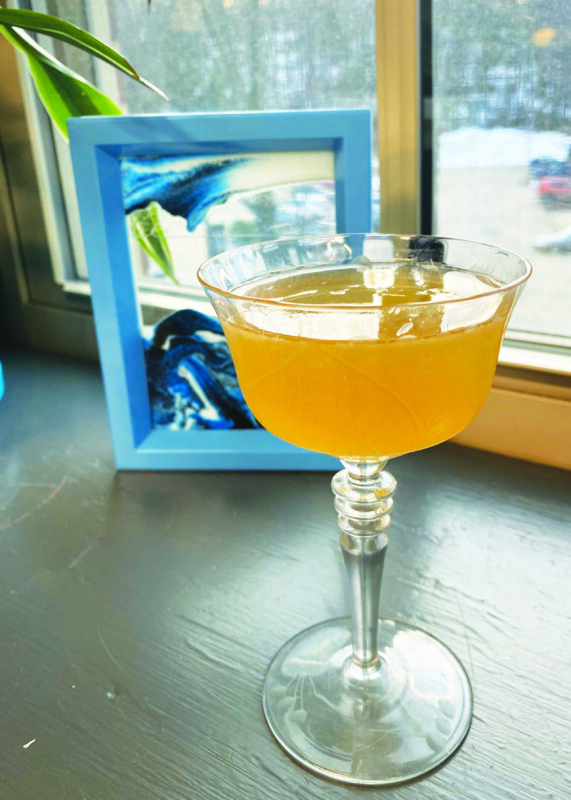
Strain into a chilled coupé glass.

Drink while making direct eye contact with a stranger.

This tastes similar to its cousin Sunshine, but with a few striking differences. The Effulgence’s golden rum is firmly in the driver’s seat. It lets you know who you’re dealing with, but it also lets you know that it is a professional and knows what it’s doing. The passionfruit adds a note of exotic devil-may-care vernality. The vermouth and the strawberry are background singers in this very nice spring-like mixed metaphor of a cocktail. Hey, nonny, nonny.

Strawberry syrup

• An undetermined quantity of frozen strawberries (Make as much or as little of this recipe as you like. The frozen berries will give up their juice more willingly than fresh ones; they’ve had their hearts broken by ice crystals.)

• An equal amount (by weight) of sugar

Heat berries and sugar in a small saucepan.

As the berries thaw and start to give up their juice, mash them with a potato masher.

Bring to a boil (to allow the sugar to dissolve completely), then remove from heat.

Cool, then strain into a small bottle and label.

Eat the remaining berry jam left in the strainer on toast or chocolate ice cream.

Featured photo: Effulgence Cocktail. Photo by John Fladd.

Stay in the loop!

Get FREE weekly briefs on local food, music,

arts, and more across southern New Hampshire!