• Noodles at Nash: The Lucky Lantern Noodle Restaurant has opened at The Nash Casino (Pheasant Lane Mall, 310 DW Highway, Nashua, thenashcasino.com). It is one of three sit-down restaurants in the casino. As its name suggests, the restaurant specializes in Asian and Asian-inspired dishes, particularly those with noodles. It is open seven days a week, from 5 p.m. to 2 a.m.
• Harpoon in NH: Harpoon will open its first brewery and pub in New Hampshire on Sunday, June 15. The brewpub will be located at 215 Canal St., Manchester, in the Queen City Center. In a June 5 press release, the Harpoon parent company said the new location will include an experimental brewery, restaurant, tap room, private event space, and an outdoor beer garden. Visit harpoonbrewery.com.
• Two great tastes: There will be a chocolate and wine pairing event at Wine on Main (9 N. Main St., Concord, 897-5828, wineonmainnh.com) Thursday, June 12, from 6:30 to 8 p.m. Chocolate expert Maggie Prittie will guide participants through tasting four single-origin chocolates alongside four complementary wines. Tickets for this 21+ event are $39.19 through eventbrite.com and include chocolate and wine samples as well as a lesson on the history of chocolate and how to taste it.
• Better than breakfast in bed: Celebrate Father’s Day with a “Dad and Me Pizza Cooking Class” at Uno Pizzeria & Grill (15 Fort Eddy Road, Concord, 226-8667) on Saturday, June 14, from noon to 2 p.m. This is an interactive cooking class where dads and the kids can bond over making deep dish pizza from scratch. Chefs will guide participants through every step from preparing the dough to adding favorite toppings. Adult tickets are $44.52 and children’s tickets are $12.51 through eventbrite.com.
• Order online for this food fest: Starting Sunday, June 15, Temple B’nai Israel (210 Court St., Laconia, 524-7044, tbinh.org) will accept orders for its annual Jewish Food Festival. Dozens of types of traditional Jewish dishes will be available for drive-thru pickup on Saturday, July 19, and Sunday, July 20. Orders will be accepted at tbinh.org/shop-page through Monday, July 7.
Not one of the relatively inexpensive ones from a big-box store. Not a cool, chromey, vintage one that would be at home in a diner. A serious blender, the type you can watch chew up hockey pucks and Barbie dolls on the internet.
My wife tried to deflate this ambition with logic — namely, why would I want to do any of these things, particularly grinding up hockey pucks? “We are not spending $500 on a blender,” she informed me in a tone that would not allow for any argument.
An hour later, after some internet research, I informed her that we could buy a reconditioned professional blender for a relative bargain of just over $200. I took the jar on my dresser that I had been dropping change into for the past year to change-counting machine at the bank. It made short work of my jar of change and returned two British pounds, $1.40 in Canadian change, two buttons and almost $300 in Blender Money.
Upon returning home, I informed my wife that we would have to pick up a change-of-address form at the post office.
“Why’s that?” she asked.
“Because we’re moving to Blender Town, Baby!” I replied, waving a wad of cash in the air.
I subsequently bought a red Vitamix blender and named him Steve.
This was Steve’s project this past weekend:
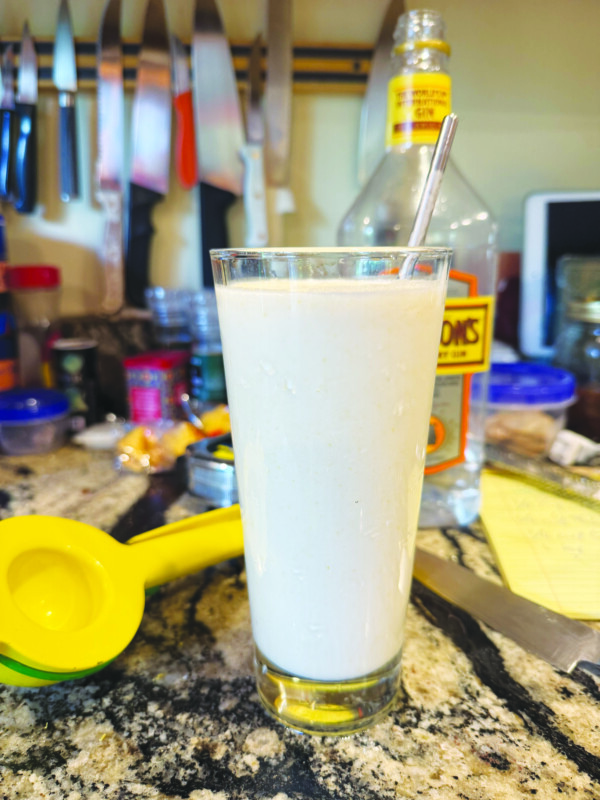
Fluffy Lemonade
1½ cups of ice cubes
Zest of one lemon
¼ cup (2 ounces) fresh squeezed lemon juice
¼ cup (2 ounces) heavy cream
¼ cup (2 ounces) sweetened condensed milk
¼ cup (2 ounces) London dry gin
Combine all ingredients in your blender (Steve).
Blend on low speed, until the ice stops rattling around, then really put the spurs to the blender, and whip the mixture up for 30 seconds or so, until it is light and fluffy in texture.
Pour into a Collins glass and drink with a straw, while your digital assistant plays “Mr. Blue Sky” by the Electric Light Orchestra. Hold up your glass, as in a toast, and gently clink it against the rim of your blender jar. Your blender will smile to itself contentedly.
Given that some of the ingredients — I’m looking at you, condensed milk — are pretty heavy, this is a beautifully light and delightful blender drink. It’s super lemony, but not too sour. The gin hides in the background. The overall drink is lightly sweet, and super refreshing.
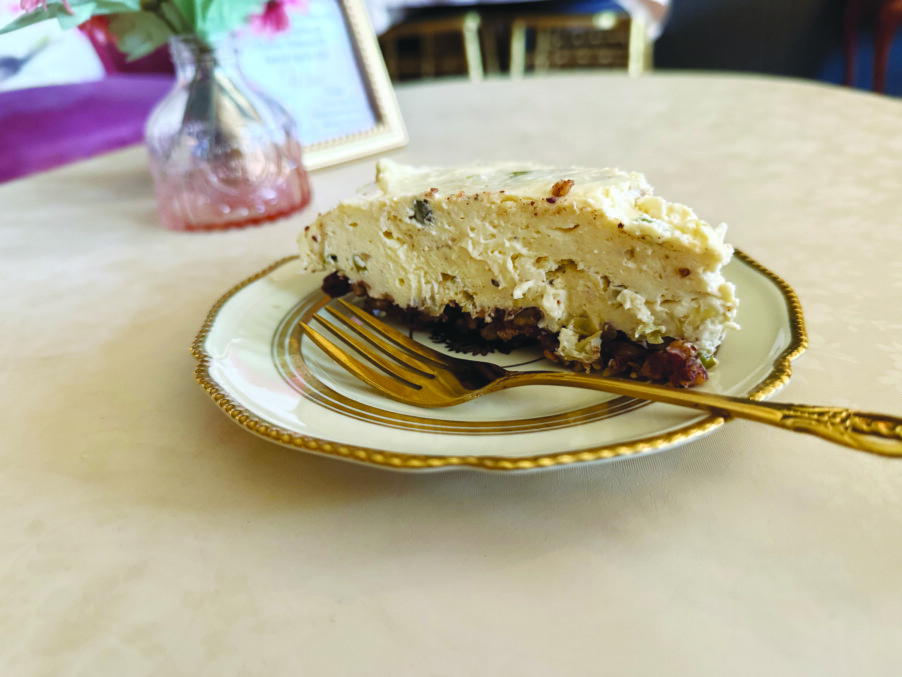
Featured photo: Amanda’s Savory Cheesecake. Photo by John Fladd.
This weekend marks the ninth annual Bacon and Beer Festival, a major fundraiser for the High Hopes Foundation (931-4999, highhopesfoundation.org), a New Hampshire charitable organization dedicated to making life a little easier for the state’s children with special needs.
“We help kids who need stuff that is deemed non-essential by insurance companies and we believe is essential,” said Lisa Rourke, a High Hopes board member. “For example, today we just threw a post out there about a little boy whose diagnosis leads him to not be able to ride a traditional bike but of course he wants to ride a traditional bike with his twin sister. There are adaptive bikes out there, but a bike [like that] is about $5,000.” Although it would significantly improve the quality of this boy’s life, Rourke said, it’s not something that insurance would cover.
That’s where the bacon and the beer come in.
This year’s Bacon and Beer Festival, which will take place Saturday, June 7, at the Anheuser-Busch Field in Merrimack, will feature dozens of area restaurants and breweries providing Festival-goers with beer and bacon-centric foods. The restaurants will compete to win bragging rights and a trophy for a People’s Choice Award for this year’s most popular bacon dish. “It’s actually a really cool trophy this year,” Rourke said.
“North Country Smokehouse is our biggest sponsor for this event,” Rourke said. “A fun fact: they donated 1,500 pounds of bacon this year for the festival, three different types. So the bacon samplers can either use chopped, chunk, or slices [of bacon]. Then they [the participating restaurants] can do something savory or something sweet, but they’re all competing for the People’s Choice Awards.”
“A bunch of restaurants and food trucks all agree to sign up to do this,” Rourke continued. “North Country Smokehouse will donate the bacon, but then they do everything else. So, for instance, if they’re pairing their dish with something like french fries or whatever they’re doing, they do that on location.”
According to Rourke, the event is expected to draw 1,800 attendees, each of whom will receive an attendance wrist-band. “And they’re not the annoying type!” she said emphatically. “They’re the kind that clicks on instead of sticks on. It’s a game changer! On the wristband, there are four voting tickets and you use those [to vote]. So if you like a bacon sample, you take one of those tickets off your wristband and throw it in there and vote. You can put all of your tickets into one guy if you really were blown away, or you can spread it out to four different bacon samplers and spread the wealth. And it’s just kind of, it’s open — you can go to a bacon sample, then go to a brewer and then go to a bacon sample, then go to a brewer, and then go to a bacon sample. You can go straight down the bacon line. You can go straight down the brewery line, however you see fit.”
“The really cool thing,” Rourke continued, “is what these guys bring to the table. They’re all different types. We have guys that come who are food trucks that make New England comfort food. And then we have Greenleaf in Milford that’s an exquisite farm-to-table classy restaurant. From a sampling perspective, that’s really amazing.”
For the most part, Rourke said, the participating breweries will be locally based.
“We have about 60 local craft brewers,” she said. “We try to keep it as local as possible. So we really try to keep it … open to those places that are within New Hampshire, New England. We have 60 breweries, but many of them will bring three or four different samples. So you can sample a ton of things and then decide what you love and sip on that all summer.”
NH Bacon & Beer Festival When: Saturday, June 7, from 1:30 to 5 p.m., with last pours at 4:30 p.m. Where: outdoor fields of the Anheuser-Busch Brewery, 221 DW Highway, Merrimack. Tickets: General admission tickets are $70.90 through nhbaconbeer.com. Designated Driver tickets (no alcohol) are $39.07. If there are any tickets left on the day of the event, they will cost $55 at the door. This event will take place rain or shine. This is a 21+ event — no children or pets allowed in the event area.
Featured photo: The trophy for the People’s Choice Award at the Bacon and Beer Festival. Courtesy photo.
There are significant differences between the terms “grilling” and “barbecuing.”
It has to do largely with what kind of meat you are cooking. If it is a tender, juicy cut of beef, for instance, you will probably want to grill it — cook it quickly, over fairly high heat.
Dan DeSouci is the owner of the Up in Your Grill Food Truck (493-3191, upinyourgrill.com) and a competitive griller. Barbecuing, he said, is something very different.
“Classic Southern barbecue is low and slow, typically,” he said. “There are other methods — hot and fast methods — but typically, it’s low and slow. And it’s usually the bigger and tougher meats. Originally, these larger cuts — like say a pork butt or brisket — if you try to cook them on a grill they usually come out very tough. If you cook it low and slow in a smoker or really any low and slow method, it’s going to break down all the fat and connective tissue. The meats are just going to kind of stew their own juices and become very, very tender. That’s the goal of barbecue.”
And then there’s grilling, he said.
“Grilling is hot and fast where [the meat is] direct over fire — like steak or a pork chop, any kind of chop, fish filets or something you want to expose to high heat. That’s grilling. I have trophies for grilling, so I have opinions about this. My nickname is actually Grill Man Dan.”
One of the most popular grilling techniques in recent years, DeSouci said, is something called a “reverse sear.”
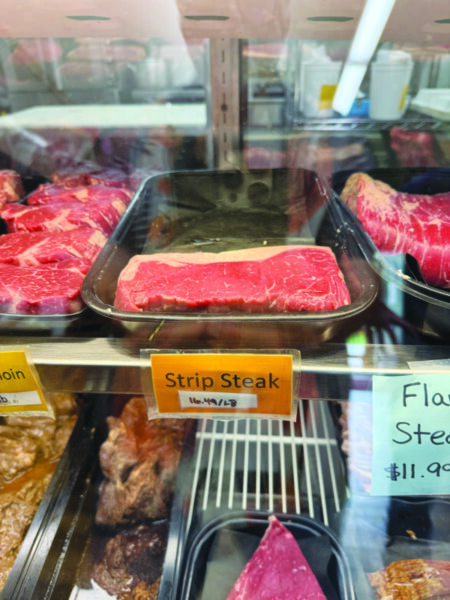
“So there’s direct searing,” he explained. “An easy example is that you take a New York sirloin strip steak, right? You put it on the grill. You put it directly on the fire, you’re just grilling it, right? Put it on there, you get some grill marks, then put it over indirect heat until it cooks to the temperature you like, and it’s wonderful. But there’s some people who swear by what’s called the reverse sear. They’ll put [a steak] over the cold zone of the grill, close the top, let it cook a little bit. When it’s cooked to the temperature they want, they open the top and put it onto the direct heat, get those grill marks and finish it really fast.”
There are any number of steaks that are well-known for how well they grill — T-bones, porterhouses and rib-eyes come to mind — but it’s easy to focus on those and miss out on a world of things to grill.
One category of meat that gets overlooked for the grill, DeSouci said, is fish.
”I actually love trout,” he said. “You can cook trout with the skin on, which helps it hold together better. You can grill right on the grill with the skin, but a lot of people [use] fish baskets for the flakier fish.” These are the black steet baskets you find where you buy grilling equipment, he explained, the ones with lots of medium-sized holes in them. “You can do like what some folks will do,” DeSouci continued, “steaks like a tuna steak or a swordfish steak — a firmer fish. You can even grill salmon steaks that are cut the other way [cut the long way, with the grain of the flesh, giving the fish a firmer texture]. Those are going to hold up better to direct grilling and direct heat, whereas with flakier fish you’re better off in a basket.”
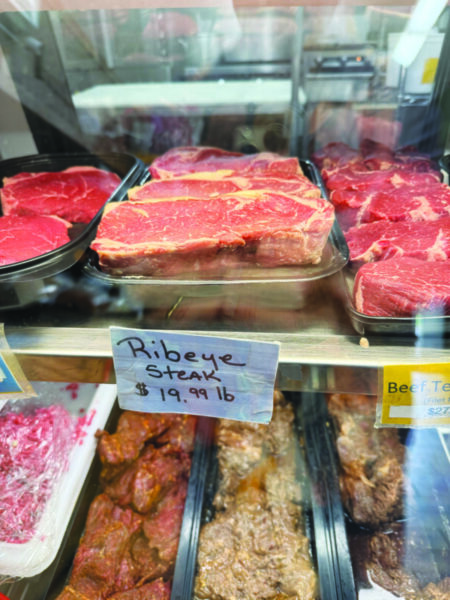
Ribeye. Photo by John Fladd.
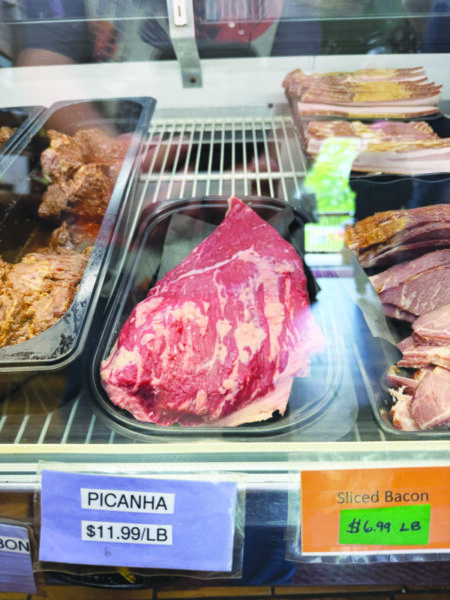
Picanha. Photo by John Fladd
Home grillers don’t necessarily have to invest in special equipment to begin with, DeSouci said. “There are other tricks too,” he said. “There are some wonderful recipes out there where you put everything in some foil and wrap it. So you’ll put something like a cod fillet, some lemon in there and some herbs, and a little bit of oil, and then you wrap it up in the foil and put it on the grill and flip it a few times and take it off the grill. It comes out wonderful.”
When he’s at home, DeSouci loves to grill pork.
“I can’t get enough of pork chops,” he said. “Chicken and pork are going to be a lot cheaper than beef or fish. And the best chops have a little bit of the tenderloin on them. In most grocery stores, it’s just going to be called something like ‘center cut pork chop.’ Look for the ones that are almost like a T-bone steak where on one part you have the pork sirloin and on the other part you have the pork tenderloin, which is very, very tender.”
Jay Beland is a butcher at Lemay and Sons Beef in Goffstown. He is a big proponent of grilling sausages.
“It’s a great way to cook,” Beland said. “Do a sausage. It’s an easy thing to do. You pretty much just put it on the grill, usually for 10, 15 minutes at most, and you get a great turnout on pretty much any of the sausages we make — everything from sweet Italian sausages to Chinese to garlic and cheese.”
The key, Beland said, is to watch your sausages carefully.
“Grilling,” he said, “versus any other way of cooking, gives you more of that char-type flavor to the surface of what you’re cooking. Plus, the thing to be careful of when you’re grilling sausages is not to grill it at a high temperature because it creates scorching. And if your sausage has a natural casing, it may not be as resilient to the heat like it would be if it was an artificial casing. So low and slower may be more preferred when it comes to grilling a sausage. So when you’ve got different [heat] zones over the coals, you cook it out toward the outside where it’s a little cooler. It’s not like a steak where a steak can take the heat, you sear it, and then you move it to a lower temperature so then you finish cooking it. What you want to do with a sausage is more of a slow, even cook, all the way through.”
Beland and the other butchers at LeMay and Sons enjoy grilling with gas grills, as well as over charcoal, but are emphatic about what type of charcoal to use. “LUMP!” they said in unison when asked. Lump charcoal is made from chunks of wood that have been carbonized in a low-oxygen environment. Many grillers like the quality of the heat they get from it.
Shop manager Rick LeMay explained his opinion about the difference in quality between lump charcoal and briquettes.
“The problem with a lot of charcoals today,” he said, “is you’ve got manmade, artificial stuff. They try to simulate what our parents or ancestors used to do when it came to burning wood, but that was cooking with wood coal, versus an artificial [briquette] that somebody’s decided to make something out of something else. Why can’t you use charcoal that looks like charcoal? I got my neighbor going with lump charcoal. It’s more like cooking with wood.”
“Plus,” LeMay added, “with charcoal, you can always inject some smoke. You know, put a little piece of hickory in there. If you want lighter, go apple. You can always inject a little smoke flavor.”
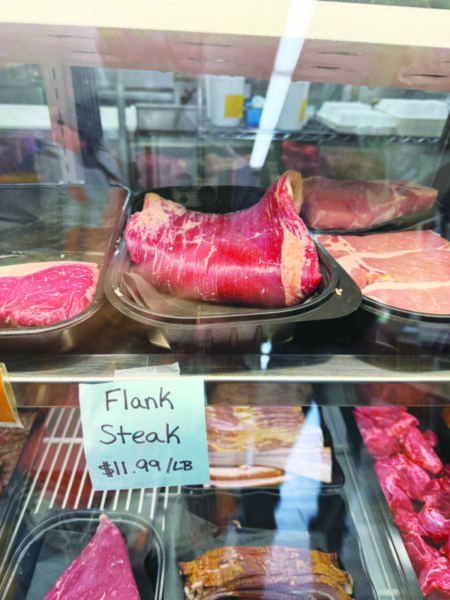
LeMay particularly likes the versatility of flank steak.
“It’s a more grainy, textured steak, like steak tips would be,” he said. “It’s what’s used in a Chinese restaurant when you get steak on a stick, the teriyaki steak, if you will. It can be sliced thin. You could use it for fajitas. Or you can slice it a little thicker. You can dry rub it. You can grill it openly, as a whole piece. It’s not very thick, but it’s like a sheet of paper in such a way where you can grill both sides. You sear it, you leave the inside medium to rare, and then you slice it afterward, after letting it rest for a bit, like any beef cut, and then you can slice it paper thin like a shaved steak, or you can slice a little bit thicker like a fajita or you can slice a little bit thicker than that like a steak tip.”
LeMay said it’s important to remember to slice any beef — especially something like flank steak, which has a lot of texture — against the grain of the muscle fibers. “Otherwise,” he said, “you’re dealing with jerky. It’s a great thing to do for the in-laws if you don’t want them to come back.”
Another cut of beef that has been growing in popularity is one called “picana,” which comes from the hip of a steer.
Flank steak. Photo by John Fladd.
Strip steak. Photo by John Fladd.
“It’s part of the sirloin,” LeMay said. “You won’t see it for sale up here in the Northeast much, because it’s more of a southwestern item. The pincana is comparable to a sirloin steak in its texture, but it has a nice fat cap on it. It has some marbling, but it’s not intense like a rib-eye. It’s a tender piece of meat that has a pretty good flavor to it for its price point. It’s commonly done as a whole piece. It’s not a large piece. It’s usually three pounds or less as an entirety. So it allows you to cook a whole muscle on the grill or the smoker without having a significant poundage for a family where you can smoke that and slice it and have it for a meal rather than doing something that would be significantly [larger] in size like a 10-pound sirloin.”
Lemay said home grillers should not be afraid of a little fat on their beef.
“The marbling on a steak is good,” he said, “because it’s forgiving. If someone overcooks it, it will still be tender if it’s got enough fat. That’s why steak tips are popular with a lot of people, because they are pretty much foolproof for grilling.”
Some hobbyist grillers are experimenting to find ways of cooking “low and slow” with their grills, LeMay said.
“Can you use your grill as a smoker?” he asked. “You can. It takes a little bit more effort to do so, but it’s possible. More people nowadays are turning their charcoal grills into smokers. My neighbor, he’s got a Weber kettle [grill]. He lights the lump coal in the back, puts the wood [for smoking] on one side, and then just lets it smolder and puts all this food on the side where [the heat] is indirect.”
Keith Sarasin, the head chef and owner of The Farmer’s Dinner (thefarmersdinner.com) pop-up restaurant, is the author of Meat: The Ultimate Cookbook (2021, Cider Mill Press). He said a home cook should use whatever type of grill makes their life easier.
“Really what I’m looking for,” he said, “is something easy. I think a lot of times people associate cooking with this laborious task, and grilling should be fun. Propane is obviously really great. If you’re looking at two-zone cooking, with one side for hot searing and the other for cooling and finishing, propane has a more regulated heat. It allows you to regulate and keep a consistent temp. It’s one of the reasons it’s been so popular throughout all the years.”
“Charcoal will give you kind of that more backyard barbecue taste,” Sarasin said, “as opposed to propane. It’s delicious and it’s a great medium and I cook on it a lot. But when you’re starting to [experiment with] woods and charcoals, you’re dealing with a tremendous amount of fluctuation in temperature.”
“There are a number of things that I like to consider when I’m looking for a charcoal grill,” Sarasin continued. “First and foremost is airflow. I need adjustable vents on both the intake and exhaust for that. That gives me control over the temperature. The better the control, the easier it is to go low and slow or hot and fast, depending on what you need. The other thing that I’m looking for is a coal management system. Basically, I’ll look for, ‘How easily can I move these coals around? Is there a charcoal grate that allows for indirect and direct zones?’”
Sarasin admitted that charcoal grills involve a certain amount of maintenance: “I think cleaning and ash removal is a really important thing. A lot of people don’t clean their grills properly. They’ll do an entire summer of grilling and they’ll never empty the coal pan or the ash tray, so you get all this buildup, and that’s one of the things that contributes a lot to fires.”
As a griller gains experience and gets more confident, Sarasin said, a natural next step is to play around with different woods that produce different levels and flavors of smoke.
“As you start to get into woods, that’s when things go very, very different,” he said. “I’d start with applewood because it’s something that we have an abundance of because of the farms here. And applewood has a very sweet and mild taste to it. It is fantastic for poultry and for veggies. I smoke with applewood quite a bit.”
“If you’re starting to get into brisket and ribs and all of those things,” Sarasin said, “you can go a couple of ways. In Texas they use post oak because it’s literally the greatest wood for smoking brisket. Hickory and mesquite also work really, really well. Then you have things like pecan and maple woods. Those are really good for poultry as well. I like maple and salmon and anything delicate because it does give a sweet and subtle flavor to it, as opposed to mesquite, which is very earthy and sharp.
Chef Sarasin said that when he grills at home he defaults to a particular cut of beef.
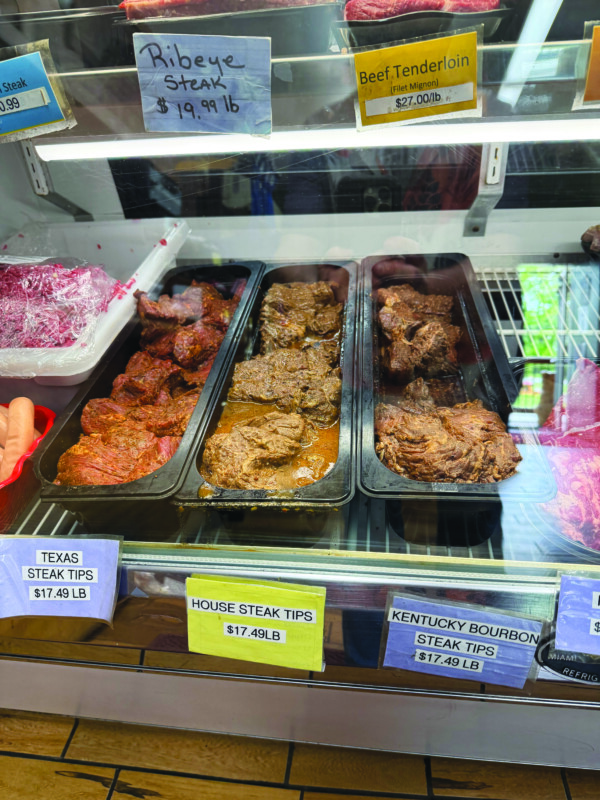
“For grilling,” he said, “I am a huge fan of just flap steak. The reason I like it is because flap has a lot of wonderful marbleization to it. It’s not too tough. It works wonderfully for steak tips. And we’re a New England culture, and steak tips are part of our New England culture. Steak tips are part of our backbone and DNA.”
“I think that’s what I’m going to do for dinner tonight,” he said after a moment of reflection.
“Why don’t you ever make anything for me?” Amanda asked.
“How about some cookies?”
“No,” she said with a frown. “I’m keto.”
“Some muffins? I could make them out of almond flour?”
“Will they have sugar in them?”
“So, what would you like?”
“You know me,” she repeated with a bright smile. “I’ll like anything you make.”
Amanda’s Savory Cheesecake
Crust Two 8-ounce bags of roasted, salted pecans 3 Tablespoons butter, melted 1 egg white
Cheesecake filling
Three 8-ounce blocks of cream cheese ½ cup (113 g) sour cream 3 Tablespoons corn starch 1 teaspoon kosher or coarse sea salt 2 eggs 2 Tablespoons capers, drained 1/3 cup (20 g) chopped chives (well, snipped actually; chives prefer to be cut with scissors) ½ 14-ounce can of artichoke hearts – four or five hearts 2 Tablespoons balsamic vinaigrette Preheat oven to 350°F.
Grease a 9-inch springform baking pan, and line the bottom with parchment paper. Welcome the lined pan to the team, and set it aside to prepare for its upcoming mission.
Chop pecans in a blender, then transfer them to a mixing bowl. Mix the chopped pecans with the melted butter and the egg white, then transfer the mixture to the springform pan, and press it down with the bottom of a measuring cup or a coffee mug. Bake it for 20 minutes, then set it aside to cool for a few minutes, while you make the cheesecake filling. Reduce the oven temperature to 250°F.
Drain the canned artichoke hearts, then squeeze them by hand — hard, like they owe you money. They will break apart, which is what you want. Put the broken-spirited artichoke hearts into a small bowl, and add the balsamic vinaigrette. Leve the two to marinate for 15 or 20 minutes.
Meanwhile, use an electric mixer to beat the cream cheese, corn starch, sour cream and salt together until they are light and fluffy. Put the corn starch in first to avoid poof-ing. Scrape down the sides of the bowl with a rubber or silicone spatula, then beat in the eggs, one at a time.
Add the capers, chives and now thoroughly inebriated artichoke hearts to the cream cheese mixture and stir them in by hand.
Transfer the mixture to the springform pan, on top of the pecan crust. Smooth it out with the silicone spatula or the back of a large, wet spoon.
Place the cheesecake on the middle rack of your oven. (You remembered to turn the temperature down, didn’t you?) Bake it for 45 minutes, then turn the oven off, but leave the cheesecake in it for another hour. Do not open the door.
After the oven and the cheesecake have calmed down together, take the cheesecake out and leave it on the counter to continue pulling itself together. Yes, 250°F is what we would call a “gentle” heat, but it can still be traumatic to a cheesecake.
Serve at room temperature, in modest-sized slices. While it’s not a sweet dish, it is very rich, and one slice per guest will be perfect. A glass of prosecco or a cup of oolong tea will be a perfect accompaniment.
Amanda’s verdict?
“This is like the best dip I’ve ever had. But it’s a CHEESECAKE!.”
Nomad Bakery
Cheryl Holbert’s bread is available weekly at Benedikt Dairy (97 Shirley Hill Road, Goffstown, 801-7056, benediktdairy.com), on the menu at The Grind Cafe (5 W. Broadway, Derry, 260-2411, facebook.com/thegrindnh), on selected dates at the Derry Homegrown Farm & Artisan Market (1 W. Broadway, Derry, 479-5918, derryhomegrown.org) on Wednesdays, June through September. She also accepts commissions through her Facebook page, facebook.com/NomadBakery.
Featured photo: Amanda’s Savory Cheesecake. Photo by John Fladd.
Cheryl Holbert is more than a baker and more than an artist. She creates works of art — mostly landscapes and scenes from nature — from brightly colored bread dough. The result is almost better than a painting or a sculpture, which would have the disadvantage of not making a good sandwich.
Holbert said she started baking professionally in 2014. Before that, she worked as a reporter.
“I worked for museums,” she remembered. “I was a tapestry artist. I ran a program at the Currier Museum for a while, weaving and all of that. I always loved bread; I grew up in a family that loved bread. It was my grandmother who was really the baker. I started baking bread, honestly, because after I moved away from my family in New Jersey I was homesick so I just started baking it at home.”
At the same time, she was also exploring her Jewish roots.
“I was discovering my heritage,” she said, “some roots I wasn’t familiar with and the two just dovetailed where I started baking and being very interested in the bread that my grandmother had made from her Eastern European culture — challah bread [a traditional braided Jewish egg bread]. And I ended up starting a small business, from my home, a homestead food operation, where I started baking bread for the farmers markets. I got a license so I could do it wholesale. And I started baking.”
This, Holbert said, is where her weaving background came in.
“During Covid,” she said, “everyone, including me, started a sourdough starter. Sourdough people started braiding and doing challah braiding. There were a lot of platforms at the time reaching out and looking for bakers with experience making braided beads. I started a relationship with King Arthur, contracting with them as a guest teacher. I began teaching a lot virtually.”
A series of family health emergencies kept Holbert tethered to her home, and creative baking gave her an outlet for her talent, and to support her family.
Holbert uses local and organic ingredients to make her breadscapes.
“I color the bread with food ingredients,” she said, “actual food ingredients. So in my spectrum of the reds to pinks, I use pureed beets. And then I might add beet root powder to make a little more red than a magenta. Yellow is definitely turmeric. I might add olive oil in the dough for that because that’s going to affect what kind of yellow that’s going to be. I love very highly saturated earth colors. I love saturation. I love contrast. And for me, because bread is going to put kind of a brownish hue on everything, I want to get as much color as possible, and this is the route I need to take to get that.”
Holbert usually tints her doughs before baking a breadscape, she said. “The colors will retain, if not brighten, the interior. When it’s on the exterior, you have to do some things to retain as much color as possible because it’s going to turn brown, but you can do certain things to control that a little bit. And then I have painted more on the surface design with [ingredients] like chocolate powder or espresso to create designs. You have to be intentional about what you think, where it’s going to land in the final piece.”
“It really has to do with the years of really having a passion about and developing a growing and evolving understanding of how all the natural elements work,” she said. “For me, that creates the art I want with this.”
Nomad Bakery
Cheryl Holbert’s bread is available weekly at Benedikt Dairy (97 Shirley Hill Road, Goffstown, 801-7056, benediktdairy.com), on the menu at The Grind Cafe (5 W. Broadway, Derry, 260-2411, facebook.com/thegrindnh), on selected dates at the Derry Homegrown Farm & Artisan Market (1 W. Broadway, Derry, 479-5918, derryhomegrown.org) on Wednesdays, June through September. She also accepts commissions through her Facebook page, facebook.com/NomadBakery.