4 cups (124 g) Cheerios – how long have these been heart-shaped?
1½ cups (210 g) salted roast peanuts
1½ cups (319 g) brown sugar
¾ cup (255 g) molasses
½ cup (113 g) water
4 teaspoons vinegar
1/8 teaspoon cream of tartar
1½ teaspoons baking soda
In a large greased bowl, combine the cereal and the peanuts.
In a large saucepan, combine the brown sugar, molasses, water, vinegar, and cream of tartar.
Over medium heat, bring the molasses mixture to a boil, stirring occasionally. Continue boiling, until the mixture comes to a temperature of 250ºF — this is what no-nonsense grandmothers and aunts used to call the “soft-ball” stage.
At this point you will need some way of measuring the temperature of the hot molasses syrup. One option is an old-fashioned frying/candy thermometer. Another is a whisk with an integrated thermometer — I like this option a lot; it allows you to multitask. You can continue to stir and still keep track of the temperature.
I would add a note of caution, however. There are two parts to this whisk/thermometer — it’s a probe thermometer that is pushed through a small hole into the whisk component. The electronic thermometer doesn’t like to get wet, so as I was cleaning up after making this candy, I congratulated myself on remembering to pull the two components apart before washing them. This turned out to be difficult. The molasses candy was very sticky and had set up more firmly than I expected. I decided to pull with more effort, only to rip the whole thing in two. As I stared down at the loose wires jutting out from the broken thermometer base, I swear they looked judgmentally at me for my betrayal.
As soon as the molasses syrup reaches 250ºF, remove it immediately from the heat, and stir the baking soda into the mixture as quickly as possible. It will foam up and look really cool.
Pour the hot, foamy syrup over the cereal-peanut mixture, and stir to combine with a well-greased spoon. The key term from this point forward will be “well-greased.”
Let the mixture sit and cool for a few minutes, which will give you a chance to grease up your hands.
Using your well-greased hands, form the cereal mixture into 2-inch patties and press them down on a well-greased silicone mat or a well-greased sheet of parchment paper. As greasy as this whole endeavor is, when you get about three quarters of the way through the patty-making process you will wish you had greased everything even a little bit more.
Let the patties sit for half an hour or so before eating any of them, and let the remainder harden up overnight.
A note about cleaning up: The best tool for cleaning your mixing bowl and saucepan seems to be a stiff-bristled kitchen brush. You might be tempted to use the green scrubby part of a sponge, but you’ll end up going through several of them, which you will end up having to throw away. A brush will not only make reasonably fast work of cleaning up; it will also clean itself of any candy residue. This brush may become your new best friend. Name him.
If you haven’t run the gauntlet of candy-making before, this is a pretty good beginner’s project. This is a good candy, with a low effort-to-reward ratio. In 1950 Betty and her ghost writer wrote that these candies are “like caramel corn,” which they are, in a way. There’s no actual popcorn involved, of course, but the Cheerios and the peanuts stay crunchy, without the annoying hard bits of corn kernels that stick in your teeth with actual caramel corn. These are chewy candies that taste mildly of molasses, Cheerios and salt. They are excellent with a mug of tea.
They just need a more exciting name. Ernesto, perhaps? Bruno? Fanaka, Queen of the Amazons?
John Fladd is a veteran Hippo writer, a father, writer and cocktail enthusiast, living in New Hampshire.
Featured photo: Molasses Patties. Photo by John Fladd.
Red Arrow shows famous visitors in online photo album
Presidential hopefuls love to have their pictures taken in diners. And primary candidates make absolutely certain to visit one of the Red Arrow diners — well-known diners in New Hampshire — particularly the mother diner in Manchester.
This makes sense to Amanda Wihby, co-owner and COO of Red Arrow, who says that visiting a diner gives candidates a chance to meet with Granite Staters from every walk of life.
“Diners are the focal point of a community,” she said. “All types of people want comfort, and we specialize in comfort food.”
The Red Arrow regularly posts photos of celebrities who eat there on an online photo album at redarrowdiner.com/category/famous-guests. It isn’t surprising that the most recent photos are predominantly of politicians — though scroll down to September 2023 and you’ll find Adam Sandler, who regularly dines at the Red Arrow and has a burger named after him.
Wihby says that sometimes the diner’s staff has advance notice of when a candidate will come to the diner, but there’s always the possibility of a surprise visit.
“Sometimes a campaign team will get in touch with us a week ahead of time; sometimes it’s a day. There are times when the Secret Service will show up and we’re like, ‘OK, I guess we’ve got a candidate visiting,’” she said
Even the ad hoc visits are not as disruptive as you might think.
“Most of our staff are veteran employees. They’ve been with us a long time, and they know how to make sure everyone is taken care of, no matter what’s happening up front,” Wihby said.
According to Wihby, these are some of takeaways from this season’s candidate visits:
• Nicest Candidate:Sen. Tim Scott — According to Wihby, he had the press wait outside during his visit, took a coffee pot around to all the customers and gave them refills. Afterward, he went into the kitchen to talk to the staff there.
• Hardest-Working Candidate: Nikki Haley, who visited four times. “She put in a lot of effort. She’s a good example of retail politics.”
• Best Tipper: “None of them pay; it’s always the campaign manager. But the servers never complain — let’s put it that way.”
What did they eat?
Tim Scott: An Arrow spinach omelet, with grits and wheat toast.
Vivek Ramaswamy: Veggie quesadilla.
Donald Trump: A Trump Tower Burger and a chocolate shake.
Dean Phillips: A peanut butter and chocolate chip waffle.
Featured photo: Tim Scott at the Red Arrow. Courtesy Photos.
Local Eateries talk about how they’re faring, Plus a pairing of restaurants and theater in Manchester
Running a restaurant has never been easy.
The past four years have surpassed the definition of “challenging” for the restaurant industry — from the pandemic that shut New Hampshire restaurants down in March 2020 to all the supply chain, staffing and inflation issues that have come after. So how’s it going now?
How it’s going
Less than optimal, according to Todd Roy, owner of Cheers Grille and Bar in Concord.
“It’s not great,” he said. “Everything is down; I can tell you that.”
Roy blames a combination of inflation and too many restaurants in the Concord area.
“There’s just not enough population to support all of us,” he said. But he sees inflation as a bigger challenge to his business. Rent, utilities, and especially food costs have gone up, but there are secondary effects as well. When money is tight, he clarifies, restaurant patrons have to set priorities: “Going out to eat goes farther down the list.”
“We’re all struggling. I’ve added breakfast on the weekends to raise our revenue,” Roy said.
Jeff Paige, chef and co-owner of Cotton in Manchester, is happier about business conditions. “Business has been great,” Paige said. Overall, his regulars have been very loyal.
“We’ve been able to build a relationship with our customers over the years,” Paige said. “A few of them come in so regularly that they call in to let us know if they can’t make it in.”
He agrees that staffing can be challenging. Cotton, which pre-pandemic was open weekdays for lunch, has had to drop lunch service.
“Lunch was busy; we just didn’t have the staff,” Paige said. Fortunately, most of Paige’s core kitchen staff have been with him for 20 years or more. “We make sure we take care of those people. We’re fortunate that we’ve been able to pay more than a lot of other restaurants.”
Amanda Wihby, co-owner and COO of Red Arrow, agrees that business is good. During uncertain times customers crave comfort food — something that diners like the Red Arrow specialize in.
“It’s been a tumultuous four years,” she said. “We’re finally coming out of the effects of the pandemic. Because of inflation, we’re seeing the customers coming back.”
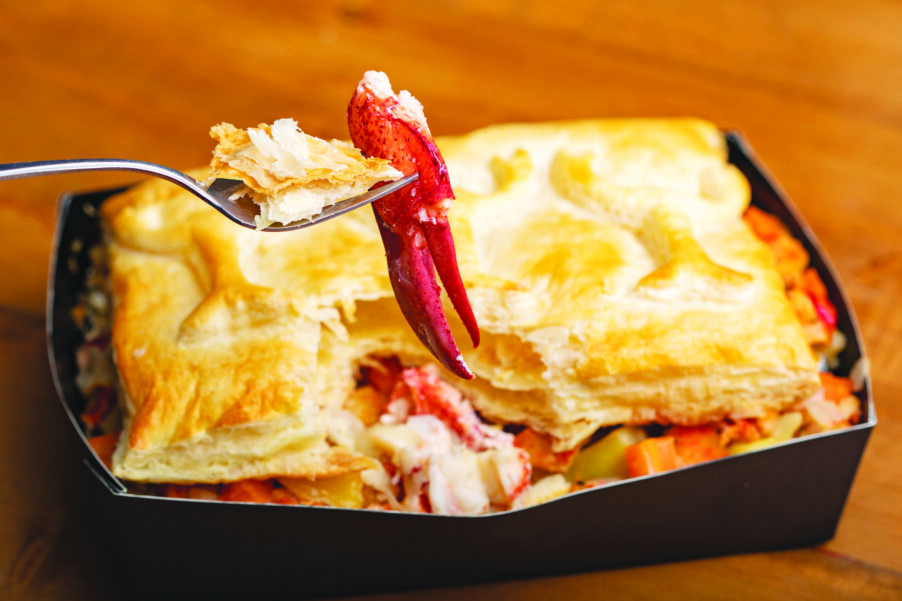
Takeout. Photo by John Fladd.
Ready to eat?
Keith Sarasin, cookbook author, chef and owner of The Farmer’s Dinner Dining Group, sees a change in many restaurant customers, who have traditionally had conservative tastes in food. “It’s encouraging,” he said. “People are embracing foods that they aren’t familiar with — that haven’t been represented in the mainstream up until now. The education piece has been much higher for the average diner. As a chef, that’s super encouraging.”
He also sees more of a relationship between customers and individual chefs.
“I’m seeing trends where people are getting involved with the [local] chef community. I see diners following chefs from restaurant to restaurant,” Sarasin said.
Chris Viaud, the chef and owner of Greenleaf (serving seasonal, contemporary American style food) and Ansamn (Haitian cuisine) restaurants in Milford, has been surprised and gratified by the loyalty of his customers over the past few years.
“Our guests have been so supportive,” he said. “In 2019, we got off to a great start, then boom! But our customers have been supportive of both our restaurants, coming out during Covid and helping build us back up.”
Viaud, too, sees customers becoming more adventurous.
“They’re definitely more sophisticated than they used to be,” he said. “Diners do want to see different and new things. As a chef, my excitement comes from being able to adapt and change. I’m excited that there is such excitement for new and different cuisines.”
Chef Chris Viaud. Courtesy Photo.
On the menu
While traditional comfort foods will always play an important role in New Hampshire dining, across the board, cuisine diversity was frequently mentioned as the biggest change in the local restaurant scene.
“I think we’re getting more international food,” said Jessica Martin, Executive Director of Intown Concord. “We’ve got our classics, but we’re getting a lot more restaurants in Concord that reflect how diverse our population is becoming.” She cited Batulo’s Kitchen, a Concord restaurant that specializes in Somali-inspired cuisine, as one example.
“There’s Buba Noodle (a Vietnamese restaurant), N’awlins Grille (Creole), and STREET, which specializes in dishes inspired by street food from around the world,” Martin said.
Sarasin agrees that the New Hampshire restaurant community is embracing diversity and food from around the world. He points to Classic Biryani, Kabab and Curry — an Indian restaurant on Manchester’s West Side.
“I travel all over the country, tasting food everywhere. As far as I’m concerned, this is the best kebab house in the country. It’s incredibly encouraging that a community like Manchester can support an Indian restaurant of that quality,” Sarasin said.
Wihby of the Red Arrow agrees.
“I’d like to see even more diversity in fine-dining restaurants,” she said. “It would be great to see more places popping up.” She expressed a fondness for Thai Food Connection, which has restaurants in Manchester and Bedford.
Viaud, whose Ansanm restaurant in Milford specializes in Haitian-fusion cuisine, feels vindicated by the expansion of offerings.
“Coming up in the industry, you get pigeonholed,” Viaud said. “I feel strongly that this is my background, and I want to share it. Customers have definitely become more sophisticated. Indian, Mexican, Italian — they’re open to it all.”
Kaji Maharjan of Kathmandu Spice, a Nepali/Indian restaurant in Manchester, said before Covid most of his business was in-house dining.
“2021 was a very bad year, though,” Maharjan said. “Now, 25 to 30 percent of our customers eat here; the rest of our business is takeout, at this point.”
He said that in addition to customers using Grubhub, UberEats and DoorDash, his restaurant has changed its online presence. “Now people can order online or call in their orders,” which, he said, translates into even more takeout business.
Maharjan said that over the past year, however, in-house dining has been on the rise.
“There are more people eating here,” he said. “It’s slowly getting better.”
Cheers. Courtesy Photo.
What’s next
According to Jessica Martin at IntownConcord, there are some very positive developments on the horizon. She points to the Capitol Center For the Arts’ Culinary Artist in Residence program, which works with newly arrived community members who want to start a food business. The culinary residents are able to use the Capitol Center’s two commercial kitchens to develop a customer base and to work out recipes on a commercial scale.
She also points to State Street Kitchen’s incubator program, which helps provide equipment and training for prospective small food businesses. Traditional restaurant models are changing. “We’ve been working on bringing more food trucks to the area,” she said, such as the food trucks that show up for the monthly First Friday shopping events.
Jeff Paige at Cotton sees more changes to traditional service models in the future.
“I’m seeing a trend toward dinner-only service,” he said. Staffing issues and kitchen efficiencies make eliminating lunch more attractive to restaurant owners. He also points to the difficulty of staying open seven days a week.
“Tuesday through Sunday makes the most sense for most of us,” he said, “and holiday Mondays.” Paige said that although the past few years have been tough, he’s cautiously optimistic. “We’re doing really well and a few of our friends who own restaurants are doing well, too.”
Kaji Maharjan at Kathmandu Spice agrees. His restaurant has been open seven days a week for years, but has just started closing on Tuesdays.
“Being open all the time is just too hard,” he said. “My staff needs a break.”
Roy at Cheers continues to worry about rising business costs: “I just signed a three-year contract with my food reps to keep prices down.”
Sarasin sees New Hampshire’s restaurant scene as only becoming more diverse, and more focused on superior ingredients. “More small, chef-driven restaurants centered around high-quality, fresh, seasonal ingredients are going to thrive,” he said.
Viaud sees area restaurants working together to build a culinary community where restaurants play off each other. As customers at one restaurant open themselves up to new experiences, hopefully they will take that spirit of adventure with them to other restaurants.
Different restaurants with different cuisines pull together to build a common culinary vocabulary. “I’m hoping the industry continues to be collaborative,” he said.
Chef Keith Sarasin. Courtesy photo.
Great Manchester Restaurant Week
Greater Manchester Restaurant Week runs through March 14. The Greater Manchester Chamber and the Palace Theatre are working together this year, to promote the Palace’s production of the Broadway musical The Prom (running weekends March 1 to March 24) by collaborating with more than 25 participating Manchester restaurants, who will have special offerings from custom cocktails to prix-fixe meals.
“Pairing a Restaurant Week with the Palace Theatre’s production of Prom is quite a creative way to experience the culinary and cultural contributions of the Greater Manchester community,” said Cole Riel, Director of Small Business and Community Development at the Greater Manchester Chamber, in a press release.
“We’ve been wanting to sponsor a restaurant week for a couple of years now,” says Kelsey Collins, the Marketing Director for the Palace Theatre. “Prom is a new show for us and we’re very excited about it, so we decided to do it now.”
The Prom is a musical comedy about four overly enthusiastic Broadway actors who try to help an Indiana teenager, who has been banned from attending her prom. Their over-the-top efforts are overwhelming to the teenage girl, who just wants to be left alone.
Many participating restaurants will be serving prom-themed cocktails and meals. Campo Enoteca has developed a pair of bespoke cocktails called “The King of Prom” and “The Queen of Prom.” The Gyro Spot is featuring an “After Prom Special” — two gyros of the customer’s choice, and a special chocolate-covered loukoumades. Current Kitchen & Bar at DoubleTree is serving a Honey Nut Cheerios ‘Prom-tini’ with Honey Nut Cheerios-infused rum, Angry Orchard hard cider and honey cinnamon simple syrup.
“A lot of theater-goers are going out to dinner,” Collins explains, “either before or after a show. This is a good way to let them know about the great restaurants in the area, and vice versa.”
The Prom is running at the Palace Theatre until March 21. For tickets and a list of participating restaurants, see palacetheatre.org/restaurant-week.
You might be sitting and having coffee or cocktails with a friend. You start talking about something safe and ordinary but 20 minutes later realize the conversation has drifted drastically. You might start with, “Oh, I like that T-shirt. Is it new?” and before you know it you are arguing about what song Romanian dictator Nicolae Ceausescu sang as he and his wife were led to the firing squad. (“The Internationale,” as it turns out.)
Sometimes you or your friend are curious enough to try to track the conversation:
“OK, you asked how my mother-in-law was, and I said something like, ‘Still mean as a snake.’”
“Right. Then that reminded me of the snake I saw in my backyard last week, and how it took me half an hour to get up my courage and try to herd it into a garbage can, but when I got close it turned out to be a hose that I forgot to roll back up.”
“Yes, and that reminded me that your son usually does that for you, but he’s in college in Omaha.”
“And then you started telling me about that girl you dated 30 years ago who used to be a fire-eater with a carnival — which I still don’t believe, by the way — and that got us talking about what kind of alcohol fire-eaters spit out to shoot flames, which led to us drinking gin.”
“I knew there was a reason.”
Drink recipes are a bit like that sort of conversation. Someone will develop a perfectly nice cocktail. Friends or customers like it, and the recipe gets passed around. At some point someone makes a reasonable substitution for one of the ingredients; then someone adapts that recipe, and eventually the drink evolves into something unrecognizable.
If you take a look through the cocktail classic The 1930 Home Bartender’s Guide and Songbook — a Prohibition-era book that warms even my cold, jaded heart — you will find a recipe for a Gin Sour, one of my favorite drinks. This is what used to be called a “Daisy.” I call it a “Utility Cocktail.” It consists of a spirit, a sweet syrup or liqueur, and something acidic, usually fresh lemon or lime juice. A margarita is a good example of this; so is a classic Daiquiri.
A riff on a riff on a riff of a margarita is a Gold Rush — bourbon, lemon juice and honey. This week’s drink is a further riff on that: rye instead of bourbon and maple syrup instead of honey. Instead of calling this a Gold Rush, we’ll call it a:
Brass-Plated Shuffle
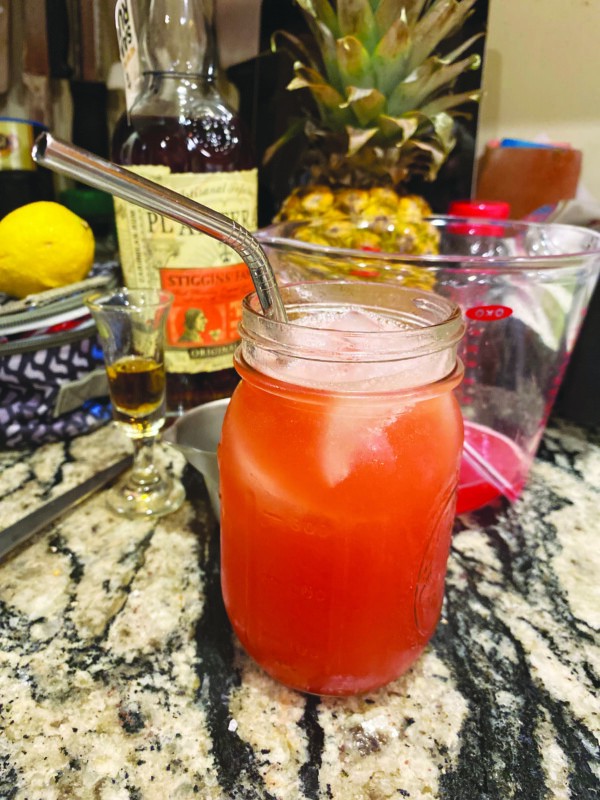
2 ounces rye whiskey – I’ve been working my way through a bottle of Knob Creek, and I’m very pleased with it
1 ounce fresh squeezed lemon juice
¾ ounce dark maple syrup
Combine all ingredients over ice in a cocktail shaker.
Shake until your hands become uncomfortably cold. You want this drink to be as cold as possible.
Strain over fresh ice in a rocks glass.
Ask your digital assistant to play “Once in a Lifetime” by the Talking Heads. Sip your cocktail. The refrain of “How did I get here?” will resonate with you.
Whiskey and lemon are a natural partnership. Because it’s a little sour and spicy on its own, rye might be even a better match for lemon than other whiskeys. That sourness needs to be balanced out, however. In a whiskey sour, this would be done with sugar syrup. In this third cousin of a whiskey sour, the sweetness comes from maple syrup. The maple back-note adds a fortitude — you might even say “brass” — to the project.
Some cocktails go down quickly and often too easily. The Shuffle is a sipping drink; it commands a certain amount of attention and respect. As it chills, it becomes increasingly more sippable.
As it gets more sippable, you will become more convivial. Regardless of how you got there.
Featured photo: Brass-Plated Shuffle. Photo by John Fladd.
The Bedford Village Inn livens up March with two events: Fondi Restaurant Week and Burgerama.
According to the Bedford Village Inn’s website, Burgerama will feature uniquely inspired burgers served in the Inn’s Tavern, a quintessential New England pub, ranging in price from $16 to $22 and served with an unending amount of fries.
For those in the mood for Italian cuisine, Fondi Restaurant Week will showcase a chef-curated dining experience at the Inn’s Italian eatery’s Trattoria Fondi from March 5 through March 9. The cost for the three-course Italian meal is $49 per guest.
No reservations are required for either event.
“Burgerama was inspired and established as a BVI tradition due to the popularity of our Wicked Burger (a menu staple in the Tavern dating back to 2011),” said Bedford Village Inn’s Sales & Marketing Director Melissa Samaras in an email. “Each weekend, our executive Chef would create an inspired, oversized and indulgent burger to offer in the Tavern. The popularity of the wicked burger inspired Burgerama.”
The burger celebration has been held in March at the eatery since 2012.
“Over the past few years,” Samaras said, “we’ve added an in-house competition to up the ante…. Our chefs enter the contest to create a new burger (never before offered on the menu), and staff votes for their favorite — the prize for the winning Chef [is] we feature their burger on Facebook and Instagram.”
Burgerama starts March with Italian Week, showcasing a Wicked Meatball Burger, Wicked Chicken Parm and Italian Sausage Sliders, all served with garlic Parmesan fries. The theme for the second week of the month is Mediterranean, where a Wicked Lamb Burger, Wicked Falafel Burger and Wicked Keftedakia Burger will be offered, all served with Za’atar Fries. The third week has an Asian spin, featuring a Duck Burger, Wicked Godzilla Burger, and Bahn Mi Sliders, all served with Togarashi Fries. Ending March with a flourish, Burgerama will showcase the Tavern’s own specialties: the Wicked Local Burger, Original Wicked Burger and BVI Sliders, all served with herbed Parmesan fries.
About Fondi’s Restaurant Week, Samaras said, “We’ve reimagined the idea to capture Italian food lovers who have yet to experience … Trattori Fondi … a hidden gem inside the Bedford Village Inn’s Grand Boutique Hotel.” Describing Fondi as “casual, yet elevated,” she added, “In Fondi, you won’t find white tablecloths…. Instead, you’ll find a large bar and intimate dining tables with plenty of privacy….”
Fondi’s menu “pays homage to the classics and offers modern Italian cuisine. All pasta and pizzas are housemade, and Chef Scott Siff composes each dish alongside Fondi’s Italian food-loving culinary team,” Samaras said.
Fondi Restaurant Week welcomes diners to choose a first course of tuna crudo, prosciutto board or romaine salad. Second-course selections are roasted pork loin, rigatoni cacio e pepe, spaghetti alla scampi, or Dunk’s mushroom risotto. To cap off each savory meal, diners are invited to take their pick from a dark chocolate torte, tiramisu sponge cake, gelato or sorbetto.
Fondi Restaurant Week When: Tuesday, March 5, through Saturday, March 9 (open Tuesday through Thursday from 5 to 9:30 p.m.; Friday and Saturday from 4 to 10 p.m.) Cost: $49 per guest; no reservation required
Burgerama
When: Friday, March 1, through Saturday, March 31 (open Monday and Tuesday, 11:30 a.m. to 9 p.m.; Wednesday through Friday, 11:30 a.m. to 10 p.m.; Saturday, 2 to 10 p.m., and Sunday, 2 to 8 p.m) Cost: $16 to $22 per burger; no reservation required
Use your barstool-sitting superpowers for good on Saturday, March 9, at the Tap House Grill in Hooksett during On Tap for CASA, their fifth bar stool challenge to raise money for CASA (Court Appointed Special Advocates), a nonprofit organization that advocates in court for children who have been the victims of abuse or neglect.
Teams of five to 10 competitors will each pay to occupy a bar stool for 10 hours. There will be an activity or a competition every hour throughout the challenge. The winning team will be the one that raises the most money for CASA.
According to CASA Director of Community Relations Erica Thoits, this is not a competition for lightweights. As at a high-stakes poker game, competitors have to put up some serious money to take part in the challenge.
“We require a minimum donation of $1,000 for a team to take part,” she said, “but the teams can fundraise right up to the end of the event. At the end, we give the winners a neat prize.”
Last year’s bar stool challenge raised approximately $65,000.
The rules of the challenge are that each team must have someone on their bar stool during the competition. Members of the team can rotate through stool duty. Over the 10 hours of the challenge the teams will compete against each other in hourly competitions, which can range from bingo to puzzle-solving to a beer stein hoisting competition sponsored by Sam Adams.
“I’m always surprised how much the teams just get into the competitive nature of the whole thing,” Thoits said. “This year, there’s a new coloring competition that I’m extremely excited about.” She said that the highest-profile competition is the stein hoist.
“I was curious, so I tried holding a stein out at arm’s length. I could only do it for a very short time. I don’t know how the competitors do it!” she said.
Participants will compete against each other in the hourly challenges for four hours, take a break — while still seated on their bar stools — for two hours, while the band plays, then compete for another four hours before a winner is announced. The band will be Rebel Collective, which describes itself on its website as “a New England based Irish/American pub rock/Celtic Folk-Punk band.”
The bar stool challenge began in 2017 and got progressively bigger and more popular for three years until being disrupted by the lockdown in 2020.
“We had to take an enforced break during Covid,” Thoits said. “This will be our second year post-Covid.” This year’s challenge promises to be the biggest yet, though there are still unclaimed bar stools, and time for new teams to register.
On Tap for CASA bar stool challenge When: Saturday, March 9, noon to 10 p.m. Where: New England’s Taphouse Grille (1292 Hooksett Road in Hooksett; taphousenh.com) Register: Contact CASA at 626-4600, ext. 2111, or go to casanh.org/on-tap-for-casa or taphousenh.com/events/on-tap-for-casa-2
Featured photo: Photos courtesy of CASA from last year’s bar stool challenge.