
The thrill-seeker’s drink

It was my bragging that brought on my most recent identity crisis.

It was Monday morning, and someone asked what I had done over the weekend. Instead of using one of the responses recommended in the official small talk manual — “You know, same ol’ same ol’” or “Not much; chew?” — I was feeling a little bit full of myself and gave an honest answer:

“I was a little tired on Saturday, and I ended up taking a three-hour nap….”

The response was all I could have asked for — something along the lines of, “Wow. You lucky bastard!” — but it got me thinking. Is this what my life has come to? I used to have dreams and ambitions. I planned to travel the world, get a regrettable tattoo, learn to bungee-jump, maybe act as a courier, delivering a mysterious package to a country ending in “-stan.”

But here I was, bragging — bragging! — about taking a medium-long nap. Even by napping standards, three hours is not all that impressive; I remember crashing for 14 hours once, after a particularly long night. Eighteen-year-old me would be pretty appalled with how I have turned out.

This is a riff on a cocktail by Colleen Graham, in which run-of-the-mill gin is replaced with cucumber gin and the wasabi is bumped up to adventurous levels.

Adventurer’s Cocktail: Cucumber Wasabi Martini

  • 4 slices of cucumber
  • ¼ teaspoon prepared wasabi paste
  • ½ ounce simple syrup
  • 1½ ounces cucumber gin (see below)
  • ½ ounce fresh squeezed lemon juice

Muddle three slices of cucumber in a cocktail shaker.

Add simple syrup and wasabi. Muddle again.

Add gin, lemon juice and ice. Shake thoroughly, long enough to get halfway through a very groovy song.

Strain into a chilled martini glass. Garnish with the remaining slice of cucumber.

Go out and seek adventure, like, I don’t know, fighting for a parking space at the gym or promising your daughter to go with her to the Barbie movie this summer.

Wasabi seems like an unlikely flavor for a cocktail, but surprisingly it’s the cucumber that does the heavy lifting here. The wasabi supports it, linking arms with the lemon juice and providing backup vocals. The sweetness of the syrup brings out the fruitiness of the cucumber.

It’s just really good.

Cucumber Gin

  • Persian cucumbers
  • An equal amount (by weight) of medium-quality gin — Gordon’s is my go-to for infusing.

Wash, but don’t peel, the cucumbers.

Blend the cucumbers and gin on the slowest speed in your blender. You are trying to chop the cucumbers finely to maximize the amount of surface area they have exposed to the gin, but you want them to still be in large enough pieces to filter out.

Store the mixture in a large jar, someplace cool and dark, for seven days.

Strain, then filter and bottle this very delicious gin.

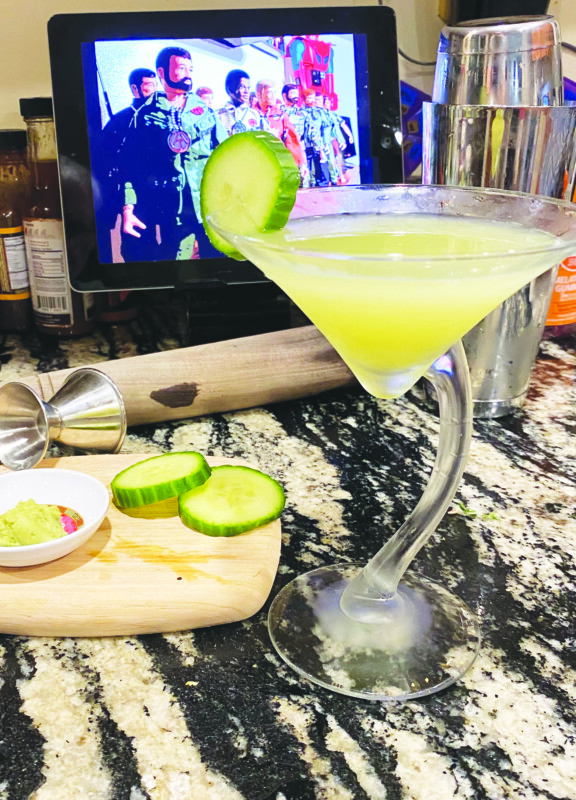
Featured photo: Cucumber wasabi martini. Photo by John Fladd.

The remedy for February

“Hi,” the lady in the apron says to me.

I look up from a pile of tangerines. “Hey. How are you?”

“I’m good. You?”

I fall back on my stock answer when I don’t really want to think too much about how I actually am: “You know how it is — the power, the money, the respect, the women. Frankly, it would crush a lesser man.”

“I can imagine. Are you finding what you want?”

And that’s when it hits me: What do I want? I have no problems that a rational man would complain about. And I realize that she’s almost certainly talking about my produce needs, not my emotional ones.

And yet—

What do I want?

I’m overwhelmed by an image. I’m on a bamboo veranda, overlooking the dark cyan* waters of the South China Sea. (*I looked it up later on a paint chip.) An overhead fan whooshes. A gentle breeze carries the scent of salt and white ginger. I’m reclining on something made out of teak.

This is all a bit much to lay on my new friend of 35 seconds, so I ask her where the macadamia nuts are.

Sill distracted by my tropical vision, I end up buying pineapple juice and paper umbrellas. It’s February. It’s time for pancakes and tiki drinks.

The pancake part is easy.

Pancake batter should be thinner than you think, as should the pancakes themselves. Fluffy pancakes are a false standard put forth by Big Pancake; go with the thin ones. You absolutely will not regret it.

The syrup is up to you, but there should be a small pitcher of melted butter. As for the cocktail —

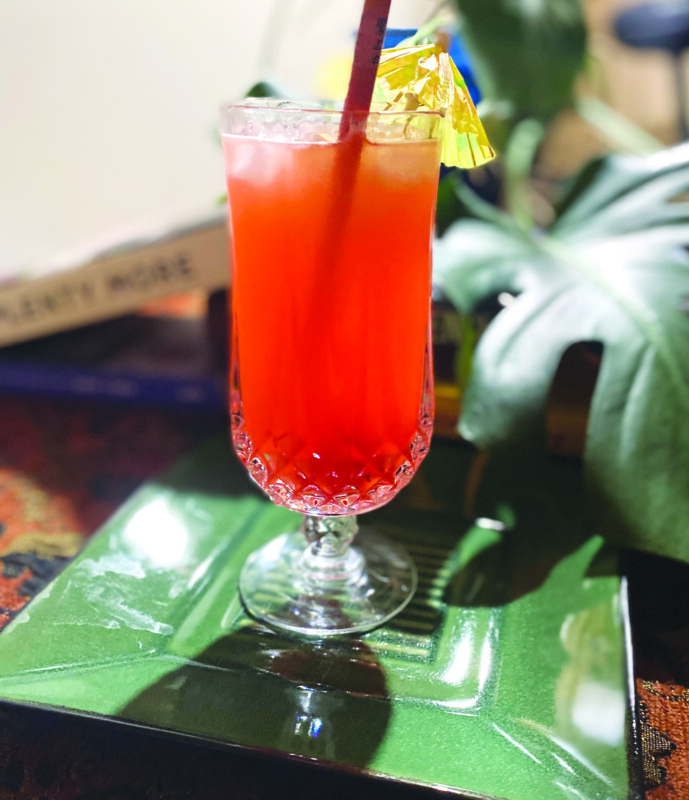
Singapore Sling

  • 2 ounces dry gin
  • ½ ounce kirsch (cherry brandy)
  • ¼ ounce cognac
  • 2 ounces pineapple juice
  • ¾ ounce fresh squeezed lemon juice
  • 1¼ ounces cherry syrup from a jar of maraschino cherries
  • 1 to 2 dashes Peychaud’s bitters
  • 1 to 2 dashes orange bitters
  • 2 ounces plain seltzer

Add all ingredients except the seltzer with ice in a cocktail shaker. Shake until the ice starts to break up.

Pour, with your now-cracked ice, into a tall glass — the type is up to you. A tiki mug would work well. So would a Pilsner glass. You could make a case for a clean peanut butter jar.

Top with the seltzer and stir gently. Garnish with at least five maraschino cherries.

The first sip of a proper Singapore Sling is deceptive. You will wonder if you forgot an ingredient. Considering the pineapple and cherry juices, you’d think it would be sweeter. Should it be this pink?

Do you know what puts negative thoughts like that in the front of your brain?

Stress and anxiety. Also, February.

By your third sip, do you know what are losing their grip and slipping down your cerebral cortex? The Negativity Triplets.

This is what you need.

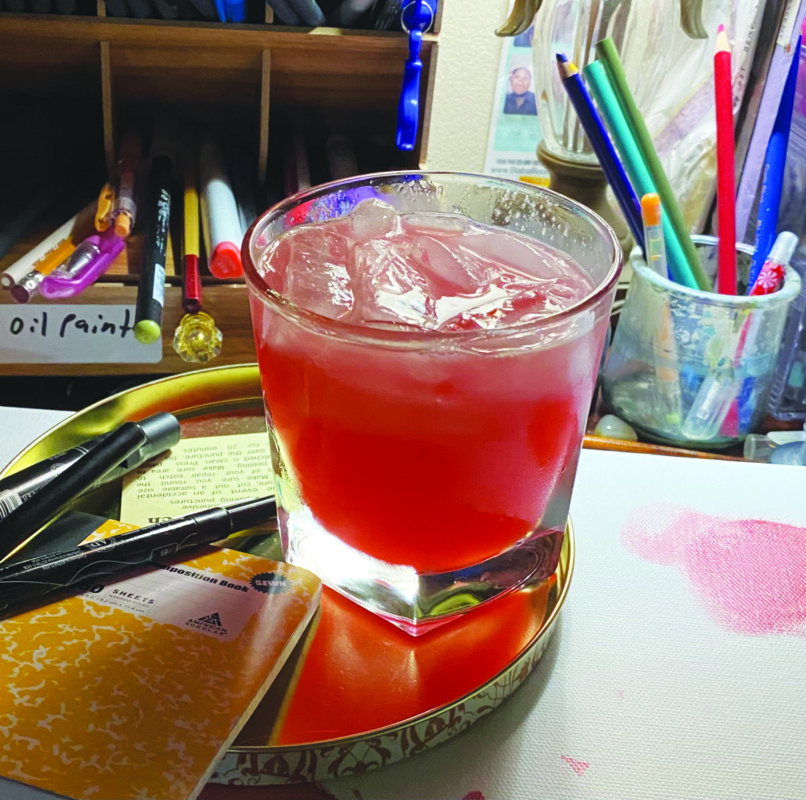
Featured photo: The Singapore Sling. Photo by John Fladd.

Make it a cava

A different way to sparkle on Valentine’s Day

It’s Valentine’s Day, and you want to create an amazing dinner for the one you love, but your food and wine skills need a little help. You want it to be special and not just a DoorDash or Grubhub delivery. You want to be themaster of the meal. After all, it is a special day that deserves that special meal, prepared, and not purchased by you!

For this special day, I chose to go to a venue to shop for that perfect dinner: Angela’s Pasta and Cheese Shop, on Chestnut Street in Manchester. I have patronized Angela’s since their very beginnings on Union Street in 1980, through their move to Chestnut Street in 1994, and I can’t begin to count the number of times I have been there. I have cultivated a taste for the different homemade fresh pasta, along with the variety of imported dried pasta.

If you can boil water, you can make pasta. Pick up a jar of sauce, or better, some Angela’s homemade sauce, fresh bread, and you are on your way! A salad or antipasto completes the meal, which can be finished with luxurious chocolates.

What kind of wine goes with pasta? A dry sparkling wine goes very well with a cream-based sauce like alfredo or if the pasta is simply dressed with extra-virgin olive oil and freshly grated Parmesan. A good cava from Catalonia is the perfect match for this dinner. The cava can be opened along with the antipasto course and will continue to pair well with the pasta. If there is a drop or two left in the bottle, it will work nicely with rich dark chocolate, as its minerality and high acidity will contrast nicely with the rich, creamy, smooth texture and intense flavor of the chocolate.

A 2019 Sumarroca Reserva Brut, available at Angela’s at $19.99, is the perfect accompaniment to this meal. This cava is made from 100 percent pinot noir grapes that grow in the Sant Sadurní d’Anoia region, just a few miles west of Barcelona, Spain.

According to the website for Bon Vivant Imports, a combination of several microclimates throughout the fields where Sumarroca wines come from, generated by warm climatic influences from the Mediterranean coupled with protection from the Montserrat mountains, and more than a dozen different soil types, makes for a wide range of still and sparkling wines from this region.

The bubbles rise in the glass, are persistent and tickle your nose. I agree with Bon Vivant’s description that the wine has aromas of wild strawberries, raspberries and slight floral notes of rose petals with flavors of cranberries and rhubarb. As advertised, this is a very crisp, dry and refreshing cava.

Featured photo: Photo by Fred Matuszewski.

Zelda and the bison grass

I know that I don’t need to remind you of it, but Feb. 2 is National Tater Tot Day. I’m sure you’ve already put up the decorations and picked out your outfit, but I’m afraid I’m going to have to weasel out on you.

I was going to develop a Tater Tot-themed cocktail, made, of course, with potato vodka. I thought about infusing it with actual Tater Tots or french fries. I was working on some solid puns for names. I was even — and I admit this was a personal low point — considering using ketchup as the sweet element.

But ultimately I had to ask myself whether I wanted to subject you, myself, or even a good-quality vodka to this kind of gimmicky cocktail indignity.

So let’s take a big swing in the other direction and make an attempt at class and sophistication. I don’t know about you, but sophistication has proved somewhat elusive for me over the past couple of years. I’d like to explore a Zelda Cocktail.

You know, Zelda.

Zelda Fitzgerald.

The novelist, playwright and artist? She was married to F. Scott Fitzgerald?

No. Not the Legend of Zelda princess.

OK, when she’s remembered at all today, Zelda Fitzgerald is known largely for her struggles with mental health, alcoholism and a really dysfunctional marriage, but for a brief shining moment in the 1920s she was widely known as one of the most beautiful, brilliant and sophisticated women alive. And a cocktail dedicated to her is a little-known classic.

Like Zelda herself, this drink is delightful, with an unexpected challenge. In this case the challenge is bison grass vodka.

You might hear rumors about Żubrówka vodka being illegal — and it was, apparently, for several years — but it is available in liquor stores, if you look for it hard enough. If you aren’t up for a multi-state vodka quest, I’m going to make a substitution suggestion. If you muddle a sprig of thyme when you are muddling the mint for this drink, it will add a subtle herbal back-note that will make a guest stop and wonder what is going on.

Apparently the Zelda Fitzgerald experience was a lot like that — people would be overcome with delight in her presence, only to wonder, just a little, what they had gotten themselves into.

The Zelda

Several sprigs of fresh mint. (As I write this, I find myself writing the word “mink,” which I think would please Mrs. Fitzgerald.)

  • 2 ounces Żubrówka Bison Grass Vodka or the best-quality vodka you have, plus a sprig of thyme
  • 1 ounce fresh-squeezed lime juice
  • ¾ ounce orgeat (almond syrup)

Muddle the mint (and thyme, if you are including it) in the bottom of a cocktail shaker.

Add five or six ice cubes and the other ingredients to the shaker. Shake vigorously.

Strain into a coupé glass and drink while it is very cold.

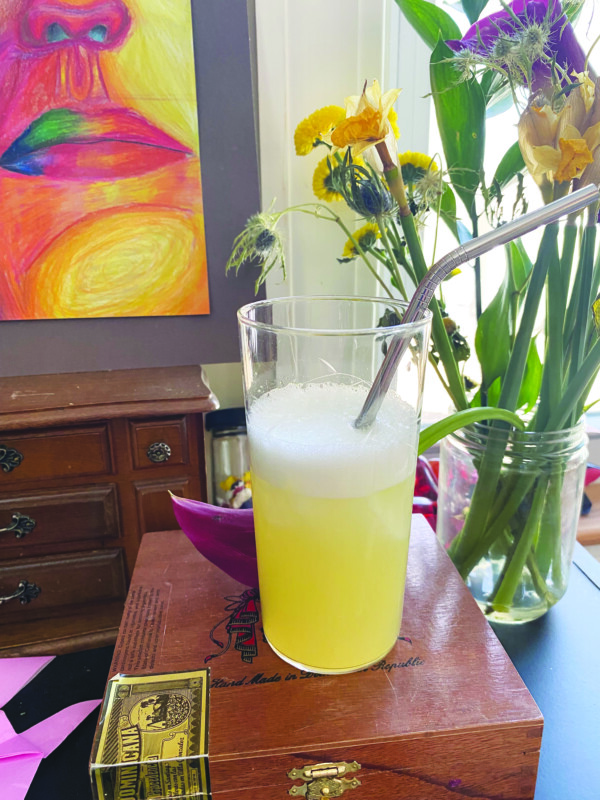
Featured photo: The Zelda. Photo by John Fladd.

Squeeze & punch

How to squeeze a lime

(Or a lemon, or an orange, or a tangerine, but limes lend themselves to being squeezed; they have the fewest inhibitions of any citrus fruit.)

Method 1 – Pure brute strength

Wash your hands.

Carefully place the lime on a cutting board in front of you. Carefully cut the lime in half.

Center your thoughts, then pick up half a lime, hold it over a bowl, and crush it.

The key here is rage. Naked, blind fury, if you can manage it. If you are a sports enthusiast, or a middle child, this should be fairly easy for you. The pain from previously unknown cuts on your hand will only make you angrier, eliciting even more juice.

Method 2 – An improvised reamer

A fork works well for this. So does a pair of kitchen tongs.

Cut the fruit in half, as before, but this time retain your composure. Insert the business end of the fork or tongs into half a lime, then twist it around, while squeezing with the hand that’s holding the lime. Tell the lime, “You might feel a little discomfort.”

You should be pleased with the result.

Method 3 – A hand-held juicer

Sometimes called a hand-juicer — though that implies that it actually juices hands — this looks something like the love child of a pair of pliers and a tea-strainer. It’s usually yellow or green — depending on the size of the fruit you intend to squeeze — and some models have a second squeezing cup, so you can tackle lemons and limes. It seems very gadget-y and might not fill you with confidence at first glance. It does a shockingly good job of squeezing citrus, though, and has become my juice extractor of choice.

A note on fresh orange juice

If you only need a few ounces of orange juice for a cocktail, a very good option is squeezing a couple of clementines. They have a fresher, zingier taste than orange juice from a carton, and they are roughly the same diameter as a lemon, so they are relatively easy to squeeze. I have found that after I have juiced both halves of a clementine, if I stack the spent carcasses of the two halves in the larger bowl of my hand-held juicer and squeeze them again I can extract a little more juice and theoretically a little citrus oil, which will intensify the flavor of the juice.

A very juicy cocktail

This is an adaptation of something called a Tangipahoa Planter’s Punch that I found in an extremely distressed copy of 1937’s Famous New Orleans Drinks and how to mix ‘em:

Ingredients

  • 2 ounces pineapple/mango juice. Could you use plain pineapple juice? The Fruit Police, or possibly the Tangipahoa Parish Liquor Commission, would probably not come crashing through the window, if you did.
  • 2 ounces fresh squeezed lime juice (see above)
  • 2 ounces fresh squeezed clementine juice. Could you just use Tropicana? That’s between you and your conscience.
  • 3 ounces white rum
  • ½ ounce raspberry syrup (see below). Could you use grenadine instead? I suppose so, if you were a COWARD!
  • 5 to 6 ice cubes

Combine all ingredients into a cocktail shaker, and shake until the ice starts making “I can’t hold it together much longer, Captain” sounds.

Pour into a pint glass and garnish as you see fit.

A lot of tropical drinks have a sort-of generic, yeah-there’s-some-fruit-in-here background flavor. The nice thing about squeezing your own juices into this one is that you can taste each individual ingredient. The lime, clementine and raspberry all step forward and raise a hand if you look for them. The rum stands in the back with hands in pockets, humming to itself.

You know those miserable winter days when all you want to do is sit by a fire, read a book and eat soup? Alternate that with drinking this and lying on the couch and watching game shows. You’ll feel 12 percent more optimistic about life.

Raspberry syrup

Combine an equal amount (by weight) of frozen raspberries and sugar in a small saucepan.

Cook over medium heat. The ice crystals in the berries have already punctured the cell walls, and you will be surprised at how much liquid they give off.

Bring to a boil, to make sure that all the sugar has dissolved, then remove from the heat.

Strain through a fine-meshed strainer, and store in your refrigerator for about a month.

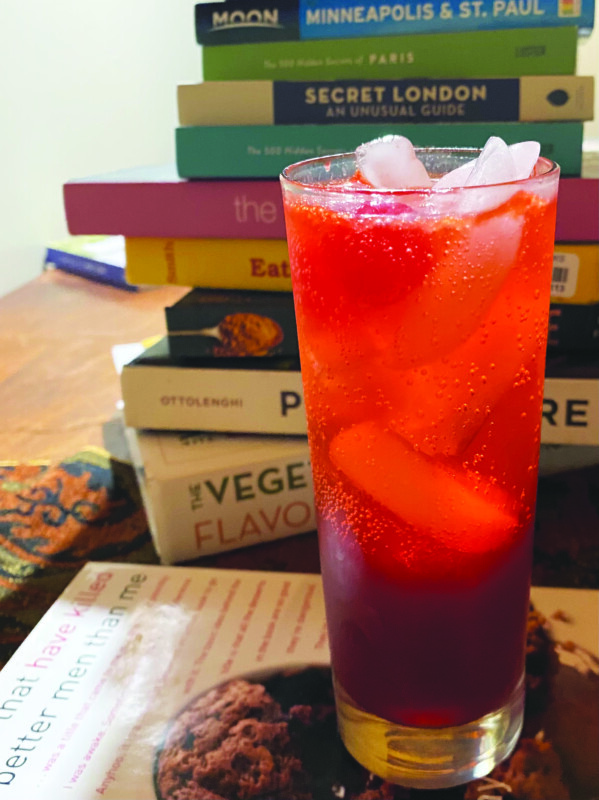
Feature photo: Tangipahoa Planter’s Punch. Photo by John Fladd.

Port — a winter favorite

Warm up with the flavors of Portugal

Planning on doing a little cross-country skiing — that is, once we really have a little snow? Or how about a little pond skating once it gets cold enough to freeze the water? Staying indoors? Why not curl up with a good book? These are all great wintertime activities, whether you’re huddled around a fire in the backyard pit after skiing or skating, or curled up under a comforter, when enjoyed with a glass of port.

What is port? It is a fortified wine that originated in Portugal and emerged into a worldwide market with an ever-growing complexity of wine varietals, growing regions and environments, all contributing to a vast array of color, noses and tastes.

According to publications by Taylor Fladgate, a respected port wine house, Portuguese port is made from grapes grown along the Douro River, where they have been cultivated since the Roman conquest of the third century B.C. These grapes produced enough wine for an export market. The Portuguese discovered that adding a small amount of grape spirit, or brandy, after fermentation not only increased its strength but kept it from spoiling. This technique evolved into the addition of the brandy during fermentation, keeping the wine’s sweetness and adding to its robust qualities.

In the early 18th century, the business of trading wines emerged, and with a long history of trading alliances between Portugal and England, the British merchants dominated the market. During this time the shape of the wine bottle changed from the short bulbous form to a long, uniform cylindrical shape, allowing the wine to age in the bottle to become even more complex in nose and taste. Port pioneered aging vintage productions.

The six most widely used grapes for red port wine are touriga franca, tinta roriz, tinta barroca, touriga nacional, tinto cão and tinta amarela. Port is a blended wine and therefore the blend is subject to change with each vintage. These grapes are principally Portuguese, unique to the Iberian Peninsula.

Our first port is Taylor Fladgate 2016 Late Bottled Vintage Port (available at the New Hampshire Liquor and Wine Outlets at $22.99, reduced to $18.99). Produced from wines from a single harvest, it has a complex rich fruity character. The color is a deep and opaque ruby red, befitting its moniker, “ruby port.” There is an elegant light floral nose along with dark cherries and cassis. On the palate the fruit continues, joined by notes of dark chocolate along with a touch of leather, with reserved tannins.

Our second port, Taylor Fladgate 10 Year Old Tawny Porto (available at the New Hampshire Liquor and Wine Outlets at $27.99, reduced to $22.99), is a rich tawny port that is fully matured in seasoned oak casks for 10 years, with each cask holding 630 liters (about 150 gallons) of wine. Aging in barrels brings delicate wood notes to combine with mature fruit. It is bottled for immediate drinking. It has a deep brick color. Its nose is of ripe dried fruit with a slight nuttiness and chocolate secondary notes. It is smooth and silky with rich jammy flavors with a long finish.

These two distinctly different ports, made by the same family-owned company since 1692, are readily approachable and very affordable. One note: Once these bottles have been opened, they should be stored in a wine fridge or standard refrigerator. Ruby port can be stored for four to six weeks without any trouble; tawny port can last for up to three months. But by all means, enjoy them this winter!

Stay in the loop!

Get FREE weekly briefs on local food, music,

arts, and more across southern New Hampshire!