A terrifying giant doll becomes even more terrifying thanks to some A.I. programming in M3gan, a lively thriller coming in at a brisk hour and 42 minutes.
Gemma (Allison Williams) is a toy designer who becomes the guardian for her tween-ish-aged niece Cady (Violet McGraw) after Gemma’s sister and brother-in-law die in a car accident. Cady, who was in the car with her parents at the time, is understandably distraught about both the traumatic accident and their deaths. Gemma, who is unsure about this whole parenting thing, decides that she can cross two tasks off her to-do list — cheer up Cady and beta test a new toy — by introducing Cady to M3gan, a 4-foot-tall doll who will bond with its primary user and learn how to relate with that particular child. Previously, Gemma had helped develop toy company Funki’s Purrpetual Petz, a sort of toothy-Sonic-plus-Furby creation that looks nightmarish but has impressive tech (we later learn that Gemma has programmed it to listen to its kid owners and collect data — but of course). It is also sort of chef’s-kiss perfect in how annoying it is portrayed as — it makes realistically parent-aggravating noises and has all of these dumb app-based features.
M3gan (voice by Jenna Davis; Amie Donald does the doll action, according to Wikipedia), which will be a kid’s best friend, surrogate parent and gentle nag about teeth brushing all rolled into one, also seems like a just awful product and one of the great aspects of this movie is that most people’s reaction to seeing the doll for the first time is to be instantly creeped out by it. For some reason, though, it isn’t until a therapist points out that Cady is transferring all of the grief-bonding that should be happening with Gemma to the doll, that Gemma starts to get a little concerned. She tries to get Cady to take some breaks from M3gan, but by then her silicone creation has started to get sassy.
Again, it is really quite delightful that this movie never tries to get us to think maybe M3gan is a good idea. From the first moment we meet the first prototype (whose face melts! It’s great!), the movie makes it clear that this poorly-thought-out toy will be some kind of horror show, even if we don’t know at first what kind. When I first saw the trailer for this movie, I probably thought something like “ugh, what ridiculous nonsense.” After seeing it, though, my reaction is “What ridiculous nonsense! 10 out of 10! Four stars! No notes!” Like the brutal artificial intelligence it portrays, it feels like this movie guessed the potential response to it and absolutely leaned all the way in. Is it all intentional, what a snort-laugh hilarious movie this frequently is? I think probably. Williams has such a great “ha! What?” energy the whole time and everyone is so appropriately, un-horror-movie wigged out by M3gan that I feel like M3gan knows it’s chosen gothicly silly over scary and that that choice was correct. B+
Rated PG-13 for violent content and terror, some strong language and a suggestive reference, according to the MPA on filmratings.com. Directed by Gerard Johnstone with a screenplay by Akela Cooper and a story by Akela Cooper and James Wan, M3gan is a delightful hour and 42 minutes long and is distributed by Universal Studios.
Boldness, intimacy, virtue and excellence — these are the four core values Jocelyn Maroun said she is taking to heart as she gets ready to launch her newest restaurant venture.
Sevmar Mediterranean Bistro, on track to open soon inside Salem’s 97 Shops Plaza, gets its name by combining Maroun’s last name with that of Kelvin Severino, owner of the national demolition company ADEP Group and Maroun’s business partner. The eatery promises traditional Mediterranean appetizers, entrees, salads and other items with a modernized twist, along with a full bar, a Sunday brunch menu, catering options and more.
It’s a new concept for the space, although Maroun said it doesn’t really feel that way. That’s because the very same storefront was once home to Salem Kabob — owned first by her father, and later by her cousins — dating back to 2001. For more than a decade, Maroun herself also ran Jocelyn’s Mediterranean Restaurant & Martini Lounge on Route 28 with her partner.
“The community knows Jocelyn’s and Salem Kabob and it feels good that it has that good reputation,” Maroun said, “and so I want people to know that it’s going to be the same quality, if not better. It’s delicious, and it’s going to be friendly and inviting. I plan on being here every open hour to greet every customer that walks in, and I just want it to be a happy place.”
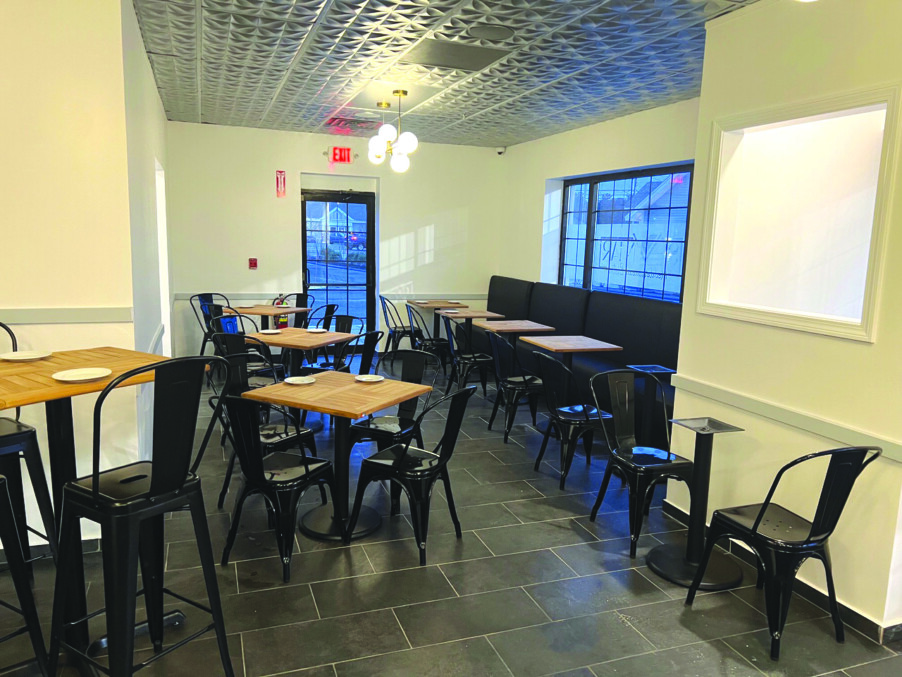
Returning to the site of Maroun’s father’s former restaurant, she and Severino have been hard at work the last few months gutting out the space, adding everything from a marble top bar to new slate floors and light fixtures to give it a uniquely hip bistro-like vibe. They’ve even added an old British telephone booth they bought that had to be delivered by a crane.
Much of Sevmar’s menu contains some of the same family recipes going back more than two decades to Maroun’s father’s tenure as owner of Salem Kabob. Additionally, Maroun and Severino have recruited longtime chef Sayde Elkhoury, who has more than 25 years of restaurant experience and who, like both of Maroun’s own parents, was born and raised in Lebanon.
But unlike Salem Kabob, which was takeout only, Sevmar offers dine-in service with about 42 seats, although Maroun said that online reservations through OpenTable will be recommended.
You’ll find many of the traditional items here that Maroun’s family has been known for over the years, from the hummus and the taboule to the falafel, stuffed grape leaves, spanakopita and baked kibbe, plus additional options like fried cauliflower served with a tahini sauce, and halloumi, or a mild cheese that’s grilled and served with olives, mint, tomatoes and pita bread.
Larger, entree-sized items include beef and chicken shawarma, and custom-grilled haddock and salmon. You’ll also find something on the menu called Gaby’s grilled chicken (named after Maroun’s father) — that’s marinated in olive oil, vinegar, lemon and fresh garlic.
“When we were kids, my father would make that chicken that was to die for … and we used to joke about one day selling it,” she said. “It’s the same recipe that we have now at Sevmar.”
Other options include various wraps — which come with french fries and with the option to add feta cheese or a garlic spread — and bowls that are served over rice pilaf. Choose a specialty option like a beef or chicken shawarma bowl or a vegan bowl with taboule and hummus, or build your own by picking a protein (chicken, beef, lamb, salmon or falafel), a sauce (tzatziki, tahini or house dressing) and other toppings (lettuce, cucumber, tomato or pickled onion).
“It’s food with delicious and healthy, organic, from-scratch ingredients,” Maroun said.
Brunch will soon be available on Sundays, she added, from 11 a.m. to 3 p.m.
“When I say ‘brunch’ it’s not just, like, eggs and grits. It’s a brunch party, Miami-style,” she said. “I started doing brunch at Jocelyn’s before I left there, and there was tropical music, people would dress up, [and] they drank Champagne. It was a vibe.”
As for the space directly next door to the restaurant, Maroun said plans are in the works to soon make it home to a cocktail lounge and event room, which they are calling Identity by Sevmar.
“The concepts are going to overlap in the sense that … Sevmar will be a place where you might come early with your kids to have dinner, or on a date and it’s very intimate, and then Identity will be a little bit more upscale,” she said.
Sevmar Mediterranean Bistro An opening date is expected to be announced soon. Visit the website, call or follow them on social media for updates. Where: 401 Main St., Unit 108, Salem Anticipated hours: Monday through Wednesday, 11 a.m. to 8 p.m.; Thursday, 11 a.m. to 9 p.m., and Friday and Saturday, 11 a.m. to 10 p.m. Sunday brunch is also coming soon. More info: Visit sevmarbistronh.com, find them on Facebook and Instagram @sevmarbistro or call 870-0018
Featured photo: Sevmar Mediterranean Bistro. Courtesy photo.
A new shop coming soon to Manchester is inviting coffee lovers to make it their new favorite spot, with a full lineup of espresso-based drinks using locally roasted beans, in addition to a food menu of breakfast and lunch wraps and sandwiches, soups, grab-and-go pastries and more.
It’s called Cool Beans Cafe, and it’s the brainchild of owner Kris Gabbard, whose 8-year-old daughter Madilyn picked the name. Last March, Gabbard took over the Queen City storefront — the former home of the Siberia Food Market, a stone’s throw away from the fork between Willow and Pine streets — and he’s been hard at work ever since getting it ready, painting the walls, building his own sitting tables and renovating the kitchen and bathroom. An avid traveler, he has decked out the space with his colorful license plate collection along the walls.
Originally from eastern Kentucky, Gabbard came to New Hampshire to be with family members. He and his brother Jeff managed the Black Bear Cafe of Ossipee for a short time.
“I had always wanted to open some kind of restaurant,” Gabbard said. “The cafe my brother and I had, that was already established. It was already up and running when we went in. … The guy that owned it was an investor, and he ended up selling the property when we left.”
Coffees served at Cool Beans Cafe are made with beans sourced through Mill City Roasting Co. of Londonderry, which is providing Gabbard with his own house blend. He’s also bringing in a variety of handcrafted loose-leaf teas and will have other drink options, like Italian sodas with the option to choose from several flavored premium syrups as add-ins. Bagged coffee beans by the pound or half-pound, both whole-bean and ground, will also be available.
For food items, Gabbard is focusing on breakfast and lunch sandwiches, with options like Italian grilled chicken, a cranberry walnut chicken salad wrap and a rustic grilled cheese, featuring cheddar cheese, bacon, tomato and honey mustard on a ciabatta roll. A refrigerated case at the counter will be where you’ll find some grab-and-go items — he’s thinking fruit and yogurt parfaits with granola, as well as some flavors of cakes and cake bars. Other pastries and baked goods like muffins, scones, cookies and cinnamon rolls round out the food menu.
“Right across the parking lot, I have an office over there that also has a full kitchen,” Gabbard said. “So I’ll do the baking over there, and I have storage over there as well. … The idea is that, where it’s a small space, I’ll have one of everything in that case that’s already dressed up, and then I have the fridge back there that I’ll pull from and serve.”
Down the line, Gabbard said he hopes to add to his menu with new items like smoothies, and he has plans to allow visitors of the cafe to utilize it as a community space.
“I want to be able to rent it out after hours or weekends, if someone wants to have a baby shower or a function or something like that,” he said. “Then, in the evenings, I want to do a paint night here once a month, and I’m just trying to fill some nights with some other activities and things that I can do.”
Cool Beans Cafe An opening date is expected to be announced in the coming weeks. Visit their website or follow them on social media for updates. Where: 100 Willow St., Unit 1, Manchester Anticipated hours: Wednesday through Monday, 7 a.m. to 5 p.m. Closed on Tuesdays (hours may be subject to change). More info: Visit coolbeanscafe603.com, find them on Facebook or call 206-5924
Here are 39 ideas for arts, crafts, outdoor activities and more to help you break out of your routine and find a new source of fun or rediscover a forgotten passion.
• Get hooked on fishing. On Saturday, Jan. 21, you can give fishing a try without getting a license during Free Fishing Day. Two days a year (the third Saturday in January and the first Saturday in June) New Hampshire Fish and Game invites state residents and nonresidents to fish in any inland water or saltwater throughout the state without a fishing license. Visit wildlife.state.nh.us/fishing for everything you need to get started, including maps of fishing locations, fishing season dates, a guide to local fish species and how to bait them, and more. If you want to keep fishing all year long, you can buy a fishing license online at nhfishandgame.com.
• Finally learn how to knit. While knitting can seem intimidating to beginners picking up the needles, the instructors at Elegant Ewe (75 S. Main St., Unit 1, Concord) are offering knitting classes to all levels. Classes range from specific projects to learning specialized stitches and fixing mistakes. The instructors also offer private classes for knitters looking for one-on-one time. The classes vary in price, as well as days and times. Visit elegantewe.com for more information about the classes offered.
• Or expand your fiber arts knowledge with crochet, rug making and more. Yarn and Fiber (14 East Broadway, Derry) isn’t just a yarn store; it also offers lessons in topics such as spinning wool into yarn and casting on for beginner knitters. The shop has an even less formal way of learning for beginners and experts alike, with a lounge area in the store where employees encourage crafters to bring projects and hang out with like-minded individuals. Classes meet on a rotation, and some require signing up in advance. Visit yarnandfiber.com
• Make works of art that keep you warm. Learn how to make quilts with the New Hampshire Modern Quilting Guild at one of their meetings. The guild, which takes a fresh approach to old-fashioned guilds, has challenges for square patterns, charity quilt making and more. The next meeting is on Friday, Feb. 10, at 7 p.m.; email nhmodernquilt@gmail.com for location details and to attend as a guest. The first meeting is free to attend as a guest; subsequent meetings cost $5. If you wish to become a member, dues are $65 and can be paid at nhmqg.org.
• Get into opera. The Music Hall (131 Congress St. in Portsmouth) explains the art with Opera Connection, where the Hall screens recordings of famous operas and holds a beginner-friendly conversation about the music and story. The discussions are led by opera writer and producer Dennis Neil Kleinman. The next opera being screened is Fedora by Umberto Giordano on Saturday, Jan. 14, at 11:30 a.m. Tickets cost $15 and can be bought in advance at themusichall.org. The operas themselves, broadcasts from The Metropolitan Opera, also screen via the Capitol Center for the Arts at the Bank of New Hampshire Stage (16 S. Main St. in Concord), as is the case with Fedora (also screening Saturday, Jan. 14, with doors opening at 12:30 p.m.). See ccanh.com.
• Expand your movie and TV horizons. Positive Street Art (48 Bridge St., Nashua) is hosting a series of movies followed by creative painting sessions. The series, called “Inspired By,” will show a movie about Jackson Pollock, an American abstract expressionism painter, at 6:30 p.m. on Friday, Jan. 27. The tickets to the movie showing are free, and the artistic session afterward costs $30. To learn more about this event or to reserve a spot, visit positivestreetart.org.
Watch movies from the early days of film at silent film screenings at Wilton Town Hall Theatre on Main Street in downtown Wilton. The films, which screen every couple of weeks, feature live musical accompaniment by Jeff Rapsis, who presents silent films and plays music at area theaters including the Rex Theatre in Manchester and the Flying Monkey in Plymouth (see silentfilmlivemusic.blogspot.com). Next up at Wilton, Safety Last (1923), a Harold Lloyd comedy, screening on Sunday, Jan. 15, at 2 p.m. Admission is free; $10 donation per person is encouraged.
Get caught up on the most recent episodes of the most popular anime at Double Midnight Comics (252 Willow St., Manchester) on Monday nights. The anime watch partyat the comic shop shows episodes that the crowd chooses that night, with all shows being streamed on the Japanese animation streaming service Crunchyroll. Entry is free and the streaming begins at 7 p.m.
• Draw. Learn how to draw your favorite animal at the Currier Museum of Art (150 Ash St. in Manchester) with Drawing Fundamentals, an adult class that will teach the basics and rules of drawing realistic animal portraits. The four-week class, which starts on Thursday, Jan. 26, is taught by local artist Robin Deary. Deary will walk students through forming the body of animals, creating visual textures and other artistic methods to capture the likenesses. There is a full list of materials available online at currier.org, as well as a link to registration for the class and information about other classes offered. The cost for the class is $200 and there are slots available for nonmembers.
• Make comics. New Hampshire-based cartoonist and educator Marek Bennett teaches comics workshops, which you can find out about at his website, marekbennett.com, where he also has videos with comics-making and drawing tutorials. Bennett spoke with Angie Sykeny in the Jan. 5 issue of the Hippo about his newest book, The Civil War Diary of Freeman Colby Vol. 3, which is on sale Jan. 25. Find the e-edition of last week’s issue at hippopress.com; the Q&A with Bennett is on page 6.
• Make stuff with added dimension. Port City Makerspace (68 Morning St., Portsmouth) offers an Intro to 3D Printing workshop on the second Wednesday of every month, from 6 to 9 p.m. Participants learn the basics of taking a design or idea and turning it into a 3D model using two different types of programs, and how to print the model using a 3D printer. The cost is $25 for Makerspace members and $45 for nonmembers. Register online at portcitymakerspace.com.
• Find your old camera and put it to use. Expand your photography knowledge and skill with the Manchester Camera Club, a group of amateur photographers who meet up to view and critique each other’s work and host workshops to help each other grow. The meetings for the club are currently done virtually over Zoom, and the group meets twice a month. The next meeting is a critique meeting with an “anything goes” segment, a “color in winter” segment and a “running water” segment. Sign up for a slot at manchestercameraclubnh.wordpress.com.
• Get your start working in clay. Explore pottery at Time to Clay (228 Daniel Webster Hwy., Nashua) with assorted projects and classes beginning in January. The next class available is Clay Handprints, where parents can capture the handprint or footprint of their little one. The studio will complete the clay casting with a personalized painting. One casting costs $35. The event will be on Tuesday, Jan. 24, and Wednesday, Jan. 25, with timed slots available from 11 a.m. to 4 p.m. Visit timetoclay.com.
• Take clay to the next level. Kimball Jenkins (266 N. Main St. in Concord; kimballjenkins.com, 225-3932) is offering “Beginner Wheel Throwing with Meadows Madsen” Fridays 6 to 8 p.m. starting Friday, Jan. 13, and running through March 17. “Students practice using the potter’s wheel and begin throwing basic forms such as bowls and mugs,” according to the website. The cost of the class starts at $355 and includes clay and tools (though a set of tools and additional clay are available for purchase).
• Make art with glass. Create some light-changing artwork at Studio 550 (550 Elm St., Manchester) with the stained glass class. The class will run for 10 weeks and will introduce people to ways to work with glass, and techniques needed to make the artwork. Students will make everything from a small suncatcher to windows for their home. Classes start and run on different days and at different times. Each class is two hours long and the full session costs $270. Visit 550arts.com for more information or to sign up.
• Make your jewelry just how you want it. The League of New Hampshire Craftsmen offers an ongoing open-enrollment Fundamentals of Making Jewelry class at SRS Studio (35 Howard St., Wilton). The class, open to adults and teens age 14 and up, covers the basic techniques of jewelry making using wire and sheet in copper and silver and how to pierce, solder and finish metals. It consists of six two-hour sessions that can be taken on Thursday, Friday or Saturday. The cost is $240 for tuition, plus $50 to $90 for materials, depending on the type of jewelry made. Participants can expect to complete four to five projects. Visit nashua.nhcrafts.org/classes.
• Start writing and then take your writing to an audience. The New Hampshire Writers’ Project is hosting writers’ night out, an informal gathering for amateur and professional writers to get critique, feedback and encouragement from other writers in their area. The event is also a space to discuss where and how to submit work for publication, and what writers are currently reading. The monthly event is held across southern New Hampshire. While most groups have already met for their January session, there are ways to contact the organizers on the website nhwritersproject.org.
• Get in the reading habit and find some new books. The Bookery (844 Elm St., Manchester) has monthly book club meetings on the third Thursday of each month, with the next one on Thursday, Jan. 19, at 6 p.m. The book for this month’s meeting is The Paris Apartment, a mystery where Jess, a woman who needs a fresh start, asks her half-brother if she can crash on his couch in Paris, to which he agrees. When Jess reaches Paris and her brother is missing, she has to dig into his life to unravel the mystery of his disappearance. Join the club at bookerymht.com.
• Become a local history buff. New Hampshire Humanities hosts free public programs throughout the state year-round on a wide variety of specialized topics. Some upcoming programs include “12,000 Years Ago in the Granite State,” exploring the native Abenaki people’s role in the history of the Monadnock region, on Thursday, Jan. 19, at 6:30 p.m. at Nesmith Library (8 Fellows Road, Windham); “African American Soldiers and Sailors of New Hampshire During the American Revolution,” held virtually on Wednesday, Jan. 25, at 7 p.m; and “New Hampshire’s Long Love-Hate Relationship with its Agricultural Fairs,” held virtually on Wednesday, Feb. 1, at 7 p.m. Visit nhhumanities.org/programs/upcoming to see New Hampshire Humanities’ full schedule of programming.
• Dust off yourFrench language skills. The Franco-American Centre, a nonprofit based in Manchester, is offering a special Traveler’s French virtual class series for adults, geared toward novice visitors to a predominantly French-speaking country. A variety of themes will be discussed in class, including everything from how to check in to a hotel to ordering at a restaurant and navigating local public transportation, among other activities. New classes start on Saturday, Jan. 21, and continue every week from 10 a.m. to noon through Feb. 18. See facnh.com to register (all are welcome regardless of your membership status with FAC).
• Understand wine. Become your own wine sommelier during an upcoming five-week wine course at WineNot Boutique (25 Main St., Nashua), which begins on Thursday, Jan. 19, and continues every Thursday at 6 p.m. through Feb. 16. Facilitated by WineNot owner and wine educator Svetlana Yanushkevich, the first two-hour class will teach you how to “taste wine like a pro” by going over basic vocabulary necessary for exploring wine to the fullest. Called “Sommelier’s Secrets,” the second class, on Jan. 26, will explore how to discern different smells and flavors in wines, while the following class, on Feb. 2, will feature tastings of six wine varietals from different regions around the world. Compare “Old World” and “New World” grape varietals on Feb. 9, and learn all about wine and food pairing do’s and don’ts during the final class on Feb. 16. The cost is $200 per person for all five classes, and includes samples of wine and fine cheeses, salami and chocolate. Visit winenotboutique.com.
• Discover mixology. Tuscan Market (9 Via Toscana, Salem) on Tuesday, Jan. 24, at 6 p.m. will hold a class for beginner mixologists (or those just looking to impress their friends at their next social gathering). This class led by Tuscan Brands beverage director Luis Betancur will go over how to craft two seasonal cocktails. All who participate will have the opportunity to snack on some desserts from Tuscan Market. If you can’t make this class, there’s another one scheduled for Saturday, Feb. 4, at 6 p.m. The cost is $45 for the Jan. 24 class and $50 for the Feb. 4 class. Visit tuscanbrands.com.
• Make artful food. Charcuterie board-building classes are hosted by the team at 603 Charcuterie. You’re given everything from the ingredients to the tools and walked through step by step to make your own “Instagram-worthy” charcuterie board, as coined by 603 Charcuterie’s Theresa Zwart. From start to finish, each class typically takes about an hour and a half to two hours and, depending on where it’s held, might include a glass of beer or wine per participant. You even get to take the board home at the end of the class. A full schedule of upcoming classes, mostly at area breweries and wineries, is available to view at 603charcuterie.com (next up is on Sunday, Jan. 22, at Pipe Dream Brewing in Londonderry) — click on the date you want to attend to register.
• Up your bread game. Learn the art of challah braiding during a special virtual class being offered by Cheryl Holbert of Nomad Bakery in Derry on Sunday, Jan. 22, at 1 p.m. She’ll walk participants step-by-step through the process of making this popular Jewish artisan bread, including how to prepare and shape the dough, which makes all the difference in the overall braiding process. The two-and-a-half-hour class will cover three ways to braid four strands total, and Holbert will also share various tips for glazing, finishing and baking these challah loaves consistently. The class is $60 per person and is open to all baking levels — it will also include printable versions of Holbert’s signature and water challah recipes and lots of opportunities to ask her questions. Visit nomadbakery.com.
• Expand your cooking skills. Learn how to cook Italian specialties at one of the upcoming Winemaker’s Kitchen cooking classes at LaBelle Winery in Amherst (345 Route 101) and Derry (14 Route 111). Sessions are to take place in Derry on Thursday, Jan. 19, and in Amherst on Wednesday, Jan. 25, from 6 to 7 p.m. Classes cost $35 per person. See labellewinery.com. Or make your “eat better” resolutions more international with an introduction to the Mediterranean diet being offered by The Culinary Playground (16 Manning St., Derry) either on Thursday, Jan. 26, from 1 to 3 p.m., or on Sunday, Feb. 26, from 4 to 6 p.m. Led by The Culinary Playground’s registered dietitian culinary instructor, the class will cover the many health benefits of the Mediterranean diet while also exploring knife and cooking skills. The cost is $80 per person and pre-registration is required — see culinary-playground.com.
• Broaden your love of chocolate. Journey into the world of cacao beans with a special chocolate adventure class, hosted by Richard Tango-Lowy of Dancing Lion Chocolate (917 Elm St., Manchester). To be held next on Thursday, March 2, at 5:30 p.m., the class will cover how to grind cacao beans into chocolate, as well as how to properly taste chocolate like a chocolatier would. You’ll even get to sip the drinking chocolate (called xichoatl) like the ancient Mayans used to. Tango-Lowy will also discuss various myths and realities surrounding fine chocolate. The cost is $125 per person and registration is available online at dancinglion.us.
• Garden. New Hampshire Audubon is presenting a workshop on seed-starting for home gardeners on Wednesday, Jan. 25, at 6:30 p.m., featuring master gardener Sarah Marcoux of UNH Cooperative Extension. You’ll learn all about the benefits and best practices for starting your own plants indoors from seeds and cuttings, including the requirements for successful germination, and different growing methods, light and temperature needs and avoiding common problems like household pests. Admission is free but registration is required to receive an emailed link to the workshop — see nhaudubon.org.
• Garden herbs, for food and wellness. Become a home herbalist with a special virtual course series taught by Maria Noel Groves of Wintergreen Botanicals in Allenstown. Participants can take the nine-part course online at their own pace — each class covers how to incorporate herbs into your diet and discusses common health concerns related to herbs and herbal medicine. This winter Groves is also offering participants the option of getting a remedy kit to go with the course series, while supplies last. Kits are available first-come, first-served and are expected to be ready for shipping this month. The cost is $495 with the remedy kit included and $395 for just the nine-week series (no remedy kit). Visit wintergreenbotanicals.com.
• Learn to forage. Mushroom walks put the “fun” in fungus. Beginner and intermediate level foragers are invited to take the two-part Mushroom ID Class by Dunk’s Mushroom Products & Foraging in Brentwood (313 Route 125). The Part No. 1 class covers what a mushroom is, a mushroom’s life cycle and the anatomy of a mushroom and will be offered on Mondays, Jan. 23, Feb. 20 and March 20. The Part No. 2 class covers mushroom identification skills, how to make a spore print and how to use resources for mushrooming and will be offered on the Mondays following the Part No. 1 classes, on Jan. 30, Feb. 27 and March 27. Participants can take either or both classes. All classes start at 6 p.m., and the cost is $60 for each. Visit dunksmushrooms.com.
• Become an apiarist. The Deerfield-based Pawtuckaway Beekeepers Association is holding a two-day Beginner’s Beekeeping School on Saturday, March 11, from 9 a.m. to 3 p.m. and Saturday, March 18, from 10 a.m. to 3 p.m. at Deerfield Community Church (15 Church St.). The course will cover everything from basic bee biology and standard beekeeping equipment to how to obtain bees, honey bee colony management, seasonal responsibilities, pest and disease management practices and more. The cost is $100 per person. Register online at pawtuckawaybeekeepers.org.
• Look to the skies and get acquainted with New Hampshire’s feathered friends. The New Hampshire Audubon holds guided birding walks at the Massabesic Center (26 Deer Neck Road, Auburn) every other Saturday from Jan. 14 through Feb. 25. They start at 9 a.m., and participants should expect to walk 1 to 2 miles. The cost is $8 for NH Audubon members and $10 for nonmembers, and binocular rentals are included. Pre-registration is required. Visit nhaudubon.org/event and select the walk you’re interested in attending on the calendar to register.
• Look to the skies and get acquainted with the stars. The New Hampshire Astronomical Society has regular skywatches, many of which are open to the public, including a monthly skywatch as part of the Super Stellar Fridays on the first Friday nights of each month at the McAuliffe-Shepard Discovery Center (2 Institute Dr. in Concord; starhop.com, 271-7827). The Society, a volunteer nonprofit educational organization, can be a place to start to learn about telescopes and telescope making, astrophotography and more, according to the group’s website, nhastro.com. Annual membership dues are $30.
• Rock climb without having to find rocks. Vertical Dreams, an indoor climbing gym with locations in Manchester (250 Commercial St.) and Nashua (25 E. Otterson St.), offers a beginner lesson package that includes instruction on everything you need to know to start indoor climbing, including how to belay, how to tie a figure-eight knot and basic technique. The cost is $40, and walk-ins are always welcome. Hours at both locations are Monday through Friday, from 3 to 9 p.m.; Saturday, from 11 a.m. to 8 p.m.; and Sunday, from 11 a.m. to 7 p.m . Visit verticaldreams.com.
• Run with a crowd. In last week’s (Jan. 5) issue of the Hippo, we looked at running clubs and groups and how the camaraderie of fellow runners can keep you going. Find that story, as well as a listing of area clubs, winter running series and a calendar of road races over the next few months in the story that starts on page 10. Find the e-edition of the issue at hippopress.com.
• Become a pickleballer. Your local YMCA might be a good place to start: YMCA of Downtown Manchester (30 Mechanic St., Manchester, graniteymca.org) offers pickleball in the morning Monday through Friday from 8:30 to 10:30 a.m., and Saturday 8 to 10 a.m.; in the afternoon on Tuesday and Thursday from 1 to 3 p.m.; and in the evening on Tuesday from 6 to 8 p.m.; and YMCA of Greater Nashua (90 Northwest Blvd., Nashua, nmymca.org) offers pickleball Monday through Friday from 6 a.m. to noon; Friday from 5 to 7 p.m.; and Sunday from 8:30 a.m. to 12:30 p.m.
• Get fit while stretching outside your comfort zone with pole dancing. New Perspectives Pole and Aerial (35 Londonderry Turnpike, Suite GH, Hooksett) offers an Intro to Pole class on Monday and Friday at 7 p.m., Tuesday at noon, Wednesday at 5:15 p.m., and Saturday at 9:30 a.m. First-time classes are available at a reduced price of $20; single classes after that cost $30 each, and there are packages available as well. Register online at newperspectivesnh.com.
• Go on a quest (with dice). For those who watched Stranger Things and wanted to get involved with a Dungeons & Dragons campaign but didn’t know how to start, Double Midnight Comics (252 Willow St. in Manchester) is hosting Adventure League D&D, a beginner- and drop-in-friendly quest, on Tuesdays at 6 p.m. The join fee is $5 per game night. Visit dmcomics.com for more information about the game, or to see a full list of rules and a link to the official Dungeons & Dragons website.
• Quest with costumes. The kingdom of Argost awaits members of Fealty, a New Hampshire-based high fantasy LARP (live-action role-playing) group. This year’s events will take place at Camp Allen in Bedford (56 Camp Allen Road) on the weekends of April 14 through April 16; May 5 through May 7; Sept. 8 through Sept. 10; and Oct. 6 through Oct. 8. In the meantime, visit fealtylarp.com to study up on the campaign and start developing your character; you can be a knight, a noble, a soldier in the royal army, a mercenary or a witch.
• Quest in your own city. Quench your thirst for adventure and put your puzzle-solving skills to the test with scavenger hunting. There are a number of apps and programs offering scavenger hunts in New Hampshire cities. They’re self-guided, so you can do them on your own schedule, alone or with a team. Compete against others and try to beat their times for a top spot on the leaderboard. Let’s Roam (letsroam.com) has hunts for Manchester, Concord and Portsmouth; Puzzling Adventures (puzzlingadventures.com) has hunts for Manchester and Portsmouth; Wacky Walks (wackywalks.com) and It’s a Scavenger Hunt (itsascavengerhunt.com) have hunts for Manchester; and Diversions Puzzles and Games (diversionsgames.com), Cashunt (cashunt.com) and Portsmouth Scavenger Hunts (portsmouthscavengerhunts.com) have hunts for Portsmouth.
• Learn how to create, record, edit and produce your beats. NH Tunes (250 Commercial St., Suite 2017, Manchester) Music Production offers lessons, taught by music professionals, that cover the music-making software program Ableton; recording midi and audio; using instruments; using effects; exporting songs; song writing and structure, and music theory while exploring a variety of musical genres. A half-hour lesson costs $31.50, and a 1-hour lesson costs $56.70. Students are encouraged to take one class a week for several weeks. All ages and skill levels are welcome. Visit nhtunes.biz/learn-music-production to schedule your first lesson.
• Discover an old-school way to socially network. Amateur radio, also known as ham radio, can be a fun way to experiment with communications technology, increase your emergency preparedness and connect with people from all over the world. To learn about how you can get on the air, attend a meeting held by a local radio club. The Granite State Amateur Radio Association (gsara.org) meets on the second Friday of every month at 7 p.m. at the Bedford High School library (47 Nashua Road, Bedford), and the Nashua Area Radio Society (n1fd.org) meets on the first Tuesday of every month at 7 p.m. via Zoom.
–Angie Sykeny, Katelyn Sahagian and Matt Ingersoll
Featured photo: The Gate City Striders’ Freeze Your Buns 5K. Courtesy photo.
New data released by the New Hampshire Department of Education revealed that New Hampshire’s average cost per student is on the rise. According to a press release, the new statewide average cost per pupil of $19,399.97 is an increase of 5.24 percent from the previous year. Costs rose substantially beginning in the 2020-2021 school year, reflecting an increase associated with federal and state Covid-relief funds; pre-pandemic, the cost per pupil was rising, on average, about 3.1 percent each year. New Hampshire school districts are expecting to grapple with high inflation costs, coinciding with the expiration of Covid-relief funding, the release said.
Aging in NH
The New Hampshire Department of Health and Human Services’ Bureau of Elderly and Adult Services and the State Plan on Aging Planning Committee are seeking the public’s input via a series of listening sessions to help guide and inform the 2024-2027 State Plan on Aging. According to a press release, the listening sessions will be held in person throughout the state, including one in Concord at GoodLife Programs & Activities (254 N. State St.) on Thursday, Jan. 26, from 1:30 to 3:30 p.m., and one in Manchester at William B. Cashin Senior Activity Center (151 Douglas St.) on Thursday, Feb. 2, from noon to 2 p.m. There will also be a series of virtual sessions held over Zoom, which are scheduled for Wednesday, Jan. 18, Friday, Jan. 27, Monday, Jan. 30, and Wednesday, Feb. 1. Residents are encouraged to complete the online State Plan on Aging Survey to help provide information about the availability of supports in their communities, including health care programs and screenings, affordable housing, transportation and in-home long-term supports and services. “As we continue to provide programs and services that focus on older adults, we must have an understanding of what their needs are as they age,” BEAS Bureau Chief Wendi Aultman said in the release. “New Hampshire has one of the fastest-growing aging populations, and these listening sessions will give us the opportunity to offer supports that are meaningful and relevant to older residents, so that everyone can participate fully in their communities.” The State Plan on Aging is required for New Hampshire to receive federal funding for programming through the Older Americans Act. Visit dhhs.nh.gov/new-hampshire-state-plan-aging.
New at the Elliot
Elliot Hospital in Manchester has become the first hospital in New Hampshire to offer the Sonata System by Gynesonics’ procedure to treat uterine fibroid, a procedure that was first performed by Manchester OB/GYN Associates at the hospital. According to a press release, Uterine fibroids, which are benign growths in and around the uterus, affect about 70 percent of white women and more than 80 percent of black women before the age of 50. They can cause debilitating symptoms, such as heavy menstrual bleeding, which can worsen over time if left untreated. The new procedure is minimally invasive, using an intrauterine ultrasound handpiece to identify the fibroids, and radiofrequency energy to shrink the fibroids and reduce symptoms. “At The Elliot, we continue to expand our leading-edge medical procedural offerings to meet the needs of our patients,” Beverly Primeau, Vice President of Surgical and Procedural Services for Elliot Health System, said in the release.
Volunteers wanted
The Aviation Museum of New Hampshire (27 Navigator Road, Londonderry) is having a volunteer open house on Tuesday, Jan. 17, from 7 to 8:30 p.m., where the public is invited to meet current volunteers and learn about the volunteering opportunities available at the museum. According to a press release, the Aviation Museum is a nonprofit organization “dedicated to celebrating New Hampshire’s role in aviation history and inspiring tomorrow’s pioneers, innovators and aerospace professionals.” Volunteering opportunities may include greeting guests at the front desk, leading tours and staffing the gift shop; working with young people through the education outreach program and student plane-building program; evaluating donations and cataloging items in the historical archive and assisting researchers; administrative tasks related to memberships, fundraising, communications and building maintenance; managing tech systems; and helping with special events. If you plan to attend the open house, call 669-4877 and leave a message with your name, or send an email to ldearborn@nhahs.org.
Seedlings online
After 112 years in business, the New Hampshire State Forest Nursery is beginning to take online orders. According to a press release, the website, buynhseedlings.com, resembles the Nursery’s traditional print catalog, but with additional features, including multiple color images of each seedling and a live inventory that shows the availability of each species and product in real time. “Sales at the NH State Forest Nursery have increased dramatically over the last several years,” NH Division of Forests and Lands’ Chief of Forest Management Will Guinn said in the release. “Much of this is due to a renewed interest in the outdoors as a result of the pandemic, as well as a desire to help mitigate climate change through planting trees to sequester and store carbon.” More than 1,000 customers used the online store to purchase 150,000 seedlings within the first two weeks of its launch. For customers who prefer to order on paper, mailed order forms are still being accepted, but will eventually be phased out, according to the release.
A New Hampshire Lottery player purchased a winning Lucky for Life ticket at Convenience Plus on Roundstone Drive in Manchester in the drawing on Jan. 5. According to a press release, the prize before taxes is the winner’s choice of $25,000 a year for life or a one-time payout of $390,000.
The majority of stores at Merrimack Premium Outlets were reopened on Sunday, Jan. 8, according to the mall’s website, after a Dec. 28 rock slide behind the mall damaged a gas main and forced the closure of some stores for several days.
A new Dollar General store is open at 17 Crystal Ave. in Derry. According to a press release, the variety store, which had 18,818 locations in 47 states as of October 2022, expects to employ six to 10 people from the community and has announced plans to donate 100 new books to a local elementary school as part of a nationwide campaign in partnership with Kellogg Co.
The girl’s eyes followed me. She glanced sideways, wordlessly imploring for help. I had to respond. But how?
Thankfully, this child was not on the street but in a photo superimposed with the words “CASA of New Hampshire.” It was an ad seeking advocates for abused and neglected kids.
Much as an image like that tugs at my heart, I like to see the big picture before joining anything.
Here’s a sketch of what I’ve learned about CASA of NH and the state’s child protection process.
CASA is a 33-year-old statewide nonprofit organization. With almost 40 paid staff and 642 active volunteers, the organization’s goal is to serve 100 percent of New Hampshire’s abused and neglected kids. In 2022 that meant 1,538 children.
When a problem is reported to the State of New Hampshire Division of Children, Youth and Families (DCYF), a social worker investigates. If corroborated, a petition is filed in family court against the parent for abuse or neglect. A Court Appointed Special Advocate or “CASA” is brought in to represent the best interest of the child.
DCYF proposes a plan to protect the child, either leaving them in-home with services and check-ins or placing them with relatives or foster families. The court specifies what actions must be taken for the family to be reunified, and what supports DCYF must provide.
Over the course of the year, as the parent works to address their issues, the CASA meets once or twice a month with the child. The CASA also gathers information from the parent, foster parents, social workers, health care providers, therapists, educators and others. The CASA writes a quarterly report to the court and attends the case hearings. Everyone’s goal is to get the family back together.
A year is not a lot of time to resolve some of the most difficult physical and mental challenges a person can face — problems such as addiction, domestic violence or mental illness, not to mention housing, food, transportation and employment. Sadly, reunification is not always possible. If the parent can’t convince the court that the child will be safe and secure in their care, DCYF typically requests that the plan be changed to adoption. If the court agrees, then a different legal case is filed to terminate the parent’s rights, and DCYF works to find an appropriate permanent home for the child.
Two years in as a CASA, I am astounded at the twists and turns abuse and neglect cases can take. Much as I want to know what’s ahead, it’s impossible to predict. I do know for certain these children need more advocates as well as foster and adoptive families. They need all of us.
Susan Hatem, former Director of Programs and Grant Making at New Hampshire Humanities, is a CASA of NH guardian ad litem and a connector, mentor and writer. Email her at susanh8m@gmail.com.