A 13-year-old girl discovers that strong emotion transforms her into a red panda in the Pixar animated movie Turning Red, a movie about puberty, moms and daughters, friends and, occasionally, Canadian-ness.
The kids at Lester B. Pearson School hustle to earn loonies in this 2002-era Toronto. Add that to the bits of late-1990s, early aughts culture — Tamagotchis, Backstreet/’N Sync-y boy bands — and Turning Red is a smorgasbord of delightful little surprise moments nestled in some top-tier storytelling.
Thirteen-year-old Meilin Lee (voice of Rosalie Chang) enjoys being a rules-following straight arrow who crushes it at school and is a dutiful daughter at home. Or has she just convinced herself she enjoys it because she has always been so eager for her mother’s (voice of Sandra Oh) approval? But her mother doesn’t understand about 4*Town, the boy band that has Mei and her friend group — Miriam (voice of Ava Morse), Abby (voice of Hyein Park) and Priya (voice of Maitreyi Ramakrishnan) — all aflutter. Mei herself doesn’t understand her buddies’ lusting over Devon (Addie Chandler), the 17-year-old who works at the local convenience store whom Mei thinks “looks like a hobo.” “Yeah, a hot hobo,” Abby says. Yuck, is Mei’s opinion, until all of a sudden one day it very much isn’t and she feverishly fills a notebook with sketches of herself and Devon, who is sometimes a merman in these drawings.
When Ming, Mei’s mom, finds the sketches, she marches a mortified Mei right down to the store so Ming can yell at a clueless Devon about how Mei is just an innocent little girl and he had better stay away and a bunch of other things that make the world sort of fall in on Mei in a way that is as hilarious as it is horrifying (so much of this movie about this drama-and-zits phase of life is hilarious and horrifying). After a night of absolute agony over this never-to-be-recovered-from embarrassment, Mei wakes up to find that her body has become unrecognizably hairy and stinky and big.
Which, like, who hasn’t been there? But in Mei’s specific case, she has become an actual polar-bear-sized red panda.
“It’s happened already?” says Mei’s dad, Jin (voice of Orion Lee), when Mei’s parents find out about her transformation. It turns out that the family, which runs a temple dedicated to their ancestors, doesn’t just have a symbolic connection to red pandas but an actual one. A long ago-ancestor gained the ability to turn herself into a red panda to protect herself and her daughters, a power passed to every woman in the family since then. Now living in modern days, the women find the fur, the size and perhaps the anger an annoyance, as Ming explains, and they undergo a ritual to harness their panda-ness so that sudden emotional changes don’t lead to a tail and ears popping out. (There is a whole graduate dissertation to be written about this movie’s very clever handling of women and their relationship with anger.)
Mei learns that while extreme emotions can bring on the red panda, calming feelings of love and acceptance can help her turn back into a girl (one whose dark hair is now red). What Mei doesn’t tell her mother is that those peaceful feelings come not from her parents but from her group of besties, a sign that she is growing into her own person, apart from her mother. Her buddies, when they learn about the panda, aren’t repelled by the gross monster Mei feels she is and tell her they’ll be there for her no matter what — especially when “what” turns into a surprising money-making opportunity. The other kids at school are charmed and delighted by the big fuzzy red panda and will fork over their hard-earned loonies for pictures of the panda and panda merch — the perfect way for the girls to earn the money they need to buy tickets to the upcoming 4*Town concert.
Remember the end of Pixar’s Inside Out when the “puberty” button showed up on the control panel inside the emotional control center of the 12-year-old protagonist? Turning Red thematically picks its story up from there, with the fully realized, well-rounded and imperfect person that is Mei suddenly finding herself with all these new emotions and desires and thoughts. It isn’t that she’s “becoming a woman,” the blech-y phrase the movie repeats just enough to drive home the goofiness of putting all that on either getting your period or seeing a boy band, but that she’s finding new facets of herself and trying to figure out how to integrate them into who she has always understood herself to be. And, sorry to spoil the ending for you, kids, but this is basically a thing that continues for forever, as Mei’s growing up and growing apart from Ming means that Ming is also seeing some part of her identity change. What is a delight about Turning Red is that we don’t have to get all in to Ming’s head and her adult issues to see this; this movie (unlike, say, Toy Story 4 or Cars 3 or all the other movies that feel like middle-aged people working out their midlife identity crises) stays focused on Mei and her various relationships as she sees them. And it does this without making Ming either all correct or all wrong. This is another one of those Pixar movies where there is no “bad guy” per se, no person doing evil but more just a group of people, each person with their own Stuff, working through some difficulties.
Before I make this sound like a total afterschool special (which, actually, this would be a great addition to some health class about “your changing body”), Turning Red is a boisterous good time with lots of smart observations about teen life, pop music, parental expectations, the appeal of kittens. I feel like the physicality of the red panda comedy would probably make this movie fun for even middle-elementary kids (maybe 9 or so and up). And the lessons about watching your kid become their own awesome self, however painful the loss of their younger version, and the movie’s overall joy — not to mention some truly beautiful animation — is a good time for an older audience as well. A+
Rated PG for thematic material, suggestive content and language, according to the MPA on film ratings.com. Directed by Domee Shi with a screenplay by Julia Cho & Domee Shi, Turning Red is an hour and 40 minutes long and is distributed by Walt Disney Studios Motion Pictures on Disney+.
Rambling House and TaleSpinner Brewery open in Nashua
Since Debbie and Denis Gleeson founded The Nature of Things (now known as 2nd Nature Academy) in 1997, the South Nashua school has evolved to have a multi-faceted curriculum focused on sustainability — the Gleesons also operate a sister farm where they raise their own eggs, lamb and cattle. Twenty-five years later, the couple has a new locally sourced restaurant with a seasonally rotating menu, along with an accompanying craft brewery onsite.
Rambling House Food & Gathering opened March 4 on Factory Street and it’s a true family affair — all three of the Gleesons’ daughters, Erin, Kerry and Meghan Ayer, are co-founders, while TaleSpinner Brewery is spearheaded by their uncle Dave, a longtime avid homebrewer.
Multiple connections to the family’s farm or school are present, from spent beer grains going back to feed the cows, to baked goods sourced directly from the campus’s commercial kitchen. It’s a concept that’s been several years in the making, said Erin Gleeson, who serves as president.
“When I was graduating college, I had it in my mind that I wanted to run my own business [and] I was interested in food, craft cocktails and farming,” she said. “I think what we were finding was that there were places around to eat and drink, but they felt like just that, places to just eat or just drink. … What we’re trying to be … is more of a community gathering space. That was our goal, and I think luckily since the time we started thinking about this, a lot of that has been popping up in Nashua. It’s growing in that way, which I definitely think is the right direction.”
In addition to the Gleesons’ own farm, the eatery’s dinner and bar menus feature ingredients sourced from purveyors all over New England, and an in-house cafe with locally roasted coffee and grab-and-go items is expected soon. Here’s a closer look at each core part of the business.
Rambling House
Erin and Kerry’s paternal grandfather, Maurice Gleeson, immigrated to the United States from Ireland as a teenager. Growing up on a farm in the small village of Glenflesk in County Kerry, Maurice would visit a traditional “rambling house,” an informal inn of sorts that was known by all the locals as the family home to come gather and share stories, play games or listen to music.
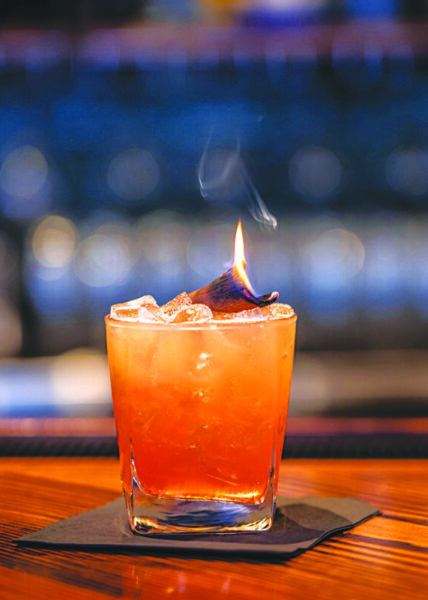
Crohan craft cocktail. Photo by Donna Desimone Photography.
“It was just the spot where everyone knew in the community to be almost like that safe harbor, and it was also the place where a weary traveler was always welcomed in by the fire to lay their head for the night,” Kerry Gleeson said. “He’d tell us all the time about how when he was young he would go visit the rambling house that was up the street from him. … He had such fond memories of it, and we just loved that sentiment, so that was a no-brainer for us for the name.”
Today, the Gleesons remain very much connected to their Irish heritage. Framed photographs taken by Maurice throughout the 1950s and early ’60s adorn the walls, and a small plaque by the door heading out to the upstairs balcony proclaims the “Margaret Mary Martha Murphy Mezzanine,” an inside joke and reference to their cousin overseas, with whom they are close.
But despite the strong family influences, Rambling House is not an Irish pub — rather, what you’ll find here is a diverse offering of meat, seafood and vegetarian options that will change every few months based on product availability and seasonality.
“We’re going to start with four menus a year, but that will probably grow to six menus a year, because our seasons are a little quick,” Erin Gleeson said. “We’ll keep a lot of the skeleton of the menu, so for example we’ll always have a burger on it, but the toppings will be different. We’ll always have a chicken [dish] on it but it might not be the lemon roast chicken we have now.”
The Gleesons have brought on Jeremy Guyotte to serve as the eatery’s head chef. A native of Gloucester, Mass., Guyotte has extensive experience working with seafood, notably during culinary stints he spent at Captain Carlo’s Oceanfront and at Passports Restaurant in Cape Ann.
Out of the gate, seafoods at Rambling House include a pancetta-wrapped Atlantic monkfish loin; pub mussels sourced from Blue Hill Bay in Maine with tasso ham, onion and herbs; and a bouillabaisse, featuring shrimp, scallops, mussels, littleneck clams and whitefish.
“When Jeremy first started making us seafood samples, we were like, ‘Oh, my gosh, who have we brought on?’” Kerry Gleeson said. “He is an artist, and our sous chef, Karyn [Polley], is fantastic too. She has been with us even longer, working at the school.”
Other menu items, like the porchetta and the shepherd’s pie, have so far received rave reviews. The latter is a traditional version made with lamb, veggies and house herbed gravy.
Baker Angel Lopez is an ardent bread maker and Erin Gleeson herself even makes her own small-batch ice cream, passion projects that are now part of Rambling House’s menu respectively in the form of desserts like brioche bread pudding and house brownie sundaes.
The restaurant’s main dining area features a unique post and beam layout with a bartop and shelves all designed by Erin and Kerry’s brother-in-law, Kyle Ayer of Green Building & Consulting Group. Once it gets a little warmer, an outdoor rooftop deck with additional seating areas will open, offering panoramic overhead views of the Nashua River.
“Our favorite thing so far is that when you’re up on that top deck, that skyline is where you can see the fireworks on the Fourth of July,” Erin Gleeson said.
A full bar features TaleSpinner brews on tap, in addition to a menu of craft cocktails, hard ciders, wines, non-alcoholic beer and hard kombucha. The cafe, meanwhile, is at the front of the restaurant and will soon be offering coffee from Bedford’s Flight Coffee Co., as well as various takeaway items like baked goods and breakfast sandwiches.
TaleSpinner Brewery
On the first level below Rambling House, TaleSpinner Brewery can be accessed through the opposite end of the building, on the Water Street side. The tasting room is at the top of a short flight of stairs from the entrance, and overlooks its full production area.
The brewery, which opened a few weeks earlier than its restaurant counterpart, was similarly named with Erin and Kerry Gleeson’s grandfather — described by Kerry as “a consummate tale spinner,” or storyteller — in mind. Their uncle Dave works closely with head brewer Scott Karlen to create TaleSpinner’s lineup of brews, which currently include a few New England-style IPAs, in addition to a Belgian blonde ale, a raspberry sour, a German-New Zealand Pilsner lager, and a Belgian strong ale. They’re also working on a peach apricot sour and an Imperial brunch stout with maple syrup, cacao nibs, vanilla bean and coffee from Flight Coffee Co. There are a total of 24 taplines: a dozen each in the restaurant and brewery.
“My uncle … made great stuff as a homebrewer and had a passion for it, and it became part of a conversation that it would be really fun to open a brewery,” Kerry Gleeson said. “So it was a natural sort of thing where the two concepts just fit into each other like puzzle pieces.”
A small bar menu is available out of the tasting room, featuring some items you’ll find upstairs at Rambling House, as well as others mostly exclusive to that space, like the fish and chips, the poutine and the duck confit flatbread. Those items, while not on the regular dinner menu at the restaurant, do become available upstairs as well after 9 p.m., Kerry Gleeson said.
Guyotte will sometimes cross-utilize TaleSpinner’s products with his food, notably a beer gravy for the poutine and spent grain waffles for the chicken and waffle sliders.
“There’s definitely a cycle with everything, and we want to build on that and make it as close to coming full circle as we can,” Kerry Gleeson said.
Rambling House Food & Gathering and TaleSpinner Brewery Where: 57 Factory St., Nashua, Suites A and B Current hours: Wednesday and Thursday, 4 to 10 p.m.; Friday and Saturday, 5 to 11 p.m., and Sunday, noon to 5 p.m. (extended hours likely coming soon) More info: Visit ramblingtale.com or follow them on social media (@ourramblinghouse and @talespinnerbrew on Facebook, and @ramblinghouse and @talespinnerbrew on Instagram) TaleSpinner Brewery’s entrance is accessed at the opposite end of the building on Water Street.
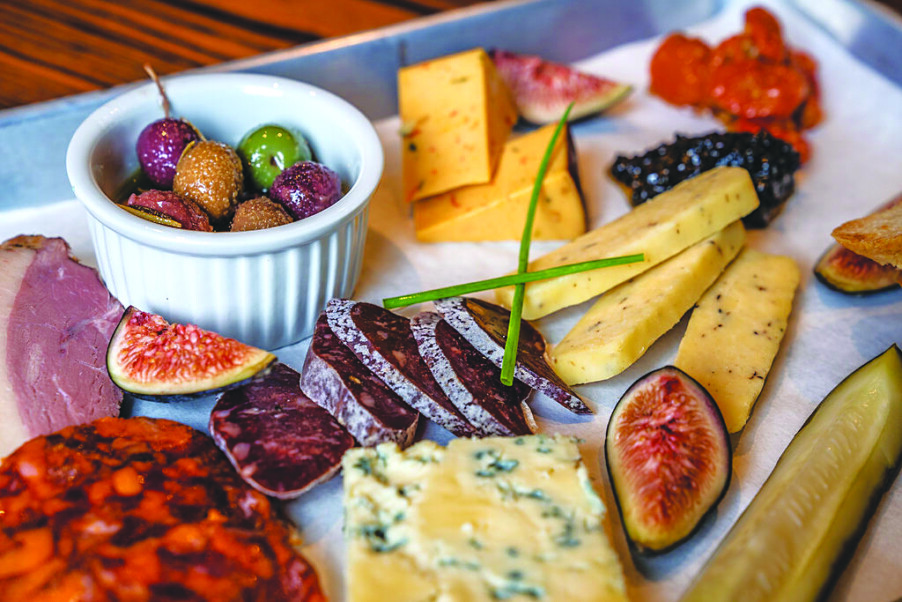
Featured photo: Winter charcuterie. Photo by Donna Desimone Photography.
New space and new equipment for Beaver Brook Maple
Curiosity — that’s essentially how Andrew Mattiace ended up with the brand new sugarhouse on his property in Bow. After his grandmother’s funeral in 2017, Mattiace and his family visited her favorite sugarhouse in Charlestown; at one point, Mattiace looked at the evaporator and thought, “This thing just boils water? I can do this.”
So, being a “curious engineer,” he built his own evaporator, tapped some maple trees in his backyard, and in 2018 produced maple syrup for the first time — a whopping 5 gallons.
“The first year was horrendous,” he laughed.
Mattiace learned mostly by scouring the internet, and then through trial and error — and there were a lot of errors, he said. But what he produced in the end was good stuff, worthy of bottling and selling.
“It was like, OK, I can make syrup now, but how do I sell it?” he said.
He decided to build a self-serve farmstand on his property and named his business Beaver Brook Maple. Once he started selling, the demand quickly outpaced how much he was producing, even after he started to get the hang of it.
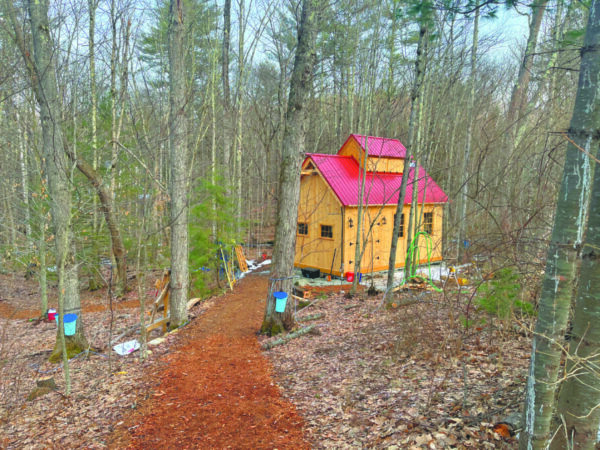
Andrew Mattiace’s sugarhouse at Beaver Brook Maple. Photos by Meghan Siegler.
Mattiace now has plenty of sap, tapping into some of his neighbors’ trees too. On a recent Friday 13-year-old Miles Miller and his dad Joe dropped off almost 130 gallons of sap from their own trees. It was their second run of the week; a few days earlier, they’d brought 80. Miles, who does the majority of the tree tapping and sap collecting, walked away Friday with $55 for that day’s delivery. He said they’ve lucked out with the maple trees on their property.
“They have a pretty high sugar content,” he said.
With neighbors selling him sap and plenty of people buying his syrup, the sugarhouse was the next logical step for Mattiace. He wanted to upsize his tank to produce more syrup in a shorter period of time.
Plus, he said, “I got tired of freezing my a** off. It’s very laborious and time consuming, and I wanted to get out of the outdoor process.”
His old evaporator processed eight gallons of sap in an hour, while the new one can process 35 gallons. His goal for this year is to produce 50 gallons of syrup, up from 23 last year, which will be much easier with the new equipment and warmer space, he said.
Mattiace isn’t in this for the money. In fact, if he sells those 50 gallons, he’ll just about break even.
“If I count my labor, I’m completely in the red,” he said.
Mattiace doesn’t want to grow Beaver Brook Maple into a big business. He has a full-time job that pays the bills, and this “hobby” already takes a lot of time.
“I want to make it worthwhile, but I never want to exceed 100 gallons a year,” he said.
Mattiace’s main goal has always been to create a sense of community, a place where friends and family come to hang out.
“That’s a real driving factor for me,” he said. “Everybody loves sweet, sugary things.”
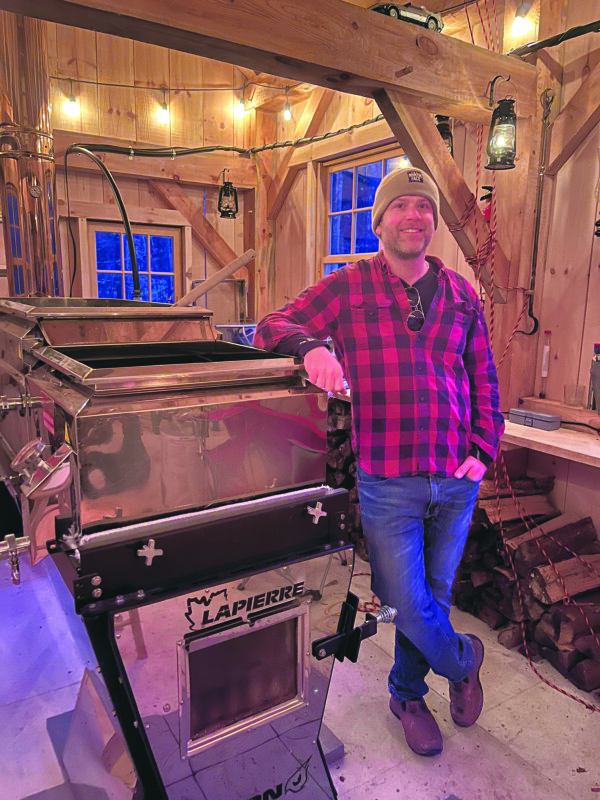
Featured photo: Andrew Mattiace and his new sugarhouse at Beaver Brook Maple. Photos by Meghan Siegler.
Celebrate the sweet stuff with sugar house visits and maple tastings
Season of syrup
New Hampshire Maple Weekend returns
New Hampshire Maple Weekend When: Saturday, March 19, and Sunday, March 20 Where: Several participating sugarhouses and farms statewide Visit: nhmapleproducers.com
By Matt Ingersoll
mingersoll@hippopress.com
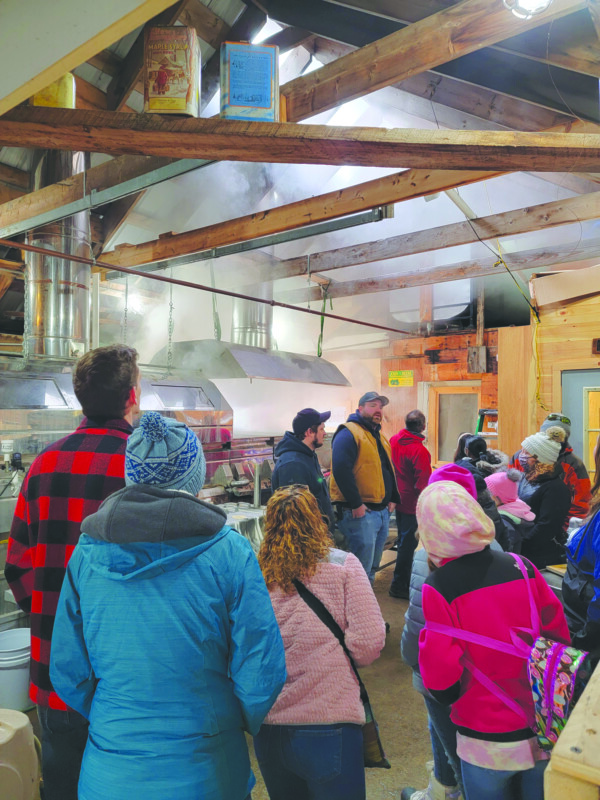
On March 5 and March 6 Ben’s Sugar Shack in Temple kicked off the first two days of its maple touring season to a great turnout — and an overall “back to normal” type of feeling, operations manager Emily Sliviak said. Free tours are set to continue every weekend through April 3.
“This is the first year that we’re starting to do samples again,” Sliviak said. “Everyone wanted a sample, and it was great to see that nobody really seemed uncomfortable or scared or anything, especially in the evaporator room, just because it is kind of a tighter space.”
Ben’s is one of hundreds of sugarhouses across the Granite State gearing up for New Hampshire Maple Weekend, happening on Saturday, March 19, and Sunday, March 20. Maple producers large and small traditionally hold open houses throughout the weekend — or all month long in March — for families to visit, take a free tour, and sample syrup and other maple goodies.
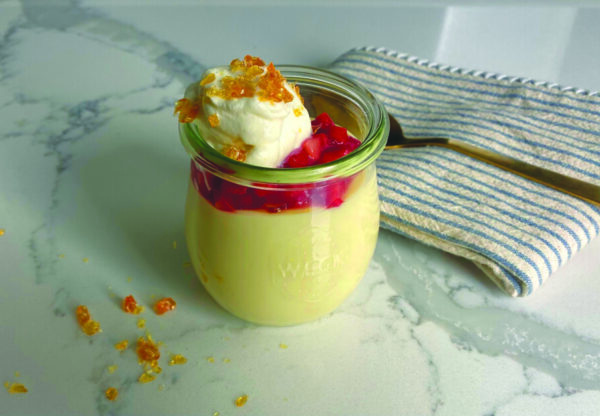
Maple warm pudding. Photo courtesy of Ben’s Sugar Shack.
It’s overseen by the New Hampshire Maple Producers Association, a nonprofit founded in 1943 that now represents roughly 350 maple purveyors statewide, president Andrew Chisholm said.
“Last year we decided to advertise it as Maple Month so that producers would have the option to spread everything out over the entire month and not have large groups come to sugarhouses, as is common on Maple Weekend,” said Chisholm, a maple producer himself who runs Chisholm Farm in Hampstead. “This year we’re doing kind of a hybrid, so we’re giving producers the option to advertise themselves as participating in Maple Month or Maple Weekend, and then my guess is that by 2023 we’ll hopefully be fully back to … calling it a Maple Weekend.”
Here’s a look at how this year’s maple sugaring season has gone so far in southern New Hampshire and what you can expect when you visit a local sugarhouse on Maple Weekend.
Maple warm pudding Courtesy of Ben’s Sugar Shack in Temple. Recipe by Mareh Bleecker
2½ cups whole milk ⅔ cup maple sugar ½ teaspoon salt 1 teaspoon vanilla extract 3 Tablespoons cornstarch 2 Tablespoons unsalted butter, softened Strawberry jam Fresh whipped cream
In a small bowl, mix half a cup of cold milk with the cornstarch. Place the remaining two cups of milk, the maple sugar and the salt in a small saucepan over medium-low heat. Cook just until the mixture begins to steam. Add the cornstarch mixture and cook, stirring occasionally, until the mixture starts to thicken and barely reaches a boil, about 5 minutes. Immediately reduce the heat to very low and stir for five minutes until thick. Remove the pudding from the heat and stir in the butter and vanilla extract. Spoon the pudding into individual jars or ramekins and let cool slightly. Top with jam, compote, fresh fruit and whipped cream.
Tapping traditions
Tours are offered at Ben’s every 15 minutes between 10 a.m. and 5 p.m. and will typically last about half an hour depending on questions, Sliviak said. Attendees learn all about the process of collecting sap and the importance of daily maintenance of the trees, especially against windy or rainy weather conditions and the intrusions of animals like squirrels, bears and moose.
“We walk them across the woods to where they can see the modern way of collecting, which is through the tubing system and the vacuum system,” she said. “Then we’ll walk groups back over to where the trucks will bring the sap. We have a 10,000-gallon holding tank, and all of the sap from there will run into the reverse osmosis room, which is a fancy system that separates the water from the sugar molecules … and that makes it much less work for the evaporator to boil.”
Depending on the sugar content levels and the time of the season, Sliviak said it takes roughly 40 gallons of sap to make one gallon of maple syrup. After the reverse osmosis process, the sap then runs into the evaporator room, where tour attendees learn about the boiling, filtering and bottling of the syrup, as well as the grades that are produced and how each is different in taste.
Samples are provided at the conclusion of the tour, and a gift shop will also have various maple products for sale. Last weekend Ben’s began offering maple ice cream — that’s expected to continue through the last two weekends of the month, Sliviak said, in addition to their maple roasted nuts, maple cotton candy and their popular maple doughnuts.
“We’re just kind of easing into everything and gradually getting back into all of the other stuff that we normally would do with the tours,” Sliviak said.
In May, following the end of this year’s production season, Ben’s is expected to break ground on a new 16,000-square-foot building on the corner of Route 101 and Webster Highway in Temple, which Sliviak said will accommodate tours that much better by this time next year.
Chisholm will similarly open his operation up for free tours, from 10 a.m. to 4 p.m. each day of Maple Weekend. He’ll have maple ice cream sourced from Shaw Farm just over the state line in Dracut, Mass., as well as maple doughnuts and a variety of his own products available for sale.
“What I like to do that’s a little unique are infused maples, so I do a vanilla-infused maple and a cinnamon-infused maple, and then also some barrel-aged stuff,” he said.
Weathering the storm
Despite a slow start to the 2022 maple season, the temperatures over the last couple of weeks and the forecast have set the stage for an ideal Maple Weekend, according to Sliviak.
“A lot of times we’re able to produce a decent amount in January and even in February, and that was not the case this year,” she said. “We’re looking for warmer days and colder nights, ideally 40 degrees or 45 at the most, but definitely a slight freeze at night, so around 25 to 30 degrees. … Overall it looks like it’s going to turn out really well, and one of the reasons is because of the amount of rain that we had in the past year, in the summer, fall and through the winter, even.”
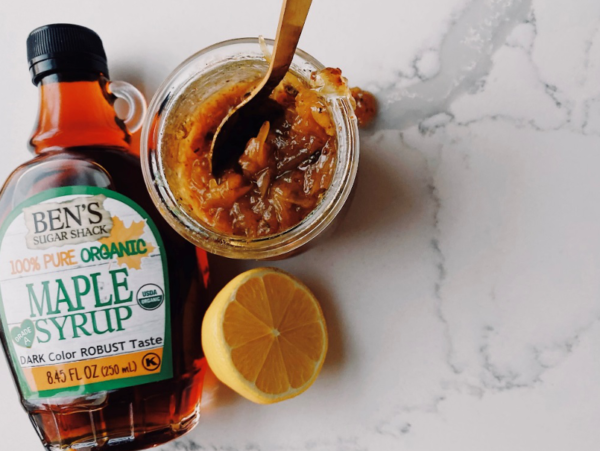
Maple onion jam. Courtesy of Ben’s Sugar Shack.
It’s already shaping out to be a better season for sugarhouses compared to last year, which Chisholm said was widely classified as a disaster due to very warm and dry conditions.
“Most producers only made about 40 percent of what they would expect to make, myself included,” he said. “Last year was an early start and a very early finish. … It warmed up real quick at the end of March, and I think for us down here in southern New Hampshire it never went below freezing. As a whole the 2021 season was a short crop across the entire region.”
Sugarhouses haven’t been immune to rising costs and supply chain issues impacting all kinds of industries in the pandemic’s wake, from plastic containers and glass bottles and jars to everything in between. But with that, Sliviak said sales of and demand for syrup are still up from before.
“We literally had some farm stands double their average sales with us last year,” she said. “I don’t really know what it’s from, whether people are more out and about or their kids are home more and they needed maple syrup, but we’re still seeing that upward trend.”
Maple onion jam Courtesy of Ben’s Sugar Shack in Temple. Recipe by Mareh Bleecker
2 large onions, thinly sliced (about 2 cups) 2 Tablespoons neutral oil (grapeseed, avocado or ghee) 2 Tablespoons Ben’s organic maple syrup 1 teaspoon fresh thyme 1 Tablespoon Dijon mustard 1½ teaspoons salt 2 teaspoons lemon juice 1 teaspoon black pepper, freshly ground
Heat a saucepan over medium heat. Add the oil, onions and salt. Turn the heat to low and cook, stirring frequently until the onions begin to soften and turn translucent. Add maple syrup, black pepper and thyme. Add a little bit of water if the onions begin to stick to the bottom of the pan. Continue to cook the onions for 25 to 30 minutes or until the onions are caramelized and deep brown in color. Add the mustard and lemon juice and stir for one minute. Taste for seasoning and adjust as needed. Pour into a small jar and let it cool. Refrigerate for up to two weeks.
Visit a sugarhouse
Here are some local farms and sugarhouses participating in this year’s New Hampshire Maple Weekend, scheduled for Saturday, March 19, and Sunday, March 20. Some will be offering maple sugaring tours and demonstrations, while others will be selling and providing samples of a variety of maple-infused products. Be sure to contact each one directly for their most up-to-date plans for Maple Weekend. For a full list of sugarhouses, visit nhmapleproducers.com.
• 6 Saplings Sugarhouse (31 Kearsarge Valley Road, Wilmot, 526-2167, find them on Facebook) Open Saturday and Sunday, from 9 a.m. to 4 p.m., offering tours, samples and products for sale, from maple syrup to maple cream, sugar, candied nuts and more.
• Babel’s Sugar Shack (323 Hurricane Hill Road, Mason, 878-3929, find them on Facebook) Open on Saturday, from 10 a.m. to 4 p.m., for an open house, with samples and syrup for sale.
• Beaver Brook Maple (1 Beaver Brook Drive, Bow, 491-0500, find them on Facebook @bbmaple) Open on Saturday and Sunday from 11 a.m. to 3 p.m. for maple demonstrations.
• Beaver Meadowbrook Farm Sugar House (402 Route 103 East, Warner, 224-2452, find them on Facebook) Visitors welcome any time, but calling ahead is recommended. Face masks are required when inside the sugar house.
• Ben’s Sugar Shack (83 Webster Hwy., Temple; 693 Route 103, Newbury; 924-3111, bensmaplesyrup.com) Open on Saturday and Sunday, from 10 a.m. to 5 p.m. Free maple sugaring tours are offered every 15 minutes and last about a half hour, depending on questions. Samples and products for sale include maple syrup, soft serve, doughnuts, roasted nuts and more.
• Beyond the Horizon Farm (19 Gillis Hill Road, Bennington, 588-6210, beyondthehorizonfarm.com) Open on Saturday from 8 a.m. to 4 p.m., featuring complimentary maple cinnamon swirl rolls and doughnuts as well as coffee, cocoa and tea while supplies last.
• Blueberry Hill Sugarworks (31 Blueberry Hill Road, Raymond, 300-6837, wickedsappy.com) Open weekends during maple season; hours vary. Check back on the website or call for details.
• Charmingfare Farm (774 High St., Candia, 483-5623, visitthefarm.com) Open Saturday and Sunday for its annual Maple Express event, to be held at various times between 10 a.m. and 5 p.m. each day. Tickets start at $22 and include horse-drawn and tractor train rides, maple syrup demonstrations and tours, taste testing, visits with the animals and more.
• Chisholm Farm (641 Main St., Hampstead, 421-4727, chisholmfarm.com) Open on Saturday and Sunday, from 10 a.m. to 4 p.m. Tours will be conducted on an on-demand basis and a variety of products will be available, from maple ice cream and doughnuts to all kinds of infused syrups.
• Chris-Mich 3 Farm (285 Elm Ave., Antrim, 588-2157, find them on Facebook @chrismich3farm) Open Saturday and Sunday, from 9 a.m. to 5 p.m., with a variety of maple products available, from maple syrup to maple cream, sugar, candies, walnuts and more.
• Connolly’s Sugar House (140 Webster Hwy., Temple, 924-5002, find them on Facebook) Open Saturday and Sunday, from 10 a.m. to 5 p.m., for tours. Connolly’s, which is also a family-owned dairy farm, will have its own maple ice cream made fresh on site with its syrup.
• Dill Family Farm (61 Griffin Road, Deerfield, 475-3798, find them on Facebook) Open on Saturday and Sunday, from 9 a.m. to 4 p.m., featuring maple syrup samples available, in addition to maple candy, cream and sugar for sale.
• Fletcher & Family Sugar House (2528 E. Washington Road, Washington, 340-4035, fletcher-farm.com) Open on Saturday and Sunday, from 10 a.m. to 4 p.m., featuring maple syrup, candy and sugar for purchase, in addition to some free samples. Coffee, hot chocolate and doughnuts will be served in the morning and hot dogs and chips will be served for lunch.
• Folsom’s Sugar House (130 Candia Road, Chester, 370-0908, folsomsugarhouse.com) Open Saturday and Sunday, from 10 a.m. to 4 p.m. Tours will be ongoing throughout each day, and there will be a variety of specialty products available, from maple syrup, candies and cream to maple barbecue sauce, mustard, pepper seasonings and pancake mixes.
• Gould Hill Farm (656 Gould Hill Road, Contoocook, 746-3811, gouldhillfarm.com) Open on Sunday from 10 a.m. to 4 p.m., featuring free maple syrup samples, as well as cider doughnuts and maple hard cider for sale. The Contoocook Cider Co.’s tasting room will also have live music by Colin Hart from 1 to 4 p.m. that day.
• Ice Mountain Maple (276 Queen St., Boscawen, 341-4297, icemountainmaple.com) Open on Saturday from 10 a.m. to 4 p.m. and on Sunday from 10 a.m. to 3 p.m., offering maple syrup and candy for sale, as well as maple coffee.
• Jessie James Maple Farm (164 Allens Mill Road, Gilmanton, 267-6428, jessiejamesmaple.com) Open Saturday and Sunday, from 10 a.m. to 2 p.m., featuring its own maple syrup for sale, in addition to other specialty products like maple mustard, maple chipotle seasoning and cinnamon maple sugar.
• Journey’s End Maple Farm (295 Loudon Road, Pittsfield, 252-6669, journeysendmaplefarm.com) Open on Saturday and Sunday, from 10 a.m. to 3 p.m., featuring live maple sugaring demonstrations, a local vendor pop-up event and a variety of maple products for sale, from maple syrup to iced maple lattes, maple shakes, sundaes, cotton candy and more.
• Kaison’s Sugar House (75 Forest Road, Weare, 660-6019, find them on Facebook @kaisonssugarhouse) Open on Saturday, from 10 a.m. to 3 p.m., featuring maple sugaring demonstrations and maple products for sale like syrup, lollipops and candy drops (cash only).
• Kearsarge Gore Farm (173 Gore Road, Warner, 456-2319, teamkgf.com) Open Saturday and Sunday, from 10 a.m. to 4 p.m., for maple sugaring demonstrations and syrup samples.
• Ledge Top Sugar House (25 Oak St., Boscawen, 753-4973, ledgetop.com) Open on Saturday, from 10 a.m. to 3 p.m., featuring maple syrup and other products for sale.
• Main Street Maple and Honey Farm (186 Main St., Belmont, 527-9071, mainstreetmapleandhoney.com) Open on Saturday and Sunday, from 9 a.m. to 3 p.m., featuring maple syrup making demonstrations and a variety of products for sale.
• Mapletree Farm (105 Oak Hill Road, Concord, 224-0820, mapletreefarmnh.com) Open Saturday and Sunday, from 10 a.m. to 4 p.m., featuring self-guided maple sugaring tours and a variety of maple products available, like maple syrup, cream, candy and more.
• Matras Maple (821 Catamount Road, Pittsfield, 724-9427, find them on Facebook @matrasmaple) Open on Saturday from 10 a.m. to 4 p.m. and Sunday from 12:30 to 5 p.m. There will be maple syrup making demonstrations and all kinds of maple products for sale, like maple cream, maple sugar and local ice cream topped with maple syrup and crunchy candies.
• Munson’s Maple (44 Blueberry Hill Road, Raymond, 303-8278, find them on Facebook) Open Saturday and Sunday, from 9 a.m. to 4 p.m., for maple tours, samples and products for sale.
• Old Pound Road Sugar House (37 Old Pound Road, Antrim, 588-3272, oldpoundroadsugarhouse.com) Open Saturday and Sunday, from 10 a.m. to 4 p.m., featuring maple tours and a variety of free samples, like coffee, maple syrup and candy.
• Parker’s Maple Barn (1316 Brookline Road, Mason, 878-2308, parkersmaplebarn.com) Open Saturday and Sunday, from 9 a.m. to 1 p.m. for maple tours, and specialty products like gourmet maple coffee and maple glazed doughnuts will also be available for sale.
• Peterson Sugar House (28 Peabody Row, Londonderry, 383-8917, pokeypeterson038@yahoo.com) Open Saturday and Sunday, from noon to 5 p.m., featuring maple sugaring demonstrations, maple syrup samples and various maple products for sale.
• Pfeil Family Farm (311 Cram Hill Road, Lyndeborough, 801-3158, pfeilfamilymaple.com) Open Saturday and Sunday, from 9 a.m. to 4 p.m., featuring maple syrup for sale as well as coffee, doughnuts and other various maple products.
• Remick Country Doctor Museum & Farm (58 Cleveland Hill Road, Tamworth, 323-7591, remickmuseum.org) Open Saturday and Sunday, from 10 a.m. to 2 p.m., featuring outdoor maple sugaring demonstrations and maple syrup for sale while supplies last.
• Ridgeland Farm (736 Loudon Ridge Road, Loudon, 520-4337, ridgelandfarmnh.com) Open on Saturday from 9 a.m. to 5 p.m. and Sunday, from 9 a.m. to 4 p.m., featuring tours of the sugarhouse and samples of maple syrup and maple peanut butter fudge.
• SMD Maple Syrup (6 Falcon Drive, Merrimack, 978-815-6476, find them on Facebook @smdmaplesyrup) Open Saturday and Sunday, from 10 a.m. to 5 p.m., featuring maple syrup making demonstrations, samples, maple syrup for sale and more.
• Somero Maple Farm (21 Poor Farm Road, New Ipswich, 562-0822, someromaplefarm.com) Open on Saturday from 9 a.m. to 3 p.m., featuring free maple syrup making tours and a variety of products available for sampling and for sale.
• The Sugar House at Morning Star Farm (30 Crane Crossing Road, Plaistow, 479-0804, find them on Facebook @thesugarhouseatmorningstarfarm) Open Saturday and Sunday, from 9:30 a.m. to 5 p.m., offering its full line of maple products, which include syrups, cream, jelly, mustard, nuts, candy, confections, homemade doughnuts and more.
• Sunnyside Maples (1089 Route 106 N, Loudon, 848-7090, sunnysidemaples.com) Open Saturday and Sunday, from 8 a.m. to 4 p.m., featuring maple sugaring demonstrations and several maple products for sale in its gift shop, like syrup, cream, mustard, candy, seasonings, coffee, pancake mixes and more.
• Trail Side Sugar House (246 Currier Road, Andover, 748-1307, trailsidesugarhouse.com) Open Saturday and Sunday, from 10 a.m. to 5 p.m., offering maple tours, samples and demonstrations. Available products all weekend will include maple syrup, candy, cream, barbecue sauce, mustard, doughnuts, cotton candy, nuts and whoopie pies.
• Turkey Street Maples (673 Turkey St., Chocorua, 323-9320, turkeystreetmaples.com) Open Saturday and Sunday, from 10 a.m. to 3 p.m., featuring maple sugaring demonstrations and various maple products available for purchase, including syrup and cotton candy.
• Two Sappy Guys Sugar Shack (324 Joppa Hill Road, Bedford, 860-7992, find them on Facebook @2sappyguys) Open Saturday and Sunday, from 9 a.m. to 4 p.m., featuring fresh maple syrup for sale.
• Windswept Maples Farm (845 Loudon Ridge Road, Loudon, 491-9130, windsweptmaples.com) Open Saturday and Sunday, from 10 a.m. to 4 p.m., featuring maple demonstrations and maple syrup, maple sugar candy and other products for sale.
Featured photo: Maple sugaring tours at Ben’s Sugar Shack in Temple. Courtesy photo.
Information from the New Hampshire Department of Health and Human Services.
Covid-19 news
On March 8, the state Department of Health & Human Services announced in a press release that all of the state-managed Covid-19 testing sites will permanently close on Tuesday, March 15. Both PCR and antigen-based Covid tests remain easily accessible, including at all New Hampshire Liquor and Wine Outlet stores and at dozens of hospitals, health care practices, pharmacies and urgent care centers. See covid19.nh.gov for a full list of locations that offer tests.
Elliot Hospital also recently said goodbye to a team of 14 officials from the federal Department of Defense helping out with the latest Covid surge, according to a March 9 report from WMUR. The team, which included several nurses and technicians, as well as a physician and an advanced care provider, had been assisting hospital staff for the past two months.
State health officials announced 86 new positive Covid test results on March 11, surpassing the 300,000 mark for overall cases in New Hampshire since the start of the pandemic two years ago. Despite this milestone, numbers continue to trend downward — only 43 active hospitalizations were reported on March 14, the fewest since early August of last year. In a press release issued that same day, DHHS reminded people of the availability of two oral antiviral medications, Paxlovid and molnupiravir. According to the release, both can be prescribed by providers via phone or through a telemedicine visit and can be taken at home.
Trooper training
Eleven members from the New Hampshire Division of State Police have completed the national Active Bystandership for Law Enforcement Project, which provides training and support to help law enforcement agencies build a culture of peer intervention that prevents harm. According to a press release, those 11 designated instructors will now be able to provide ABLE training to all other New Hampshire state troopers. The Project’s Board of Advisors is made up of civil rights, social justice and law enforcement leaders, and the strategies and tactics that are taught through the program aim to prevent misconduct, reduce mistakes and promote health and wellness, the release said. The training is consistent with the recommendations of the state’s Commission on Law Enforcement Accountability, Community, and Transparency. “This training will ensure that we continue to provide the highest degree of law enforcement service throughout the state while maintaining our core values of professionalism, fairness and integrity,” State Police Col. Nathan Noyes said in the release.
Courtroom equity
The New Hampshire Women’s Foundation released a new Gender Matters report last week that explores the inequitable representation of women and people of color in the New Hampshire judicial branch, according to a press release. “Women in the New Hampshire Judiciary” points to the fact that 38 percent of all New Hampshire state court judges are women, with the ratios of female judges being even smaller in the state’s Superior and Supreme Courts. Only one person of color, a woman, is currently serving as a judge in the state judicial system. According to the release, governors’ administrations play an important part in who makes up the judicial system; former Gov. Maggie Hassan’s administration appointed the highest percentage of women during her tenure, at 48 percent. “Representation matters in all branches of government,” Tanna Clews, CEO of the New Hampshire Women’s Foundation said in the release. “We see many opportunities in New Hampshire to increase gender and racial diversity among New Hampshire judges.” Some of the Foundation’s policy recommendations to increase gender and racial diversity include urging governors to nominate more women and people of color; appointing more members with gender and racial diversity to the Judicial Selection Commission; and providing female attorneys a mentorship program that supports career trajectory, including judgeship.
University system chancellor
The University System of New Hampshire Board of Trustees voted last week to combine the university system’s chancellor position with the role of the president of the University of New Hampshire on an interim basis for the next two-plus years. According to a press release, UNH President James W. Dean Jr. will serve as interim chancellor effective immediately, and the combined role will be in place through June 30, 2024. The board will evaluate the efficacy of the new position throughout that time. The chancellor role has remained vacant since former Chancellor Todd Leach departed in June 2021; since then, the board and administrative leadership have focused on “the economic stability, growth and transformation of its institutions” and explored various governance structure options to determine which might best secure those outcomes. In the new role, Dean will “lead and ensure the success of UNH, including the current merger of UNH and Granite State College, while working with the other campus presidents to advance the interests of KSC, PSU and the overall university system,” the release said.
Preschooler support
Federal funds are being used to make the Waterford Upstart at-home program available to hundreds more pre-K-age children in New Hampshire. According to a press release, the federal Elementary and Secondary School Emergency Relief Fund will give more kids access to Waterford Upstart Summer Learning Path from June to August. The program is designed to prepare young students for kindergarten, and many who complete it “will be reading at a nearly first-grade level,” the release said. It offers positive parent-child interactions through personalized online instruction. The summer program has kids working on the curriculum for 20 minutes a day, five days a week. “Preschool is the ideal platform for children to build a strong academic foundation and enhance language and literacy — skills that are critical for school readiness,” Christine Brennan, deputy commissioner of education, said in the release. New Hampshire families with a child entering kindergarten in the fall of 2022 or the fall of 2023 can register by calling 1-888-982-9898 or visiting WaterfordUpstart.org. “The Waterford Upstart program helps close the well-documented preschool access gap, providing proven school-readiness support for children most at risk of school failure,” Frank Edelblut, commissioner of education, said in the release.
The Nashua Board of Education and the Nashua Teachers’ Union have tentatively reached a four-year contract agreement. According to a press release, negotiating teams met last week and agreed to an average salary increase of 4.1 percent over four years for all teachers, totaling $11,127,830. “Our teachers, nurses, counselors, school psychologists, and many others have been at the front lines of the Covid-19 pandemic these last two years and this agreement recognizes their efforts and honors their work with increased pay, benefits, and support,” Superintendent Garth J. McKinney said in the release.
Husband and wife Max and Saverna Ahmad of Bedford, who founded the ride-share startup Rydelinx, have expanded their operations beyond New Hampshire to all 50 states. According to a press release, Rydelinx lets riders name their price and choose specific drivers or vehicle types, while drivers can accept the ride, counter the offer or decline the ride.
Hollis police are cracking down on drunk drivers, having doubled the number of arrests for suspected drunk driving this year compared to this time in 2021, according to a report from WMUR. Several officers have taken advanced roadside impairment detection classes to help with this effort, the report said.
What does a high school diploma get you? Some might say that someone with a high school diploma will earn more money over their lifetime than someone who hasn’t earned a diploma. That may be true, but do you credit the diploma for the extra earnings? Does that diploma tell you anything about the specific skills that an individual would bring to the workplace? I believe that the high school diploma has largely outlived its usefulness and that the end game in high school should no longer be to simply earn a diploma.
What does a high school diploma tell you about someone? For example, if someone got a B in biology, can anyone tell me what that person knows and is able to do with what he or she learned in biology? How did they get the B? Did they get it because they got a B average on their tests? Was it because they passed their homework in on time? Did they regularly participate in class discussions? Did they do well on the final exam? Maybe they were nice to the teacher. Whatever they did, it translated into a B. Even if we assume that they did fairly well in their biology class, how much of what they were taught will they actually retain even two weeks after the exam?
And what are colleges supposed to translate from your grades in high school? Why is it that 40 percent of college freshmen need to take remedial courses in either math or language arts? Can we assume that their high school transcripts were interpreted by the admissions officers to be that these students actually had skills in those areas? Then how come they had to take remedial courses?
I believe the high school diploma’s usefulness is coming to an end, and that the new coin of the realm for high schools will be certifications and career credentials; something that will give confidence to anyone who has interest in someone holding one of these credentials that they have achieved the skills necessary to perform the associated tasks, be it a welder’s license, a massage therapist’s license, an associate’s degree in a specific field, etc. These credentials not only give someone confidence that you have the requisite skills but they immediately carry weight in the marketplace when seeking specific jobs.
Career-related credentials are coming soon to a high school near you and they will be a welcome improvement over the outdated notion of a diploma.
Fred Bramante is a past chairman and memtber of the New Hampshire State Board of Education. He speaks and consults on education redesign to regional, state and national organizations.