Amanda McCarthy is back in New Hampshire, after living and working in Nashville for the past several years. The singer-songwriter is still following her dream of music success, but she’s returning with a clearer sense of purpose, along with something she found harder to hold onto in Music City: joy.
“I’ve just been very disenchanted by Nashville,” she said by phone recently, while packing up her husband’s and daughter’s things and readying for final shows there in mid-May. After a Kentucky date on the return drive, her first Granite State gig is May 27 at Fratello’s Italian Grille in Manchester.
McCarthy said she began thinking about coming home after a harrowing moment about three years into her stay in the city. A tornado tore through her neighborhood, leveling nearly every building around her. Miraculously, her apartment was barely touched. However, she was shaken.
A 17-year-old boy was pulled from a unit that McCarthy originally was scheduled to occupy herself. That fact haunted her.
“I kind of had an existential crisis,” she recalled. “I just started thinking … music is fun, but what really matters? When I’m 80, what do I want to matter to me?”
Along with missing the ocean and the mountains, she desired the freedom to be herself and stop worrying about industry expectations. Another factor was her daughter, now in grade school. “Tennessee education is going downhill,” she said. “Opening that door allowed me to be honest with myself about myself as well.”
Still, McCarthy is clear-eyed about Nashville’s upside. Her second album, Looking for the Light, is evidence of that. The sophomore effort is a confident, layered collection of songs that swings from Nashville-flavored rockers to personal and confessional songs.
A through line from her debut LP Road Trip is both clear, and deliberate. The first record was about escaping challenges in her home town. Life ultimately worked out in Nashville, but she realized, “I can’t go back to New Hampshire until I can tackle the things I ran away from up there.”
The move, McCarthy concedes almost grudgingly, was a success. She credits the city with sharpening her craft in ways that wouldn’t have happened anywhere else.
“Even the bad parts really helped me,” she said. The relentless pace of Nashville’s live circuit, with longer sets, fewer breaks and lower pay, built a stamina she now takes for granted.
“Now, when I go home and I do a three-hour show with breaks, it’s really easy,” she explained. “I’ve always compared singing longer gigs to running. You don’t run 3 miles overnight. You start with a half mile and work your way up.”
After Fratello’s, she’s at Washington General Store for its music series May 28, and Exeter Brewing on May 30.
Her craft also evolved. Collaborating with a bevy of talented songwriters, she absorbed new techniques — sometimes at the expense of her own voice.
“At one point, I was writing with other people so much, I almost forgot to write by myself,” she said. “So I took a step back … to get back in touch with that part of me.”
When she’s back home, McCarthy is eager to rediscover something Nashville’s music economy had slowly drained out of her performing life — the simple pleasure of making people happy. She’s also eager to leave behind the Nashville norm of demanding twenty bucks to play a song request.
“At home I would just take everyone’s request and they’d probably tip me $20 or more anyway,” she said. “It really took out the joy of performing. I love making money from music, but I want it to be natural, not forced.” She didn’t comment on whether her policy applied to playing “Free Bird” or “Mustang Sally.”
Regarding whether Nashville was worth it, and if she accomplished what she set out to do, McCarthy offered an answer that reflected the work she’s done on herself.
“A lot of my obsession around trying to be famous… was from wanting to prove people wrong,” she said. “Through a mix of therapy and reassessing … it’s like none of that matters.”
What does matter, she concluded, “is what I’ve accomplished.” McCarthy is returning to where she began having bought a home with money she made as a musician. Beyond that, she’s written songs that hold up, that are true to who she is. “I do feel like I should be proud of myself for that.”
Amanda McCarthy When: Thursday, May 28, 6 p.m. Where: Washington General Store, 29 Main St., Washington More: Full show schedule, including a June 3 gig at Homestead Restaurant in Merrimack, at amandamccarthy.com
Featured photo: Amanda McCarthy. Photo credit: Phil Silverberg
April Repoza and her daughter Bailey own and operate Bigfoot Sourdough in Milford, a sort of a combination homestead bakery and mad science lab that goes well beyond simple loaves of bread.
“We do make artisan loaves,” April Repoza said, “and then we do all of the very standard ones like jalapeno-cheddar and pesto-parm. We make bagels and they’re sourdough obviously, but they’re New York-style where they’re boiled in malt syrup and then baked. We make hamburger buns. We make stuffing cubes for Thanksgiving, cookies, and brownies. We do sourdough pizzas. It’s endless. But what we’re known for is when people reach out and say, ‘Hey, can you make this flavor?’ and if it’s something I’ve never done, I’ll say, ‘Of course — you know, let me try that.’”
“We love taking on crazy ideas,” Repoza continued. “We made a Pizza Night Loaf that we actually folded cooked spaghetti into. We used a tomato sauce-based dough and added cheese and it was literally a whole meal. You’d cut it and there’d be pieces of spaghetti inside. We made a Demogorgon Loaf for Stranger Things that went kind of viral. But yes, so we make regular loaves, too. Our English muffins have definitely been our best seller recently. We make standard sourdough English muffins and then we do a flavor of the week; this week we’ve got banana-nut ones and then we do a sourdough coffee cake of the week. This week we’re doing a Cosmic Brownie Coffee Cake. We make a cinnamon roll of the week and this week it’s based on the concept of a ‘kitchen sink’ cookie; we call it Bigfoot’s Junk Drawer. There’s a viral trend of people holding their sourdough like men hold their fish when they’re showing off their catches, so I upgraded my sourdough one week and made it into a fish shape”
Getting creative with sourdoughs began with April’s daughter Bailey, Rapoza said.
“She had gone to college and came home for Christmas break and said, ‘Mom, I got us a sourdough starter. Let’s try to make some bread.’ I was like, ‘OK, sure,’ I’ve never done it before. I went to culinary school 500 years ago, but I was like, ‘Alright, let’s try it out.’ We both just fell in love with it and fell in love with the science. We did hundreds and hundreds and hundreds of hours of research before we even offered it out to friends or family or anything like that. I wanted to really try to perfect it before we went any further. Eventually we started getting known for our unique flavors and the different projects that we take on. Every product we make is sourdough-based, from cookies to king cakes, which we made this year. It was insane! I think we sold about a hundred different king cakes this season.“
The Rapozas started with a purchased starter, April said, but after developing thousands of batches of dough, their dough has evolved to the point of being uniquely suited to their needs. “It’s funny,” she said, “because people will say, ‘Well, I use a 200-year-old starter…’, and that’s partially true, but once you start feeding it your own water and your own flour, it changes. So it’s not the exact sourdough starter from 200 years ago. Ours is definitely its own thing at this point. My family jokes that if we go on vacation I have to arrange babysitting for our dough. My mom will come over to feed it; she’s like, ‘We never expected for you to have another child.’”
Working with sourdough, and learning to think about it as a living organism, has changed the way she looks at her baking and at food in general, Rapoza said. “We constantly look for ways to make not-so-healthy things healthy, but we also like to go kind of over the edge and make healthy things a little crazy too. I feel like you can do both.”
Bigfoot Sourdough Where: 33 Cortland Road, Milford, 801-6265, facebook.com/BigfootSourdough When: open Thursday through Sunday, 8 a.m. to 7 p.m. Pickups can be arranged seven days a week by appointment. Special orders require notice 48 hours in advance.
FLOW, the Friends of the Library Of Windham, who support the Nesmith Library, is holding its biggest fundraiser of the year this weekend, its annual Strawberry Festival and Book Sale.
Mary Connelly, a FLOW member, said the event is time- and labor-intensive.
“We start meeting in September [the year before],” she said, “and then go all the way up until the end of May with the actual event. FLOW supports the library; we give about $7,000 in programming money for the teen, children and adults programs. We have supported some of the physical needs that they had this year. We helped pay for a new fence around the storybook garden that they have outside and bought a picnic table for them. The Library needed a new book return this year, and if there are other things that we can help out with as we go along, we try to support those. The Library here is a wonderful resource and we’re very proud of it. We hold two book fairs each year, one in December and then this one that’s part of the Strawberry Festival.”
The book sale goes on for four days, Connelly said.
“It starts next Wednesday,” she said, “and on Wednesday it’s for FLOW members, senior citizens and teachers. And then Thursday and Friday it’s open to anybody, after which we’ll pack up whatever’s left and take it over to the High School for the Strawberry Fest on Saturday.” By the end of the day on Saturday, the book sale will become a Bag Sale. “We provide the bag,” she said, “but then for $5, whatever you can fit in the bag, you can take home with you. Over the years, we’ve learned that we need to provide the bags; we’ve had people be a little too creative in the past.”
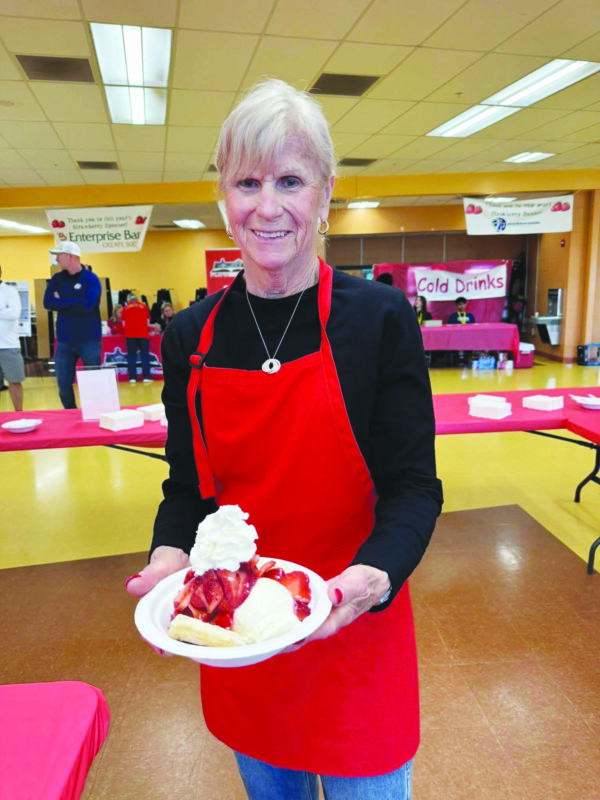
The key element of the Strawberry Festival however, is the strawberries. FLOW sells a lot of strawberry shortcake over the course of the day, Connelly said, serving upwards of 2,000 strawberry enthusiasts most years.
“Last year, we went through 480 quarts of fresh strawberries. Anyone who wants to learn the recipe of our shortcake is welcome to come volunteer, but it isn’t complicated.” FLOW sells a classic biscuit-based shortcake with strawberries and whipped cream, she said. “And there’s ice cream too, for people who want it.”
The Strawberry Festival is a way of recognizing the start of strawberry season, Connelly said. “It was established in 1984. Originally it took place later in the season, but now we’re just a little bit outside of it. It’s a great community builder. Last year we probably had 2,500 people come over the course of the day. It was just kind of nice and steady and everybody seemed to be having a good time. It was typical weather — one minute it was sunny, the next minute it was overcast. Then it was rainy and we had to go indoors. It’s New England, though, so there’s nothing you can count on, but the high school is big enough that it can handle things indoors or outdoors.”
Strawberry Festival and Book Fair When: Saturday, May 30, from 11 a.m. to 5 p.m. Where: Windham High School, 64 London Bridge Road, Windham. What: There will be food trucks, live performances and a bicycle parade. More info: Visit flowwindham.org.
Less Leg More Heart raises funds with Fire Truck Pull
Christina Hurley has given the question of what kind of fundraiser to hold a lot of thought.
She is the Founder and Executive Director of Less Leg More Heart, an organization dedicated to helping amputees get resources to help them thrive.
“We started eight years ago,” she said, “and we sort of threw spaghetti at walls for years trying to figure out what our niche sort of flagship events would be. There are a lot of galas and similar types of events. We wanted to create something that was unique, that had a little something for everyone, and that was able to involve a larger demographic in the community and create a real sense of inclusion and accessibility and community spirit.”
Which, in a nutshell, resulted in this weekend’s Fire Truck Pull.
This Sunday, May 31, from 1 to 5 p.m., Less Leg More Heart will host its third annual Fire Truck Pull and Festival. Participants pay for the bragging rights to physically pull an antique fire truck with a rope, competing with other individuals or groups. It is the sort of event that fuels bragging rights and spurs competition. According to Hurley, it was inspired by another, even more grunt-filled event in Maine.
“Some of our mentors are in the veteran space,” she said, “and Travis Mills, who runs a wonderful foundation up in Maine to recalibrate veterans, does an airplane pull. And they were mentioning the facets of it and how successful it’s been over the years. And so we started to look in our area, southern New Hampshire, about doing something similar like that. But, you know, airplanes have a little higher barrier to entry; fire trucks seem to be a little bit more up our alley. They are certainly fun for the kids and something fun for the strongmen in the area and athletes. We toyed with that three years ago and found it to be really successful. And now we’ve done it every year. This is our third annual Fire Truck Pull and Festival. It is a multifaceted event that has a large vendor village and a car show, as well as a fire truck pull. Children lead it off by pulling power wheels, and they’re rigged and educated by local New Hampshire strongmen. And then individuals will pull an antique, smaller-sized truck and then teams sign up to pull our larger rig — the 40,000-or-so-pound rig.”
There is something primal about pulling a fire truck, Hurley said, that speaks to each individual in personal and different ways.
“We’ve actually added some divisions to our awards this year,” she said. “We have really great trophies for the fastest team pulls — for first, second and third, but then we also have the strongest singles for men and women. This year we’ve added a costume award, a spirit award, a crowd favorite award, and a grit award. There’s an opportunity for folks to come out and be part of a community. We celebrate having people with all different types of abilities and different types of accessibility devices. In fact, several amputees last year, even from wheelchairs, participated in a pull and the strongmen would push it.”
This event has even surprised Hurley with how successful it has become, she said. “It’s just been really neat to see how folks just keep pouring out. We were unprepared for the 400-plus people who came to the event last year, and that’s a great problem to have.”
Less Leg More Heart’s Third Annual Fire Truck Pull and Festival When: Sunday, May 31, from 1 to 5 p.m. Where: Arms Park, 10 Arms St., Manchester More: lesslegmoreheart.com/events
Folk Voices and Fantasies, an upcoming afternoon of classical music from the New Hampshire Philharmonic Orchestra conducted by The Phil’s Music Director Mark Latham, offers three works from three composers, each from a distinctly different corner of the world.
What binds together Igor Stravinsky’s Petrushka, Max Bruch’s Scottish Fantasy, and Carlos Chávez’s Sinfonía India isn’t style or era but instinct, Latham explained in a recent Zoom interview.
“The main connecting thread is composers using folk music from their native traditions,” he said.
For Petrushka, Stravinsky borrowed Russian folk songs and even a few German waltzes; most of its melodies weren’t his to begin with. Bruch did the same with Scottish reels and airs, and Chávez went even further, working not from memory or nostalgia but from within a living indigenous Mexican tradition.
To honor that, an orchestra member hand-built a traditional güiro for the performance. The notched hollowed-out gourd is usually played with tines and produces a ratchet sound. “Because the percussion element in the Chavez is very strong and uses a lot of Mexican instruments,” Latham said. “It’s trying as much as we can to use those instruments.”
It reflects a late 19th- and early 20th-century trend of composers “very interested to explore what was going on musically in their native arena,” Latham offered. “Bartok, for instance, was going out into the countryside before the advent of recorded sounds, actually notating local folk songs and that kind of thing … very early musicology.”
The concert begins with Stravinsky’s tale of a carnival puppet who turns out to feel things too deeply for his own good. It’s an exhilarating choice for an opener, and it concludes not with a bang but with a ghost: Petrushka, apparently killed, reappears hovering over the theater in the final bars, leaving the question of his humanity forever unresolved.
A superimposed C major and F-sharp major, called the Petrushka Chord, recurs throughout the work. It denotes the main character’s many dualities: puppet and person, ridiculous and suffering, knowable and unknown. The motif became a go-to for composers like John Williams, who used it for his “Theme From Jaws.”
Fifteen-year-old violin prodigy William Yeh solos on Scottish Fantasy. Yeh is a student at the Juilliard School in New York and last year’s Sempre Musick Competition winner. The Phil has collaborated with Sempre Musick for the past few years, Latham said. “These days, the Grand Winner plays their piece with the New Hampshire Philharmonic the next season.”
The piece is a back-and-forth that Latham described as a conversation. With the young soloist still developing his voice, it has its own particular texture — the orchestra takes its tempo from listening to Yeh, and shapes its phrases around his. “The soloist provides the main musical impetus, and then we answer.”
The evening ends with Chávez’s percussion finale and its offbeat sparks that, Latham said, “aren’t quite agreeing with the rhythm,” and a frenetic ending that inspires both audience and orchestra. “It’s like a rock drummer … ‘Let’s just go for it at the very end,’ right? It’s percussion going crazy.”
Latham has made the case throughout The Phil’s current season that classical music belongs to everyone. Folk traditions aren’t less powerful when they’re arranged for an orchestra, and the barriers people feel entering a concert hall are mostly imaginary.
“If people at a classical music concert would be more like a rock concert,” Latham said, “that’d be fantastic.”
Beyond that, he believes music is a salve for challenging times, remembering Romanian conductor Sergiu Celibidache’s observation in an interview with a French journalist 30 or 40 years ago. “Beauty is a stepping stone to freedom,” he recalled him saying.
Latham added that the act of creation is, more often than not, a political one.
“Some people say, ‘art for art’s sake’ — I’m not one of them,” he said, citing Leonard Bernstein’s words in the aftermath of his close friend John F. Kennedy’s assassination. “This will be our reply to violence; to make music more intensely, more beautifully, more devotedly than ever before.”
Folk Voices and Fantasies: Music Rooted in Culture and Imagination When: Saturday, May 30, and Sunday, May 31, at 2 p.m. Where: Seifert Performing Arts Center, 44 Geremonty Drive, Salem Tickets: $5-$35, nhphil.org
Featured photo: Clockwise from top left Sean Williams, Pauline Berger, Margot Lasalle, Anna Multone. Courtesy photos.
For gardening nerds and the occasional gardener alike, a trip to a top-notch “professional” garden is more fun than a week at Disney. Seeing what is really possible if you have enough experience and put in the hard work can be truly inspirational.
A really good resource for this is the reference book The Garden Tourist’s New England: A Guide to 140 Outstanding Gardens and Nurseries by Jana Milbocker, who views these visits as a good way to see gardening from somebody else’s perspective. She recommends paying close attention to the combination of plants that a master gardener has put together.
“People really give a lot of thought to how they use the forms of the garden design,” Milbocker said in a telephone interview. “I think it’s really helpful for me to go through a garden in that direction, to experience it the way that the garden owner wants you to experience it.” Thinking about the question “Why is this here?” can help reframe a home gardener’s outlook, she said.
But then, she advised, take a second look.
“You’re going to see things that you missed the first time. It’s possible also, for instance, a garden conservancy will have a garden open in the early summer and that same garden open later in the season, like late summer or early fall. It’s great to see any garden in different months because it can be vastly different. Different plants have beautiful colorful foliage in the fall. So to see a garden [over time] is really a great experience.”
A good way to find gardens to be inspired by is to take part in a sponsored garden tour.
Amy Murray is the Open Days Program Manager for the Garden Conservancy (gardenconservancy.org), an organization dedicated to garden preservation.
“We assist public gardens that are either damaged or are in need of preservation services,” Murray said. “We also give small grants to a variety of horticultural organizations that are bringing gardening to people and making significant impacts within their communities.” Murray’s particular job is working with gardens, public and private, in a given area, to help them participate in “Open Garden Days” — one or more days per season when the public can visit them.
“Unless you have a very explicit program or invitation through something like the Open Days program, there’s really not a ton of opportunities to see these spaces,” Murray said. “Open Days are absolutely wonderful because if you are interested in a garden and you want to see it, you have to go to that Open Day. There are no guarantees that a given garden will be open in a subsequent year or even ever again. We have a variety of gardens. Some love the practice of opening every single year. Some will take a few years off in between and then open once and then stay closed for several seasons. And then some will open once and never again. And so if you want to see it you have to see it on that day.”
Michael Gordon is in charge of working out the details for the Open Garden Days in New Hampshire. He said each garden in the program brings something different to each visitor.
“On one level, it’s just fun to have a nice day and you get to see pretty places. And then if you’re a more serious gardener like I am, you get ideas and see plants. It’s a good way if you live in the area to go to a garden and find out what they’re able to grow because you will be able to grow it too because it’s local to you. You can make a day of it and go from garden to garden. And people are generally really excited to share their garden,” Gordon said.
Another popular garden tour each year is put on by the Palace Theatre in Manchester. It is one of the Palace’s biggest fundraising events each year, said Box Office Manager Cherie Prior.
“The garden tour is a self-guided tour we’re running on June 20 this year,” she said. “In the morning, participants register at Demers Garden Center and they’re given a program, which lists the individual gardens. We have a combination of private and public gardens and [people on the tour] have the rest of the day to travel to the gardens and take their time at each one. Our host gardeners are there to talk about the garden and we have write-ups about each garden and its history and sort of the plants and the things that the host gardener wants to talk about.”
“We work with the Manchester Garden Club,” Prior said. “They help a lot about picking the gardens because they’re the ones out there looking at other people’s gardens and letting us know. We [the Palace Theatre] are invested in art in the community. And we consider gardens to be a part of that as well; a beautiful garden is just as valuable as a beautiful stage production. And we like to be able to promote beauty in any form within our community.”
Elinor Terrell of the Manchester Garden Club described the Palace Theatre Garden Tour as a way of giving area gardeners inspiration and a jumping-off point for their own garden projects.
“The Garden Tour is about showing the lovely hidden treasures of Manchester,” Terrell said. “We have little pocket gardens that are just tiny little things. We also have some of the nice big homes down on River Road. So it’s a wonderful way to show the treasures of the city and also to promote the love of gardening and inspiration. People will see them and go, ‘OK, I’ve got something like this. I could do this.’”
Palace Garden Tour. Courtesy photo.
The Garden Club of Deerfield will host a garden tour in June called “Heritage in Bloom” that will showcase gardens and plants tied to Deerfield’s almost 300-year history.
“One of the stops,” said Robin McKinnon, the President of the Garden Club, “is a fourth-generation property. It comes from the 1830s. And there are plantings of lilacs that were taken from the Governor Wentworth mansion in Portsmouth. And those were the original lilacs that came to the New World. We have one farm that lies within the region historically inhabited by the Algonquin-speaking peoples, including the Seneca and related groups of the Wabanaki Confederacy. And there’s a small family cemetery on site, including the grave of a young man who served and died in the Civil War. Another [stop on the tour] is a farm from 1742 that chooses plants for their beauty but also their sustainability and healing qualities — perennial herbs, fruits, trees, vegetables selected for their dependability and heirloom varieties long valued by earlier generations.”
There are a variety of garden tours throughout the growing season, but there are also public and private gardens throughout the state that welcome visitors but are not part of organized tours. Each appeals to a different type of gardener and embraces a different gardening philosophy.
For 17 years, Petals in the Pines in Canterbury has been a go-to choice for families to spend a day outdoors, hiking along trails and enjoying gardens. According to owner Donna Miller, if you haven’t ever visited, you probably should do so this summer.
“This year will be our last year of being open to the public full-time,” she said. “Four years ago, my husband Jim and I drew a line in the sand. We said, ‘Let’s do this for five more years.’ And this is Year Number 5.”
In addition to pollinator gardens and gardens where visitors can pick their own flowers, “we have 2 miles of outdoor trails,” Miller said. “We have two labyrinths that some people use to get in touch with their thoughts, almost like meditation. We have an outdoor classroom, and a Tale Trail, with laminated pages from four different nature books that parents can read to young children as they walk, and older children can read themselves. There’s something for everyone.”
For families who want to visit throughout the season, season passes are available.
The Canterbury Shaker Village (288 Shaker Road, Canterbury, 783-9511, shakers.org), on the other hand, probably not surprisingly, takes a more historical approach. The Shakers took growing plants very seriously, said Garrett Bethmann, the museum’s Manager of Communications and Engagement, and that is reflected in the gardens on the grounds today. “There are basically three main agricultural or garden spots that people can walk through and check out,” Bethmann said. “There are the granite beds, kind of that smaller plot of what people I think would traditionally see as gardens or botanical gardens. Then we have our farm fields, and those have a lasting imprint on the site. And then we have our orchards.”
“The orchard is filled with different versions of apple trees,” Bethmann said. “The Shakers used to grow apple trees in different locations throughout their close to 200 years of active living here. The orchards in the space, where they are now, first got placed there in about 1917, and a lot of those trees are from that time period.”
“The thing that I think has always been true about when people come and visit our spaces here,” Bethmann continued, “is that as best as we can, we try to use our gardens and our agricultural spaces as ways to showcase the Canterbury Shaker legacy and, as best we can, tie the things that we have going on now to elements and aspects of what they were doing in the past when the Shakers were here. So, for instance, over in our herb gardens where the granite beds are it’s a nice show of preservation in action. Typically we try to use the granite beds to kind of showcase some of the plants and herbs and perennials that were grown there in the past.”
Other gardens focus on plants that grow under very specific conditions.
The Evergreen Woodland Garden in Goffstown, for instance, features plants that thrive in the limited light found on the floor of a forest.
“It’s a one-acre woodland garden heavy on pines,” said Robert Gillmore, the garden’s creator. “There’s a total of around 400 rhododendrons. It’s probably one of the largest rhodi gardens in Northern New England. Of course, there are other ericaceous plants like mountain laurel and Lakota weed and so forth. It’s an extremely low-maintenance garden and it was designed that way. One of the problems, if you want to have a large garden, unless you’re rich with 20 gardeners on your payroll, it’s got to be low-maintenance. So with a woodland garden, one of the reasons it’s low-maintenance is that there’s no grass. There are no high-maintenance plantings, like trees and shrubs and ground covers. Another thing that makes it low-maintenance, of course, is that it’s in the shade. A woodland garden is a shade garden. And a shade garden is a slow ecosystem. Things happen slowly. Weeds happen slowly or not at all.”
“In gardening,” Gillmore said, “there is a quote by the poet Alexander Pope: ‘Consult the genius of a place,’ and by that he meant consult the special character of the site and use what’s on the site. The special character of Evergreen is a pine woods. The most expensive plants in a garden — the plants that are unavailable in any nursery at any price — were already there, planted, growing: the trees, free of charge. There are also some lovely large granite glacial erratics. It’s a wonderful topography,”
Bedrock Gardens. Courtesy photo.
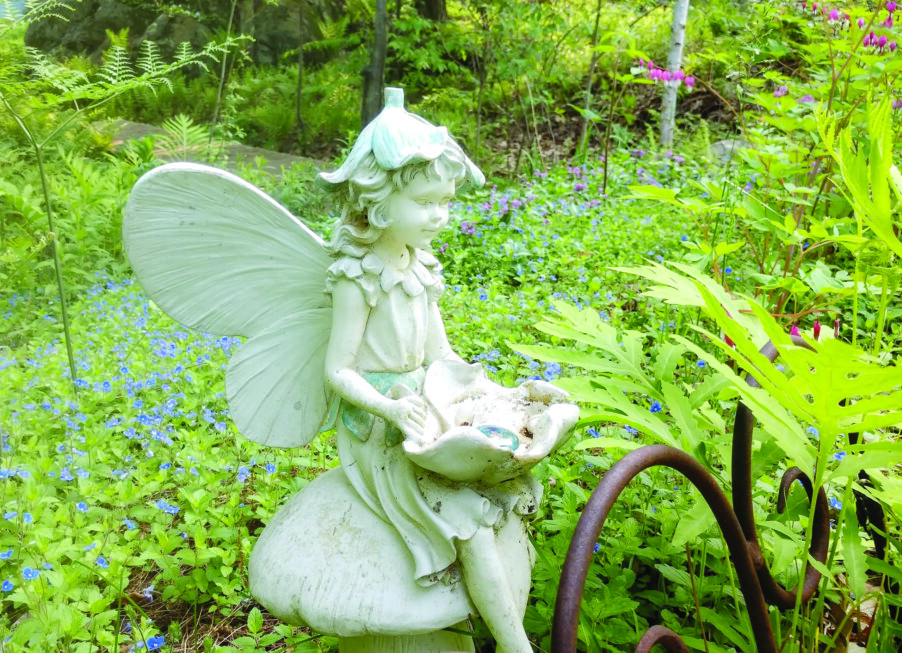
Another approach to gardening is aligned with the Palace Theatre’s philosophy of gardening as an art form. This is the perspective of Bedrock Gardens in Lee. John Forti is the Executive Director there.
“Bedrock Gardens opened to the public formally as a public garden nine years ago,” Forti said, “and we just reopened for the season a week or so ago. It’s a 37-acre old farm that has been here for centuries. The founders of the garden, Jill Nooney and Bob Munger, worked for over 30 years to create a really fascinating garden infused with art and rare botanicals that has become an oasis of art and horticulture. It’s become a public garden where people can take garden tours, art tours, special educational programs and events for all age levels that really help people connect to nature and art and find just a really unique, beautiful green space. Unlike a lot of public gardens, this is really designed to just take you on journeys so that it can be a serene step away from the world, but a place where you can really find some sanctuary and some peace. Gardeners or art enthusiasts are drawn into every corner, because there are dozens of outdoor rooms, one after the next, each with its own mood and emotion and color palette and seasonal specializations and rare plants that just tell stories and pull you away from your daily life into experiences all throughout that 30 plus acres. [The art] is largely sculptural art that really is found in every nook and cranny.”
At NH Audubon’s McLane Center in Concord, the focus is immersing visitors into native species. The Center’s Diane DeLuca said that an aim has been to restore an entire ecosystem. “Four years ago or so,” she said, “we restored an old field area that was full of invasives to an acre of pollinator meadow. It hasn’t been possible to clear out all the invasives, as you might imagine, but now there is at least an acre of native pollinator plants out there. We also have native plant pollinator gardens that go all the way around the building. And also up on the hill there’s some space that we call our butterfly garden, which is meant to be more attractive to some of the species of butterflies that move through here — monarch butterflies specifically — and the pollinators that use areas late in the fall, including migrating butterflies.”
“Our gardens here,” DeLuca said, “are meant to be as diverse as possible in order to attract all kinds of wildlife. They have a lot of different structural diversity, meaning we have some attractive trees for pollinators, which would include our birds, some of which are actually nesting in and around the garden. It’s definitely an area that’s attractive for hummingbirds, because there are a lot of plants that are in here that specifically hummingbirds enjoy and will be pollinators of those particular plants as well. The structural diversity in the garden allows for different wildlife species.”
A decision was made early on when planning the Audubon’s gardens, DeLuca said, to fill it with plant species that would peak throughout the entire growing season.
“We have blooms that start in the early part of the spring … and are available for pollinators to come out early, like queen bumblebees and some of the other bees which tend to emerge pretty early in the season and need plants that they can both nectar on and get pollen from. We think about blooms across the season, into mid-summer, and then as late as possible into the fall. We also think about diversity of the flower structures for those plants, because some of the pollinators need plants where they don’t have to get their tongues deep into the plants, because they don’t have that ability. Some of them can reach far in. So you want plants that are tubular, that hummingbirds might be attracted to. You want plants that are flat-topped, that are much easier for some of the bees and butterflies to get into. We want a diversity of structure. so that we can attract many different forms of wildlife into the garden.”
Public gardens
Here are some area public gardens.
Bedrock Gardens (19 High Road, Lee, 659-2993, bedrockgardens.org) A nonprofit public garden that integrates unusual botanical specimens, unique sculptures, and interesting landscape design and features into an inspiring journey. This 30-acre site has recently transitioned from a historic farm and private garden to a self-described “public oasis of horticulture, art, and inspiration.” Adults $15. Children 12 and under free.
Brigit’s Garden in Livingston Park (156 Hooksett Road, Manchester) A public garden within Livingston Park, created by the Brigit A. Feeney Foundation for Hope and Healing, in memory of Brigit A. Feeney, a victim and witness advocate with the NH Department of Justice, who died in a motorcycle accident in 2021.
Canterbury Shaker Village (288 Shaker Road, Canterbury, 783-9511, shakers.org)Canterbury Shaker Village describes its mission as “preserving and sharing the legacy of the Canterbury Shakers, promoting learning, connection, and rejuvenation for people from down the street and around the world.” There are three main gardens on site: an herb and culinary garden, apple orchards, and farm fields. Throughout the summer the Village will be open seven days a week from 10 a.m. to 4:30 p.m. Nature trails are free to explore daily from dawn to dusk. Adult admission is $25.
Kimball Jenkins Estate (266 N. Main St., Concord, 225-3932, kimballjenkins.com) A historic mansion in Concord, now the site of the Kimball Jenkins Art School. The campus grounds have gardens that are currently under renovation.
Maple Hill Gardens at the Beaver Brook Association (117 Ridge Road, Hollis, 465-7787, beaverbrook.org/visit-us/maple-hill-gardens) “There are 13 themed gardens, a natural play area, a demonstration compost court, picnic areas and even a wildflower trail to explore,” according to the website.
New Hampshire Audubon Society NH Audubon has two visitor centers in the region with gardens: The Susan N. McLane Audubon Center (84 Silk Farm Road, Concord, 224-9909, nhaudubon.org/center-and-events/mclane-center-concord) is open Wednesdays-Saturdays from 11 a.m. to 5 p.m., with trails and pollinator gardens open from dawn to dusk daily; Massabesic Center (26 Audubon Way, Auburn, nhaudubon.org/center-and-events/massabesic-center-auburn) is open Wednesdays-Saturdays from 11 a.m. to 5 p.m., with trails and pollinator gardens open from dawn to dusk daily.
Petals in the Pines (126 Baptist Road, Canterbury, 783-0220, petalsinthepines.com) A family-friendly farm with hiking trails, pollinator gardens, PYO flower bouquets and a farm stand. The summer of 2026 will be its final year open to the public. Open Wednesday through Sunday; closed Monday and Tuesday. Season passes are available for $25.
Pickety Place (248 Nutting Hill Road, Mason, 878-1151, pickityplace.com) An 18th-century Cape surrounded by vast, well-established garden beds, mainly perennials and herbs. The herbs are served in the restaurant’s five-course lunches.
Garden tours
Here are some upcoming garden tours. Know of any tours not mentioned here? Let us know at adiaz@hippopress.com.
37th Annual Pocket Gardens of Portsmouth Tour What: The tour features 10 private gardens in the historic South End neighborhood of Portsmouth, the Goodwin Garden at Strawbery Banke Museum, and the garden at South Church. When: Friday, June 19, Saturday, June 20. Admission: Early bird tickets $25 (until June 13), general admission tickets $30 (June 14, until day of tour). More info: Visit portsmouthnhtickets.com/e/37th-pocket-gardens-of-portsmouth
7th Annual Palace Theatres Garden Tour What: A self-guided, self-paced tour of both private and public gardens throughout Manchester. When: Saturday, June 20. Admission: Tickets are $20. Registration is from 9:30 a.m. to noon at Demers Garden Center in Manchester. More info: Visit palacetheatre.org/events/2026-garden-tour.
4th Annual Lilac City Garden Tour What: Organized by Lilac City Gardeners (formerly Rochester NH Garden Club). Local gardeners will showcase their gardens, share knowledge, and inspire others in the community. When: Saturday, June 20. More info: Visit Lilac City Gardeners’ Facebook page.
Heritage in Bloom What: A tour of six historic gardens in Deerfield. When: Saturday, June 27. Admission: senior/student $8, general admission $10, carload $30. More info: Visit givebutter.com/heritage-in-bloom
Jaffrey Artist and Garden Tour What: Features local private gardens, each hosting a local artist at work. You’ll have the chance to see artists create in real time — painting, sketching, and capturing the beauty of each setting. When: Saturday, July 11. Admission: $15. More info: Visit jaffreyciviccenter.com/event/event-artist-garden-tour.
Hospice Home and Garden Tour What: A tour of four residential properties on or near Lake Winnipesaukee, benefiting Granite VNA. When: Wednesday, July 15. Admission: $55 Visit granitevna.org/ways-to-give/hospice-home-garden-tour.
Garden Conservancy’s Open Garden Day What: A self-guided tour of some of the area’s best public and private gardens in Manchester, Nashua, Milford, Pelham, Hollis, Hudson and Hooksett. When: July 18. Admission: $10, by pre-registration only. More info: Visit gardenconservancy.org/open-days/ticket-release-dates
The Second Annual Five Senses Tour at Tiffany Gardens What: Use your five senses while exploring the private gardens hidden in a quiet Londonderry neighbor. Enjoy food, drink, music, art and nature. When: Saturday, July 25, and Sunday, July 26. Admission: $20. More info: visit comcaregivers.org/garden-tour.