Mind & Body

Events and spots for a night out with longtime sweethearts, first dates and friends!

By John Fladd

jfladd@hippopress.com

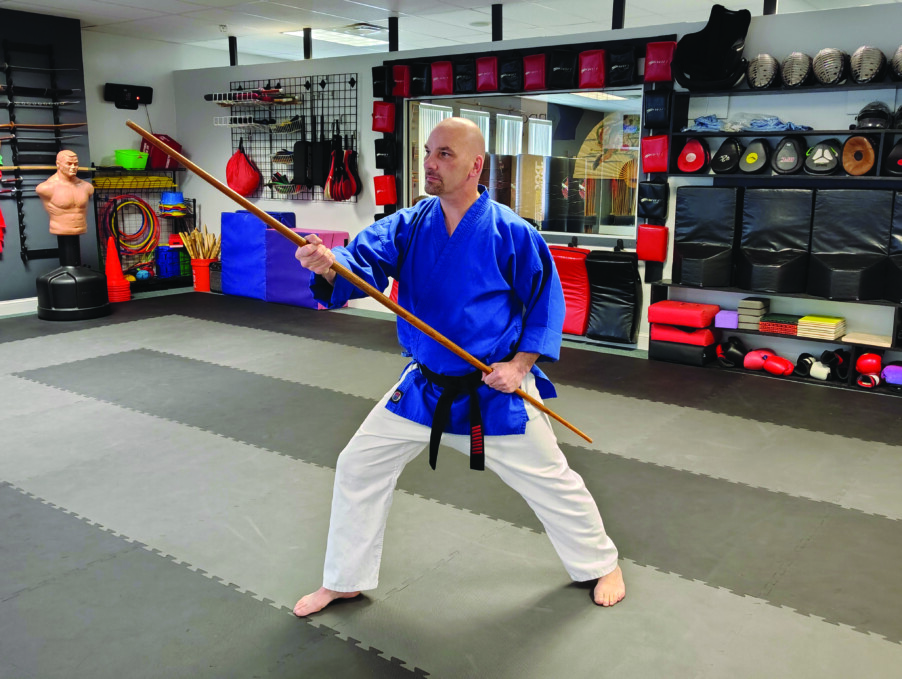
Lenny Demers is frustrated at how a lot of people see martial arts.

“I hear a lot of, ‘This is going to take me a couple of months,’” he said. “They’ll say, ‘I’m going to be a black belt in a couple of months. And I’m going to be able to fight 20 guys with knives and guns coming at me.’ And I try to tell them, ‘That’s not self-defense. That’s a movie. That’s not practical. Self-defense is when you’re minding your business, someone sneaks up and grabs you by your neck, and you react really quickly, and you get out of it.’”

Demers, the owner/operator of Kenpo Academy of Self Defense in Londonderry, is a master of Shaolin kenpo karate but also teaches classes in taekwondo, kickboxing, Brazilian jiu jitsu and several martial arts weapons. Many of Kenpo Academy’s classes are geared toward children, but some of Demers’ most rewarding experiences over the years have been with adult students.

“I have a lot of adult students that I’m very proud of,” he said. “I have one kid that started with me when he was 5 years old — him and his twin sister. They became like part of my family. They’ve been with me for 25 years. He just got his sixth degree [black belt in karate]. His sister is a fourth degree. ”

Adults, he said — most adults, anyway — have an easier time wrapping their heads around the emotional aspects of karate.

“Everyone thinks karate’s all just about the anger,” he said, “punching and hitting. I say karate’s mostly about your mind, calming your mind down, keeping cool, keeping calm instead of freaking out. We talk about that a lot. Adults will take a step back a little bit, once in a while, I think, but kids don’t.”

Andrew Jefferson, owner (and instructor) of Bulsajo Kaekwondo in Goffstown, agrees that the martial arts are as much about emotional development as they are about shouting, kicking and throwing. He teaches taekwondo to students from 4 years old to 70.

“There’s a lot of character development,” Jefferson said. “You see it a lot in kids because we are giving kids extra structure and teaching them discipline and about being respectful, but you do see it just as much in teens and adults. For them it’s [rooted in] how they work really hard and overcome an obstacle and that helps them improve their self-confidence and their determination.”

“Character-building has always been part of martial arts because being a warrior or a soldier, you have to have a certain level of confidence and belief in yourself. And I think that that just carries over from old and ancient times, if you will, to modern times. And so martial arts are a great way to help people build character.”
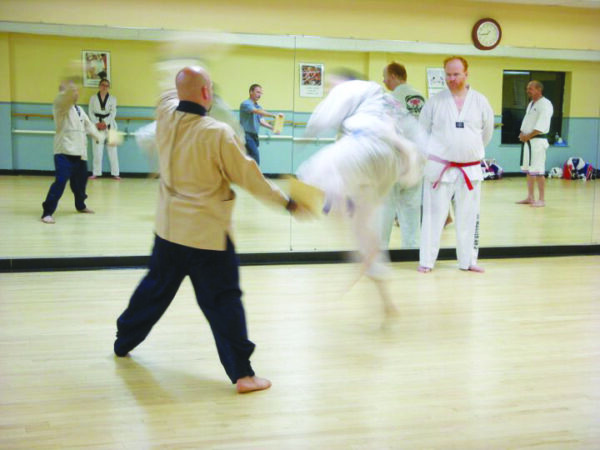
Bulsajo TaeKwonDo
Bulsajo Taekwondo. Courtesy photo.

Jefferson said adults come to taekwondo for many reasons, some philosophical and character-driven, but most come for practical reasons.

“Depending on the time of the year,” he said, “their reasoning for coming in is, ‘Well, it’s something I’ve always wanted to do and now I’m getting around to doing it.’ Or sometimes, like around the new year, they’ll … want to lose some weight, or gain flexibility, or get in shape, and martial arts seems like a fun way to do it.”

“Kids are also very fun to teach,” Jefferson said, “but there’s something about adults overcoming obstacles or gaining abilities that they never thought they would that feels even better.”

Linda Murphy, the owner of Bare Knuckle Murphy’s Boxing Gymnasium and Go Ninja Circus Arts in Manchester, is something of an outlier among martial artists; she teaches mostly adults. “This studio is primarily focused on competitive fighting arts, like kickboxing and boxing — USAB-style boxing,” she said. “We have a lot of people in their 20s and 30s, but we do have older people. We have right now a man who’s in his 50s and he wants to compete in boxing. There is a Master’s Division [for older competitors] and he’s doing really well. There is a kind of a team sort of atmosphere here. It’s not like the traditional bowing, black belt; it’s more military style.”

Murphy has been involved in a variety of styles of martial arts for many years.

“I started in a Japanese style and went into a Korean style,” she said. “I got black belts in those. And then shodokan and then taekwondo. But I’ve studied a lot of different things. I taught self-defense at Dartmouth College and took wing chun, like a kung fu style, up there. I’ve studied some sabbat, some tai chi, like just different things.”

Over the years, Murphy said, the approach to martial arts in her gym has changed.

“This place started out in 1978,” she said. “It was like a lot of very traditional martial arts out in that time period; people wouldn’t hit each other.” Gradually Murphy shifted to a more full-contact approach, centered on actually winning fights, in the ring or on the street. Now her gym attracts students from many walks of life.

“We get a lot of people who have a background in sports,” she said. “They take an interest in boxing or kickboxing before and want to come in and try it. I usually know they’re going to love it because they already have an understanding of what it is like to train for a sport activity. Boxing has a lot of detail on balance, footwork, head movement, positioning of how your body needs to be, and then all the strategy and the conditioning that go with it. We also get people who have done nothing. One of our coaches, who’s so much fun, he did art and ate potato chips all through high school and then finally dared to come into boxing. He was about 26 and now he’s one of the top [boxers] in New England in the 165-pound class.”

In addition to full-contact martial arts, Murphy teaches gymnastics-based circus skills tumbling, trapeze and silks. While the students in the ring tend to be men, her circus students are generally women, she said. “That tends to be more women,” she said, “but guys are always asking if they can do it. So I’ll include them if they want. Usually the easiest sell is the guys that want to compete because they want to do whatever it takes to get better at their activity. Plus they might be a little more confident to cross over that line.”

“People find that interesting. I find it interesting.”

Jason Bryant is the owner and head instructor at Leverage Brazilian Jiu Jitsu in Concord. He said that while Brazilian jiu jitsu (or BJJ) is one of the fastest-growing sports in the country it is also a very effective form of self-defense. [BJJ is] a martial art or a sport that’s grappling-based,” he explained, “so it’s very similar to wrestling. However, instead of pins we use submissions to win a match, if we’re talking competition. It’s a very hands-on physical sport that uses a lot of leverage, which is why I named my gym that. [Jiu jitsu] uses leverage techniques to overcome someone who might be able to beat you with, let’s say, strength. Classically, it would allow a smaller person to beat a larger, stronger person in a self-defense situation. So it’s a very effective self-defense.“

Bryant said one of the reasons he loves BJJ is that it is built around community values.
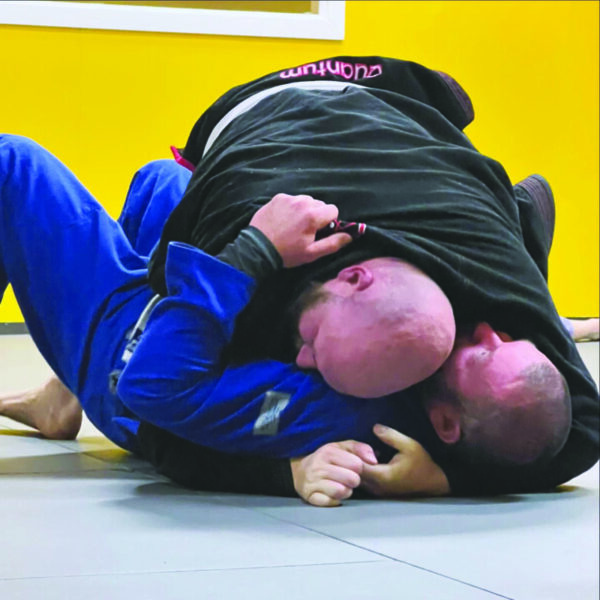
Brazilian jiu jitsu. Courtesy of Leverage Brazilian Jiu Jitsu.

“I have people who come in that will never compete but they get in great shape through training here,” he said. “BJJ is great for law enforcement and first responders, which is something I’m passionate about. With law enforcement, they have to get hands-on a lot. And first responders too, which I hadn’t thought of until I opened the gym. [They might have to deal with] someone who may have overdosed or did something on some substance and they have to get hands-on with them and you’re an EMT, so you may have to know how to kind of handle a person. So it gives you the tools to handle another person physically while doing it with compassion so you don’t have to hurt someone. We don’t have strikes, so it’s not like we’re kicking and punching each other. So it’s very effective when it comes to being hands-on and controlling another person’s body and keeping both people safe.”

There is not really any one type of person who studies BJJ, Bryant said. “It’s a broad mix of people. We have a handful of police officers. We have firefighters that train here, nurses that train here; it’s a very family-oriented group in here. We have a lot of kids whose parents train here. My wife trains here. Both of my kids train here. They want an activity that can help them feel safer, gain some confidence, get in better shape, and have a lot of fun, and building this community of people.”

The prices martial arts studios charge their students varies widely, depending on the style of martial art they teach, and the intensity with which students want to train. Most will offer one or two free classes for new students to get a feel for the experience.

“We offer a two-class pass,” Lenny Demers said, “so students can come in and it costs nothing. I show them what we teach. I don’t expect them to remember everything that I’m teaching them, but I teach them about basic self-defense, defense against somebody grabbing you, defense against somebody pushing you, defense against somebody punching you. They’re not going to master it in the two classes, but in those two classes they’ll get an idea of how I teach and what I teach. I don’t change. If you don’t like me Day 1, you’re not going to like me Day 2. If you love the class Day 1, you’ll love the class Day 2, because it doesn’t change. All they need to do is wear some baggy clothes and come in with an ‘I can” attitude and have fun.”

Depending on what they want to learn and who they want to study from, many martial arts studio owners say adults should expect to pay about $150 per month for wice-weekly classes.

Andrew Jefferson agrees.

“I would say you’re going to be paying over $100 a month for at least two or three days a week,” he said. “Some schools will cost more if their overhead is greater or they have more instructors they have to pay. I would like to help be on the end of the spectrum where I’m a little cheaper for people who need that and don’t have the funds for a bigger full-time school. I’m filling a niche.”

“It’s pretty basic, a monthly, kind of monthly plan, like most fitness gyms would be,” Jason Bryant said. “I offer different tiers based on training frequency, unlimited plans so someone could come in here every single day with a class as much as they want. We mostly charge month-to-month. Some people will have a seat during a sports season and then maybe they’ll pause the membership for a couple months so they can go play or watch a sport. I don’t want finances to be a speed bump for why someone couldn’t come train in jiu jitsu.”

Ultimately, the instructors of martial arts studios say they teach for the love of their particular style and to have a chance to do it full-time. Andrew Jefferson put it like this: “This is pretty great. It’s amazing because it’s such a positive environment and we’re helping people make positive changes. Even on your most trying days you still go home with a smile because you’re doing good work. It’s a rewarding job that I really, really like and honestly I can’t imagine doing anything but teach martial arts.”

Returning to the practice

Roland Cere and Bill Big study taekwondo at Bulsajo Taekwondo in Goffstown.

They are both in their mid-60s and have come back from fairly stark physical challenges in recent years.

“I have a lot of injuries,” Big said. “I’ve got seven fused vertebrae in my neck and two more fused down below. And because of my injuries and some other things, my flexibility has been diminishing to the point where I feel like my body has been atrophied. I felt like, well, I remember I used to do tai chi as well and that helped, helped that a lot. So I decided to go back and just go easy and see if that would help with my flexibility and my pain and so on and so forth. And I have found that it has helped with those things.”

Big said that making real progress in taekwondo has meant a combination of gaining flexibility and learning to work around his physical limitations.

“I’ve been able to pick up some of those flexibility and skills and then I know that I cannot do certain other things because of all the metal in me and I find that I have to dismiss one technique, but I can focus in on a different one instead.”

Cere faced similar challenges.

“I have a steel rod with screws in my back,” he said, grimacing, “also, fusion and four back surgeries. I was told I could never walk again. This was eight years ago, and here I am walking.”

Both men studied martial arts in their youth and came back to it in the past few years. Both of them worked their way, belt by belt, to earn second degree black belts in taekwondo last fall. This came at the cost of constant, relentless practice, which has been a source of pride to both men.

“Martial arts have helped me get my self-confidence back,” Big said. “Because I was told if I moved the wrong way or fell down or this or that, I could easily be paralyzed for life, but I loved [martial arts] 20 years ago, so I said, ‘You know what? I’m just going to do it, and test it out.’ I was really scared to do anything, but slowly but surely, It has been wonderfully helpful.” He said his improvements have been as much psychological as physical. “This really gave me something to focus on and think about and it’s really helped my attitude. It’s improved my outlook in life and given me that confidence to be able to get back in there and do things.”

“And to surround yourself with wonderful people,” Cere added. “I mean, there isn’t a jerk in this whole place. Everybody is very helpful and courteous. For me, taekwondo has been a fountain of youth.”

Big added that in his experience martial arts has been a team effort. “You’ve got to get up,” he said. “You have to do the kicks, you have to do the punches, but it’s also a bit of a team player thing. Learning from others, working with them, getting feedback — I think that that really makes a great difference.” —John Fladd

What are some of the styles of martial arts that are taught in our area?

American Kenpo Karate

“Our system is based on the principles of situational awareness, stability, balance, coordination, power, flow, and timing, all teaching the maximum application of motion through following natural geometry in a ‘Universal Pattern’ and mathematics. Adults that are looking for a system that can be adapted to fit individual ability and energy levels would find our art to their liking.” —Jason Cote, Studio Operations Director, Concord Karate Studio and Academy, 89 Fort Eddy Road, 224-5425, cks-nh.com

Brazilian Jiu Jitsu

“Brazilian Jiu Jitsu (BJJ) is a grappling sport where the mat serves as your ally, and having trustworthy training partners is essential for a safe and effective training environment. BJJ draws a wide range of individuals, such as fitness aficionados, martial arts enthusiasts, those interested in self-defense, trauma survivors, veterans, and people who appreciate the social environment of training and the camaraderie found in a dojo. Ultimately, BJJ is an inclusive sport that welcomes people of all ages, backgrounds and fitness levels.” —Tony McBee, owner and Head Instructor, New England BJJ Academy, 30 Henniker St., Concord, 369-4764, nebjj.com

Enshu Do

“Enshudo is a straightforward traditional self-defense art. There are few forms, and memorization is not a priority, but the techniques have been tested over the last half century. The class is perfectly suited for a busy person who is interested in learning self-defense but doesn’t have the time for an extensive curriculum. The atmosphere is relaxed, and training is as gentle or as intense as you and your classmates want it to be.” —Chris Marsh, owner, Independent Martial Arts School, 138 Lake St., Nashua, 882-6917, imasnh.com

Jiu Jitsu (as opposed to Brazilian Jiu Jitsu)

“Jiu jitsu as applied for self-defense is going to be more conducive regardless of your weight or your size. You’re using leverage, advantage positions against a stronger, more powerful opponent. You don’t have to be physically gifted or athletic or in any type of condition or shape to apply the skills that are highly effective for self-defense. If you’re willing to learn and put in a little bit of effort , then it becomes effective. Nothing is an overnight success.” —Christopher Koneles, owner/instructor of Martial Arts Zone, Manchester, 31 Auburn St., Manchester, 206-5716, themartialartszone.com

Judo

“[Competition] judo is the ability to off-balance your opponent and throw them to the ground with sufficient force to score a full point, and if that’s not possible, throw them to the ground and score half point and finish with a submission. Typically the people that do well [in judo] are folks who are physical and have kept themselves in relatively good shape through the years. It is not something I would recommend for somebody looking to get in shape.” —Lee Rossi, owner and Chief Instructor, Checkmate Martial Arts, 200 Elm St., Manchester, 666-5836, checkmateselfdefense.com

Krav Maga

“Krav Maga, it’s not a martial art. It’s sometimes categorized into that, but it’s more of a combat science or system of self-defense. It was formulated by a gentleman named Yimi Lichtenfeld in Israel for the Israeli military. We don’t do things like sparring or gameplay. We don’t have a gamification of violence because we don’t engage in any activity that does not lead to the immediate resolution of a situation, whether that be to have physical violence or to de-escalate or to run away. The people who come [to us] are people who are looking to defend themselves, people who are looking to not get into fights, people who want to feel a little bit more safe walking around.” Joe Estee, IMI Krav Maga, 150 Nashua Road, Londonderry, 617-774-7188, dotokushin.com

Muay Thai

Muay Thai is an art, a martial art from Thailand, and it’s known as the art of eight limbs, so your punches, your elbows, your knees and your kicks. It originated as their military weapons and how they would defend their borders and such. And then it has eventually evolved into a sport, and it’s the national sport of Thailand. It’s an art that can be modified if you have injuries or limitations, but it’s great for physical fitness, stress relief, coordination, confidence and empowerment. It’s just a sport that everybody can do. —Laura Barchard, instructor, Professional Martial Arts Academy, 15 E. Broadway, Derry, 301-4252, pmaderry.com

Shaolin Kenpo Karate

To me, Shaolin kenpo is the most practical form of self-defense. It’s very practical, it’s very fast. You defend yourself and you get out of there. It’s not very flashy, it’s not very flowery. It’s basic self-defense. Somebody’s trying to hurt you, you defend yourself and you get out of there. Everybody works with their own ability; we have a wide variety of age range and levels. I have a lot of students that come in from other styles that they’ve stopped — ‘I made it to brown belt 10 years ago; I would love to get my black belt’ — and we help them. —Lenny Demers, owner, Kenpo Academy of Self Defense, Crossroads Mall, 123 Nashua Road, Londonderry, 437-9900, kenpo-academy.com

Shotokan Karate

Shotokan is a very traditional style of Japanese martial arts. The focus is on strong stances. We do katas, which are forms or memorized steps that have self-defense within them. Our focus is on spiritual growth as far as trying to perfect techniques, trying to build a strong body [and] a strong mind. Some of our adults started in a different style and chose shotokan because, even though it’s a strong style, we’re not full-contact, trying to beat each other up all day, so you can do it as you get older as well. —Sarah Beth Gosselin, Chief Instructor, Phoenix Fire Martial Arts, 79 Plaistow Road, Plaistow, 234-8665, phnixfire.com

Taekwondo

Taekwondo is a mixture of karate and Korean martial arts like taekyeon, modernized. It emphasizes simple techniques and is easy to learn. It is very popular in the Olympics and for its dramatic kicking techniques. Taekwondo would suit any adult, especially one who is wanting to not just improve like maybe not just learn self-defense but also be able to learn how to make improvements to their well-being or to their like self-improvement. —Andrew Jefferson, Bulsajo Kaekwondo, 703-1914, bulsajotkd.com

Tai Chi Chuan

“Tai chi chuan is a low-impact training method that helps to develop one’s internal energy and external strength. Based on self-defense movements, the tai chi chuan forms are practiced as a series of movements connected in a flowing pattern and performed slowly to gain precision and deep body awareness. Adult students of any age who want a holistic approach to wellness should consider tai chi chuan as a means to remain active, promote balance control and improve their health.” —Laoshi Michael Coulon (Yang YaHua), NH Yang Chengfu Tai Chi Chuan Center, 107 Alsace St., Manchester, 623-2371, nhyangtaichi.com

Martial arts for self-defense

Many martial arts studios teach classes in self-defense geared toward women.

Maddie Pratte is in charge of the Women Empowered Program (WEP) at Manchester Karate Studio (371 S. Willow St., Manchester, 625-5835, manchesterkarate.com). She said her program is designed to provide practical solutions to common dangers many women face.

“Our classes are for women only,” Pratte said. “The program addresses 20 physical threat scenarios and 20 possible solutions to them. Because typically in most physical conflicts men are generally physically bigger and stronger, we provide women with strategies that don’t depend on physical strength.”

As with other areas of martial arts, Pratte said much of the WEP training is psychological.

“Self-defense for women isn’t just about punching and kicking,” she said. “It has just as much to do with risk assessment and setting boundaries.” Because many women are socialized to please other people, she said, it can be hard for them to be assertive in the face of aggression.

Linda Murphy, the owner and operator of Bare Knuckle Murphy’s Boxing Gym (163 Lake Ave, Manchester, 623-6066, bareknucklemurphy.com) agrees.

Murphy’s Gym. Photo by John Fladd.

“When I teach women self-defense,” Murphy said, “I like to do a variety of things. We talk a lot about boundary-setting, knowing about how to set boundaries, and verbal assertiveness, which is the midpoint between being aggressive and being passive. I like to give set words and have people practice them.”

“I think culturally we might be either too aggressive or maybe passive altogether,” Murphy said. “I coach a lot of guys, so I see it in both, but women have some different issues — self-defense when it comes to, like, dating violence or sexual assault. Women have to set a boundary in that regard, which can be hard if you want to be liked or, you know, it’s just like a difficult thing to navigate. So I think having words to help with that. And then also I like to do educating on the type of people that might be more likely to not listen to a boundary when you set it and realize that those people [are people you] can be more aware of, or keep a distance from, or maybe realize that’s not a person to date.” —John Fladd

Find a studio

Many martial arts studios offer classes or workshops in self-defense for women, but they don’t always display information about them clearly on their websites or social media.

If you have children who study at a particular school or you are looking for classes near where you live, call any studio and ask if they have any programs specifically for women.

If you find yourself in a dangerous relationship, the NH Coalition Against Domestic and Sexual Violence has a 24/7 statewide helpline to get in touch with a caring and trained advocate at 866-644-3574.

Featured Image: Lenny Demers of Kenpo Academy of Self Defense in Londonderry (courtesy photo).

A priest, an atheist and a teacher walk onto a stage

Faithless is a fast-paced look at modern religion

By Michael Witthaus

mwitthaus@hippopress.com

A play with humor, intelligence, drama and the pacing of a West Wing episode, Jon Klein’s Faithless arrived on director Monique Peaslee Foote’s desk at an inconvenient time. New Hampshire Theatre Project head Sean Robinson gave her the script, asking if she’d give it a read, when “I was in no position, with no desire to do it,” she said by phone recently.

Then she dug into the story of a family crisis confronting Gus, an aging atheist, and his two grown stepchildren; Calvin, a minister, and Claire, who teaches comparative religion but is a skeptic until a head injury causes her to think she’s seen the divine. The cause of the conclave is Gus’s adopted teenage daughter Rosie, who’s decided she wants to become a nun.

“I was hooked after three pages,” Foote said. “Number one, it’s funny, and I think we’re at a time in life where that’s good. It’s witty, and it’s fast-paced…. I’m all about a 90-minute show, no intermission these days. Get me there, tell me the story, and then I’m going to peace out. And that’s what this piece does.”

Foote describes the play’s four actors as “whip smart” — Jim Sears playing Gus, Stephanie Lazenby as Claire, Matt Recine in the role of Calvin, with Michelle Levine playing Rosie. “Each of them, their comedic timing is everything,” she said. “I mean, I have to do little to no work, because they’re bringing all of it.”

Preparation began at a pace befitting the script. “I knew the rehearsal process wasn’t super long, so as a director, I set the scaffolding,” Foote said. “Sometimes you get those golden groups of people where they all kind of get it, and we started that way — everybody got it. We’re all on the same page at the same pace.”

Blocking done, the cast was ready, she continued. “Now we get to play. Let’s dig into the layers of these guys. The biggest problem for us in rehearsals is to stop them from laughing. I’m like, all right, guys, get [it] together, like, let’s go. Because they’re funny, they’re just hilarious people. So we’re all there just laughing our tails off. It’s great.”

Faithless is the first Klein work that Foote’s been involved with. “He’s pretty clever,” she said. “Quite frankly, I haven’t done a ton of research on Mr. Klein, but what he has right is the story, and the way people talk to each other. The banter, the way they just throw it back and forth is really wonderful and real.”

In a review of a Washington, D.C., production of the play, DC Theatre Arts writer Amy Kotkin agreed. “The playwright’s sure-fire dialogue combines lofty questions with very funny analogies to popular culture,” she wrote. “Watch how he references time-shares, dodgeballs, crowbars, and Little House on the Prairie as his all-too-human characters slug it out.”

Foote joined New Hampshire Theatre Project in 2009 as an actor. Directing “is fairly new to me, but I really think I love it,” she said, Collected Stories, a two-woman play she directed last year starring Genevieve Aichele and Amy Desrosiers, was nominated for multiple New Hampshire Theatre Alliance awards.

“We didn’t win, but it was nice to be seen,” she said, adding that the experience reinforced her commitment to NHTP.

“I have a personal passion for the organization because it does really smart theater, and it tells really smart stories,” she said. “The foundation of their work is starting a conversation [and] that’s what I’m here for. They want to bring the tough stuff out and get people talking about it, because that’s where community starts. That’s where we find our humanness, in the conversation.”

Faithless
When: Fridays, 7:30 p.m., Saturdays, 4 p.m. and Sundays, 2:30 p.m. through March 9
Where: New Hampshire Theatre Project, 959 Islington St., Portsmouth
Tickets: $28 and up at portsmouthnhtickets.com

Featured photo: Jim Sears, Stephanie Lazenby, Michelle Levine, and Matt Recine. Courtesy photo.

News & Notes 25/02/20

Landfill moratorium

During her Feb. 13 budget address, Gov. Kelly Ayotte announced “a landfill moratorium and a revamped regulatory process for approving these projects going forward, to ensure that our beauty as a state is not compromised,” according to text of the address available at governor.nh.gov. New Hampshire has six large landfills including “two private mega-landfills” in Bethlehem and Rochester and “roughly half of the waste buried in New Hampshire landfills comes from out of state,” according to a press release from the Conservation Law Foundation. “For too long, our state has been burdened with out-of-state waste, leading to harmful pollution,” said Tom Irwin, vice president of Conservation Law Foundation, in the statement. “While this is a significant first step, more work remains. It’s essential that we prioritize waste reduction and implement innovative solutions to ensure that waste disposal is only a last resort.” For more on that organization, see clf.org.

More from Ayotte

In her address presenting her recommended budget for fiscal year 2026-2027, Ayotte said, “In comparison to our last budget, we are spending $150 million less in General Funds. This adjustment in General Funds was undertaken smartly and thoughtfully, with a scalpel, not a shovel. It does so without across the board cuts and prioritizing those who are depending on services provided by the State,” according to the text at governor.nh.gov. Ayotte highlighted aspects of the budget including that: “This budget … ensures that our education system has the resources it needs. We are making a $98.8 million investment in special education, nearly a 50% increase from the previous biennium.” Ayotte’s address also highlighted that the budget “sends more money to the local level,” “begins the overhaul of the Group 2 retirement system,” “expands education freedom to all public school students,” “will help get cell phones out of the classroom,” and “continues the tuition freeze at our community colleges” among other points. In discussing cuts, Ayotte said “We focused on making our government more efficient and ensuring tax dollars do more with less. We cut bloated contracts with out-of-state vendors, took a hard look at how our agencies operate and worked with commissioners to dial in spending. … We brought our adult Medicaid eligibility back in line with pre-pandemic levels and joined our neighbors in requiring nominal copays for those receiving these benefits.”

See the full address at governor.nh.gov/news/2025-budget-address. You can find the text of Ayotte’s recommended budget at gc.nh.gov/lba/budget/fy2026_2027_budget.aspx.

Chamber prez retires

Tim Sink, president and CEO of the Greater Concord Chamber of Commerce, will step down from his position on Sept. 30, according to a Chamber press release. Sink has been Chamber president for nearly 33 years. “I have had the privilege of serving this dynamic chamber through some challenging and exciting times. It has been an incredible and fulfilling opportunity and I am beyond grateful for the hundreds of talented and generous volunteers and staff that have helped build this organization into what it is today,” Sink said in a statement in the release.

Tech support

United Way of Greater Nashua has expanded its Digital Navigator Program, which provides tree technology assistance at locations throughout the community, according to a press release. Find digital navigators available to the public at Rodgers Memorial Library in Hudson (on Tuesdays from 1 to 2 p.m.) and navigators available for clients, congregants and residents at Nashua Presbyterian Church, Coliseum Residence, AHEPA 35 and H.E.A.R.T.S. Peer Support, the release said. The United Way of Greater Nashua is looking for additional Digital Navigator locations as well as volunteers for the program; contact info@unitedwaynashua.org for details. See unitedwaynashua.org.

Homeownership

New Hampshire Housing, “a self-supporting public corporation that promotes, finances, and supports housing solutions for the people of New Hampshire,” according to its website, will hold a Homeownership Conference on Tuesday, March 18, from 8 a.m. to 12:30 p.m. at the Grappone Conference Center in Concord. Tickets cost $50 and include breakfast, according to an email about the event. The agenda for the conference includes: “Housing Market & Policy Update,” “AI and Digital Innovation in Real Estate & Lending,” “Economic Outlook: Market Trends & Interest Rates” and “Housing Solutions Panel: Innovation in Action,” the email said. See nhhfa.org.

For the dogs

Salem Animal Rescue League (4 SARL Drive in Salem; sarlnh.org) is holding a Pot of Gold raffle through March 17, according to a press release. The League is selling 350 tickets for $50 each with the big winner taking home $5,000, the release said. The next early bird drawing, for $200, will be held on March 3, the release said. All proceeds from the raffle will support the animals at the League, the release said.

Every Little Thing (NR, 2025), a documentary about a woman who cares for hummingbirds in Los Angeles, will screen at Sweeney Hall auditorium at NHTI in Concord as part of the NHTI Friday Night Film Series on Friday, Feb. 21, at 7 p.m. Admission costs $10 at the door, cash or check.

The Pembroke Historical Society’s presentation of “Vanished Veterans: An Illustrated Introduction to NH’s Civil War Monuments and Memorials” by historian George Morrison was delayed due to weather and now you can catch it on Thursday, March 6, at 7 p.m. at the Pembroke Town Library, 313 Pembroke St. in Pembroke. The event is free and open to the public. Call 566-1031 for info.

Local Street Eats, 112 W. Pearl St. in Nashua, will host a Boozy Book Swap on Tuesday, March 4, at 6 p.m. Bring up to 10 gently used books with “a little note on a sticky note sharing what you loved about each book and stick it to the cover,” according to the event description. A $25 ticket comes with a glass of wine and a personal charcuterie plate (a full menu is available for purchase). Browse others’ offerings and take up to as many books as you brought. See local-streeteats.com.

Students from Rochester’s Spaulding High School designed and painted a new mural for Max the Moose, New Hampshire’s mascot who is housed at the New Hampshire Department of Education. Max’s new background is a mural showcasing the White Mountains and created with paints and paint markers, according to a department press release.

The Nashua Garden Club will host a program on “Groundcovers: What are They and How to Use Them” presented by Kathie Skinner, lifetime master gardener, on Wednesday, March 5, at 7 p.m. at First Baptist Church, 121 Manchester St. in Nashua. The event is free and open to the public. See nashuanhgardenclub.org.

History and song

Guy Davis returns to Flying Goose

By Michael Witthaus

mwitthaus@hippopress.com

History through song and storytelling imbues the performance of Guy Davis. His 2024 album, The Legend of Sugarbelly, was inspired by a woman murdered in Georgia during the early 20th century, a tale Davis’s uncle would share every time he visited. Though the victim’s name was a mystery, everyone was aware of her killer’s identity.

“I knew the story by heart, it was like a ceremony between my uncle and I,” Davis said by phone recently. “Not only did my whole family know this man, that same man at one point was assigned by the Ku Klux Klan to kill my grandfather, because he was a Black man. I’ll just say that my grandfather’s death at his hands never did take place; a lot of mitigating circumstances that had to do with family looking out for each other, that kind of thing.”

The Legend of Sugarbelly began as a song and later became a play that debuted at Crossroads Theatre in New Brunswick, N.J., in 2022. Davis will draw from the work at an upcoming New London show, and do a monologue from the theatrical version.

“That uncle who used to tell me the story, he died the day I finished writing the play,” Davis noted poignantly.

The son of actors and civil rights leaders Ossie Davis and Ruby Dee, Davis grew up with people like Harry Belafonte and Sidney Pointier stopping by his home.

“I remember my dad introducing me to Malcolm X and having to reach way up and him having to reach way down to shake my hand,” he said. Meeting boxer Joe Louis at a Harlem fair housing protest was another favorite memory.

Davis found music at a Vermont summer camp run by John Seeger, Pete’s brother, where he learned banjo, later adding six- and 12-string guitar to his repertoire. He grew so dedicated to banjo that one day on a hike that stopped at an estate auction, he bid all his money on an armless rocking chair. “I was 25 cents short, but then the guy running the auction looked at me and said, ‘Here, I’ll give you the quarter.’”

It was perfect for practicing, which the camp counselors let him do during rest time.

“They allowed me to take my rocking chair, sit it outside the cabin with my banjo, and just sit, rock and play,” he said. “I wasn’t any good … but I was trying to learn that basic baton stroke that Pete does.”

He’d meet the legendary folksinger a few years later, after seeing him in concert on a camp day trip. “I came home and I found Pete Seeger standing in my living room,” Davis recalled. “I didn’t know he knew my folks. He asked me a couple of questions, and then over the years, I got to go up to his cabin and meet his daughters…. His door always seemed to be open for the rest of his life to me. I was very grateful.”

In his 20s, Davis began playing with Seeger. “Pete made the mistake of never chasing anyone off the stage who came up to sing with him,” he said. “A bunch of us would just follow him around, and when he went on stage, we’d … back him up. If his guitar or banjo was on the floor of the stage while we sang, he seemed to not mind if I picked one of them up.”

Seeger figured prominently in the recent Bob Dylan biopic A Complete Unknown, and Davis was asked to comment on Edward Norton’s Oscar-nominated portrayal of the man he’d grown to call “Uncle Pete” — along with his wife, “Aunt Toshi” — as the interview wound down.

He enjoyed it, Davis began. “He captured something of Pete, and I can’t quite explain what it was, but there’s a sense of humility, a sense of decency, a sense of being a helping hand,” he said, then added his take on the film’s subject. “As far as Timothee Chalamet is concerned; after seeing the movie, I think I knew less about Bob Dylan after than I did before.”

Guy Davis

When: Thursday, Feb. 13, 7:30 p.m.
Where: Flying Goose Pub, 40 Andover Road, New London
Tickets: $30, call 526-6899 to reserve

Featured Photo: Guy Davis. Courtesy photo.

September 5 (PG-13)

The ABC Sports crew covers a terrorist attack at the 1972 Olympics in West Germany in September 5, a swift, tense re-creation of the historical event.

These Olympics are at the dawn of live-via-satellite coverage, we are told, with all the news networks sharing windows on one satellite. Working with a six-hour time difference between Munich and the east coast of the U.S., the ABC sports crew put together packages of sports as well as live sporting events broadcasts. These share screen time with stories from ABC News, such as on-site Peter Jennings (Benjamin Walker) interviewing David Berger (Rony Herman), an American-born Israeli weightlifter, about competing in Germany as the country tries to separate new West Germany from its Nazi past. Then, early, Munich time, in the morning on Sept. 5, the TV crew hears gunfire. They scramble to send out staff and with the help of translator Marianne (Leonie Benesch) they put together that shots were fired in the Olympic Village and that Israeli athletes have been taken hostage. ABC Sports head Roone Arledge (Peter Sarsgaard) demands that the story stay with Sports, and not New York-based ABC News, and works with Geoffrey (John Magaro) to feed as much news and live footage as possible to on-air anchor Jim McKay (shown here in the real-world footage). They build the live coverage capacity as they’re airing it — sending Peter Jennings to a neighboring Olympic Village dorm building to report what he’s seeing in the Israeli rooms and pushing a studio camera out onto the lawn to get live shots of the building and the terrorists who occasionally step onto the balcony. Even the word “terrorists” becomes something of a spur-of-the-moment addition to the coverage, according to the movie — Peter Jennings uses “Palestinian guerillas,” guessing before there’s confirmation that the group Black September may be involved. Roone decides to go with terrorists, which is how the German police refer to the hostage-takers.

As they maneuver cameras and solder telephone wires to get Peter’s reports live on air, the team, in particular Roone, are laser-focused on the “how” of what they’re doing, only slowly realizing that, for example, Olympic village rooms have TVs that receive the ABC broadcast. Thus, they realize, does their ability to offer live coverage outstrip the inexperienced German police’s ability to take that coverage into account with their own plans to attempt to rescue the hostages.

September 5 is a tight retelling of the roughly day-long stand-off mostly focused on how the Sports crew is both watching history and making history for how they are telling the story and how it sets the template for future news coverage. There is no “we’re doing it for the ratings” mustache twirler here, it is just kind of a story of people trying to make the right decisions based on the limited information they have and the sometimes at-odds desires to get the story (and get it first) and not to cause harm. While the movie has solid performances all around, I can see why it is the movie’s no-slack-in-the-rope story that garnered the movie its one Oscar nomination for Best Original Screenplay. B+ Available for rent or purchase.

Nosferatu (R)

A young couple are terrorized, in different ways, by the demonic Count Orlok in Nosferatu, a remake of F.W. Murnau’s 1922 Nosferatu that is full of vibes.

Like, this film looks creepy-beautiful — even the scenes of, say, a coffin full of rats have a kind of grotesque loveliness. This movie reminded me a lot of Maria (which is on Netflix), its nomination-mate in the Best Cinematography category of this year’s Oscars (Nosferatu also got nods for costume design, hair and make up and production design — again, all praise for the look of the thing). Both Nosferatu and Maria (Angelina Jolie’s biopic of Maria Callas) are beautiful to look at and cast a spell that puts you in the art-book-worthy worlds they create. But I fell asleep multiple times during Maria, and Nosferatu crept along in a way that eventually stopped building tension and just had me wishing we’d get to the vampire factory already.

Newly married goofus Thomas Hutter (Nicholas Hoult) travels to Transylvania for a document signing with Count Orlock (Bill Skarsgård, looking like a living corpse) that even in the 19th century feels like it should have been an email. Melancholy-afflicted Ellen Hutter (Lily-Rose Depp), his wife, afraid at home, is wrapped up in foreboding, with moments of mania and what seems like possession. Herr Knock (Simon McBurney), Thomas’s boss, maneuvers for Orlock to, I guess, drain the life out of Thomas so Orlock can come and be with Ellen, who he first seduced years ago somehow. The movie hits all the beats, looks great doing it, but doesn’t push beyond. I feel like, with the plague, the dread of a mysterious plague ship, the inability of science (such as it is) to help Thomas or Ellen, the movie had all kinds of places to dig into something more, to make this story terrifying and relevant. Instead, the “innovation” here seems to be a few boobs shots. C+ Available for rent and in theaters.

Back in Action (PG-13)

Mild-mannered suburban parents are actually former super spies in Back in Action, a one-notch-above-average older-kid family comedy.

Matt (Jamie Foxx) and Emily (Cameron Diaz) were once fighting dudes on airplanes but now they are parents to sassy teen Alice (McKenna Roberts) and computer kid Leo (Rylan Jackson), who both just think their parents are standard-issue uncool Olds. But then Matt and Emily catch 14-year-old Alice and her fake ID at a club and when club muscleheads try to give them some trouble Alice is shocked to watch her parents lay waste to the thick-necked bros. Also shocked is Chuck (Kyle Chandler), Matt and Emily’s old boss who thought they were dead before their “Boomers fighting” video goes viral. If he can find them, so can all the various baddies who might be looking for them, he says right before he’s shot on their front porch. Thus must Matt and Emily grab their kids and go on the run to find a hidden MacGuffin item that they think might buy them some protection. Matt hid the item at the home of Emily’s mom — former MI6 agent Ginny (Glenn Close), with whom Emily has always had a difficult relationship.

This movie is not as cute-fun as the various Spy Kids movies that have done this general “secret spy parents” concept but more fun than the Mark Wahlberg movie (2023’s The Family Plan) that did this on Apple TV+. It is a perfectly cromulent movie for families in the PG-13 range, with fun-enough “parents are lame” and “teens, ugh” jokes, that benefits from the natural charisma of Jamie Foxx and Cameron Diaz even if their couple chemistry never really ticks above “sure, whatever.” It does, however, serve as a good reminder that it’s enjoyable to see Cameron Diaz in movies. B- Streaming on Netflix.

Sonic the Hedgehog 3 (PG)

Sonic and his increasing number of friends take on another angry hedgehog-thing in Sonic the Hedgehog 3.

In the second movie, Sonic (voice of Ben Schwartz) added Tails (voice of Colleen O’Shaunghnessy) and, spoiler I guess, eventually Knuckles (voice of Idris Elba) to his found family, which also includes humans Tom (James Marsden) and Maddie Wachowski (Tika Sumpter). Now they will all be tasked with taking on Shadow (voice of Keanu Reeves), another hedgehog-or-whatever treated shadily by the humans who harbors all sorts of grudges. He is working with Professor Robotnik (Jim Carrey), grandfather to Dr. Robotnik (also Carrey), to build a weapon and enact vengeance, yada yada. Mostly, this movie is Carrey physical comedy, cartoon character sassy jokes and occasional battles. I was neither particularly delighted nor demoralized by all of this while my kids seemed to have fun and I suspect that is kinda the point. The deeper into Sonic lore we go, the more it is about the world of characters and their doo-dads and magical gem things and, sorry, Sonic, Marvel has already used up all that space in my brain. I care less than I did back in the first Sonic when we were more about the Sonic-James relationship. But for the youngs, this mythology stuff seemed great — particularly in the credits scenes that they reacted to with a “Captain Marvel’s pager!” level of excitement to the appearance of a new character. So, like B- for the “kid entertainment for your dollar” ranking? In theaters and available for rent or purchase.

Featured Image: September 5

Meatballs and music

Elm Street eatery offers Swedish, red sauce, ‘Thanksgiving’ and other variations

By John Fladd

jfladd@hippopress.com

Even after 28 years in the business Kevin Cornish finds himself relearning a basic lesson of restaurant ownership: it doesn’t matter how delicious a dish is if none of your customers order it.

“We had a vegetarian meatball,” he said. “After cooking them seven days in a row without one person ordering them, we had to get rid of it.”

Rock ‘n Roll Meatballs, on Manchester’s Elm Street, is Cornish’s new restaurant, themed around — perhaps not surprisingly — 1980s rock music and meatballs. After three decades of running his successful barbecue restaurant, KC’s Rib Shack, Cornish has decided to open a second place to indulge one of his other great passions, live music.

“I love live music,” Cornish said. ”It’s probably my biggest hobby. This place [the restaurant’s location] has been opened twice with different people running it and pretty much closed twice. Manchester hasn’t always supported live music all that much. Especially in something this size, you need a scene to create a scene. There’s got to be little, ragged rock clubs for big rock clubs to succeed. My band used to play at Mad Bob’s and if we brought 25 people it was great. It was a little hole in the wall and a little bar, but in New Hampshire you can’t have a bar — you have to have a restaurant.”

Cornish had seen a few meatball-specific restaurants on the West Coast and liked the idea. He and three partners decided to adopt that formula for their menu. Despite his number of years as a restaurant owner, though, Cornish found that developing recipes for the new place required a long process of trial and error.

“When it came to the meatballs,” he said, “for one day or several days, we’d just work on beef meatballs, or beef and pork meatballs, or chicken meatballs. For months leading up to this, my wife was so sick of eating chicken meatballs — she was like, ‘What do we have for dinner tonight?’ Meatballs, you know?”

Ultimately, developing the recipe turned out to be a group project.

“We would come in and we lined this whole bar up with all the ingredients we would need. Each of us would take a table, and a bowl, and work up a recipe. It was nice to get in here and cook seven different types of meatballs in an afternoon, and being able to try them right next to each other. By coming in here and having everybody make a different one … we were able to zero in on, ‘Wow, we really like the flavor of this, but maybe, but we like the mouth-feel of this one, maybe that’s because this one was made with bread as opposed to this one made with panko breadcrumbs,’ and things like that. So we were able to kind of tweak and zero in on it and that’s what we did.”

Even after the kinks in a recipe have been ironed out, there’s still no guarantee that it will work on the restaurant’s menu. Which brings us back to the vegetarian meatball.

Rock ‘n Roll Meatballs’ menu is centered around five core meatballs: a standard red-sauce one, a Swedish meatball in a creamy sauce, a brisket-macaroni and cheese one, a “Thanksgiving” meatball made with ground turkey and stuffing, and a chicken Parmesan one.

One of the biggest surprises, though, was an appetizer that sold well from opening day onward. “The escargot is great,” Cornish said, a bit perplexed. *It’s a very simple dish, and it’s selling great.”

Rock n Roll Meatballs
179 Elm St., Manchester, 931-3654, rocknrollmeatballs.com
Open seven days a week: Monday through Thursday 4:30 to 9 p.m., Saturday noon to 10 p.m., and Sunday noon to 9 p.m. There will be live music twice monthly. Visit facebook.com/RnRMeatballs for notice of upcoming events.

Featured photo: Swedish Meatballs. Courtesy photo.

Stay in the loop!

Get FREE weekly briefs on local food, music,

arts, and more across southern New Hampshire!