Last chance

Three area shows before Senie Hunt returns to Nashville

By Michael Witthaus
mwitthaus@hippopress.com

Since moving from Concord to Nashville a few years ago, Senie Hunt has found a lot of opportunities to grow as an artist. What was hard in New England, like driving two hours to pitch his percussive guitar skills to a new venue, is a lot more manageable in Music City.

“In Nashville, you walk down the street and find a place, and if they don’t get back to you, it’s just another walk down the road to go back and try it again,” he said by phone recently. “Trying to stay consistently active, but also trying to find gigs that I want to be doing more, is … easier.”

It’s also a hub to other Southern cities; Hunt has played in New Orleans and in Tennessee cities like Gatlinburg, Knoxville, Murfreesboro and Pigeon Forge, home to Dollywood. He still makes time to return home to play, and when he does it’s often to do a special show. That’s the case with a few upcoming gigs, his last in New England until next spring.

The biggest is a triple bill on Sept. 20 at Rockingham Ballroom in Newmarket. Hunt will perform backed by Amorphous Band, a venerable Seacoast group, with fiddler EJ Ouellette joining in. He has a full band, the electric Senie Hunt Project; it played last June at Concord’s Bank of NH Stage. But this will be the first time he’ll be backed by a band while playing his acoustic guitar and djembe.

“I’m really excited about that,” he said. “Normally if I do an acoustic song with my band, I have them step off and they come back for the electric set.”

However, those looking for a taste of Hunt’s blues rock material can see a trio version of his Project on Thursday, Sept. 19, at Penuche’s Ale House in Concord. Finally, Hunt will play an afternoon solo set at the Concord Multicultural Festival on Sept. 22 in Keach Park.

It’s a regular annual event for Hunt, who built his current schedule around it. When the festival debuted a few years ago, Hunt came away impressed. This year’s lineup includes Nepalese dancers Barranquilla Flavor, Suri Wang performing traditional Chinese music, Irish step dancers, Ruby Shabazz’s old-school soul and R&B, Bollywood from Varnika, and hip-hop and Afropop from Martin Toe, as well as Israeli dancing and Japanese Taiko drumming.

“It really opened my eyes up to how much diversity is in Concord that’s just kind of tucked away,” Hunt said. “Just to know that there’s so much diversity and culture around in their home neighborhood, bringing out the music and food and dancing all in a public space really gives anybody the opportunity to come up and really see for themselves how vibrant the community can be.”

Hunt will wrap up with shows in Rhode Island and Newburyport, Mass., before heading back to his new home. While here, he’s also adding guitar and vocals to “Harmony,” a song by his longtime friend Hank Osborne, at Rocking Horse Studio in Pittsfield.

“I’ve worked with Hank since pretty much Day 1 when I moved to Concord,” Hunt said. “When I heard Hank’s music, there were so many similarities between his and my style of playing. I’m a little rougher on my guitar than him, but he’s one of the few musicians in the town that plays a similar style.”

Then it’s back to Nashville, where Hunt’s original music is getting much-deserved attention.

“I get to play my own style, my own thing,” he said. “That’s something I didn’t know I would find while I was down here, because you go downtown and it’s all covers. But there are certain places that are a lot more open, not the country or rock scene, and they want to hear your own original stuff. I’ve been pretty well off with being able to find enough places that are interested in that … it’s keeping me active, that’s a big upside. I’m able to play the music I want to play.”

World Music for Peace – The Meter Maids, Amorphous Band w/ Senie Hunt & EJ Ouellette, and Big Blue World
When: Friday, Sept. 20, 7:30 p.m.
Where: Rockingham Ballroom, 22 Ash Swamp Road, Newmarket
Tickets: $20 at coastalsoundsnh.com (21+)

Senie Hunt Trio appears Thursday, Sept. 19, at 9 p.m. at Penuche’s Ale House in Concord, and Senie Hunt plays solo at the Concord Multicultural Festival in Keach Park on Sunday, Sept. 22, at 3 p.m.

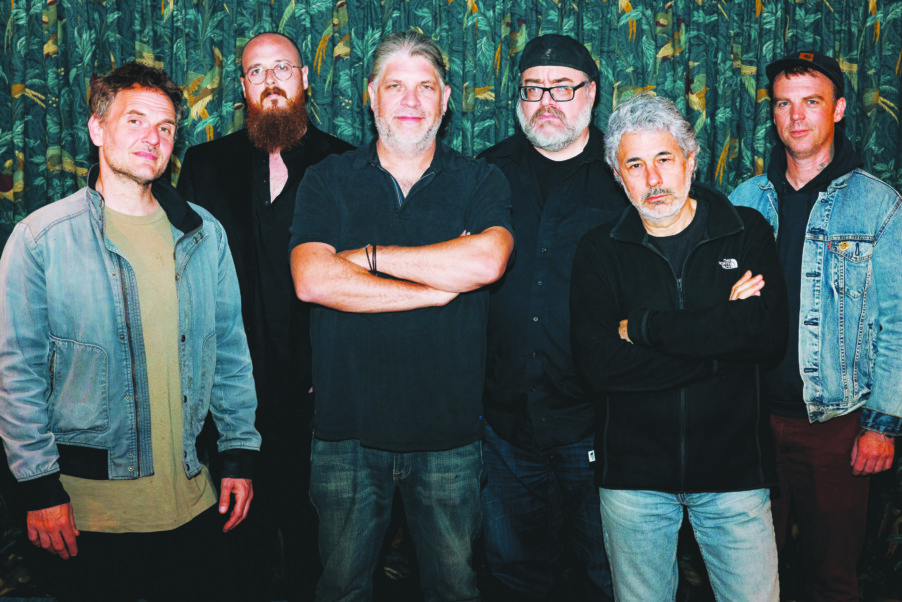
Featured photo: Senie Hunt.Courtesy photo.Photo by Christine Torrey (Birch & Fern Photography)

Art is an open door

Bookery talk fosters appreciation

By Michael Witthaus
mwitthaus@hippopress.com

Visual artist and critic Franklin Einspruch will appear at an upcoming Bookery Manchester event to discuss Aphorisms for Artists: 100 Ways Toward Better Art. Edited by Einspruch and written by the modernist painter Walter Darby Bannard, the book is a guide to seeing as much as a source for creating, and Einspruch’s talk will also appeal to non-artists.

Anyone who’s ever stared blankly at a wall of paintings in a gallery, or puzzled over an article packed with critical terms, will be relieved by the book’s simplicity. “Good art is good art. Period.,” it begins, followed by an explanatory page; this format continues for the rest of its 240 pages.

“Way down deep we are all the same,” Bannard writes. “Taste, if we have it, is what takes us down to where art lives.”

In a recent Zoom interview, Einspruch explained that his discussion at Bookery is a way in for anyone who’s had an unpleasant experience looking at art.

“This is for folks who’ve gone into a museum and just felt bewildered,” he said. “The refreshing message is you’re allowed to have your own experience. You must learn to trust that … because it’s yours.”

The inspiration to collect Bannard’s Aphorisms for Artists was born in the early 2000s, when Einspruch was a writer for Artblog.net, one of the first blogs about visual art. His old professor frequently responded to his articles, using an alias.

“He left all these jewels of wisdom in the comments section; I said, ‘We ought to assemble this into readable form.’” Over the years, “we went back and forth developing the aphorisms. It was all his creation, but I would give feedback on some of them and advice … once he was done, I wrote a foreword.” Sadly, Bannard, “Darby” to his friends, passed away in 2016 and wasn’t able to witness the first edition of his book sell out in 2022.

Bannard, whose works are in New York City’s Metropolitan Museum of Art, the Smithsonian and the National Gallery in Washington, D.C., and San Francisco’s Museum of Modern Art, was integral to Einspruch’s growth as a painter. He came to the University of Miami in the early ’90s with a newfound interest in abstract painting, sparked by seeing a Willem de Kooning work in a New Orleans museum.

“I tried to figure out what was going on by making abstract paintings in this very de Kooning mode,” he said. “Darby, who with Frank Stella was thrown out of de Kooning’s studio as a young painter, knew this material very, very well. I’d make a bunch of paintings, and he’d say, ‘OK, well, that’s your best one, and that one’s OK, the one next to that is no good, and

the fourth one will be fine if you rotate it 90 degrees.’”

He was right every time, Einspruch added. “The manner in which Darby could troubleshoot paintings was unbelievable.”

Those who don’t spend their days with a brush in hand shouldn’t be intimidated by the depth of this knowledge, however.

“Art is,” he declares early on, and it’s for everyone. One of the book’s key aphorisms is, “An ivory tower is a fine place as long as the door is open.” By that, Bannard meant that, like all specialties, art is elitist. “There’s nothing wrong with that,” he wrote. “Art may be for the privileged few, but they have earned the privilege and deny it to no one.”

A passion for helping others find their “eye” — a conduit to beauty — drove him as a teacher and creator. “There is no way to specify what good art is or how to create it,” he wrote in the book’s introduction. There was a caveat, however. “Certain principles, like gold in a pan, eventually wash clear enough to express in a few words.”

The many nuggets sprinkled on the pages of Aphorisms for Artists are a treasure for anyone hoping to connect with art.

“This is a book written by someone who knew very well how to make art, and he knew it so well that he could help other people,” Einspruch said. “That turns out to be a very rare skill, partly because his talent was of such extraordinary degree, but also he was able to articulate what he was doing.”

Franklin Einspruch discusses Aphorisms for Artists
When: Friday, Sept. 20, 5 p.m.
Where: Bookery Manchester, 844 Elm St., Manchester
Tickets: Free; register at eventbrite.com

Featured image: Franklin Einspruch. Photo from Zoom call by Michael Witthaus.

Discover the Corn Maze Craze

Where to have fun on farms with a live action puzzle

By Zachary Lewis
zlewis@hippopress.com

In addition to filling totes with apples and picking out a pumpkin or two, at many farms you can extend your visit with a corn maze. These live-action puzzles offer an all-ages fall activity and another way for the farms to benefit from visitors during the harvest season.

At the Coppal House Farm in Lee, you’ll find a different design each year. “Every year our corn maze theme encompasses something that you would see in your own back yard, be it animal, plant, reptile, amphibian, or avian,” according to the farm’s website. “Our crops are rotated around the farm for the health of the soil, so our corn maze is a different experience every year. Depending on the weather, the corn maze has been planted by our Belgian Draft Horses and it is almost always harvested by them. Our corn is not of the human eating variety, instead it is a feed corn used for the nourishment of our sheep flock and our horses.”

At Elwood Orchards in Derry, they posted photos of green corn stalks in early July: “Corn maze construction is underway!” the post read, highlighting the multi-step process and long journey of turning corn to maze.

At Moulton Farm in Meredith, a post from fall 2023 also talks about starting the maze in the summer: “Our corn maze is planted every year in mid to late June, depending on the weather. The field is planted in both directions to create a grid. The maze is then designed by hand. ​An outline of the field is drawn on about 20 pieces of graph paper taped together. Each line on the graph paper represents 1 row of corn. Wes Thomas, who has worked at our farm since he was in high school, starts translating his design idea onto graph paper. This process alone takes one or two days and several erasers.”

At Beech Hill Farm and Ice Cream Barn in Hopkinton, the farm creates two unique corn mazes every fall. This 200-acre farm, under conservation and going back to 1771, is open every day until Thursday, Oct. 31, for corn maze fun until dusk. An admission price of $7 covers both mazes, and children 3 and under get in free.

Holly Kimball, one of the owners of the farm, is a former educator whose love of her family’s farm is apparent.

“This is a multigenerational farm, so we have the seventh, eighth and ninth generations running the farm,” Kimball said. Much of the farm is run and maintained by Holly as well as her son, Nate Kimball-Barr, and his wife, Hannah Kimball-Barr.

Besides corn mazes they have around 500 trees tapped for maple syrup, they raise pork, and there’s a menagerie of farm animals that include baby goats, sheep, lambs, peacocks, Shetland ponies and more.

“We have a wide array of farm animals that people love to visit,” Holly Kimball said. “Over 100 animals here, actually.” Beef cattle are a mainstay as well.

“We have a nice mixture of Black and Red Angus and then we have some Simmental blood mixed in there…. We were a dairy farm for 225 years, and the dairy cattle were sold in 1996. That’s when my parents decided to sell ice cream to keep the farm going,” she said.

Ice cream is as big a draw as the animals at Beech Hill, she noted. “So many times when I’m outside taking care of the plants I’ll hear people come and they’ll say, ‘Do you want to see the animals first or get the ice cream first?’”

As the weather begins to get cooler, fall becomes apparent. “We also grow acres of pumpkins so it won’t be long before we’ll start picking pumpkins and gourds … the barnyard is just a sea of orange once the pumpkins get ripe.”

The mazes opened on Aug. 1 this year, and although they start in the summer the mazes lead the farm into the new seasons.

Kimball’s background in teaching fuels each new maze theme.

“I want one that’s good for school-aged [visitors] and one that’s for everyone,” she said. “We come up with two fresh new themes each year and we come up with designs that complement the themes. I vary it each year so that the format is different. People can make it competitive or a team-building activity.”

These are not your typical mazes.

“I work on some kind of a scavenger hunt-style activity for each one,” she said. “That is hugely popular with people because they are not just walking through a maze. They actually have a piece of paper in their hand and they’re trying to solve a giant crossword puzzle or sometimes it’s a Jeopardy! game. I always try to have at least one that’s a game style.”

One of the themes this year is Museum Mixup.

“It’s based on the Smithsonian Museums that my family actually went and saw last January. I chose a lot of the artifacts that we saw from five different museums and then I turned that into a scavenger hunt where people need to find all of the items listed and match them to the museum that they are displayed in,” she said. These include the National Zoo, the American History museum and the Air and Space Museum. “It’s a lot of pop culture, things that are multi-generational and people will kind of get a kick out of.”

The concept is easy to follow, Kimball said. “What we do is we hide the signs in the maze, all throughout it, and if people can find all the items on the scavenger hunt list they know they’ve been through the entire maze.”

In honor of Hawaii’s 65 years as a state, the second maze is The Amazing Aloha State Maze. “That one’s a giant crossword puzzle. People really love the crossword puzzle. They’re finding signs in the maze that say one-across or 13-down, whatnot, and they fill in the puzzle as they go,” Kimball said.

Mazes have a little something for everyone.

“It appeals to all ages. The kids like to go in because they can spy all the signs and the older children that are reading, that becomes another level, and then the ones that want to do the crossword and check the answers as they go through, and some do it as a team, some as a family, it really makes for a fun fall outing for people,” she said.

Kimball is always figuring out new ways to maze.

“It’s always in the back of my mind. I do research. I look at every different angle…. It gets very tricky not to repeat,” she said.

How do Holly’s designs come to life? First is the planting.

“My son grows the fields, the acres of corn. He plants the corn very close together. It’s almost cross planted so it’s very dense, very close-growing stalks of corn in the field. We’re also using a hybrid corn that grows quickly and it grows tall,” she said. It has reached 10 feet.

The corn is not just for the mazes.

“First and foremost, we’re planting this corn anyway because we have 50 head of beef cattle here on the farm. That corn is 100-day corn that gets planted and it has nutritional value for our cows,” she said. “We have a lot of signs up that say, ‘Please don’t pick the corn,’ because that’s a food crop that is really essential for our farm.”

After agriculture comes the technology.

“Nate and his wife, Hannah, actually use Google Earth and a lot of math and figure out how to put that design and make it fit in the shape of that field,” Kimball said.

“The first step after that is the design. They draw out on graph paper, then they’re looking at Google Earth and they’re deciding which design is going to fit better on one piece rather than the other,” she said.

The shape of each plot is a deciding factor: “One is a little longer and thinner. The other one is a little more boxy, the acreage.”

The growth of the corn helps dictate when the structure gets crafted.

“There’s the old farmer’s saying, ‘knee high by the fourth of July’ — that’s when we start thinking about wanting to cut the corn because if you wait until the corn is eye level, it’s really, really hard to see where your next point is that you’re trying to go to,” Kimball said.

Farm engineering lends a hand as the maze is sculpted out of corn.

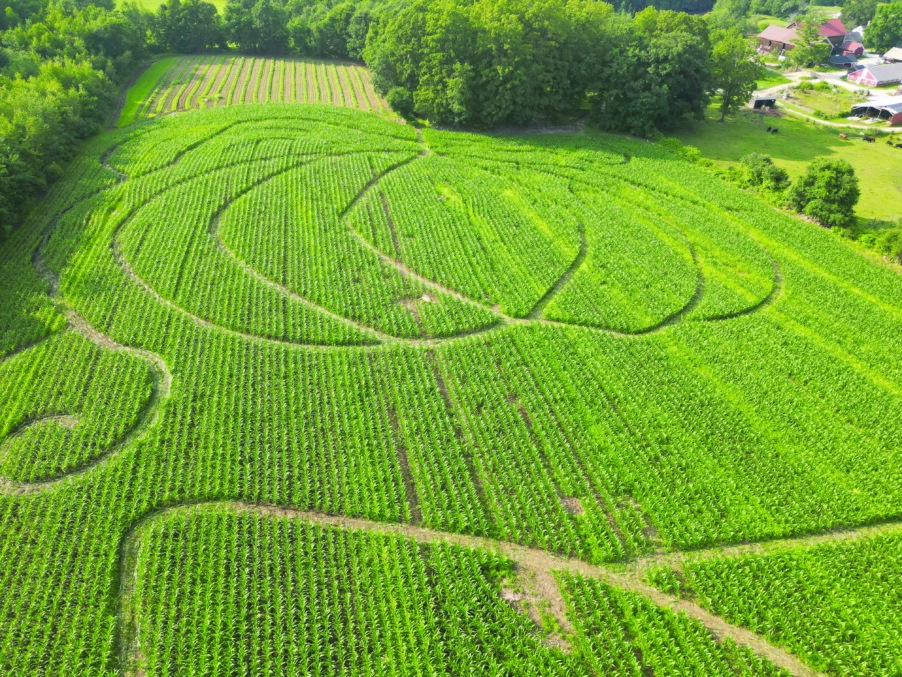
“They have to scale the dimensions of the design to the 4-acre plot. They use a GPS point finder and Nate is able to mow the path while his wife is standing and holding a surveyor stick,” she said. “He does an amazing job because his designs come out with a lot of symmetry and that is not easy to do. He’s done an octopus, he’s done a cow, a beehive, some Olympic medals, and it’s remarkable how precise he can be just using your own basic tools like an old beater lawn mower. You have to go over all the paths in the maze several times until it’s just dirt…. It’s very labor-intensive.”

How long is this path? “We do know that it takes 30 to 40 minutes to do each maze. That’s finding the signs, stopping, writing in the answer. People like that too because they don’t want to go in there and get really lost. You still can’t see over your head but the size is very doable.”

After Halloween the corn is siloed. “It will feed our cows all the way through the winter up until April. Not many people that have corn mazes actually do something with the corn, and ours go to the cows.”

How did the maze craze start? Kimball was with her father around 25 years ago in Vermont and saw either a brochure or bumper sticker that sparked the interest. “There’s a maze they call the Great Vermont Maze, and I said to my dad, ‘I think we can do that,’ and over the winter we tried to think of everything that would be involved and what we would have to do…. That’s what started it, a maze in Vermont.”

The belief in themselves has sparked a new tradition at this old farm, Kimball said: “We get a little better each year, I think.”

Where to corn maze

Here are some of the area corn mazes. Call before you go to make sure the maze is open that day as availability can change based on weather and other factors. Know of a maze not mentioned here? Let us know at adiaz@hippopress.com.

Applecrest Farm Orchards (133 Exeter Road, Hampton Falls, 926-3721, applecrest.com) Hours: Daily, 8 a.m. to 6 p.m. Cost: $9 per person and free for ages 5 and under. This 8-acre corn field features a maze of twists and turns that typically remains open through Halloween or early November depending on weather conditions. Applecrest, which features pick your own apples, also hosts a fall festival every weekend through the end of October with live music, tractor rides and food for sale, according to the website. On Sunday, Oct. 20, it’s the annual Great Pumpkin Carve from noon to 4 p.m. when the master carver creates a many-hundred-pound jack-o’-lantern, the website said.

Beans & Greens Farm (245 Intervale Road, Gilford, 293-2853, beansandgreensfarm.com) Hours: Daily, 10 a.m. to 4 p.m.; a night maze is offered Friday and Saturday from 7:30 to 10 p.m. with last entry at 9:15 p.m. Cost: $14 for adults and $10 for kids 9 and younger Monday through Friday. $16 for adults and $12 for kids 9 and under for Saturday and Sunday. The cost for the night maze is $24 according to their website; it is anticipated to open Friday, Sept. 20. On Saturday, Sept. 28, the Notch Biergarten by Beans & Greens Farm will hold its second annual Oktoberfest from 11 a.m. to 8 p.m. (with activities such as a sausage toss at 1 p.m., chicken dance-off at 2 p.m., a beer stein holding contest at 3 p.m., a kids’ fun park and more) and a Harvest Festival on Saturday, Oct. 12, and Sunday, Oct. 13, 9 a.m. to 4 p.m. with live music, a kids’ fun park, candy cannon, craft fair, hayrides and more, according to the website.

Beech Hill Farm and Ice Cream Barn (107 Beech Hill Road, Hopkinton, 223-0828, beechhillfarm.com) Hours: Daily, noon to dusk. Cost: $7 per person and free for kids ages 3 and under. Beech Hill Farm and Ice Cream Barn has two 4-acre corn mazes, and $7 gives you access to both. This year’s themes are “Museum Mixup” and “The Amazing Aloha State Maze,” and maze-goers search for signs with clues in a scavenger hunt style. Complete the puzzles to navigate through. The mazes are open daily through Oct. 31. In addition to the ice cream and homemade waffle cones, Beech Hill offers pumpkins, mums and more in its Gardner’s Barn. On Sunday, Sept. 22, from 1 to 4 p.m., author Matt Forrest Ensenwine will sign copies of his picture books; his new book Tractor Dance is for sale at the ice cream barn, according to the farm’s Facebook page.

Brookdale Fruit Farm (41 Broad St., Hollis, 465-2240, brookdalefruitfarm.com) Hours: Saturday and Sunday, 10 a.m. to 5 p.m. Cost: $4 per person. The corn maze is among several family-friendly activities that will be available at Brookdale Fruit Farm this fall, along with hayrides and apple picking. The farm also features an ice cream stand and a wide variety of local products in its farm stand, including the farm’s own honey, canned vegetables and jellies and more, according to the website.

Brookford Farm (250 West Road, Canterbury, brookfordfarm.com, 742-4084) Corn maze hours: Saturdays and Sundays, 10 a.m. to 5 p.m. Admission costs $8 for everyone 3 and over; free for kids 2 and under. This coming weekend, the farm’s pick-your-own offerings include raspberries and pumpkins, according to the website, where you can find the picking schedule through the end of October and purchase corn maze tickets. The weekend of Saturday, Oct. 12, through Monday, Oct. 14, is Pumpkins and Puppets, which will feature pumpkin picking, Wicked Witches of the Lakes Region (on Oct. 12 at 11 a.m.), marionettes (Oct. 14 from 11 a.m. to 2 p.m), feed the pigs, cow parades, farm basketball, hayrides, puppet show, build your own scarecrow and more, according to the website, where you can purchase tickets for a day’s admission.

Coppal House Farm (118 N. River Road, Lee, 659-3572, nhcornmaze.com) Hours: Monday, Thursday and Friday, noon to 5 p.m., and Saturday and Sunday, 10 a.m. to 5 p.m. (last entrance is at 4:30 p.m.). Columbus Day hours are 10 a.m. to 5 p.m. Cost: $10 for adults, $8 for kids ages 5 to 12 and for students, seniors and active military service members, and free for kids ages 4 and under. This year’s theme is the 2024 Anniversary Moose Corn Maze to celebrate 20 years of Coppal House Farm. There are also three nighttime maze dates that are open to the public, scheduled for Sept. 28, Oct. 12 and Oct. 26 (general admission is $15 per person; online ticketing only) — bring your own flashlight. The farm’s farm stand is open daily from 10 a.m. to 5 p.m. and offers meats, local maple syrup and more, according to the website. A Harvest Weekend celebration will be held Saturday, Sept. 21, and Sunday, Sept. 22, with events including horse-drawn wagon rides, fairy house building (Sept. 21 from 1 to 3 p.m.), acorn scarecrow building (Sept. 22 from 1 to 3 p.m.), wildlife encounters (Sept. 22 from 11 a.m. to 2 p.m.) and farm animals, according to the website. Catch live music both days and food will be for sale from Crescent City Kitchen, Refuge BBQ and Ken’s Corn, the website said.

Elwood Orchards (54 Elwood Road, Londonderry, 434-6017, elwoodorchards.com) Hours: Daily, 8 a.m. to 6 p.m. (last entrance is at 5 p.m.) Cost: $12 per person and free for kids ages 5 and under. The 15-acre corn maze at this family-owned and -operated farm and orchard is open now and typically through the first weekend of November. In addition to pick-your-own apples, the orchard offers “delicious treats at the farm stand” and fall decorations, according to the website.

J & F Farms (124 Chester Road, Derry, 437-0535, jandffarmsnh.com) Hours: Monday through Friday, 10 a.m. to 6 p.m., and Saturday and Sunday, 10 a.m. to 5 p.m. Cost: $10 per person. The corn maze is Fall-themed in September and Halloween-themed in October at this longtime family-run farm and is open to the public now through the end of October. Also at the farm, you can visit and feed the animals at the petting farm and buy some fresh produce and honey, according to the website.

Lavoie’s Farm (172 Nartoff Road, Hollis, 882-0072, lavoiesfarm.com) Hours: Daily, 8 a.m. to 7 p.m. Cost: Free. At the family-owned and -operated Lavoie’s Farm, visitors can traverse the 3-acre corn maze. Visitors in the fall “can … enjoy hay rides, a corn maze, a corn boil, and apple cider — all free with any produce purchase,” according to the website. Pinky’s Traveling Smokestack is expected to be selling barbecue at the farm on weekends in September and October, according to a Facebook post from the Farm.

Mack’s Apples (230 Mammoth Road, Londonderry, macksapples.com, 432-3456) Corn maze is open daily 10 a.m. to 5 p.m. On Saturdays and Sundays Mack’s also has weekend Bee Train rides from noon to 5 p.m. and hayrides around the orchard from 1 to 5 p.m.

Moulton Farm (18 Quarry Road, Meredith, moultonfarm.com, 279-3915) Corn maze hours: 8 a.m to 4 p.m. daily. The cost is $10 per person, $6 for ages 3 to 6, free for under 3, the website said. The corn maze opens for the season on Saturday, Sept. 21, which will also see the opening of pumpkin picking (which will run through Oct. 14), according to the website. Other events include a view of the baby goats (called “New ‘Kids’ On the Block”), horse drawn carriages and live music some weekends (starting Saturday, Sept. 28) and face painting from 11 a.m. to 2 p.m. Saturday, Oct. 12, through Monday, Oct. 14. The farm also features Sal’s Fresh Seafood Thursdays through Sundays; baked goods, salads, meals, soups, sandwiches and more for sale at the farm market; Cider Bellies cider doughnuts Monday through Friday from 8:30 a.m. to 2 p.m. and Saturday and Sunday from 8 a.m. to 4 p.m.; Moutlon’s Hay Wagon food truck Thursday through Saturday from 10 a.m. to 3 p.m. and Sundays 9 a.m. to 3 p.m., and fresh produce from Moulton’s and other farms in the market, according to the website.

Riverview Farm (141 River Road, Plainfield, 298-8519, riverviewnh.com) Hours: Wednesday through Sunday, 10 a.m. to 5:30 p.m. Cost: $8 per person and free for kids ages 4 and under. Artist and illustrator Emily Zea comes up with new themes each year for Riverview Farm’s corn maze, and visitors this year will see monsters and folklore, a similar theme to last year but with a whole new path. The Farm Store is open through October, offering doughnuts, cider, jams, honey and more; visitors can bring a packed lunch to eat at the picnic tables on the lawn.

Trombly Gardens (150 N. River Road, Milford, 673-0647, tromblygardens.net) Hours: Daily, from 9 a.m. to dusk. Cost: $9 per person and free for kids ages 3 and under. Bringing in a canned good will result in $1 off entry (one can per person) and the item will be donated to a local food bank. Visitors can also “grab an ice cream and visit the animals while you are here,” according to a recent Facebook post from the Gardens. Starting in October on Friday and Saturday there will be a night maze whose times vary based on the schedule of The Dark Woods (thedarkwoodsnh.com), which is a haunted trail on the other side of the farm, through Halloween.

Washburn’s Windy Hill (orchard 66 Mason Road, Greenville, 878-2101, washburnswindyhillorchard.com) Hours: Monday through Friday, 10 a.m. to 5 p.m., and Saturday and Sunday, 9 a.m. to 6 p.m. Cost: $5 per person and free for kids ages 3 and under. The 5-acre corn maze at Washburn’s Windy Hill Orchard is open daily, rain or shine, through the end of October. Visitors can visit farm animals and browse the gift shop; there are picnic tables and a play area for children.

Featured Photos : A previous maze at Beech Hill Farm. Photo by Jody Reynolds.

News & Notes 24/09/19

New library

A groundbreaking ceremony was held on Sept. 12 for a $6 million library project that will replace Mont Vernon’s Daland Memorial Library with a larger, modern, accessible structure, according to a press release from the Mont Vernon Library Charitable Foundation.

The new library is expected to be completed in the fall of 2025 and is a “public/private partnership with financial support provided by a bond and capital reserve fund approved by taxpayers, a significant gift from the Sophia G. Daland Trust and a successful capital campaign conducted by MVLCF,” the release said. The current building was built in 1909; the new building will allow for a “significant expansion of the library’s collection” as well as offer “space, technology and accessibility to allow library staff and visiting presenters to offer high-quality programming for area residents,” the release said. For more on the project, see mvlcf.org.

Daland Memorial Library produces the Tiny Town Library Podcast, which offers monthly episodes with town news, community updates, book recommendations and guest interviews, according to the description on Apple Podcasts. The most recent episode includes an interview with “special guest Howard Brown, beloved school bus driver,” according to the library’s website, dalandlibrary.com.

Driving for all

The New Hampshire Department of Education’s Bureau of Vocational Rehabilitation has acquired an adaptive driving van to help individuals with disabilities gain access to adaptive driving training, according to a press release. The department acquired its 2021 Chrysler Pacifica wheelchair-accessible van and handicap vehicle from MobilityWorks in Londonderry, the release said.

“The addition of this high-tech adaptive driving van represents a major milestone in our commitment to supporting Granite Staters with disabilities,” said Frank Edelblut, education commissioner, in the press release. “We understand how important it is for teens and young adults living with disabilities to learn how to drive and achieve another step toward independence.”

The department is seeking a qualified Certified Driver Rehabilitation Specialist to oversee the vehicle and provide the specialized training, the release said.

Manchester bike tour

The nonprofit Queen City Bicycle Collective hosts the 2024 Tour of Manchester on Sunday, Sept. 22. Join the 30-mile family-friendly ride around the city, from 8 a.m. to noon, or just the 8-mile West Side loop with its views of the city from Rock Rimmon and the Hands Across the Merrimack footbridge, which starts at 10 a.m. There’s also a 22-mile option. Bicyclists receive lunch and a commemorative T-shirt, and proceeds from the ride help QCBC continue its affordable bike repair offerings and its Earn-a-Bike program. Registration is $55 for ages 14 and older, $20 for ages 6-13, free for those under 6 years old. Ages 13 and younger must be accompanied by an adult rider. The tour offers rest stops, bike support, and lunch at the end of the ride, according to the website. Visit qcbike.org to sign up and see some nifty video from previous rides.

Always next year

The New Hampshire Fisher Cats concluded their 2024 season with a loss to the Somerset Patriots on Sunday, Sept. 15, who took the Eastern League Northeast Division second half title, with the Fisher Cats finishing the season in sixth place in the Northeast Division, according to a Fisher Cats release. But season tickets are already on sale for the 2025 season, which kicks off on Friday, April 4, at Delta Dental Stadium with a matchup against the Binghamton Rumble Ponies, the release said. See nhfishercats.com.

Staying warm

The United Way of Greater Nashua is holding a “Button Up Workshop” as part of their monthly “Coffee and Causes” series on Friday, Oct. 4, from 11 a.m. to 12:30 p.m. at the Amherst Town Library, 14 Main St. in Amherst, according to press release. Presentations by Andy Duncan, energy trainer, and Tim McDonald, weatherization director from Southern NH Services, will focus on explaining how to improve a house’s energy efficiency, weatherization programs, available rebates on gas and electric appliances and more, the release said. The presentation is followed by a Q&A; register at tinyurl.com/Oct2024-Coffee and email info@unitedwaynashua.org for more information.

Healthy lakes

NH Lakes, a statewide nonprofit organization whose mission is to “restore and preserve the health of New Hampshire’s lakes,” is urging homeowners to get their septic systems inspected for Septic Smart Week, which runs through Sept. 20, according to a press release. Problems in septic systems can “lead to nutrients and bacteria seeping into groundwater and finding their way into our lakes, causing potentially toxic cyanobacteria blooms,” the release said. The release said a licensed professional should inspect an entire system once every three years, in addition to regular pumping of septic tanks based on type of system and usage. See nhlakes.org.

Woodworking

The second annual New England Woodworking Competition will be held Saturday, Nov. 2, at University of New Hampshire in Durham, with both amateur and professional woodworkers encouraged to enter, according to a press release from the Guild of NH Woodworkers, which is organizing the event in association with the university and the New Hampshire Furniture Masters. The deadline to enter is Friday, Oct. 18, up to two pieces per woodworker allowed for judging, according to the press release and the rules for entry at gnhw.org. The cost is $60 for the first piece, $30 for the second piece for non-members, with no charge for students (of middle or high school, college or technical school) who enter (students are limited to one entry), the website and release said. Judges will evaluate the entries in 11 categories relative to ability and experience, the release said.

Many of the submissions will be for sale, the press release said. Admission is $22 in advance, $25 at the door, and includes complimentary hors d’oeuvres and an awards program, the release said.

Eclipse art exhibit

The Museum of the White Mountains at Plymouth State University will open a new exhibition, “In the Path of Totality,” about the April 2024 solar eclipse, on Friday, Oct. 4, from 3 to 5 p.m., according to a press release. The exhibition will feature more than 20 art pieces in a variety of media as well as weather data gathered by students and faculty who participated in NASA-funded eclipse research, the release said. The museum is located at 34 Highland St. in Plymouth and is open Tuesdays through Fridays from 10 a.m. to 4 p.m. and Saturday from 11 a.m. to 4 p.m. (closed Mondays, Sundays and university holidays), according to plymouth.edu/mwm. The exhibition is free and open to the public Saturday, Oct. 5, through Friday, Dec. 13, the release said.

BioBlitz!

BioBlitz, the annual dawn-to-dusk biological survey of Odiorne State Park in Rye, will take place Saturday, Sept. 21, from 7 a.m. to 4 p.m., according to the website and a press release for the Seacoast Science Center. Come for all or part of the day; admission costs $17 for ages 12+, $15 for ages 3 to 11 and senior and military, according to seacoastsciencecenter.org, where you can sign up. Explore the park with the center’s experts as well as guest experts, the release said. “In 2023, we found a total of 426 species, 34 of which were new to our list! That brings the total number of species identified since our first BioBlitz in 2003 to 2,388,” according to the website, where you can find an exploration schedule.

UNH Wildcats women’s basketball team, under first-year head coach Megan Shoniker, has released its 2024-2025 game schedule, with the first home game at Lundholm Gymnasium at UNH Durham versus Worcester State University on Monday, Nov. 4, according to a press release. See unhwildcats.com for the full schedule and to purchase tickets; single game tickets to women’s basketball games at UNH are $12 in advance ($14 on the day) for general admission and $10 in advance ($12 on the day) for youth and seniors. Single game courtside tickets are $17 in advance, $19 on the day. Wildcats men’s basketball will play their first home game on Wednesday, Nov. 6, against UMass Boston.

Franco-American Centre will hold a black-tie-optional Beaujolais Nouveau Gala dinner and dance on Saturday, Nov. 23, from 6 to 10 p.m. to celebrate the release of the 2024 Beaujolais in France. The three-course meal, with optional wine pairing with each course, will be at Oscar Barn Wedding Venue, 191 W. River Road in Hooksett. Tickets cost $115 ($90 without wine) for non-members. See facnh.com.

Tickets are on sale now for the Trans-Siberian Orchestra appearance on Friday, Nov. 29, at the SNHU Arena in downtown Manchester. The shows are at 2:30 and 7:30 p.m. Tickets cost $59.99 to $119.99, according to snhuarena.com.

NH Roller Derby will hold a Charity & Community Yard Sale on Saturday, Sept. 28, from 8 a.m. to 3 p.m. at 57 Joppa Road in Merrimack. According to the group’s Facebook page, there will be a large variety of items for sale including a “cappuccino maker, kids’ toys, stained glass, shoes, beach gear” and more.

Pick Apples Make Pie

This year’s apple harvest looks (Golden) delicious

This year’s apple harvest looks (Golden) delicious

By John Fladd
jfladd@hippopress.com

2023 was an exceptionally bad year for apples in New Hampshire.
After a particularly frigid snap in February, temperatures in May across the state plunged well below freezing and killed off almost all the apple blossoms. Without apple blossoms, there can’t be any apples. Many apple-growers lost 80 percent or more of their crop. Sen. Jeanne Shaheen urged Congress to provide disaster assistance to New Hampshire farmers impacted by the weather. The event was later declared a disaster by the U.S Secretary of Agriculture.
But that was last year.
2024 has been as good as 2023 was awful.
“It’s a good apple year,” said Madison Hardy, the president of the New Hampshire Fruit Growers Association (38 Broad St, Hollis, 465-2241, nhfruitgrowers.org). “The weather has been cooperating and people have good crops. We’re looking forward to the fall agritourism since we didn’t have the apples last year; it’s shaping up to be a good fall here.”
In spite of some hail earlier in the summer, the weather has been excellent for apples.This spring and summer were warm, with plenty of, but not too much, rain, and Hardy said the September weather has cooperated, too.
“We’ve had some good, nice, cool weather that’s coming in. That really helps the apples color up this time of year. A lot of people are wrapping up picking Paula Reds and early varieties and we’re starting to get into the McIntosh and Cortland season coming up,” Hardy said.
Dianne Souther, co-owner of Apple Hill Farm (580 Mountain Road, Concord, 224-8862, applehillfarmnh.com), agrees that this year has been a lot less stressful than 2023. Her farm was one of the ones that lost more than 80 percent of its apple crop, but like other apple-growers, she is cautiously optimistic.
“This year’s crop is looking good,” Souther said. “The weather’s been good to us this year. We expect to pick through Indigenous People’s Day in the middle of October.”
Unlike Dianne Souther, Tim Bassett at Gould Hill Farm (656 Gould Hill Road, Contoocook, 746-3811, gouldhillfarm.com) wasn’t badly affected by last year’s weather — at least not directly.
“We did have a pretty decent crop last year,” Bassett said, “and unfortunately I think the news was out that there were no apples and we just didn’t have people coming out. So it just seemed [business was] very off last year and not because we didn’t have apples, just because I think people thought nobody had apples.”
Bassett said that this year is looking good, though.
“We’ve been open for a week for Pick Your Own,” he said. “Our hard cider company is open weekends, and we have a restaurant. I think we have nine varieties of hard cider going. So we kind of try to get people and give them a full day’s experience here,”
As Madison Nelson said, picking has already started on early-season varieties of apples like Paula Red, McIntosh and Summermacs. Mid-season varieties should be ready to pick sometime until the end of September. These include Cortland, Empire, Gala and Macoun apples. Late-season varieties like Mutsu, Honeycrisp, Braeburn and heirloom cider apples should be available through October, and perhaps a little longer.

APPLE FACTS
According to the United States Department of Agriculture (USDA), as of 2022 (the most recent year with published data) New Hampshire had 271 working apple farms, covering 1,435 acres.

According to Gould Hill Farm (656 Gould Hill Road, Contoocook, 746-3811, gouldhillfarm.com), far and away the most popular apple in New England is the McIntosh, which was developed from a sapling graft in 1870 by John McIntosh of Ontario, Canada. It is a sweet, firm apple, good for out-of-hand eating or baking.

The biggest apple producer in the U.S. is Washington state, which produces 6.7 billion tons of apples annually, according to the USDA.

Pick Your Own

Here are a some of the nearby orchards allowing you to pick your own apples. Dates and times may change according to the weather.

  • Applecrest Farm Orchards (133 Exeter Road, Hampton Falls, 926-3721, applecrest.com) Open 7 days a week, 9 a.m. to 6 p.m. The orchard also features a corn maze and a sunflower trail. For up-to-the-minute weather and picking conditions, call the orchard’s PYO hotline at 926-3721. Apples can also be ordered online.
  • Apple Hill Farm (580 Mountain Road, Concord, 224-8862, applehillfarmnh.com) Open 7 days a week, 8:30 a.m. to 5 p.m. This year there are 19 varieties of apples available. Different varieties will be ready to pick at different times throughout the season. Apple prices for PYO is $24 for a peck, $36 for a half bushel.
  • Appleview Orchard (1266 Upper City Road, Pittsfield, applevieworchard.com, 435-3553) Open for PYO Saturday and Sunday only, 10 a.m. to 6 p.m. Enjoy baked treats, ice cream and a petting zoo.
  • Brookdale Fruit Farm (41 Broad St., Hollis, 465-2240, brookdalefruitfarm.com) Open 7 days a week, 8 a.m. to 6 p.m. An ice cream stand is open daily from 11 a.m to 6 p.m. Call the Farm for current picking conditions.
  • Carter Hill Orchard (73 Carter Hill Road, Concord, 225-2625, carterhillapples.com) Open 7 days a week, 8 a.m. to 6 p.m. An on-site bakery offers a variety of pies, sweet breads and cookies, cider doughnuts and whoopie pies. Visit the Orchard’s website for apple variety descriptions, calendar and orchard map.
  • Currier Orchards (9 Peaslee Road, Merrimack, 881-8864, currierorchards.com) Open Tuesday through Sunday, 10 a.m. to 6 p.m., with the last entry for PYO at 5 p.m. Apple varieties include Jonastar, Honeycrisp, Liberty and Empire.
  • Elwood Orchards (54 Elwood Road, Londonderry, 434-6017, elwoodorchards.com) Open 7 days a week, 8 a.m. to 6 p.m. There is a corn maze on site.
  • Gould Hill Farm (656 Gould Hill Road, Contoocook, 746-3811, gouldhillfarm.com) Open Tuesday through Sunday, 10 a.m. to 5:30 p.m. More than 100 varieties of apple are available during the picking season. Visit the website for a description of each variety and to find out which are ripe and ready to be picked.
  • Hackleboro Orchards (61 Orchard Road, Canterbury, 783-4248, hackleboroorchard.com) Open seven days a week, 9 a.m. to 6 p.m. Pick your own in half peck, peck, and half bushel amounts. The orchard’s owners report having a very good crop this season.
  • Hazelton Orchards (20 Harantis Lake Road, Chester, 490-9921, facebook.com/HazeltonOrchardsChesterNH) Open 10 a.m. to 6 p.m. Monday through Friday, 10 a.m. to 5 p.m Saturday and Sunday. Many varieties of apple, including McIntosh, Honeycrisp, Cortland, Gala and Zestar.
  • Kimball Fruit Farm (184 Hollis St, Pepperell, Mass., 978-433-9751, kimball.farm) Open 7 days a week, 9 a.m. to 6 p.m.
  • Lavoie’s Farm (172 Nartoff Road, Hollis, 882-0072, lavoiesfarm.wordpress.com) Open 7 days a week, 8 a.m. to 7 p.m. Apple varieties include Fuji, Spartan Macs, Gravenstein and Sansa. Guests can enjoy hay rides, a corn maze, a corn boil and apple cider, all free with any produce purchase.
  • Lull Farm (65 Broad St., Hollis, 465-7079, livefreeandfarm.com) Open 7 days a week, 7 a.m. to 7 p.m.
  • Mack’s Apples/Moose Hill Orchard (230 Mammoth Road, Londonderry, 434-7619, macksapples.com) Open 7 days a week, 9 a.m. to 6 p.m. Mack’s Apples is the largest pick-your-own destination in New Hampshire. Driving between picking stations is recommended. Call the Orchard’s hotline at 432-3456 for the latest picking conditions and to find out what varieties are ready.
  • McLeod Brothers Orchards (735 N. River Road, Milford, mcleodorchards.com) Open Monday through Friday, 1 to 5:30 p.m., Saturday and Sunday, 10 a.m. to 5:30 p.m. Apple varieties include McIntosh, Gala, Mutsu and Cortland.
  • Meadow Ledge Farm (612 Route 129, Loudon, 798-5860, meadowledgefarm.com) Open 7 days a week, 9 a.m. to 6 p.m. Fresh-pressed apple cider and award-winning apple cider doughnuts are available at Meadow Ledge’s farm store. For the most current information, visit the Farm’s Facebook page.
  • Oliver Merril and Sons (569 Mammoth Road, Londonderry, 622-6636, facebook.com/olivermerrillandsons) Open Monday through Friday, 10 a.m. to 5 p.m., Saturday, 9:30 a.m. to 4:30 p.m., and Sunday, 10 a.m. to 4:30 p.m.
  • Smith Orchard (184 Leavitt Road, Belmont, 387-8052, facebook.com/SmithOrchardNH) Open 7 days, 9 a.m. to 5 p.m.
  • Stone Mountain Farm (522 Laconia Road, Belmont, 731-2493, stonemtnfarm.com) Open Thursday to Monday, 10 a.m. to 6 p.m., Tuesday and Wednesday, 10 a.m. to 4 p.m. 30 apple varieties are available as they become ripe.
  • Sunnycrest Farm (59 High Range Road, Londonderry, 432-7753, sunnycrestfarmnh.com) Open 7 days a week, 9 a.m. to 6 p.m. Call Sunnycrest’s PYO hotline at 432-9652 for daily updates on picking conditions and varieties available. There is a “Meet the Farm Animals” area, home to goats and sheep along with the occasional pig. Visitors can feed and pet the animals through the fence.
  • Washburn’s Windy Hill Orchard (66 Mason Road, Greenville, 878-2101, washburnswindyhillorchard.com) Open Monday through Friday, 10 a.m. to 5 p.m., Saturday and Sunday, 9 a.m. to 6 p.m. There is a corn maze, ice cream and hot apple cider doughnuts.

Making an apple pie is as easy as — well, it’s not hard
Advice from an expert

Lynn Donnelly is the owner of Bittersweet Bake Shoppe (272 Derry Road, Litchfield, 978- 649-2253, bittersweetbakeshoppe.com), a small-batch bakery that specializes in seasonal desserts. It would be fair to call her an apple pie expert.

What makes a good apple pie?
A well-made apple pie has color and texture — the greens, the reds — brown sugar so it’s a little more caramely, and of course a fresh homemade crust.

A top and bottom crust?
Yes, though we do switch it up [at the bakery]. We do a Dutch crust with the crumbs on top, and sometimes we do a lattice crust. Some people just want it like an old-fashioned rustic tart, so to speak. We just fold the edges in. But our typical [apple pie] is a two-crust pie.

What’s the secret to a good crust?
The secret to the crust is a secret.
Actually, it’s a technique. Everybody has one. We have one that works for us, but you have to make sure that fat you choose — whether it’s shortening or butter or a little of both — you have to make sure it’s good and cold so that when you bake it, your layers will explode and pop with the fat and create the flakes.
What kind of fat do you use in your crust?
Do you ever use shortening? The shortening crust can be delicious. But stay with the Crisco because at least you know where it’s been, what it’s doing, and it is non-hydrogenated. They were the first ones to jump into that. I will use shortening in my crust because it adds to the flake.

Do you cook the apples down before you put them in the crust?
Not really. The apples are the last thing to go in. I make my filling, the roux [a thickened sauce], and I put in my fruit last. And then I cook it until it’s just right. The apples aren’t fully cooked. They’re only somewhat cooked. And it’s only because they’ll release some juice and change the texture of the roux. So you’ve got to make sure that all comes together; then you pour it into the pie, and it’ll finish baking in the oven. That way, your apples aren’t mushy. You want them to hold up so when you slice it [the pie] you’ll see pieces of apple.

—John Fladd

Apple pie
This recipe comes from owner Brookdale Fruit Farm owner Cameron Hardy’s grandmother Betty Hardy. Cameron and his wife, Nicole, recommend baking this pie with raw, crispy apples, preferably Baldwin, Northern Spy or Jonagold. They, too, are proponents of a Crisco crust.

1 recipe pastry for a 9-inch double-crust pie
1/2 cup unsalted butter
3 Tablespoons all-purpose flour
1/4 cup water
1/2 cup white sugar
1/2 cup packed brown sugar
8 apples, peeled, cored and sliced
Preheat oven to 425°F (220°C).
Melt the butter in a saucepan. Stir in flour to form a paste.
Add water, white sugar and brown sugar, and bring to a boil. Reduce temperature and let simmer.
Place the bottom crust in your pan. Fill with apples, mounded slightly.
Gently pour the sugar and butter liquid over the apples, and cover with a latticework of crust. Bake 15 minutes in the preheated oven, then reduce the temperature to 350°F (175°C). Continue baking for 35 to 45 minutes, until the apples are soft.

Additional apple reading
To learn more about the long and strange history of apples, Louisa Spencer from Farnum Hill Cider recommends reading The Botany of Desire: A Plant’s-Eye View of the World (2001) by Michael Pollan. “In a way, I think that’s the best book he ever wrote,” she says. The movie documentary based on the book was partially filmed at Farnum Hill’s orchard.

Apple by the glass

A look at cider, brandy & wine — from apples

By John Fladd
jfladd@hippopress.com

When most of us think about apple season, we think of apple-picking, pies and lunch boxes. There is a completely different side to apples, though — one best enjoyed in a glass.
Flag Hill Distillery and Winery (297 N. River Road, Lee, 659-2949, flaghill.com) makes an apple-cranberry wine around the holidays, but its main interest in apples is for making brandy. Brian Ferguson is the owner of Flag Hill. According to him, fermenting apples and distilling brandy from them are important, and taken very seriously, but the key process for making excellent apple brandy is how it’s aged.
“After fermentation, we double pot distill [the cider],” Ferguson explained. “It’s very similar to the way we would make bourbon, but with a very full flavor, very rich. And then we put it in a barrel and it sleeps there for about six years.” He said Flag Hill uses several types of oak for the barrels — toasted, to bring out specific flavors to infuse the brandy — but that it is vital that some of the oak has been aged for at least three years, which allows microscopic strands of fungi to tunnel through the wood. “The mycelium [fungus], as it grows throughout the oak, creates more porosity over that longer period of time,” he said. “So we get more micro-oxidation during this process. These are much more expensive barrels to use, but they result in much more of the exciting compounds that we’re looking for out of the brandy.” The porosity — the tiny tunnels — in the oak provides more surface area to allow the exchange of flavor-bearing chemicals.
Apple brandy and its slightly more relaxed cousins apple wine and hard cider are enjoying a renaissance. It has taken about a century to recover from an involuntary hiatus that knocked the apple alcohol industry back on its heels since 1920. The Volstead Act, otherwise known as Prohibition, was rough on apple farmers.
Up until that time, in the U.S. and around the world, apples were used more for making alcohol than for eating or cooking. Louisa Spencer of Farnum Hill Ciders (98 Poverty Lane, Lebanon, 448-1511, farnumhillciders.com) explained that American orchardists had to rethink everything about their industry. Prior to Prohibition, the vast majority of apples grown in the U.S. were specialized varieties that were excellent for fermenting into hard cider but not very good for eating out-of-hand.
“When you’ve got acres and acres and acres of woody plants that do not produce anything that anybody would put in a pie or a fruit bowl, what are you going to do?” Spencer said. “You can see in these old agricultural journals people talking about in the run-up to Prohibition whether they’re going to stop making cider, and what they’re going to do was disassociate the word ‘cider’ from alcohol. And alone on Earth, we became a culture that thinks of cider as apple juice. That was quite intentional. They distinguished sweet cider from hard cider and it happened incredibly fast.”
For several generations, apples remained lunch-box fruit and cider was a cold, refreshing, alcohol-free beverage. That changed in the 1980s. Woodchuck hard cider, made from Vermont apples, was the first mainstream commercial cider, and Farnum Hill led the way with artisanally made cider from heirloom varieties of apple.
“So the decision was made here at Poverty Lane Orchards to plant a whole lot of apples that no one in the States had ever heard of and no one would be able to eat even if they had heard of them,” Spencer said.
Since then, apple-based alcohols have become increasingly popular, especially in apple-growing regions like New England.
In addition to making traditional red and white wines, Sweet Baby Vineyard (260 Stage Road, Hampstead, 347-1738, sweetbabyvineyard.com) produces eight different fruit-based wines. Lewis Eaton is the vineyard’s owner; he has made apple wines for 16 years, making his vineyard one of the pioneers in New Hampshire apple wine. “You know it,” he said. “We’ve been around a bit.”
Sweet Baby makes two apple wines: a cranberry-apple wine, and one with apples only. Their complex flavors come in part from the number of varieties of apple used to make them.
“[We use] 13 different kinds of apples,” Eaton said, “heirloom and standard varieties. The heirloom apples are old English-style apples.” Sweet Baby starts with a proprietary blend of apple juices from Applecrest Farm Orchard (133 Exeter Road, Hampton Falls, 926-3721, applecrest.com). “It’s what they call their holiday cider,” Eaton said. “So it’s the best of the best, in that it has all those 13 or so different kinds of apples. Obviously they adjust the blend, depending on whether it’s too sweet or too tart, and then we take it in as fresh pressed cider. We remediate it to get up to 12 percent alcohol.” Eaton and his team use Champagne yeast, which tolerates higher levels of alcohol than traditional cider yeast, which normally tops out at 4 or 5 percent alcohol by volume.
Sweet Baby Vineyard makes about 400 cases of the straight apple wine per year, and 200 cases of their apple-cranberry.
“We sell out of it every year,” Eaqton said. The apple-cranberry wine is extremely popular around the holidays. “It goes bonkers and we never seem to make enough,” he said. “People get a little mad, but whatever. It is what it is. Maybe that makes them want it more, I suppose. If we made too much of it, then they wouldn’t want it so much.”
By contrast, Pete Endris, the owner and cider-maker at Bird Dog Farm and Cidery (150 Bayside Road, Greenland, 303-6214, birddogcider.com), has been in business for two years. He, too, is a firm believer in using juice blends from different apples to make a complex cider.
“At Bird Dog we focus on making ciders using traditional methods,” he said, “and definitely paying attention to the right cider varieties. So what I like to tell people is much like with wine, you don’t make the best wine from table grapes, and it’s usually the case that you don’t make the best cider with just any old apple.” He credits the popularity of hard ciders to the resurgence of bitter-tasting heirloom apple varieties. “They tend to have more tannins, which are usually associated with bitterness or complexity, and they have different flavor compounds that, honestly, over the years have made them maybe less desirable for eating, and some of these apples have fallen by the wayside. And the traditional cider movement is bringing some of these apples back to the forefront.”
As a small cider producer, Bird Dog Farm is just getting started. “We’re just getting kind off the ground,” Endris said. “We make around 2,000 gallons of cider a year, but alongside the cider we’re growing out our orchard, so we have nearly 1,500 trees planted. My wife and I bought this farm, which for most of its modern history was a working dairy farm, but it hasn’t been a working farm for about 50 years. And so we have planted all these trees, and we’re growing them in a high-density fashion, like a vineyard, basically. They’re on a trellis, they’re dwarf rootstocks, the trees only get to be about maybe 12 feet tall, and they’re kept within about a 3-foot space.”
Endris is in the process of opening a tasting room where customers can compare Bird Dog Farm’s eight varieties of cider.
“We’ve been spending a lot of time renovating an old dairy barn built in the 1950s,” he said, “and it now houses our cidery. Recently we’ve been focusing on the tasting room part of it, which we will be planning to open up here in late September.”

An apple vocabulary word to make you look cool
Under certain conditions, apples can develop rough, brownish skins. This is called “russeting”. Some varieties that are particularly susceptible to russeting have the word “russet” in their names — golden russet or English russet, for example. Russet potatoes are called that because they are entirely covered with russetted skin.

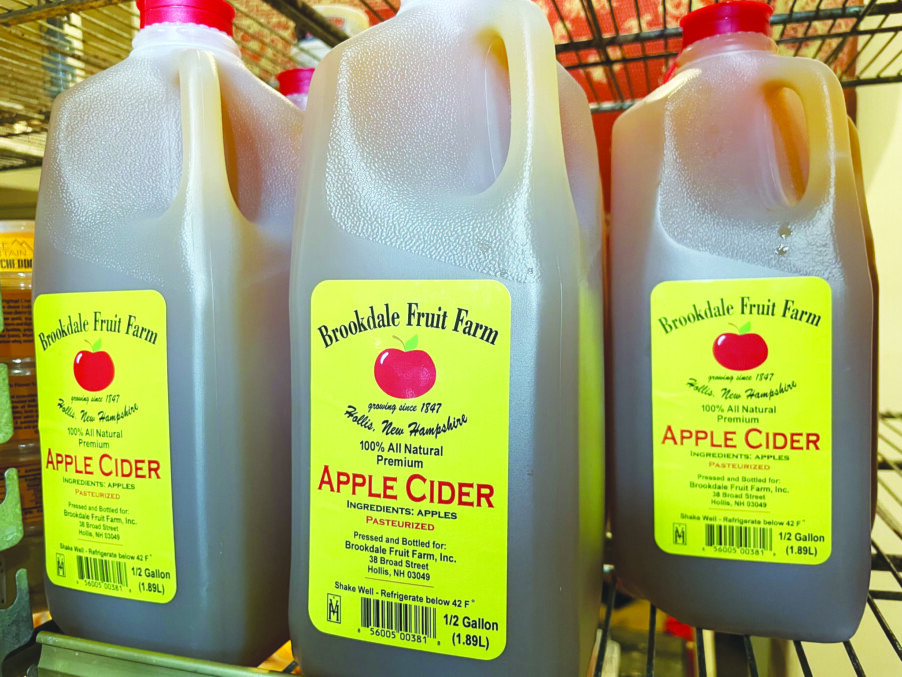
Featured Photos : Brookdale Fruit Farm. Courtesy photo.

A journey in music

Stephane Wrembel brings Triptych to UNH

By Michael Witthaus
mwitthaus@hippopress.com

Triptych is the latest album from French guitarist Stephane Wrembel. The expansive 20-song collection is a meditation on life, represented in three musical movements. It’s a collaboration with pianist Jean-Michel Pilc, which came together after Wrembel’s manager suggested that the two connect. Initially, Wrembel was reluctant.

“Piano and guitar are very difficult to marry,” he said by phone recently. “It’s a difficult match because we kind of occupy the same space, and it’s very easy for tones to clash.” He decided to give it a try anyway, and quickly became enamored of the pianist. Pilc is renowned for his improvisational skills and has an impressive resume. His credits include time as music director and pianist for Harry Belafonte.

At the time, Wrembel had a concert series at Joe’s Pub in New York City coming up to celebrate the release of Django l’impressionniste, a collection of 17 preludes for solo guitar.

“Django is also influenced by Claude Debussy, so I wanted to do something around him,” he recalled. That’s when Pilc’s name came up; the two had not yet met.

He was recruited for the shows, and “the chemistry was immediate and so powerful that we decided to record together,” Wrembel said. “I had the instinct that we needed to go to the studio and record a triptych. I had the vision of a triptych. I didn’t know why, but I could see that it was the right thing to do.”

It’s a true collaboration, with both Wrembel and Pilc contributing new songs. Overall, the album is anchored by selections from Django Reinhardt like “Douce Ambiance,” which is transformed by Pilc’s piano flourishes in the intro before settling into a joyous jazzy rhythm familiar to fans of Reinhardt.

Wrembel is a devotee of the legendary guitarist. As David Fricke wrote in 2009, he “studied Reinhardt’s fleet precision and soulful swing the hard way — playing in actual Gypsy camps.” He lived in the Paris neighborhood where Reinhardt spent his final years and considers him an essential musician.

“Django is to the guitar what Bach is to the keyboard,” he said. “When you practice Django, you become a better guitarist; it’s automatic. You will understand the guitar better, you will see things better, you have a better technique, so everything about your playing is going to be better. Django is an archetypal source like that.”

Triptych’s first movement begins with “Ecco Homo” — an introduction, Wrembel explained. “It means ‘here is the man,’” he said. “It’s the birth of the triptych.” The next section starts with “Jonathan Livingston Seagull,” a Wrembel composition that provides insight into what informs him beyond gypsy jazz.

The first song Wrembel recalls hearing as a very young child is Pink Floyd’s “Comfortably Numb.” He’s progressed past rock, but “those sounds are still there, I make no difference between Debussy, Pink Floyd, Chopin,” he said. “All that’s the same for me.”

There’s a link to the ’70s literary touchstone in Floyd’s song “Echoes,” Wrembel continued. “It’s about an albatross hanging motionless upon the air,” he said. This led him to Richard Bach’s novel, and “the idea of a floating seagull that tries to find what’s noble in its own nature rather than just finding food. It’s a beautiful tale.”

The third section of Triptych is its most ambitious, beginning with “Life In Three Stages Part I: The Child and the Desert,” continuing with “Part II: Building a World” and concluding with “Part III: Old Age, Grace and Wisdom.” The last offers an elegiac cadence that’s gorgeous and haunting, with Wrembel and Pilc the only musicians.

The final movement’s tone reflects Wrembel’s own sentiments.

“I’m 50, I’m entering old age,” he said. “That’s the third stage, where I believe that as an artist, if you keep working and concentrating and studying philosophy, it’s possible to reach very high levels of consciousness. You don’t think the same when you are 50 than when you are 20, and probably you don’t think the same when you are 80 than when you are 50. Every time there is more and more wisdom coming.”

Triptych – Stephane Wrembel Band with Jean-Michel Pilc
When: Friday, Sept. 13, 8 p.m.
Where: Johnson Theatre, 50 Academic Way, Durham
Tickets: $10 and $12 at stephanewrembel.com

Featured photo: Courtesy photo.

Stay in the loop!

Get FREE weekly briefs on local food, music,

arts, and more across southern New Hampshire!