A new restaurant brings lessons from one Elm Street corner to another
By John Fladd jfladd@hippopress.com
For 15 years, The Farm Restaurant was a solid presence on Elm Street in downtown Manchester. Then after the holidays, it was gone.
Ryan Cox is part of the family that owned The Farm and several other restaurants in New Hampshire and Massachusetts.
“What happened,” he said, “was the lease [for the Manchester Farm] had ended. We were there 15 years. We had a great run there. We love The Farm. We still have one location in Dover, New Hampshire, and one in Essex, Massachusetts, as well, and they’re still staying open. It was just one of these things where we couldn’t see eye to eye with the landlord, and with the age of the building, we just decided it was time to kind of look somewhere else.”
“Somewhere else” turned out to be on the corner of Elm and Lowell streets, in the location most recently occupied by Keys Piano Bar.
“We found this great location two blocks over,” Cox said. “And we were able to bring in a different one of our concepts, which is what we have in Methuen, Massachusetts. It gave us a chance to revitalize what kind of what we’re doing as a business.”
The new restaurant, which opened in early January, is The Miller’s Tavern. It specializes in upscale American pub food.
Cox said the Tavern is not the same place as The Farm, but they share some of the same DNA. “We’ve learned a lot in our 16 years of operating our company,” Cox said. “And so we’ve really been able to dial in our menu and really been able to dial in what we’re going for, which is an American tavern. It’s a place where we would like people to be able to come three days a week. Perhaps you come in for a burger and a beer and watch a game. Perhaps you come in another time for dinner. and perhaps you come in with your family if you want as well. The idea is to cater to all price ranges and all types of people.”
The concept of the menu at The Miller’s Tavern is to take pub classics and elevate them to their highest potential. Cox used mozzarella bites as an example.
“Instead of what people would buy as mozzarella sticks, frozen, we make them all in house,” he said. “We take real chunks of mozzarella, so when you stretch it, you take a bite, it stretches for days. We have our famous fajitas that we’ve taken from The Farm, which we would put up against any Mexican restaurant out there. Our steak tips, we make them in house. That’s a home run. We have a pizza oven. We have a panko chicken that we think is outstanding. Our fish and chips are seriously good — our seafood’s fresh, you know, which is something that we’ve kind of learned from being down on the coastal areas.”
Cox said there are also high-end items on the menu.
“On Thursday, Friday and Saturday, we have a choose-your-own-cut-size of rib-eye steak. You can choose a 16-, 18-, 20-, 24-, 28-, 30-ounce cut, if you’d like. We cut it for you right here, topped with gorgonzola cheese, caramelized onions, and onion rings on top of that, so it’s a really cool meal.”
The Miller’s Tavern 1087 Elm St., Manchester, 854-8442, themillerstavern.com Open Monday through Saturday, 11:30 a.m. to 10 p.m., and Sunday, 11:30 a.m. to 9 p.m.
• Whiskey 101: Arts Alley (20 S. Main St., Concord, 406-5666, artsalleyconcordnh.com) and Tamworth Distilling (15 Cleveland Hill Road, Tamworth, 323-7196, tamworthdistilling.com) will join forces to teach the basics of whiskey. Whiskey 101: Sip, Savor & Learnwill introduce participants to three distinct styles of whiskey — bourbon, rye, and scotch — while teaching how each is made, how to properly smell and taste, and what flavor notes to look for. This class will take place at Arts Alley on Friday, Jan. 23, from 6:30 to 8 p.m. Tickets are $65.87 through eventbrite.com.
• Pie and wine: On Friday, Jan. 23, from 6:30 to 8 p.m. Tuscan Market (Tuscan Village, 9 Via Toscana, Salem, 912-5467, tuscanbrands.com) will host a class teaching participants tobake two seasonal pies from scratch with wine pairings. Tickets are $75.03 through eventbrite.com.
• Romantic Valentine’s Day dinners: Many area wineries will hostromantic dinners for two on the weekend of Feb. 14:
• Averill House Vineyard (21 Averill Road, Brookline, 244-3165, averillhousevineyard.com) This is a five-course, chocolate-themed dinner with a wine pairing for each course. $79 per person.
• Birch Wood Vineyards (199 Rockingham Road, Derry, 965-4359, birchwoodvineyards.com) This is a four-course meal, with wine pairings available. The cost starts at $85 per person but will vary depending on menu and wine options.
• Flag Hill Winery (297 N. River Road, Lee, 659-2949, flaghill.com) This is a three-course dinner with wine pairings. Entree options include blackened terres major (a tender cut of beef), plantain-crusted halibut, and eggplant rollatini. The price is $65 per person.
• LaBelle Winery Amherst (345 Route 101, Amherst, 672-9898, labellewinery.com) This is a four-course dinner, each course paired with a LaBelle wine. The meal is accompanied by a string quartet. The price is $99 per person.
• LaBelle Winery Derry (14 Route 111, Derry, 672-9898, labellewinery.com/labelle-winery-derry) This is also a four-course dinner, each course paired with a LaBelle wine. This meal is accompanied by a jazz quartet. The cost is $99 per person.
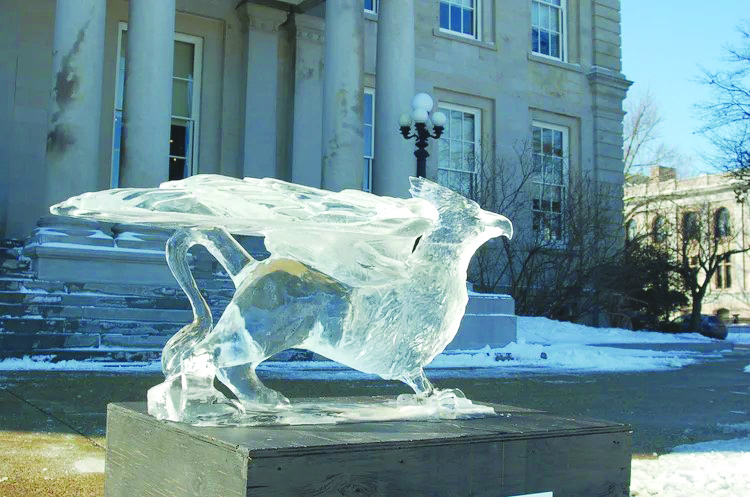
According to Jessica Martin, the executive director of Intown Concord, one of the most exciting parts of this weekend’s Concord NH Winter Fest will be the ice carving.
“They use two large locks of ice and they’re so beautiful,” she said. “They carve things like eagles and dragons and The Old Man of the Mountain on the Statehouse lawn. There will be a little preview Friday night if anybody wants to come down between 3 and 9 p.m. the evening before the event, if anybody wanted to come down and watch them.” On Friday night, Martin said, the ice carvers will recreate the logos of the Festival’s sponsors in ice, but the actual ice carving competition will take place on Saturday.
Saturday will also see food trucks on Main Street. “We have so many different food trucks that are attending this year,” Martin said. “We have Batulo’s Somalian food, we have Deadproof Pizza, we have Wicked Tasty and we have Bumblebee Dumpling and Bumblebee Tea.”
Winter Fest will include activities like curling, axe-throwing, s’mores-making, a morning matinee of the animated movie Balto with complementary hot chocolate at Red River Theatres, and an ice bar in Arts Alley.
Also on Concord’s weekend schedule are the Concord Garden Club’s 23rd Annual Art and Bloom exhibition at Kimball Jenkins (Thursday, Jan. 22 through Saturday, Jan. 24); the Winter Fest Hot Cocoa Tour at participating downtown restaurants (11 a.m.to 2 p.m.; register on Intown’s website); a family fun day at the New Hampshire Historical Society (30 Park St.) from 2 to 4 p.m., and the Black Ice Pond Hockey Championship (blackicepondhockey.com) Friday, Jan. 23, through Sunday, Jan. 25.
Concord NH Winter Fest Where: Downtown Concord, in front of the Statehouse, plus some off-site events When: Saturday, Jan. 24, from 11 a.m to 4 p.m. More: Visit intownconcord.org/events
Do you know anything about this toy clown set? I recently bought this for my daughter at a flea market. Examining it closer I’m not sure if it’s not just for decoration. I’m hoping she can play with it. The vendor told me it was old but in new condition. Any information you could give me would be appreciated.
Thank you, Donna.
Tammy
Dear Tammy,
What you bought is a collectible Schoenhut clown. The German company started in Philadelphia. Good catch in wondering if it’s a toy. It actually came out in the 1990s as a souvenir. So depending on how old your daughter is, be careful. Schoenhut has been around since the late 1800s, first bringing quality-made toys like pianos, animals, circus toys, etc. Some of the early toys can bring a high value in today’s market. But even today there are collectors for any of the pieces, even souvenir ones like yours.
I would say items made as souvenirs are really more for show than for full-on playing. So careful play, as I stated.
Now on the up side, Tammy, depending on what you paid for it: The value of your clown set is in the range of $50. So maybe this could be the start of her collection.
The Grand Kyiv Ballet Company was forged through the crucible of two crises. In 2014, Russia occupied Eastern Ukraine, forcing dancer Oleksandr Stoianov and his ballerina wife Kareryna Kuhkar to move to Kyiv. Once there, Stoianov formed a ballet company consisting solely of his fellow countrymen and women.
“Before this we worked with the Russian companies, promoting the Moscow Ballet or the Russian Ballet,” Stoianov said in a recent phone interview. “Many people didn’t know that they were about 50 percent Ukrainian. It was my main idea to create the Grand Kyiv Ballet with a Ukrainian name, and with Ukrainian dancers.”
In 2022, Russia’s full-scale invasion of Ukraine forced another turning point. When the war began, Stoianov and Kuhkar were performing across Europe. They quickly put together a solidarity tour in France and Scandinavian countries, along with working to get dancers and students to safe places.
Government officials, including Scandinavian royalty, attended performances. Ballet became a voice for grief, resistance and national identity.
“We did speeches from the stage about weeping for our country,” Stoianov recalled. “It was a most difficult and terrible time.”
Theaters in Ukraine were closed. Jobs disappeared overnight, and for dancers, life without rehearsal and performance is unimaginable. Many were young, only in their teens, and forced to start from zero in foreign countries. Others were caring for children or elderly parents. Homes were destroyed, and stability vanished.
Some paid a much higher price. Oleksandr Shapoval, who’d danced with Stoianov and Kuhkar, volunteered for service and died in September 2022. Artem Datsishin, another principal dancer from Ukraine’s National Opera, died from injuries sustained from Russian shelling.
In response, larger and more frequent tours were created to provide work, income and purpose for displaced performers. Its scale has grown steadily and adapted to shifting challenges. The company is now a global presence, appearing across Europe, Scandinavia, the United States, Australia, New Zealand, Japan and more recently China.
Each tour and performance reinforces the visibility of Ukrainian culture on the world stage.
Stoianov, Kuhkar and their two daughters now live in Seattle. Stoianov oversees Grand Kyiv Ballet’s many projects, like two upcoming New Hampshire stops. Giselle, with principal dancers Victor Tomashek and Ekaterina Malkovich, will be performed in Nashua on Jan. 22, and Swan Lake is at Portsmouth’s Music Hall Jan. 25.
These days, the two dance infrequently. An injury stopped Stoianov in 2024, but he hinted, “perhaps a grand return is still ahead” on the company’s website. In the interview, he shared that a world tour of the ballet Carmen will happen next year. “We’ll start class and rehearsals this summer, and then in 2027, we’ll say goodbye to everybody from the stage.”
Giselle is a tale of love, deception and betrayal. Malkovich said in a late December Instagram post that it’s among her favorites to perform.
“When the curtain falls, you leave the stage not tired, but drained,” she wrote. “It’s a ballet after which you don’t want to say anything because there’s nothing left to say.”
Stoianov agrees, adding that its themes resonate with audiences. “All people feel sometimes in their lives in a situation like Giselle, a young girl who was in love, was betrayed and became crazy,” he said. “I’ve seen this ballet a thousand times and my eyes still become wet — but they are happy tears.”
Grand Kyiv Ballet presents Giselle When: Thursday, Jan. 22, 7 p.m. Where: Nashua Center for the Arts, 201 Main St., Nashua Tickets: $46.75 and up at etix.com Sunday, Jan. 25, 4 p.m. Grand Kyiv Ballet presents Swan Lake at The Music Hall, Portsmouth, themusichall.org.
Featured photo: Giselle. performed by The Grand Kyiv Ballet. Courtesy photo.
As with most wonderful things that seem straightforward and simple at first glance, the subject of french fries gets surprisingly intricate and granular the deeper you look at them. And while you can look at them through any number of lenses — the best types to dip in milkshakes, or the best ones to fall in love over — today we’re going to look at six important factors: the variety of potato used, the shape they are cut into, how they are cooked, what type of oil they are fried in, how they are seasoned or topped, and what we dip them into.
Consideration No. 1: What kind of potato?
While there are thousands of varieties of potato, according to the website Potatoes USA (potatogoodness.com) “only” 200 or so are commercially available in the United States. Each variety has its own characteristics, some of which make them suitable for french fries, others not so much. Unfortunately, french fry experts can’t agree on which is which.
Matt Berry, the executive chef at Unwined Wine Bar and Bistro in Milford, has put a lot of thought into this.
Very thin shoestring potatoes from River Road Tavern. Photo by John Fladd.
“I joke around all the time about how we have very over-engineered french fries,” Berry said. “When we were going to put fries on the menu, I wanted to do something a step above just frying potatoes. I wanted, in essence, to make the perfect french fry. So I thought about what that meant — what criteria, if you will, make up the perfect french fry. And we wanted a really light, crispy exterior and a really light, fluffy, almost creamy interior.” To that end Unwined uses an Idaho Russet potato, which is often described as a “floury” potato. When it is cooked it has a fluffy texture. This is the type of potato often used in mashed potatoes.
Renee McMaster is the owner and operator of a food truck called HotMess Poutine. She also spends a lot of time thinking about french fries — or, as she puts it, Quebec-style fries. She too, uses Russet potatoes, but they are not her first choice.
“I just got back from Quebec,” she said. “In Quebec we use red potatoes and I think it makes the french fries even better. The reason why I don’t use the red potatoes here is that it’s very hard to find a big red potato here. The red ones are a lot more sweet. I think they make [fries] a lot better. I would use red potatoes with peanut oil if I had my choice. In Quebec we use potatoes like we match wine. So here we use russet potatoes but we keep the skin on the potatoes for more flavor.”
Red potatoes are what is frequently called a “waxy” potato. They keep a firm texture when they are cooked, which makes them excellent for roasting or to use in potato salad. For McMaster the flavor of the reds outweighs texture issues. Or it would, if she could find large ones.
Consideration No. 2: How do you cut the potatoes?
For many people, perhaps the most noticeable difference between types of french fry is the shape of the fry. The shape will affect the crispiness of finished fries and even their flavor. A waffle fry will present itself completely differently than shoestring fries, which in turn are a world away from steak fries.
The most common cut of fries in this part of the world is the straight-cut matchstick, an inch or two long. Most restaurants that advertise “hand-cut” fries are talking about this shape.
By “hand-cut” a restaurant almost certainly means using a lever-controlled french fry press that pushes raw potatoes through a metal grid to achieve that shape. Not even the most dedicated cook in a commercial kitchen is willing to cut hundreds of potatoes with a chef’s knife. John Ramsey, the owner of Stark House Tavern in Weare, said that would not be practical for his kitchen.
“We go through about 1,200 pounds of potatoes a week,” he said. “So it’s a substantial part of our business.”
What Ramsey does make, in addition to traditional straight-cut fries, are house-made tater tots. “We got the idea from traveling to Indiana for football games a couple of times a year,” he said. “At one stop, we were in Cleveland at a brew pub. We ordered tots and they made them to order. They were essentially deep-fried mashed potatoes, very pillowy. That was our inspiration.”
Tater tots are also part of the fried-potato repertoire at 603 Brewery in Londonderry.
“All of our fries are hand cut here,” said 603 Brewery sous chef Charley Moore. “Our regular fries are punched every morning, and then for our waffle fries we use a special tool called a mandoline. That lets us get it to the shape that we want and the size that we like.” During happy hour, 603 offers all three types of fries — traditional straight-cut, waffle fries, and tater tots — as part of a french fry flight with four types of dipping sauce.
When Josh Buxton, the owner of Buxton’s Restaurant in Derry, was developing his french fry recipe, he decided to use a more substantial cut of potato.
“I said, ‘You know what? Let’s give people a french fry, but let’s do it differently.’ I wouldn’t call them a wedge, but they’re one and a half to two inches long, and they’re in a wedge style,” Buxton said. He uses small waxy yellow potatoes for a firmer texture; they are par-cooked, then sectioned off.
The River Road Tavern in Bedford has gone in the opposite direction. According to kitchen manager Joe Carey, it was important to find the narrowest cut of shoestring potatoes available. Super-skinny cuts of potato have more surface area to crisp up in the fryer, he said.
“Ours are three-sixteenths of an inch thick, so they get nice and golden and crispy. They don’t get as soggy as some of the thicker fries. We don’t hand-cut them. We actually buy them, but we get them special ordered, so they are always consistent. We’re the only ones around that serves them this thin.”
Crinkle-cut fries Crinkle-cut french fries sound like a really good idea. Cutting the potatoes in a zig-zag pattern gives them a much larger surface area-to-volume ratio than regular straight-cut fries, and should be extra golden-brown and crispy. Unfortunately, when ordered at most restaurants, they usually come to the table, undercooked, pale and soggy.
Joe Carey from the River Road Tavern said it’s a bit of a mystery. “I don’t know what’s going on with them,” he said. “I don’t know if they just aren’t being cooked long enough. I’ll be honest, they’re my least favorite cut. I like crispy fries; if you don’t like crispy fries, then maybe the crinkle-cuts are for you, but I just, I think they’re bland, even when they’re seasoned.”
Charley Moore from the 603 Brewery agreed. “[Crinkle-cuts] seem to steam and hold in the moisture a little more,” he said. “With any kind of potato, you want to pull out as much moisture as possible. That’s what gives you your crispiness. They [crinkle-cut fies] seem to hold in more water. Once you bite them, even when you fry them up, they seem to soften faster.”
Consideration No. 3: How are the french fries cooked?
Every style of fry is different to some degree, but many of the best fries have a few steps in common.
After cutting the potatoes, most ambitious french fry makers soak them in cold water.
“We put them in cold water overnight in the refrigerator,” John Ramsey said, “to leach the starch out. If you don’t do that they’ll burn without being crispy. They’ll turn brown but be sloppy, limp fries; no one likes that.”
“We usually soak them for three to four hours to pull off some of the starch,” Charley Moore from 603 Brewery said, “then we rinse them off again so they’re not foamy.
Matt Berry from Unwined is even more exact. “We give them a quick overnight ferment,” he said, “in a one and a half percent salinity bath.”
Another common french fry technique is frying the potatoes twice — once at a low temperature to cook the interior of the fry, and a second time at a higher temperature to crisp up the outside. The first, low-temperature fry is referred to as “oil blanching.”
“We blanch them and then we cool them down,” John Ramsey said, “and then we cook them to order with a high temperature.” Although he doesn’t blanch the potatoes in oil, Josh Buxton said it is extremely important to precook potatoes before frying them to serve to customers.
“We just boil them in salted water,” Ramsey said. “They’re cooked whole and that also helps season them. We don’t want them to be too soft. When we drop them in the fryer we’re just looking to crisp them up.”
Consideration No. 4: What kind of oil are they fried in?
There are two schools of thought when it comes to french fry oil. One is to use a mild, neutral-tasting oil that won’t distract from the flavor of the potato.
“We use a canola oil for our fryers,” Joe Carey from the River Road Tavern said. “We’ve used peanut oil in the past, but with all the allergies we’ve moved away from that.”
“Our trick is we use canola oil,” Renee McMaster from HotMess Poutine said. “Olive oil is really good for potatoes, and peanut oil as well … if I use a red potato I will use peanut oil.”
Some olive oils are excellent for frying — the ones with what is called a high smoke point, meaning that they won’t burn at frying temperatures. Virgin and extra-virgin olive oils usually have a low smoke point and will fill your kitchen with caustic smoke. A good rule for cooking with olive oil is that the pricier it is, the worse it is for frying.
The other approach to french fry oil is to use an extremely flavorful oil (with a high smoke point) to add savory notes to the finished fries.
“We only use beef tallow,” said John Ramsey from the Stark House Tavern. “There’s no vegetable oil in the whole building, and no seed oil. It’s all tallow and olive oil.” (If you’ve ever heard an older relative rhapsodize about how good McDonald’s french fries used to be, this is what they are talking about. Until the 1980s, McDonald’s fried everything in beef tallow, which was affordable for them and delicious for their customers. But, as Robert Frost wrote, ‘Nothing gold can stay.”)
French Fry Flight from 603 Brewery. Photo by John Fladd.
Harpoon Brewery in Manchester also leans into savory fry oil — customers can ask to have their french fries finished in duck fat.
“It just honestly produces a better product,” said Harpoon’s Steve Shoemaker. “The denser fat and flavor of the duck goes somewhat deep into the french fries. It just produces a much better fry. I’ve tried beef tallow. I tried various iterations of canola, corn, peanut oil, all of those things. This seems to work ultimately the best.” Because duck fat is denser than vegetable oils, he explained, it takes longer for the water vapor to be forced out of the potatoes, giving the whole enterprise a comparatively golden-brown and savory finish. The kitchen at Harpoon has multiple fryers working at any given time, he said. “If somebody is a vegetarian, we can cook [the fries] in a combination of canola and sunflower oil. That way they have options.”
Consideration No. 5: Toppings and seasonings
While there is a beauty to the simplicity of hot, crispy french fries served with a sprinkle of salt, a well-made batch of fries can serve as a canvas for more ambitious presentations.
Peter Macone is the co-owner of the Republic Brewing Co. in Manchester. He said Republic’s fries are outstanding on their own but what really sets them apart is how they are finished.
“They’re cooked to order,” he said, “then tossed with Aleppo pepper, fine herbs — which is just an assortment of, you know, French herbs chopped — and salt and pepper. But one thing that is always a little bit of a surprise for people is the fried capers. We crisp capers with our fries. You can walk by tables often and hear customers sort of debating what it is that’s in their fries that’s so good. People often refer to our fries as, they’ll say ‘truffle fries,’ and in your head, you’re thinking, ‘It’s nothing like a truffle flavor,’ but they just know that the flavors stand out.”
“We toss them in chives,” Josh Buxton said, “and salt and Parmesan cheese, and then we just toss in a very little drizzle of oil so that the cheese and the chives can stick to them.”
John Ramsey from the Stark House Tavern said french fries are infinitely adaptable — “we’ll use truffle oil with Parmesan,” he said, or “we’ll make a short rib poutine with cheese curds.”
But it is tater tots that really shine with extra toppings.
“We have several different ways we serve them. On the menu with barbecue brisket, or we’ll toss it in Buffalo sauce with blue cheese crumbles, or ranch dressing, and we have a sweet chili sauce we make with some sesame oil, like a sesame vinaigrette, a little Asian taste to it,” Ramsey said.
Fries and wine We asked Emma Round, owner of Unwined Wine Bar and Bistro in Milford, “What wine would you suggest to go with french fries?” “The best Champagne you can get, always. And I highly recommend devouring both in a bubble bath or hot tub!!”
Consideration No. 6: Dipping sauces
Purists may prefer ketchup or a splash of malt vinegar with their french fries, but something about dipping sauces brings out an extra level of creativity in some cooks.
“[Fries] come with a special fry sauce of ours,” Joe Carey from the River Road Tavern said. “It used to be part of a recipe for a spicy tuna roll; then someone dipped a fry in it one day and we decided that it went from a sushi sauce to a fry sauce for potatoes, and now we sell it by the pint. It comes with every order of fries or every sandwich that comes with fries. It has a sesame base, so it tastes almost like a peanut sauce, but there’s no peanuts in it whatsoever. I can’t share the rest of the ingredients, but it’s creamy and really savory.”
603 Brewery’s French Fry Flight comes with four different sauces.
“Obviously, we have our classic ketchup,” Charley Moore said. “And then we have our pub mustard, which is a blend of different mustards and our Winni Ale. Our beer cheese, which is made with our 603 IPA. And then there is our secret sauce, which is a blend of sauces we create in house.”
Herbed potato wedges from Buxton’s Restaurant. Courtesy photo.
Matt Berry at Unwined is extremely proud of their fry sauce.
“The sauce we have with our fries right now is kind of infamous,” he said. “It’s a cherry pepper ranch-style sauce. It’s a buttermilk ranch, and it starts its life as an aioli. Then we add just-pickled cherry peppers that we rinse the seeds out of and puree roughly in the food processor. That’s folded in with confit garlic and chives and herbs. But the real secret that to me makes ranch ranch is tarragon. We use a lot of fresh tarragon in it.”
Josh Buxton refers to his french fry sauce as a “labor of love.”
“We make a great little potato,” Buxton said, “but I think the aioli that we make is what ties it all together. We make a Calabrian chili honey and we mix it with confit garlic. We make our own mayo and then we blend in some chili crunch. The honey takes at least three or four days to really combine the flavor. Confit garlic takes a few hours. You know, we make our own chili crunch. I think there’s more labor of love into the sauce than the actual potato.”
Fry Panel
French Fry Flight — 603 Brewery (42 Main St., Londonderry, 404-6123, 603brewery.com) is open Tuesday through Thursday from 11:30 a.m. to 9 p.m., Friday and Saturday from 11:30 a.m. to 10 p.m., and Sunday from 10 a.m. to 4 p.m.
Herbed potato wedges — Buxton’s Restaurant (Metro Market, 158 Rockingham Road, Derry, 818-4105, buxtonspizza.com) is open Wednesday through Saturday from 4 to 9 p.m.
Duck fat fries — Harpoon Brewery Manchester (Queen City Center, 215 Canal St., Manchester, 945-3797, harpoonbrewery.com/manchester-brewery) is open Wednesday and Thursday from noon to 9 p.m., Friday and Saturday from noon to 10 p.m., and Sunday from noon to 6 p.m.
Poutine and french fries — HotMess Poutine (973-7001, facebook.com/goeycheese) serves southern New Hampshire throughout food truck season.
Shoestring fries — River Road Tavern (193 S. River Road, Bedford, 206-5837, riverroadtavernbedford.com) is open Monday through Thursday from 11 a.m. to 9 p.m. and Fridays and Saturdays from 11 a.m. to 10 p.m.
French fries and tater tots fried in beef tallow — Stark House Tavern (487 S. Stark Highway, Weare, 487-6002, starkhousetavern.com) is open Tuesday through Saturday from 11:30 a.m. to 9 p.m., and Sunday from noon to 8 p.m.
Fries with capers — Republic Brewing Co. (72 Old Granite St., Manchester, 836-3188, republicbrewingcompany.com)
Tarragon fries — Unwined Wine Bar and Bistro (1 Nashua St., Milford, 213-6703, unwinednh.com) is open Wednesday and Thursday from 5 to 10 p.m., and Friday and Saturday from 4 to 10 p.m.