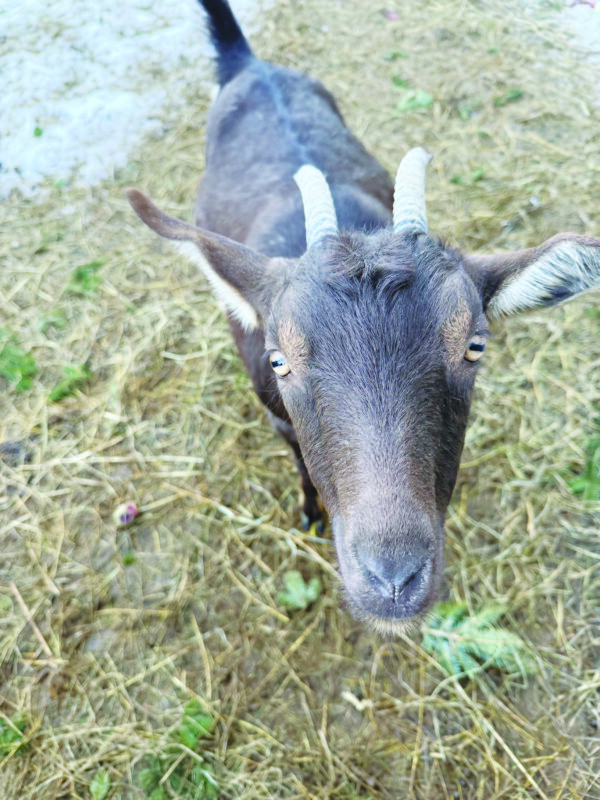
A look at Hickory Nut Farm and their goats
“When I see goats out in the field,” said Donna-Lee Woods, “I just cry for those goats inside barns because they don’t have Christmas trees. Right over there,” she said, pointing to a pile of pine and fir trees that had clearly seen better days, “there’s over 300 Christmas trees. They get dropped off from Newmarket and some of the other towns around here. People keep dropping them off all winter.”
“But the point is,” Woods continued, “the goats love them; it’s their forage. That’s what makes that healthy, alkaline [goat] milk. Every day, we give them three, four, five trees and they will eat everything right down to the white core of the trees. They use [the cores] as scratching posts all summer, and then in the fall time, we have a big bonfire.”
And in the meantime, there is cheese.
Wood and her husband, both former architects, manage a small herd of dairy goats at Hickory Nut Farm in Lee and use raw goat’s milk to make cheese, yogurt and soap, which they sell at area farmers markets.
“We also make a fudge,” Wood said, “which is a 1910 recipe. There’s no high-fructose corn syrup, so it’s not as smooth as most people expect. It’s crystal-y. The raw milk yogurt is very good, and the raw milk itself. Our soap is made with edible oils, not industrialized oils, so there are no chemicals. And you can use it as shampoo, and then you can lather it up and use it as a moisturizer. They use this sort of soap on babies with eczema because it’s so pure.”
But for the Woodses, it’s mostly about the cheese.
“Our cheeses are raw,” she said, explaining that heating goat milk during the pasteurization process breaks down some important nutrients and flavor compounds. “We don’t pasteurize. But our cheeses age for a minimum of two months at a certain temperature and a certain humidity, 54 degrees temperature and 84 percent humidity.” Maintaining those conditions can be particularly tricky in the winter, she said.
Hickory Nut Farm produces three main varieties of goat cheese: Lacey White, a firm, cheddar-like cheese with a distinct nutty flavor; Terrene, a blue-veined, “goaty” cheese that is aged longer than other varieties, and Chebar, a hard, Parmesan-like salty cheese with a buttery flavor. Woods said the only goat cheese she refuses to make is a traditional soft chevre. “Everybody makes that,” she said. “You can find it anywhere, so what is the point in making more of it?”
Woods said one of the things she likes most about selling cheese at markets is being able to talk one on one to customers, who often think they don’t like the flavor of goat cheese. They don’t understand the role pH plays in flavor, she said.
“I tell people, ‘You take a cube of the cheese, just a little cube, and eat half of it. You may not like the flavor, but swallow it, wait a few seconds, then eat the next half. You’re probably going to like it.’ Because what’s happened is the cheese has changed the pH of their palate. Our palates tend to be very acidic because of the types of food we eat.” The high pH of goat cheese neutralizes some of that acidity, Wood said. “That’s the true flavor of the cheese the second time around.”
“When people tell me they don’t like goat cheese,” Wood said, “I say, ‘Do you drink red wine?’ A lot of times they don’t because it tastes bitter to them. I tell them, ‘You probably have a tannin sensitivity because there’s a lot of tannin in red wine, just as there is in goat milk, because of what the goats eat.”
Like Christmas trees.
Cheese!
Hickory Nut Farm products are available at the farm (22 York Lane, Lee) and at the Saturday Concord Winter Farmers Market (7 Eagle Square, Concord,downtownconcordwinterfarmersmarket.com). During farmers market season, Hickory Nut Farm products will be available at several area and Boston markets.