Meet the Locals

Native plants support wildlife and offer beauty in your garden

In recent years there has been a real upsurge in the use of native plants in the landscape as a way to support pollinators, birds and other wildlife. This is due, in part, to the fact that native plants are recognized and used by our wildlife, while most foreign species of plants are not. For example, birds generally nest in native trees and shrubs, but avoid those originally from Europe or Asia, and caterpillars rarely are seen on any imported species of plants. Not only that, most natives are hardy and lovely.

Scientists have found that birds depend on the caterpillars of butterflies and moths as the primary food source for baby birds. No caterpillars? No birds nesting. Entomologist Dr. Doug Tallamy found that a clutch of chickadees needs 6,000 to 9,000 caterpillars to survive from hatching to fledging. So let’s take a look at some common native perennials, trees and shrubs that are handsome and easy to grow.

According to Dr. Tallamy, the best perennial for pollinators is goldenrod. There are many species of goldenrod. Some of the wild types are not suitable for garden beds as they spread by root and easily elbow out plants we also want. But there are some nice ones readily found for sale at nurseries and that do not spread like crazy.

My favorite goldenrod is a variety called ‘Fireworks.’ It grows to be 2 to 4 feet tall and stays in a nice clump that does increase in size but is not aggressive. It does best in full sun with damp soil, but will take some shade and dry soil.

The Mt. Cuba Center is a research center in Hockessin, Delaware, that trials and rates native plants. They rate ‘Fireworks’ goldenrod as the very best, a 4.6 out of 5.0. Another one I like is a dainty little goldenrod called blue-stemmed goldenrod (Solidago caesia) that grows well in dry shade, blooming late in the fall. For me it stays about 18 inches tall.

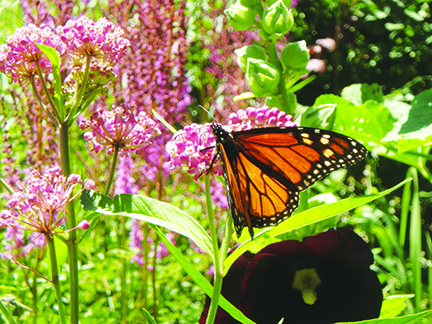
You probably know that monarch butterflies need milkweed for their caterpillars. The milky alkaloids in milkweed are ingested, making the caterpillars distasteful to predators. But common milkweed, the wild one, spreads aggressively by root and seed, making it a problem for most gardeners. The answer? Buy swamp milkweed (Asclepias incarnata). This comes with pink blossoms (or sometimes white ones) and stays in a nice 3- to 5-foot-tall clump. Other pollinators enjoy the nectar and pollen of this fine plant, too. It does best in moist soil, but will grow in ordinary garden soil. It blooms in early to mid-summer.

One day last September we were visited in our garden by hundreds of migrating monarch butterflies. Just like marathon runners, monarchs need lots of calories before their long trip. These were feeding on nectar from a late-blooming native plant, Joe Pye weed (Eutrochium spp.). I’d not seen so many monarchs all at once in 30 years or more.

There are several species and cultivars of Joe Pye weed. All do best in full sun or partial shade, and consistently moist soil — though I’ve read that they will tolerate ordinary garden soils once well-established. Most Joe Pye weeds are tall — 5 to 8 feet tall — and develop into large clumps. Blossoms are purplish to pink, lasting for several weeks in the fall. Their seeds are eaten by birds in winter if you leave the stalks uncut in the fall.

My favorite Joe Pye is a variety called ‘Gateway.’ It has purple stems and the blossoms look good in a vase longer than the wild ones I also grow. There are two varieties that are claimed to stay short, one called ‘Baby Joe’ and another ‘Little Joe.’ Both are said to grow to just 3 feet, but I haven’t grown either one.

Goldenstar or Green and Gold (Chrysogonum virginianum) is a nice, low native that does well as a groundcover. It blooms with 1-inch bright yellow flowers in early June for me, but also re-blooms off and on throughout the summer. It does fine in shade or part shade with rich, moist soil. If the soil stays moist, it will grow in full sun, though it will go dormant in the heat of summer. Each plant can cover a circle about a foot in diameter. Look for it in better nurseries: It is not a plant you’ll find in a big box store. It is native to Pennsylvania but is hardy in all but the coldest pockets of New England.

All wildflowers are native, and many are called ephemerals because they disappear after an early spring flush of flowers. All are important for native pollinators and beneficial insects because there are few sources of pollen or nectar in a New England spring. A good selection of wildflowers are available at The Garden in the Woods in Framingham, Mass. The Garden in the Woods is a nonprofit garden, education center and plant nursery run by The Native Plant Trust, formerly called the New England Wild Flower Society.

One of my favorite spring ephemerals is Dutchman’s breeches (Dicentra cucularia). This is a low-growing plant with delicate, finely divided leaves and white blossoms that look to me a bit like pairs of white long underwear! Mine is growing under an old apple tree in partial shade and deep, rich soil. It only blooms for a couple of weeks.

If you see a bumblebee at this time of year, it is a queen that has overwintered. They love Dutchman’s breeches and other early wildflowers — they use the pollen to feed their worker bees that are growing into real workers, so the queens can retire to a life of luxury.

Dutchman’s breeches have two relatives that you may know or grow: bleeding heart (Dicentra spectabilis) and wild or fringed bleeding heart (Dicentra eximia). Some books say both are natives, others say Dicentra spectabilis is native to Asia, or native both here and there. It dies back in late summer.

I’ve seen wild bleeding heart (Dicentra eximia) growing in the wilds of Vermont, though it is not common. It is an unusual wildflower because it keeps its foliage all summer and blooms on and off all summer. It is much lower-growing than its bigger cousin and has nice finely divided delicate-looking leaves. Both of these plants are readily available in nurseries.

If you live in suburbia with a big lawn and want to support wildlife, think about giving up some lawn and planting native trees. Trees really are the workhorses of the plant world. They have more leaves and greenery than our annual and perennial plantings, and hence can let moth and butterfly larvae munch their leaves — and you will probably never notice. Before you plant any full-sized tree, do your homework. Learn how big it will get and leave plenty of space for it.

According to Doug Tallamy’s excellent book, Nature’s Best Hope: A New Approach to Conservation That Starts in Your Yard, the very best trees to plant to support wildlife are the oaks. There are 90 species of native oaks that grow in the United States, and all are excellent. Of these, the white oak (Quercus alba) is the best. It commonly grows wild in the Northeast and it supports many more species of caterpillars than any other tree. Not only that, it grows to be a huge tree, one that can live for hundreds of years. So the white oak is also great at sequestering large quantities of carbon from the atmosphere, helping to reduce global warming.

If you want to plant a white oak, do not be deterred by how long you think it might take to grow. If you can afford a tree that is already 6 to 8 feet tall, it will be 20 feet tall inside of five years. Or if you are young and patient, you can plant acorns. At this time of year, or soon, you should be able to find and dig up seedlings that are just starting to grow. Oaks send down deep taproots, so digging up bigger plants is more difficult.

The only downside to white oaks, from my perspective, is that deer love to nibble on them when the trees are young — much more so than red oaks, which are also good native trees to grow for wildlife. If you plant a white oak and have deer in your vicinity, the safest way to protect it when young is to surround it with a wire mesh fence.

However, I have planted white oaks where deer are a problem and did not fence them. Instead I relied on a repellent device that clips onto twigs like a clothespin. It is called “Fend Off Deer and Rabbit Repellent” and contains garlic extract in small cylinders. Once you puncture the seal inside the capsule, it emits a strong odor that deer hate. These repellents last for over six months. I’ve seen footprints of deer going right up to white oaks with these garlic oil repellents — and then walking away without taking a bite.

Oaks have very strong limbs and can send out limbs that are almost parallel to the ground, sometimes 20 feet or more in all directions. So do not plant your tree near the house. It is a good “specimen tree” suitable for the middle of your back lawn, or protruding out from the edge of a wooded area. White oaks do not do well in areas that have poor drainage. For such an area, choose a swamp white oak (Quercus bicolor). They also do well in ordinary soil.

We all know and love the sugar maple (Acer saccharum) for its great fall colors and delicious syrup. Unfortunately it is not a perfect choice for suburban landscapes. It is not tolerant of pollution, compacted soils or salt. It does not tolerate long periods of wet soil. It struggles in soils low in calcium. It is better suited for rural areas where it grows wild.

If you want a maple tolerant of soil compaction and suitable for soils from wet to dry, sandy to clay, our native red maple (Acer rubrum) is a good choice. It is relatively fast growing and shows off bright red leaves in the fall. It does not tolerate road salt, so it is not a tree to plant near a paved road. But almost anywhere else? It’s a great tree.

According to the terrific book Essential Native Trees and Shrubs for the Eastern United States by Tony Dove and Ginger Woolridge, the red maple supports 300 kinds of caterpillars as well as providing nectar while blooming in the early spring. Some varieties have male and female trees, but others have flowers of both sexes on the same tree. The seeds on female trees are important for birds and small mammals.

For smaller properties there are many fine native shrubs to choose from. One of my favorites is mountain laurel (Kalmia latifolia), the state flower of Connecticut. I grew up with it blooming in hardwood forests with a high canopy — mature oaks in particular. I did a lot of off-trail hiking as a boy and always stopped dead in my tracks when I came upon mountain laurels in bloom. Here I have planted three of them as they are hardy but are not found in the wild near me.

Mountain laurel, I have read, is not an easy shrub to grow, but my own experience is different: I planted my first one on a moist hillside with morning sunshine and acidic soil. It has thrived and blossomed nicely for decades even though I do nothing for it. It is a relatively slow-growing shrub, 6 to 12 inches per year. In the wild they can grow to 10 or 12 feet in height, but they stay smaller in cultivation.

Mountain laurel is in the heath or heather family, so it needs soil that is quite acidic, pH 5.5 or so. When planting, dig a nice wide hole and add sulfur or soil acidifier to the soil. It’s best to use a pH test kit to determine the soil pH, and then add acidifier as directed on the package to bring down the pH. Adding peat moss at planting time will help, too. Mulch with pine needles if you have them.

The mountain laurel has glossy green leaves that are a bit like those of rhododendrons. They look good all year. But then, ka-boom, the buds and flowers appear in June. The blossoms appear in clusters, which open up to small cups, often with a mixture of pink and white inside, though there are some varieties that are deep rose throughout.

Hydrangeas are well-loved shrubs for home gardeners, though many of them are not native. According to the Mt. Cuba Center, the best native is one I grow, a smooth hydrangea (Hydrangea arborescens) called Haas’ Halo. This is a relatively new selection with lacecap flowers in mid-summer. The flowers have both fertile and sterile blossoms on flat-topped corymbs 4 to 8 inches across. Bees and other pollinators flock to it when blooming. In the wild, smooth hydrangeas are found in woodlands, and this one will boom well in either sun or shade, and tolerates dry soils well.

The best-known smooth hydrangea is ‘Annabelle,’ which I don’t use because the first time the blossoms get rained on they flop to the ground. Not so with Haas’ Halo. It has sturdy woody stems that hold up its blossoms well. Even after the flowers go by, the dry floret looks good into the fall and winter. Though I have seen reports saying it is not attractive to deer, I have seen deer demolish young Haas’ Halo shrubs. I cut the stems right to the ground in late winter or early spring as they bloom on new growth, and this keeps the shrub from getting too lanky.

My last pick for a handsome native shrub is Common Sweetshrub (Calycanthus florida), which is native to Pennsylvania and south through Florida, but hardy here to Zone 4. It does best in part shade with well-drained rich loam — but will grow in clay soil and survive in full sun if given adequate moisture. I have had it scald in full sun, so I don’t recommend that.

Common Sweetshrub’s claim to fame is the strong fragrance of its wine-red 1- to 2-inch flowers. I suggest you buy one in bloom if fragrance is important to you. I have two specimens, both of which have only a minor fragrance. But the blossoms are delightful to look at, and they are vigorous plants. It provides pollen to bees and the leaves are eaten by caterpillars.

Although statistics vary, most authorities agree that at least 50 percent of Americans do at least a little gardening. If all of us planted a few native plants, it would help our birds and pollinators to thrive. Remember, native plants co-evolved with our native animals over millions of years. They are wired to recognize and use natives. So strive to plant more natives this year!

Henry can be reached by e-mail at henry.homeyer@comcast.net. If you’ve grown some of these plants, feel free to e-mail him and give a report on how yours did.

This Week 26/04/30

Friday, May 1

The curtain rises tonight on To Kill a Mockingbird, an adaptation of the Harper Lee novel by Christopher Sergel, performed by the Community Players of Concord tonight and Saturday, May 2, at 7:30 p.m. and Sunday, May 3, at 2 p.m. at Concord City Auditorium, 2 Prince St. in Concord. See communityplayersofconcord.org for tickets.

Friday, May 1

Puffs, or: Seven Increasingly Eventful Years at a Certain School of Magic and Magic, a parody of a magical school and the students who go there, will be presented by the Windham Actors Guild on Friday, May 1, and Saturday, May 2, at 7 p.m. and Sunday, May 3, at 2 p.m. at Windham High School Auditorium, 64 London Bridge Road in Windham, according to a press release. “The play follows the journey of Wayne Hopkins, a regular boy from New Mexico who finds out he’s a wizard and is whisked away to a magic school in England. There, he is sorted into the ‘Puffs,’ a group of well-meaning, loyal, and often disregarded students…,’” according to the press release, which also stresses that this is “not authorized, sanctioned, licensed or endorsed by J.K. Rowling, Warner Bros. or any person or company associated with the Harry Potter books, film or play.” “Due to language/themes, this play is suited for audiences 13+,” the release said. See windhamactorsguild.com/tickets for tickets.

Saturday, May 2

Frizzhome Gardens, 270 Back River Road in Bedford, is holding its Spring Blossoms Festival today from 10 a.m. to 4 p.m. featuring 20 local vendors and Wicked Tasty Food Truck (slated to arrive at 11 a.m.), according to a post on Frizzhome’s Facebook page. Seefrizzhomegardens.com.

Saturday, May 2

The annual Kitty Angels fundraiser featuring an artisan, craft, flea and yard sale with more than 100 vendors as well as raffles, food and more, will take place today and Sunday, May 3, from 9 a.m. to 5 p.m. at Treasures Antiques, Collectables & More at 106 Ponema Road, Route 122, in Amherst. See treasuresnh.com.

Saturday, May 2

The Queen City Bazaar will offer “premier vintage clothing and period antiques and high-end collectibles” today from 10 a.m. to 3 p.m. at 3 Sundial Ave. in Manchester, according to a Facebook post about the event. The market will also feature artisanal goods, furniture and historical items, textiles, and more, the post said. Admission is free, according to a press release.

Saturday, May 2

The Concord Chorale will perform Brahms’ Requiem today at 7 p.m. and Sunday, May 3, at 3 p.m. at St. Paul’s Church in Concord, according to concordchorale.org, where you can purchase tickets.

Saturday, May 2

The Liberty House: Stand Up for Vets featuring Jimmy Dunn and friends will take place tonight at 7 p.m. at the Dana Center at Saint Anselm College in Manchester. See tickets.anselm.edu for tickets. “Enjoy a lineup of talented comedians, exciting raffle and auction items, and an overall fun night out, all while supporting a meaningful cause. Proceeds from this event directly benefit Liberty House’s program and services for veterans in our community,” the website said.

Wednesday, May 6

The Concord Hospital Rock’N Race will be held today at 6 p.m., featuring live music and food on the Statehouse lawn in downtown Concord, according to runsignup.com/Race/NH/Concord/RockNRace, where you can register.

Save the Date! Saturday, May 8
Monday, May 18, is the deadline to apply to be part of the 14th annual New Hampshire Maker Fest, which will be held in and around the Children’s Museum of New Hampshire in Dover on Saturday, June 6, from 10 a.m. to 3 p.m., according to a press release. “If you are an engineer, a scientist, a baker, a tinkerer, a hobbyist, or an artisan, we want to see what you do! Makers must offer a demonstration, free make-and-take activity, or some kind of interactive experience,” the release said. See childrens-museum.org/programs/nh-maker-fest.

Featured photo: To Kill a Mockingbird. Courtesy photo.

Sox fire Alex Cora

The Big Story – Cora Gets the Axe: It takes something big to knock the NFL draft and crucial playoff games for the Celtics and Bruins off the week’s top story. But Red Sox owner John Henry did it Saturday by scapegoating Alex Cora and several coaches for the team’s you-get-what-you-pay-for dismal 10-17 start by firing them, leaving this question to be answered: Now what, Mr. Henry?

Sports 101: When the Patriots traded down with SF from 16 to 28 in the 1985 draft for extra picks, who did the 49ers take with the Pats’ original pick?

News Item – Patriots Draft Observations:

• They drafted for need in the first three rounds to improve the OL with tackle Caleb Lomu and tight end Eli Raridon, sandwiched around edge rusher Gabe Jacas. If they can play, nice job.

• It doesn’t mean he won’t be a good player, but it was interesting seeing six edge rushers taken in Round 2 alone ahead of Pats taking their new edge guy Jacas.

• After the Eagles used their top pick on the highly rated receiver along with dealing for pricey DL Jonathan Greenard, it’ll be a stunner if that AJ Brown-to-NE trade doesn’t happen in June.

The Numbers:

0 – sacks allowed on the 358 snapsLomu played last year for Utah when he allowed a puny eight pressures and six hurries.

21 – rebounding edge when the Celtics destroyed Philly on the boards 46-25 in Sunday’s blowout win.

43 – points scored off the bench by Ayo Dosunmu after Minnesota lost Anthony Edwards early in their 112-96 Game 4 win to lead Denver 3 games to 1.

Of the Week Awards

Thumbs Up – The Celtics: A little of their annoying but familiar lost in game focus in the Game 2 loss. But mostly solid the rest of the time in taking a 3-1 lead over Philly.

Thumbs Down – Prime and the NBA: Blacking out playoff games, as the NBA did with the Celtics-Philly on Friday, so desperate fans will buy a Prime subscription is a good way to kill the goose that lays the golden eggs. Until it stops, boycott Amazon and NBA merch.

Bad Announcing Moments of the Week – Jayson Tatum: To all NBA announcers now slobbering over him every time he has the ball: He did not cure polio as you’re making it seem. It should be: admirable job on the rehab and nice to have you back, young fella, and leave it at that.

Anti-Raffy Devers Quote of the Week – Pats’ Top Pick Caleb Lomu: “I just want to play, I’ll play wherever. I’m coming in to play some football, the game I love. I’m able to play any position, so wherever the team needs me, I’m going to be able to play.”

Sports 101 Answer: That ill-fated 1985 draft swap is the Patriots version of selling Babe Ruth to the Yankees, as SF took the great Jerry Rice with the 16th pick that day.

A Little History – Yikes, What a Steal: The Patriots used the first, second and third SF picks from the swap for center Trevor Matich at 28, then DE Ben Thomas and DB Audray McMillian. The Niners got the all-time leader (by wide margins) in receptions, receiving yards and TDs, while leading them to three SB wins.

Final Thoughts – Alex Cota Firing: Some of it’s on Cora, as they lacked spark coming out of spring training again. However, a bigger reason is that their best players have not lived up to management’s expectations. But the GM also put a team out there on the cheap so devoid of power that they’re somehow last in MLB in homers while playing at Fenway! Whichhappened despite there not being anyone in New England who didn’t know they needed to add power last winter.

They cheaped out on Pete Alonso, whose slow three-homer start for Baltimore would still be second on the Sox in homers. Let Alex Bregman walk, which I was fine with because he’s injury-prone and not worth close to the $40 million per he got from the Cubs. How is that fatal flaw Alex Cora’s fault, Mr. Henry?

Especially when another big bat they didn’t even try for was slugging Japanese import Munetaka Murakami. Yes, he was untested in the MLB (so were Ichiro and Shohei Ohtani). All he did last week was hit more homers than any Red Sox has hit the entire season. His five bombs in five games gave him a second best in MLB 10 homers in 2026. And all baseball’s worst team (White Sox) gave him was $34 million over two years. Not a lot even for the ever evolving cheapness of John Henry.

Blame Cora all you want. But the truth is the mess at Fenway is much more a front office and ownership failure than bad managing. Email Dave Long at dlong@hippopress.com.

Email Dave Long at dlong@hippopress.com.

Quality of Life 26/04/30

Spectacularly beautiful murals for kids

From April 16 to April 26, the Boys & Girls Club of Greater Nashua hosted Mural Fest 2026, a public art initiative that covered walls in the building’s basketball courts, swimming pool room and other large spaces with brightly colored, highly detailed murals. As described on the Club’s website, “The festival brings together professional international mural artists, Club youth, families, and community partners to create murals that celebrate creativity, unity, and youth empowerment.” The murals are stunning.

QOL score: +1

Comment: In a telephone interview, Derek Pollacchi, the director of communications for the Boys & Girls Club of Greater Nashua, explained why the murals are so important: “It really boils down to this: It’s for the kids. It’s for the members. It’s for inspiration. It’s a message. It’s hope. The kids are involved with the murals from the start, you know, underneath the mural is their touches and their art. It’s really about using the space that we have to put out a message of inspiration and hope and inclusivity for the youth that we serve.”

Fewer cigarette butts, more science

On April 20, the SEE Science Center, Manchester Connects, and the City of Manchester worked together in the second year of SEE’s Park2Park clean-up event. In an April 23 press release, SEE Science Center reported, “With the coordinated power of 227 volunteers who each spent 2 hours in this effort, 266 bags of trash and 20 containers of sharps were removed from 15 parks in 4 city wards. Volunteers at this year’s event collected 23.75 bags of cigarette butts (approximately 6,000 butts) for special recycling and also participated in citizen science recording how much trash was collected where.”

QOL score: +1

Comment: According to the same press release, “Manchester public spaces span more than 1,400 acres of municipal property across 83 sites, including parks, trails, recreational facilities, cemeteries, and public schools.Anyone interested in how they can support Manchester’s public spaces throughout the year can learn more by visiting the division’s Adopt-a-Site and Blue Bags for Litter programs on the Manchester city website.”

QOL score last week: 44

Net change: +2

QOL this week: 46

What’s affecting your Quality of Life here in New Hampshire?

Let us know at news@hippopress.com.

News & Notes 26/04/30

Text scam

New Hampshire Attorney General John M. Formella sent out an April 22 press release “warning residents about an ongoing wave of scam text messages falsely claiming to be from New Hampshire Courts, including a new variation that uses QR codes to direct recipients to fraudulent payment sites.” Consumers have made reports to the New Hampshire Department of Justice Consumer Protection and Antitrust Bureau about text messages alleging that “they have missed a court date or owe a fine. These messages may include what appears to be an official ‘notice of hearing’ and now, in some cases, a QR code that recipients are instructed to scan to obtain more information or submit payment to avoid legal consequences,” the release said. The state’s Judicial Branch does not solicit payments via text and does not request payment through links or QR code sent by text, the release said. To check on the status of a court case, go to courts.nh.gov.

Record scholarships awarded

The Foundation for New Hampshire Community Colleges, which “supports the Community College System of New Hampshire by securing and stewarding resources to assist students,” awarded 1,650 scholarships totaling $1.1 million during the 2025-2026 school year, the most scholarships awarded in the Foundation’s 25-year history, according to an April 20 press release. Students received scholarships ranging from $200 to $3,000 that went toward “tuition, fees, and emergency financial needs to reduce obstacles that can derail a student’s path to degree completion,” the release said. See givenhcc.org for more on the organization.

Climate summit

NHPR will present By Degrees Climate Summit: Community Resilience on Friday, May 8, from noon to 4 p.m. at Manchester Community College, according to a press release. “This year’s summit will examine water quality and environmental pollutants including PFAS chemicals and other emerging contaminants, and the ways communities are creating change through policy, science, storytelling and collective action. We will focus on community resilience, highlighting how local towns and neighborhoods respond to environmental threats and work toward practical solutions,” the release said. See nhpr.org for a link to register.

Golf for a cause

It’s golf fundraiser season.

The Junior Service League of Concord will hold its eighth annual Golf Tournament on Monday, May 11, at Pembroke Pines Country Club in Pembroke to raise money to “support women and children in crisis across the greater Concord area,” according to a press release. Golf starts at 8 a.m. and the day features a seated banquet lunch, raffles and games, according to a press release. See jslconcord.org/upcoming-events.

The Hooksett Soccer Club will hold its Golf Classic on Monday, June 1, at Pembroke Pines Country Club in Pembroke to benefit the club, according to an email from event organizers. The day starts with registration at 7 a.m. and a shotgun start at 8 a.m. and will feature lunch, awards, prizes for top teams, raffles and more, the email said. See birdease.com/hscgolf.

The Seacoast Cat Club will have its annual Cat Show at the Everett Arena, 15 Loudon Road in Concord, on Saturday, May 2, 10 a.m. to 5 p.m., and Sunday, May 3, 9 a.m. to 3 p.m., featuring vendors and a feline agility competition, according to cfa.org/shows-events.

The Craftworkers’ Guild Spring Fair Craft Shop at Oliver Kendall House (3A Meetinghouse Road in Bedford, behind the Bedford Public Library) will be open Thursday, April 30, through Sunday, May 24, Thursdays through Sundays, 10 a.m. to 5 p.m. See thecraftworkersguild.org.

Tickets will go on sale May 16 for this year’s PountineFest, which will be held Saturday, Aug. 29, at 603 Brewery in Londonderry. See poutinefest.com/newhampshire for details about the event, including different ticket tiers, and to purchase tickets.

Malvenn, described as “a traditional Balfolk trio based in Montreal with harp, cello and clarinet,” will perform Friday, May 1, at 7:30 p.m. at the Wilton Folk Cafe Coffeehouse, Wilton Collaborative Space, 21 Gregg St., Second Congregational Church Hall in Wilton, according to a press release. Admission for the coffeehouse is free; doors open at 7 p.m. with the show at 7:30 p.m., said the release, which recommends reserving a spot by emailing strumma@aol.com or calling Sandy at 603-654-1245.

Stay in the loop!

Get FREE weekly briefs on local food, music,

arts, and more across southern New Hampshire!