Iced coffee offers a refreshing way to get your caffeine in the hot season and year-round
Chip George gets a unique, ground-level view on just how much local coffee drinkers love iced coffee. His company, AAA Ice Cube Delivery, specializes in making large deliveries to businesses whose ice makers have broken down temporarily.
“I’m an emergency service,” George said. “I have personal relationships with a lot of the [restaurant] managers, and basically, if they call me, I’m there.” He used Dunkin’ as an example: “They have hundreds of [ice] machines, and they break all the time. People pull into Dunkin’ expecting to get an iced coffee, and if they don’t have ice, you know, it’s a real horror show. In a day, one location can easily go through a thousand pounds [of ice] — most of them more.’
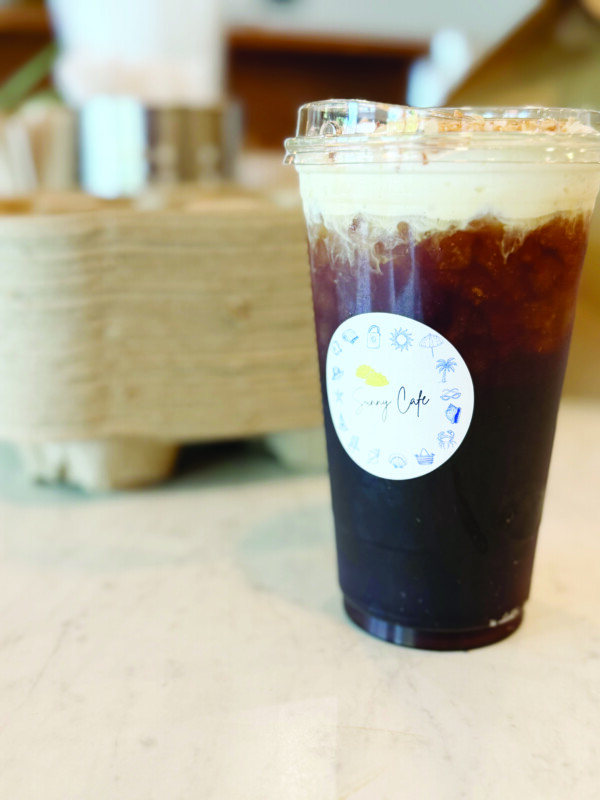
Angelica Basile is the hospitality manager at Sunny Cafe in Manchester. She has worked in coffee for her entire career. (“I love, love coffee so much!” she said.) Her theory is that New Englanders’ love of iced coffee is tied to a sense of comfort and predictability.
“I think a big part of it is that it’s easier to get a consistent cup of coffee when it’s iced,” she said, “because you don’t have to worry about temperature. You don’t have to worry about the texture of your milk and everything. It’s dependable. I know that if I go to Dunkin’ today, I can get the vanilla iced coffee that I got when I was 16, and it’s going to taste exactly the same. And that means something to somebody. To get your drink and to not have to question whether or not you’re going to enjoy it by the time you get to your office when you’re able to take your first sip, that matters. It’s dependable. I think it’s a ritual. I’m the same way. Anything with a straw, you sign me up. So I have to have it in my hand. It also might have to do with the fact that New Englanders, in the last 20 years, all decided to quit smoking at the same time. So the straw plays a big part, too.”
The coffee
Basile said that another factor with commercial takeout iced coffee is the size of the company selling it and the quality of the coffee beans they use. Huge coffee chains have to balance the quality of the ingredients with the price a customer is willing to pay. Iced coffee, she said, lends itself to extras that tend to mask subtle tasting notes of the base coffee.
Some coffee drinkers have started “to change their drinks to be more coffee-focused, and then there’s people that love what they love, with 12 pumps of caramel,” she said, “and there’s no shame on either way. When a place has a poor-quality bean or the extraction method is not up to par, then the flavor’s not there just on its own and so that’s when we add the sugar and everything.”
Meg Wright, the owner and operator of Two Moons Cafe in Manchester, said she serves a lot of iced coffee. “Probably 150 cups a day on average.” She and her staff might serve several cold coffee drinks at a given time, she said, but they are all built around the same base coffee.
“We’ve always used a medium roast,” she said. “That usually goes well with whatever flavors customers ask for. But for the last couple of weeks I’ve been trying to switch it to a blend called Blackcraft’s Salem 1692, which is more of a dark-medium. People seem to enjoy that more with ice. We use nugget ice, so it tends to be more drink, less ice.” Wright said her customers are encouraged to experiment with different flavors in their iced coffees. “On average, we have about 15 different flavors. We can make our house specials with that. But customers can make any variation. We love making potions here, we love to just create things and make customers happy.”
The Iced Shaken Muskov
Brothers Cortado in Concord has a reputation among area iced coffee drinkers for making one of the best cold coffee drinks around. According to Chuck Nemiccolo, it’s called an Iced Shaken Muskov.
“The idea behind this drink,” Nemiccolo said, “is that we like to use this really dark, unrefined sugar, which gives it a real earthiness but also some caramelization when it heats up. That’s where the name came from; ‘muscavado sugar’ is a mouthful to say, so we changed it to ‘Muskov.’”
“What we do is we use a shaker, like you’d find at like a bar or anything like that, and we muddle bourbon vanilla, which we make in house. It’s vanilla syrup that we’re famous for as well, along with the unrefined dark sugar and espresso. We muddle those together, then we add ice, shake them up, put them in a cup, and then top it off with oat milk. It’s a layered beverage, so when the customer typically gets it, it’s going to be dark brown on the bottom, and then it turns to a light color at the top. It’s creamy. The oats actually provide a lot of the flavor since we use full-fat oat milk. It has a very distinct flavor that it also adds to the drink’s profile, along with that dark sugar and the vanilla to round it out to give it a three-tiered tasting. It’s like drinking in three dimensions.”
The add-ons
For Wright and her staff, syrups and flavorings for iced coffee are not afterthoughts.
“We make half of our syrups in-house,” she said. “Sometimes getting a syrup is harder than we’ve counted on — our boysenberry syrup, for instance. That one turned out to be very involved and time-consuming. Basically, a boysenberry is a mix between a blackberry and a raspberry, and you have to boil those down. You have to strain out the seeds, and then you can start making the syrups. But you have to strain the seeds like five different times. It can take hours before I’m able to add the sugars, the cinnamon, and all the other things I need to to create that thick syrup.” And some flavors just aren’t team players. “We made a blueberry-lemon latte at the beginning of the year and the lemon sang through the whole thing. It was good, but you could not taste the blueberry. I was like, ‘OK, that’s not great….’”
In spite of the dozens of flavors available at Two Moons, and the hundreds of possible combinations of flavors, Wright said many of her customers consistently make the same two choices.
“A lot of people just come in and get black iced coffee; they’re mostly mill workers. And they’ll just come in, get their coffee, and walk out. They’re just looking for the caffeine hit; sometimes they’ll ask for a splash of milk, but no syrups, no sugars, just straight up. Nothing fancy, We offer them sugars and milks, but they tend to opt out. The other iced coffee we get a lot of is vanilla, because our house-made vanilla is really, really good. People with the specialties are people with a little more time on their hands and a little quirkier. Some people are really into the sweet stuff, but a lot of our house syrups are not super-sweet. That’s on purpose, because we want the coffee to shine. That’s kind of why we’re here.”
The grind
Smithers Lafferty is the owner of Mill City Roasting Co., an industrial coffee roasting company in Londonderry.
“It’s important to get the name right,” he said. “Mill City Roasters is actually a company that builds [coffee roasting machines] in Michigan, and we get their phone calls all the time.”
Mill City Roasting roasts raw coffee beans and custom blends them for a variety of customers. Because the vast majority of the beans are ultimately used to make traditional hot coffees (including espresso-based drinks), iced coffees and cold brewed coffee, Lafferty puts a great deal of thought into coffee brewing, as well as roasting. He said that to make good coffee of any kind it’s important to think about everything it goes through before it touches your lips.
“Originally,” he said, “someone would take hot coffee and actually pour it over ice.” That would melt most of the ice and water the coffee down. Then, he said, kitchens would compensate by making the coffee stronger. “You’d take a finer grind and a heavier drop-weight to make a more intense base coffee.”
In coffee parlance, “grind” refers to how tiny the pieces of roasted coffee beans have been processed to. The same weight of coffee with a finer grind will have much more surface area that comes in contact with the brewing water and will have a more intense flavor. Beans for espresso, for instance, are ground almost to a powder. “Drop-weight” refers to how much of the ground coffee — measured by weight — goes into the basket of the coffee maker. Thus, a finer grind and a heavier drop-weight results in a stronger pot of coffee.
“Now,” Lafferty said, “typically, people will brew the coffee and set it out, let it come to room temperature, and then refrigerate it. The coffee we sell to be used in iced coffee is usually a slightly darker roast, which has a fuller taste. We recommend that the users grind it finer [than for hot coffee] and use a heavier drop-weight. Typical drop weights [for a standard 64-ounce pot of coffee] are two ounces to three ounces. For iced coffee we recommend a three-and-a-half-ounce drop weight.” This is the brewed coffee that is left to cool to room temperature, then refrigerated.
Cold brew
Then there is cold brew.
“Cold brew is coffee extraction without hot water,” Lafferty said. “Hot water is what pulls the oils, the tannins, the essence out of coffee grounds during a typical three to three and a half minute brew cycle. Cold brew alleviates the heat, so the coffee grounds steep in room temperature or cold water for 12 to 24 hours, depending on what strength you want. Caffeine extracts differently, so cold brew is a much more caffeinated product. There’s a deepness and a richness to it. We do it for our customers in filter bags to make it easy for them. And with cold brew, you grind it the opposite of iced coffee — you grind it coarser because it’s in contact with the water for so long. If you were to grind it finer It would just be far too overextracted.” Additionally, he said, there are some chemical compounds in ground coffee that are only released with heat, so cold brew will actually have a different chemical composition than traditionally brewed coffee.
Not surprisingly, Emeran Langmaid, the vice president of operations of Rare Breed Coffee in Nashua, has strong feelings about iced coffee.
“I am somewhat opinionated on this,” she said. “I think the best way to have iced coffee in the summer is actually to make a cold brew concentrate. It is basically a one-to-five up to one-to-eight ratio of coffee to water. That’s by weight. I make it in a French press, with a coarse grind. I let it steep for 24 hours, and the benefit is that you end up with a concentrate that you can dilute with whatever liquid you want to dilute it with. So my preference is diluting it with an alternative milk and it resembles a quick and easy iced latte. You can dilute it with water. You can dilute it with seltzer. You can dilute it with ice cream. So there’s a lot of different ways that you can serve that beverage. And that concentrate is shelf-stable for 20 days in the refrigerator.”
“In terms of like the actual dispensing of it,” Langmaid said, “because it is refrigerated, ideally it would be in a pitcher. So if you are hosting an event, then you would take that concentrate and dilute it with whatever beverage you want to, and that would be in a pitcher, which you would then pour out into glasses with ice.”
Langmaid suggested using standard-sized ice cubes for iced coffee.
“I wouldn’t use shaved ice or chips,” she said. “This is not a sipping drink that you’re going to linger over for a while. You wouldn’t want to use some of those oversized ice cubes that are used for cocktails sometimes.”
Straw or no straw? “I think that kind of depends on the glass that you put it in,” Langmaid said. If it’s like a rocks glass, if it’s like a smaller drink, then I would say no straw. But if it’s in a tumbler, like a 12- or 16-ounce tumbler, then I’d put a straw in it.”
The Iced Coffee Klatch
Brothers Cortado (3-5 Bicentennial Square, Concord, 856-7924, brotherscortado.com), Open Monday through Saturday, 7 a.m. to 4:30 p.m.
Mill City Roasting Co. (669-7625, millcityroasting.com)
Rare Breed Coffee (2 Pittsburgh Ave., Nashua, 578-3338, rarebreedcoffee.com)
Sunny Cafe (50 S. Willow St., Manchester, 935-8658, sunnycafenh.com), open Monday through Thursday, 7 a.m. to 3 p.m., and Saturday and Sunday, 7 a.m. to 5 p.m.
Two Moons Coffee & Curiosities (155 Dow St., Suite 102, Manchester, twomoonscafenh.com), open Tuesday through Friday, 7 a.m. to 2 p.m., and Saturday and Sunday, 8 a.m. to 2 p.m.
Iced coffee at home
According to our experts, there are some general principles you should stick to when making iced coffee.
Start with whole beans. This will allow you to have more control over how fresh the coffee is and how fine the grind is. Most supermarkets have grinding machines in the coffee aisle that will allow you to grind your beans to whatever degree of fineness suits you. Most of them will also calculate and measure the weight of your ground coffee for you. “They use a timer for a custom drop-weight,” Smithers Lafferty from Mill City Roasting said. “You set it for a particular weight, and the timer turns the grinder off at the right time for that amount.”
Grind the right amount of coffee for the type of coffee you want. Lafferty suggested a three-and-a-half-ounce drop-weight for traditionally brewed iced coffee.
Don’t dilute the coffee more than you have to. “We put our coffee in an immediate bath,” Meg Wright of Two Moons Cafe said. “We put it in a secondary container, we let it sit in there. We don’t want to water it down with more ice, so we don’t add ice to it.”
There are rumors of area restaurants that make ice cubes from frozen coffee, which will not water down iced coffee, but they are difficult to verify. There seems to be a word-of-mouth network of area coffee enthusiasts who keep track of such things. Lafferty endorsed this idea but cautioned, “Take the time to make ice cubes — it’s worth it — but buy yourself a coffee-only ice tray because you’ll find there’s going to be a sticky frozen residue. You’ll never make clean water ice in the same tray again.”
Pay attention to the details when you make cold brew. Meg Wright from Two Moons Cafe suggested a 10-hour soak for cold brew. “You want to make sure you’re submerging all of your beans,” she said.” Make sure you stir it up every once in a while.”
For large batches of cold-brew, Smithers Lafferty recommended suspending 5 pounds of coarse-ground coffee in 5 gallons of water for 10 to 14 hours. He uses large reusable nylon bags to hold the cold brew grounds, much like a giant tea bag. These can be purchased online and fit easily across the rim of a standard (food-safe) 5-gallon bucket.
Emeran Langmaid uses a ratio of water to coarse grounds (by weight) to make a concentrate, which she said gives the drinker a lot of flexibility.
Shake it like a Polaroid picture. When Smithers Lafferty serves iced coffee — either traditionally brewed or cold brewed — he shakes it with ice and a small amount of whole milk in a cocktail shaker. “That gives it a little bit of body,” explained his wife, Sarah. After shaking, the coffee will have a thick head of foam. “Typically, cafes will serve it with a foam topper,” Smithers said, “which they just make out of a little whipper. Again, it’s an add-on for them to be able to maximize some form of marginality in it. Any little thing that you can differentiate yourself to seem unique.”
Recipes
Easy Iced Coffee
- 3 ounces cold-brew coffee concentrate, homemade or premade
- 6 ounces half & half – With iced coffee, the richness is part of the point. In theory, you could use any dairy or dairy substitute, but try to use something with about a 15 percent milkfat content.
- 1 ounce simple syrup – Sugar is resistant to dissolving into cold liquids. Take a tip from southern sweet tea enthusiasts and use syrup instead. Simple syrup made from sugar and water will keep the flavor straightforward, but any flavored syrup will work well here.
- Frozen coffee (optional) – Ice cubes made from frozen black coffee will keep your iced coffee from getting watery if your conversation runs long.
- Garnish – shaved dark chocolate. Freeze a few squares of your favorite dark chocolate or a handful of chocolate chips. To garnish your iced coffee, use a vegetable peeler to sprinkle chocolate shavings over your iced coffee. Alternatively, bash a small handful of frozen chocolate chips with a hammer.
Combine coffee concentrate, half & half, and simple syrup with ice (preferably frozen coffee cubes) in a cocktail shaker and shake enthusiastically for 10 to 15 seconds, then pour into a tall glass.
Iced Irish Coffee
- 3½ ounces freshly ground coffee
- 6 Tablespoons (about ⅓ cup) brown sugar
- 1¼ cups (10 ounces) Irish whiskey
- Garnish – gloppy whipped cream
Fill the basket of your coffee maker with 3½ ounces of your favorite coffee. Brew a standard 64-ounce pot of coffee with it.
While it is still hot, stir in the brown sugar. Stir it more than you think you need to. Because the coffee is hot, the sugar will dissolve, but it might take a little convincing.
Leave the coffee to cool to room temperature, then refrigerate.
When it has cooled to your satisfaction, stir in the Irish whiskey, and pour into individual glasses over ice; frozen coffee cubes would be very good in this application. Top with a healthy glob of whipped cream.