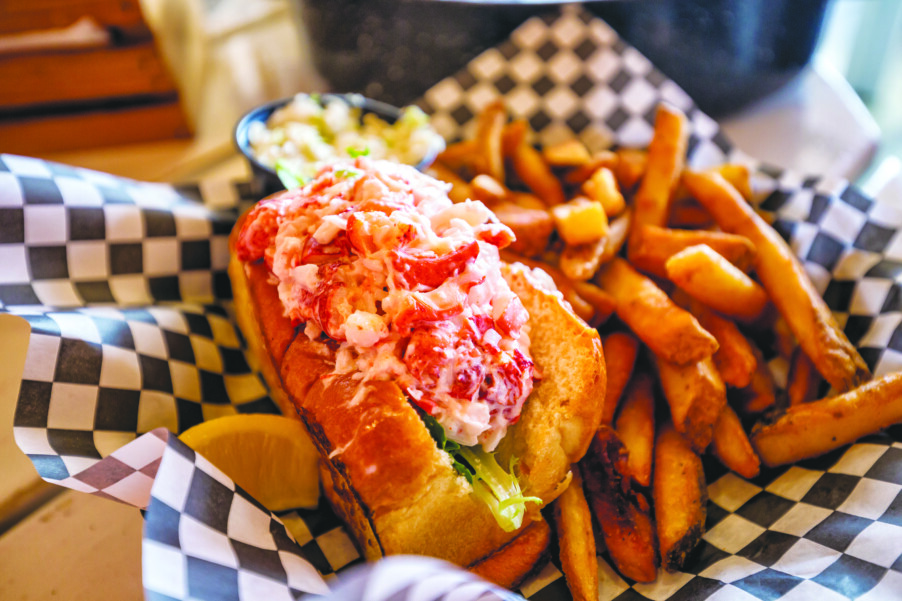
On enjoying one of New England’s seafood treats
Fred Fullerton is the owner of Freddie’s Fish in Manchester. According to him, he’s sold more lobsters than anybody on the planet.
“Well, maybe …,” he said. “I’m not 100 percent sure, but it’s not that far from the truth. I’ve been dealing with lobsters since I was 10 years old. My father had a boat. My brother and I were fishing on a boat, and the boat caught fire one night, so I ended up going to work for the largest live lobster company in the world, and he ended up going fishing with my cousin….”
The point is that Fullerton has spent decades working with lobsters. Like most seafood markets, Freddie’s sells lobster meat, whole cooked lobsters and live lobsters. For lobster fans who want to make sure they get the highest possible quality of lobster Fullerton recommended buying and cooking live lobsters.
“The reason supermarkets [precook] lobsters, he said, “is because what ends up happening is they’re selling lobsters that, you know, aren’t in the best shape. … Lots of people think, ‘Oh, they’re cooking a lobster for me!’ They don’t necessarily know what they’re getting.”
Lobster shopping
Fullerton explained that all the lobsters in the Northeast — the ones with two claws — are the same species, so a consumer should look at the condition of individual live lobsters.
“You want to look for hard-shell lobsters,” he said. Because lobsters grow throughout their lives, but their shells do not, they moult once a year or so. After they’ve shed their old shells, they are referred to as “soft-shell” lobsters, until the new shell hardens up.
“Hard-shell lobsters are the best bet,” Fullerton said. “They’ve got the most meat content inside. That’s where [a customer is] going to get the best bang for their buck. You’re going to pay more money if you buy a soft-shell lobster because there’s less meat inside. You’re not eating the shell, right? You’re only going to get [each lobster] a dollar, maybe two dollars cheaper. But there’s probably half as much meat.”
(If you’re worried about how much pain a lobster will experience as it is boiled, most chefs recommend dropping the lobster into the water head-first, which they say will kill it instantly. Some chefs will quickly cut through the lobster’s head with a sharp chef’s knife before dropping it into the boiling water. The website getmainelobster.com advises chilling the lobster before cooking: “We recommend killing the lobster humanely just before cooking. Place lobster in freezer for 2 hours. Remove from freezer, making sure it is no longer moving. Push the tip of a skewer or large, sharp, heavy knife into the center of the cross on its head.” Contrary to what your brothers or cousins might have told you when you were little, the whistling sound a cooking lobster makes is not “screaming”; it is the sound of steam escaping the shell.)
Actually cooking a live lobster is easy, Fullerton said. If you’re cooking a lot of lobsters at the same time, he recommends steaming them.
“It’s a little faster,” he said. “It just takes less time for the water to heat up. And that way you don’t have water spilling out, like I did the other day. I had water spilling all over my stove.” Either boiled or steamed, he said, cooking lobsters doesn’t take long.
“Hard-shell lobsters take 16 minutes after you boil them. So as soon as the water boils, throw them in — 16 minutes. Two to three takes 18 minutes. And there’s an easy way to check … take it by the antenna. Give the antenna just a little tiny pull. If the antenna pops off, it’s done. … that’s good to know. Soft shell lobsters take way less time to cook — eight minutes,10 minutes.”
Mark Merrik is the warehouse manager for Shyer’s Lobster Pound in Salem. He’s worked there for more than 30 years. Shyer’s has a retail store that sells lobster and other seafood, but the bulk of the business is shipping lobster around the country and around the world, he said.
“We ship lobsters, primarily. Seventy to 85 percent of the business is wholesale shipping into places like Florida and Texas. We do some stuff to casinos out in Nevada, but we primarily go into Fort Lauderdale and then the Dallas-Fort Worth area. Our big orders we ship basically through truck as well as via air out of Boston.”
According to Merrik, the idea of a “lobster season” is a bit of an illusion.
“Summertime prices for lobsters tend to come down a little bit — we are bringing in soft-shell lobsters now, since they do moult every year, and there’s less meat, so the prices do come down a little bit through that.” But from a wholesale perspective, he said, lobsters ship out throughout the year. “We’re generally busy during the holidays — Mother’s Day, Father’s Day, Fourth of July and stuff like that, but apparently lobster is a traditional present on Mother’s Day. For some people, anyway. In the old days we used to have people come in at Thanksgiving, instead of getting a turkey. We used to bring in, you know, jumbo lobsters and … it used to be a tradition with a couple of New England families who used to come here. We’d get them a 16-, 17-pound lobster and that would be their turkey dinner. But it would give you a nice look, like a roast, a roast of a lobster tail.”
Merrik said lobsters are picky about their water. It has to be very cold salt water.
“If they’re actually in water, it’ll kill them if they’re in warm water.” It has to be 40 to 45 degrees, he said. So surprisingly, lobsters are shipped dry. “As long as they’re cool and dry, they’re good for two or three days during transit.” They are packed into compartmentalized coolers that look like wine cases. “We ship them overnight to Florida. We’ve got three-pound gel packs we use to keep them cool. You keep them cool and when they get to their destination the following day some of the companies we ship through have their own tanks with refrigerated water down there where they put them.”
Lobster dinner
Andy Day, chef at Cask & Vine in Derry, described lobster as “New England soul food.”
“It’s one of those things,” Day said, “where if you’re from this area you want lobster. You want a lobster bake. You want to crack them. You want to make a mess. You want the butter. You want all of that experience. And it is fairly unique to this area. It’s our thing.”
While restaurants add lobster to a great number of dishes, Day prefers simple preparations that showcase the flavor and texture of the lobster itself.
“Personally,” he said, “one of my favorite things to do is butterfly the tail — take the tail off, butterfly that — and then if I’m feeling fancy I’ll … take some of the claw and knuckle meat and after I’ve butterflied it I’ll stuff some of that in there so it’s kind of like a double stuffed tail so you’re getting a little bit more meat, a little bit of the knuckle and a little bit of the tail. I might do something with risotto, with some sort of green sauce. But at the end of the day, I am, yes, I’m pouring some garlic butter over it, and then maybe another sauce with it. Something that complements it.”
Paul Saella, who describes himself as the “Head Bottle Washer” at Makris Lobster and Steakhouse in Concord, said that although his restaurant makes any number of lobster dishes, the most popular one is a traditional steamed whole lobster, which can be intimidating to some customers at first, but he and his staff are happy to guide them through it.
“We shuck hundreds of pounds of lobster a day,” Saella said, “and we’re more than happy to show anybody who comes in how to do it.”
“We crack off the arms first,” he said, “then the tail off of the body. Then we crack the tail in half so that we can rip it in half to get the meat out. And then we crack the claws and get the meat out of the claws. And if the lobster is big enough we even take the meat out of the body. We use rolling pins to get the meat out of the legs.” That’s more of a professional technique, he said, better suited for in the kitchen than at the table. “If you come to my establishment,” he said, “it’s even simpler. All of our placemats have a how-to guide on them. It gives the breakdown right there.”
Because of its rich taste and firm texture, lobster lends itself to a host of rich dishes, Saella said.
“We make a lobster and asparagus fettuccine; that’s with an alfredo sauce. It’s very popular. We do lazy man lobster — we take it out of the shell. And to get eight ounces of lobster meat, we’re probably looking at about three pounds of lobster in the shell. We get about a third of the weight out of the lobster. A one-pound lobster gives us about four ounces of meat.” That’s enough for a small lobster roll, he explained. “With a four-ounce lazy man’s lobster, we use a simple lemon butter and crumbs and we bake it.”
“We stuff lobster,” Saella continued. “We stuff it with sea scallops, shrimp, haddock, and crab. And our lobster stew is very popular — it’s the best. We make everything from scratch here, so we can make [the lobster stew] with stock that doesn’t have anything but lobster bodies in it.”
Saella views lobster as the perfect complement for rich foods. “I think that just the texture of it and the flavor goes well with natural fats and butters. Like with bacon, it goes wonderful. With cream, it goes wonderful. It goes great with eggs. But just as a lobster cocktail, cold is great too if you like lobster.”
Lobster roll
Perhaps the quintessential summer lobster dish is a classic New England lobster roll.
Chrysanthi’s Restaurant in Belmont is well-known for its lobster roll, co-owner Evan Gerekos said.
“We are worth traveling for, for a lobster roll, 100 percent,” he said. “We have people that come from all over the place for ours. It is a half-pound lobster roll, seasoned with a light mayo and a little bit of lemon — not overly powered — and we do it in a nice buttered roll.”
There are two schools of thought about the lobster salad that goes into a classic lobster roll, Gerekos said. “We only do one type of lobster roll here. Many do a buttered lobster roll. Our lobster salad only includes lobster and some lemon and that’s about it. And mayo of course.” The other type is butter-based, he said. “People take hot liquid butter and they pour it on top of the roll. Clarified butter, or ‘drawn butter’ as the lobster people like to call it.”
Lobster rolls at most restaurants use either a four-ounce or an eight-ounce portion of lobster.
“We use eight ounces of claw and knuckle lobster meat for our lobster roll,” Gerekos said. “There’s no cutting corners; it’s a whole lobster. And we don’t use a hot dog bun either. We use a brioche roll. We bake it in-house and then we butter the inside and then we grill it and then we fill it with a lobster. We heat the roll up, which makes the bread just easier to eat and also makes it more malleable, so it contours to the lobster meat. That way when you bite it, it doesn’t just all fall out. Have you ever had an overstuffed anything? The moment you bite it, it all comes out of the roll. So if the bread has more elasticity to it when we heat it up, it makes it possible to hold the food inside.”
While there really isn’t a season for lobster, lobster rolls definitely have one, Gerekos said.
“We only do it seasonally,” he said. “We start in May, right around Mother’s Day. And we run it till the end of August, beginning of September. It’s definitely a summertime season. And that’s pretty much the case — I’m not going to say everywhere — but that’s a rule of thumb in the industry. I think it’s one of those things that, in February, you would prefer something like beef stew in New Hampshire. In July, you wouldn’t mind a light lobster roll.” (“Light” for half a pound of lobster meat, dressed in mayonnaise, being a relative term.)
Because of its richness, Gerekos suggested something sharp-tasting to drink with a lobster roll. “Probably some sort of beer,” he suggested, “an IPA of some sort. We like one by Great North Brewing out of Manchester. For non-drinkers, such as myself, I’d suggest something carbonated — Coca-Cola is always a good choice.”
Gerekos said most restaurants in New England get their lobsters from the same sources.
“We all use a pretty similar lobster or lobster meat,” he said. “So from the coast of Maine to even here in interior New Hampshire, you’re getting a quality product as long as it’s treated with respect.”