Braided breads, cinnamon rolls and more ideas for your holiday meals
There is a similarity between baking bread and celebrating holidays, according to Cheryl Holbert, the owner and baker at Nomad Bakery. She bakes a full spectrum of breads, but challah, a traditional Jewish braided loaf of enriched dough, really resonates with her.
“What is so wonderful about baking challah for me is that it really is a time where all of the busyness, all that we’ve been doing, kind of settles down in that moment before your workspace, your baker’s bench. It just, it quiets. We enter into a time that is different. It’s set apart. It’s a time when we slow down. We breathe. We become more intentional. It’s kind of defining that one moment constantly blending into another where you just kind of feel overwhelmed with life. It really allows you to reset as well.”
Recipe: Challah
As Cheryl Holbert alluded to, basic recipes for challah have remained remarkably similar over time. A recipe for “Cholla – Sabbath Twists” from a copy of The Way to a Man’s Heart: The Settlement Cook Book, dated Jan. 25, 1921, is nearly identical to recipes from modern Jewish baking books. This is a synthesis of those recipes. Makes two braided loaves.
- 1 envelope dried yeast
- 3¾ cups (500 g) flour, ideally bread flour, with more for dusting and kneading
- ¾ cup (170 g) warm water – as warm as a relaxing bath
- 2 eggs + 1 egg yolk, plus another egg for glazing – so you’ll need to start with four eggs altogether
- ¼ cup (55 g) vegetable oil, but not canola oil, because reasons
- 1½ teaspoons salt
- ⅓ cup (70 g) sugar
- Poppy or sesame seeds for sprinkling
Mix the dry yeast and warm water together, and set them aside to proof.
Separately, whisk the two eggs and the egg yolk together with the oil, salt and sugar. When everything has dissolved into each other, mix all the flour. Using a wooden spoon, or a dough hook on your stand mixer, mix it at slow speed until it comes together to form a rough or “shaggy” dough. Knead it until it pulls together into a smooth, and slightly silky dough. You can do this by hand or with the dough hook. Add small amounts of flour if it gets too sticky, but be frugal with it.
Divide the dough into two equal blobs and put each inside an oiled bowl — again, not canola oil — cover them, and let them rise until doubled in size, usually about two hours if your kitchen is warm.
Line two baking sheets with parchment paper.
Take first one ball of dough, then the other, cut it into three equal pieces, and roll each piece out with your hands to make a snake. A long cylinder of dough, not an actual snake. That would be super-cool but would not make good bread. Braid the three ribbons of dough to make a braided loaf, and tuck the ends underneath to make everything look neat. Cover the dough, and let the bread rise until it has tripled in size, about two hours. Preheat your oven to 325°F.
Beat your remaining egg, and brush the two braided loaves with it. This will make the crust a highly attractive golden brown color and will make the poppy or sesame seeds stick to it (see next sentence). Sprinkle poppy or sesame seeds over the top of each loaf.
Bake the bread for 35 to 40 minutes or until it sounds hollow when you tap the bottom with your finger.
Let the bread cool slightly before cutting it; otherwise the challah will squish up and get gummy.
Breads with braids
Braided breads are common throughout Eastern and Northern Europe, particularly during times of celebration, Holbert said. “Celebratory breads really, to me, are cousins. They’re all very similar. You have the kolach for the Ukrainian Christmas; it’s very, very similar to challah. Even the shaping is similar.”
That said, Holbert observed, recipes for basic challahs are very simple and virtually interchangeable. They become adapted over time, depending on what other ingredients are available.
“There is milk in Jewish bread,” she said, “but you would add water so it could be served with meat for a holiday or for Friday night Sabbath. [All challah is] very similar in that it’s a bread flour, a fat — usually an oil for challah — with or without egg, salt, yeast, yeah, and that’s pretty much it. I use honey in mine at certain times and not in another, so those kinds of things, and then of course you can do creative takes on it, but that is essentially the core.”
Tara Bartilucci is the owner and baker of the Big Trees Bread Co. in Canterbury. This would normally be her busiest time of the year, but she is taking a medical hiatus for the next two months. But, because the November and December holiday season is so bread-focused, she is spending this time developing new recipes. The one on her plate right now, so to speak, is for nisu, a typically-braided bread made in Finland at the end of the year.
“It is a sweet Finnish cardamom bread,” she said. “It’s a very enriched dough and they typically make it for Christmastime. It’s braided. Sometimes they put some pearl sugar on it or sliced almonds.” She explained that an “enriched” dough is a bread dough that uses yeast but also includes rich ingredients. “In this case,” she said, “eggs, butter, and milk.” The issue with an enriched dough, she said, is that those ingredients slow down the yeast, meaning that it takes much longer for the dough to rise. Baking with an enriched dough can become an all-day process.
But this bread is extremely intriguing to Bartilucci.
“I actually have never even seen or tasted nisu before, and I’m not Finnish,” she said. “This was brought to me by one of my older customers at the Canterbury Farmer’s Market. And she told me about her fond memories of nisu as a child … around Christmastime and sometimes Easter her family would make it. So a few weeks later she brought me a recipe and wanted me to try to make it. But I’ve been holding on to it for about two and a half years and haven’t had the time until now.”
“Typically, from what I understand at this point, it’s braided, usually four or more plaits,” she said. “It could either be in a loaf pan shape or a ring, but it’s served sliced at the holiday. It’s usually accompanied by tea or coffee — more of a dessert bread.”
Quick breads
High-effort, high-reward breads like nisu start to make an appearance in the weeks leading up to Thanksgiving, not just because they are special and make good gifts, but also because they let bakers really go all out and try over-the-top ideas that they might be intimidated by at any other time of the year.
But there is another, equally valid way to make bread presents for the holidays. Kristen Chinosi, the owner and an instructor at Culinary Playground in Derry, said quickbreads are naturals during the holiday season and make great hostess gifts.
“They’re quickbreads because they don’t use yeast, Chinosi said. “They rely on chemical leaveners such as baking powder or baking soda to get their rise. So, they end up being a quicker process. They still have a long bake time, but you don’t have the proofing required that a yeasted bread does. As a hostess I actually don’t love when people bring food that they expect me to put out with the meal. That’s hard to manage and hard to coordinate. So I love something like that I can save for later, right? Like, ‘Oh, I have breakfast for another day,’ or ‘I’m hosting in a few more days and here’s a little breakfast something that I can put out,’ rather than trying to sneak another something onto the buffet.”
Chinosi said that because they are denser and less airy than most yeast breads, quickbreads are excellent vehicles for strong flavors. “I love thinking about quickbreads as a savory bread as well,” she said. “They can actually be a substitution for like a dinner roll or some other kind of bread. And they’re fun, because you still bake them in a loaf pan, so it’s a really pretty presentation. But you can use all different kinds of cheeses. You can use bacon or salty meats in there. You could have sun-dried tomatoes. You can have fresh or dried herbs. I love the savory ones in terms of adding that to your kind of dinner menu. And then the sweet ones are just fun because you can have those made in advance. There’s something you can freeze and pull out like on Christmas morning. And then all of your kind of fall Christmas holiday flavors you can have in there. You know, the citruses are really bright and fun paired with cranberries, you know, like orange-cranberry is a great combination. You can have a lemon poppy seed. You can also glaze your quickbreads if you’re looking to make them even a little bit sweeter, a little bit more decadent, a little something more special. You can have various glazes that you can put on there to coordinate and highlight what you have in your quickbread for a filling.”
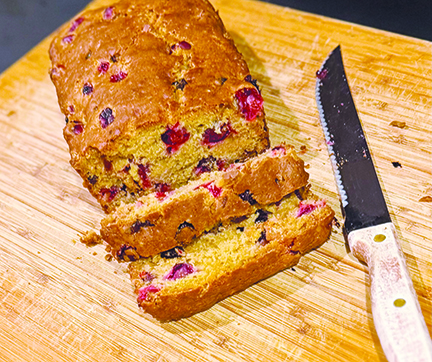
Recipe: Cranberry Bread
A sweet quickbread that can also be made as muffins.
- 2 cups (240 g) flour
- 1 cup (99 g) sugar
- 1½ teaspoons baking powder
- 1 teaspoon salt
- ½ teaspoon baking soda
- ¼ cup (half a stick) butter, chopped into smaller pieces
- 1 egg
- ¾ cup (170 g) orange or tangerine juice
- The zest of one orange
- 1½ cup (150 g) whole cranberries
- ½ cup (57 g) dried cranberries for extra cranberryness
Preheat your oven to 350°F. Grease and flour a loaf pan, or line it with parchment paper.
In a mixing bowl, whisk together the flour, sugar, baking powder, salt and baking soda. Add the chopped butter to the dry mix, and pinch it in with your fingers, until it looks like you’ve got a bowlful of medium-sized crumbs.
In a separate bowl, whisk together the egg, juice and zest, then add it to the dry ingredients and stir until everything is combined. Stir in the whole and dried cranberries, then transfer the batter to your loaf pan, and bake for 65 to 70 minutes, or until a toothpick comes out clean.
Let the cranberry bread cool in the pan for about 15 minutes before turning it out.
Recipe: Blueberry Muffins
Adapted from the 1950 Betty Crocker Cookbook
- 1½ cups (180 g) flour
- 2 teaspoons baking powder
- ½ teaspoon salt
- 1 cup (170 g) frozen wild blueberries
- ¼ cup (½ stick) butter
- 1/4 cup (950 g) sugar
- ¼ cup (50 g) blueberry or maple syrup (see below)
- 1 egg
- ½ cup (114 g) milk
Heat your oven to 400°F. Line 12 muffin cups with paper liners.
In a medium bowl, whisk together the flour, baking powder and salt. Set it aside.
With an electric mixer, beat the butter, sugar and syrup together until light and fluffy. Beat in the egg and then the milk, until everything is thoroughly incorporated. Set the mixing bowl aside for the moment. Don’t let it panic; you’ll be right back.
Dump the frozen blueberries into the flour mixture, and toss them until they are all covered. This is a sort of camouflage against gravity. If you just mix them into a regular muffin batter, gravity will act like a bully and force them to the bottom of the muffin cup as they bake, and your finished muffin will have a berry-heavy layer at the bottom, and be berry-deficient throughout most of the muffin. If the berries are coated with dry powder, gravity — not to be mean or anything, but isn’t very observant — will say, “Oh, flour and stuff. OK, carry on.”
Spoon the dry mixture (with hidden berries) into the wet batter, and stir gently, until it is all mixed in. Don’t overbeat it, or it will become Tough Muffins, which is a name I danced under in the ‘80s.
Fill the muffin liners with batter, then bake for 20 to 25 minutes. Let them cool slightly — just for a few minutes — before handing them out and slathering them with butter.
Even sweeter breads
“This is the time that I look forward to the most,” said Alyssa Guzman, the owner and baker of Sugar Street Buns in Milford. She said she has been looking forward to this holiday season all year. “This is a chance for us to stretch our imagination and our skills. We just launched the Thanksgiving lineup. I have been so excited about this one. Thanksgiving’s my favorite holiday, so of course I was super pumped; we have so many exciting flavors. This month, we’re making pies [pie-themed buns].
“They’re all super-indulgent buns,” Guzman said. “We’ve got a pumpkin pie, apple pie, chocolate chip pecan pie, and a Thanksgiving Sandwich, which is exactly what it sounds like — that classic leftover sandwich, but we’re using sliced turkey, cranberry sauce, and Swiss cheese. It’s got the crunchy onion bits that you would put on top of your green bean casserole and some mustard as well. Each bun has its own flavor.”
Guzman said December will bring even more holiday-intensive buns. “We’re going to go over the top for our Christmas buns. And I am so excited to show everyone what we’ve got coming. We’ve got some surprise specials planned out. In December, I want to do a gingerbread bun with a gingerbread person on top of it, all decorated. There will be an eggnog bun, of course, and maybe a peppermint one, and of course all of our toppings and cookies and everything we make here in-house. On the weekends we started offering pumpkin hot chocolate with a house-made toasted marshmallow, and that went really well.”
April Repoza of Bigfoot Sourdough is also using the season as a chance to try new ideas.
“We are so excited,” Repoza said. “Our motto is ‘Bigfoot Bakes Different.’ We’re known for wonky, crazy ideas, and we’re OK with that. We call it our Bigfoot Chaos. So some of the things we’re doing for Thanksgiving, We’re doing, obviously, just original sourdoughs, but then we’re making small — maybe too small — little pumpkin-shaped sourdoughs that you can put on your table, but the larger size has a cinnamon stick on the top for a stem. A lot of people in the last few years have been using those as part of their tablescape. But then for the flavors, we have one that was very, very popular the last couple of years — it’s our Thanksgiving bread. It has poultry seasoning in it. It has celery, onion and cranberries. It’s almost like a Thanksgiving stuffing but in sourdough form. We use dried cranberries. We tested with the fresh cranberries, and people liked the dried better.” She said fresh cranberries had a tendency to burst as the bread baked. “I preferred the fresh, but you know, we go with what people like. Some people just want everything to be neat. It’s a savory loaf — it just kind of screams all things Thanksgiving, but in sourdough form.”
“One of our sweet loaves that we have for Thanksgiving, which was really popular last year, is a sweet potato [bread],” Repoza said. “It’s kind of like a sweet potato casserole loaf. It’s a sweet potato loaf, so it is sweet. It has a cinnamon sugar swirl to it. And then, once we bake it about halfway, we cover the entire top with marshmallows and then bake it the rest of the way, so it gets all toasted. So it’s like a sweet potato casserole sourdough. It sounds a little strange, of course, but it’s amazing. It’s really good. And then we’re doing some of the kind of regular flavors, like Italian herb and cheese. We have a croissant loaf that people love. We’re doing that. We’re doing a dried apple and aged cheddar [sourdough loaf].”
“We have these huge, family-sized stars,” Repoza continued, “and one is like a giant cinnamon roll, but it’s shaped like a star and it comes dressed up with some drizzle — but I always put frosting on the side if somebody wants more. And then we do a savory pesto mozzarella star also, and again, that’s sourdough-based. And they’re just, they’re stunning. They’re really nice, nice to bring to a party. Another thing that people really loved last year was stuffing kits. We dry out the sourdough bread and doctor it up with all of the seasonings and sell it dried in a bag with instructions on how to make stuffing. And we also do frozen sourdough pie crust, a ready-to-bake, ready-to-fill pie crust. We do a baked brie. It’s a hollowed out round of sourdough, and we give them the baked brie cold and also a fresh cranberry compote. We hollow out the middle, so that the baked brie is right there and we give them the instructions to just put it in the oven. You can just tear off pieces of the bread and dip it in there and have the cranberry on the side.”
“Another big thing last year that we’re doing again this year, but we’re doing a little bit different, is our sourdough that comes with a butter candle,” she said. “And last year we did, you know, an original and then a roasted garlic.You just, you know, you melt down the butter and shape it into a circle and you put it again inside the hollowed out sourdough and you light it because it’s a food-safe beeswax wick, and then you just tear pieces off and you dip it. It’s an experience and it’s fun.”
Like Alyssa Guzman at Sugar Street Buns, Repoza said she really lets loose in December. “We’re making gingerbread spice loaf. Another bread that went crazy last year was the Little Debbie Christmas tree. It’s a sweetened vanilla sourdough bread — a true sourdough, fermented for 48 hours — and then we laminate it with Little Debbie Christmas tree cakes and sprinkles and bake it, and it’s just, people go crazy for it. And then, of course, we’ll do things like peppermint mocha and like all of the fun holiday flavors. And rolls, of course. We probably sold 500 rolls at Thanksgiving alone last year.”
Recipe: Cinnamon Rolls
Adapted from ambitiouskitchen.com
- ¾ cup (180 g) milk
- 2¼ teaspoons (one ¼-ounce envelope) dry yeast
- ¼ cup (50 g) granulated sugar
- ¼ cup (half a stick) salted butter, melted and cooled
- 1 egg plus 1 egg yolk
- 3 cups (360 g) flour, plus more for dusting and kneading
- ¾ teaspoon kosher or coarse sea salt
- Oil, for greasing the bowl
- ¼ cup (half a stick) salted butter, softened
- ⅔ cup (142 g) brown sugar
- 1½ Tablespoons ground cinnamon
- ½ teaspoon ground cardamon
- 4 ounces (half an 8-ounce package) cream cheese
- ¾ cup (85 g) powdered sugar
- 3 Tablespoons (slightly less than half a stick) butter
- 1 glug of vanilla
Warm the milk until it is about the same temperature as a hot bath, the kind you would take after standing in the cold, waiting for a friend to finish a half-marathon. Combine it with the sugar and yeast, then leave it alone to “proof” for 10 minutes or so. When you come back it should be slightly foamy — that’s the yeast waking up and looking for a party. Beat in the egg and melted butter.
Stir in the flour and salt by hand, or on the lowest speed on your electric mixer, to keep it from poofing up in your face.
Knead the dough — either by hand for eight to 10 minutes or with a dough hook in your stand mixer. Add a small handful of flour, as needed. Kneaded. Whichever. Kneading can be intimidating to start but becomes comfortable and even relaxing once you’ve done it once or twice.
Set the dough aside in an oiled bowl, and cover it with plastic wrap. Put it someplace warm, but not hot, for an hour or two, until it has doubled in size. If you forgot to soften up your butter, this would be a good time to set it out next to the bowl. They can talk with each other until you come back.
When there is a big plastic bubble of gas over the top of your dough, and it’s looking super-poofy, dust your counter down with flour, and roll the dough out into a large rectangle, maybe 10 by 14 inches. Smear the butter over the surface. Clean hands are probably the best tool for this job. Mix the brown sugar, cardamon and cinnamon together, then sprinkle and spread it across the buttered dough. Again, your hands are probably the way to go with this.
Without trying to brutalize it, roll the dough up tightly, starting from one of the narrow ends. With a serrated knife, cut the roll into nine pieces. Line a baking pan with parchment paper or a silicone mat. When the brown sugar mixture melts, some of it will inevitably leak out the bottom and form cement. Delicious, delicious cement. You will regret your life choices less if you don’t have to scrape and clean the bottom of the pan, later on.
Cover the rolls and let them rise for another hour or so — check them at 45 minutes — until they have doubled again. You squeezed out most of the carbon dioxide that will make them fluffy, when you rolled out your rectangle of dough. You have to let the individual rolls make more now. Preheat your oven to 350°F.
When the rolls are big and basically yelling at you, “Put us in, Coach! We’re ready!,” bake them for 20 to 25 minutes. They should just be turning golden brown. Just slightly. Don’t take them to full bread-crust brown; they will be too dry and chewy.
Whisk the cream cheese, powdered sugar, butter and vanilla together. If you do this by hand, let them all warm up first. This is your frosting. Smear it across the cooling cinnamon rolls in whatever way feels best to you. If you decide to use clean hands again, the Cinnamon Roll Police will not come crashing through the window.
Recipe: Popovers
Adapted from the 1950 Betty Crocker Cookbook
Need a savory bread? Even the simplest from-scratch dinner rolls can take up an afternoon. Most of them require two rises, and experience. Popovers, on the other hand, are super-satisfying and not very difficult, though timing is everything.
- 1 cup (120 g) flour
- ½ teaspoon salt
- 1 cup (227 g) whole milk
- 2 eggs
A mirror, or the camera function on your cell phone.
Preheat your oven to 425°F.
Liberally grease large muffin tins with a flavorful fat — butter, beef fat from a roast, turkey drippings, etc. Let a little pool in the bottom of each muffin tin.
Gather your ingredients and set up your mixer. Look at yourself in the mirror or on your phone, and tell yourself, “OK, baby, it’s go time.”
Pop the muffin tins into the hot oven, to get the fat sizzling hot.
Without missing a beat — so to speak — beat the other ingredients together at high speed with your mixer. Pull the sizzling-hot muffin tins from the oven, and pour the popover batter into them.
Bake until puffed up and golden brown, which theoretically takes about 35 minutes, but might not, so check them early. Serve them immediately.