Bespoke beans

Kawa roasts custom coffee blends

It was late at night on a Wednesday and everyone was asleep except Jeff Wilkins, who, ironically, was roasting coffee.

Wilkins is the owner and roaster of Kawa (pronounced “Kah-Vah”) Roasters, a small-batch coffee roasting company in Manchester. He was roasting batches of three pounds of coffee each.

“I ordered this machine brand new,” he said, laying his hand on a large, stainless steel appliance with a window showing roasting coffee beans being tossed and circulated. “This does a maximum of three pounds at a roast at a time,” he said. “I can buy a machine in this same design that will do up to 18 pounds, and that’s what I’m hoping to grow into, but at the moment this is where I’m at. I do multiple roasts a night, and then I blend them all together because it’s all manual. I don’t have any automation on this, so it’s all by sight, smell, time and temperature. Sometimes I’ll get there and that’s the whole point that I mix it. If one roast is a little too dark, I blend it with one that’s lighter.”

Wilkins said coffee roasting started out as a hobby for him.

“About three and a half, almost four years ago,” he said, “I decided that it was time to quit drinking alcohol and needed something to stay busy at night. My wife and I love coffee. So I said, hey, let’s learn how to make it. So I bought a roaster. It’s a little tabletop, you know, $500 job. I set it up in my garage and started playing around with it. I started watching videos, I read articles, and I did whatever I needed to do to try and figure out how to do this process. I made a lot of bad roasts and I burnt a lot of things. I found some things that worked, and eventually I kind of settled in on a, I’ll call it a recipe, that worked for the tastes that we like to come out of the beans.”

This led to gifts of home-roasted coffee to family and friends, who eventually convinced Wilkins to start roasting coffee professionally. Although he sells his coffee at a number of farmers markets and other events, most of his focus is on custom-roasting coffee beans for individuals and small businesses.

“I can do customized roasts for those that want to do their own unique blends,” he said. “I can do [bespoke] roasting where if you’re a cafe or a baker that’s doing, you know, 20, 30, 40 pounds a week and you want to private-label it, I’ll roast them and put them in your bags. Or I can do wholesale. So I can pretty much do whatever somebody wants.”

Wilkins said a lot of the variety in the flavor of coffee comes from how dark it has been roasted, but also from where it has been grown.

“There are so many different varieties of coffee,” he said, “ just like there’s so many different varieties of wine. But you can grow a chardonnay grape in California, and it’s going to taste completely different than a chardonnay grape coming from Europe. It’s because of the terroir, the conditions specific to where it was grown — it’s the nutrients, it’s the water, it’s the temperature, all plays a part in it. The same thing is true about coffee.”

This means coffee grown in different parts of the world, Wilkins said, often needs to be roasted differently.

“On my website I sell coffee beans from Costa Rica, Brazil, El Salvador, Vietnam, Thailand, and Sumatra. The Vietnamese coffee is unbelievable. I [roast] that one to a medium dark roast. It brings out a nice, almost like a Baker’s chocolate flavor to it at the end of the sip. I have tried the Sumatra as a light roast and it’s like drinking tree bark, it’s just terrible, but you take it to the darker levels and you get some really nice flavors coming out of it. Same thing with the Costa Rica. That bean lends itself to a lighter roast to pick up those nuances.”

Kawa Roasters
Fresh roasted and custom whole-bean Kawa coffee is available at kawaroasters.com, as is grinding and brewing equipment. Visit kawaroasters.com/our-retailers.

Featured photo: Coffee beans at Kawa. Photo by John Fladd.

The Weekly Dish 26/04/09

Diner social: The Rose and Rye Diner at Arts Alley (20 S. Main St., Concord, 406-5666, artsalleyconcordnh.com) will host a Diner Social on Friday, April 10, beginning at 5 p.m., featuring selections from Concord Craft Brewing (117 Storrs St., Concord, 856-7625, concordcraftbrewing.com). Expect a relaxed, social atmosphere with cocktails, beer and wine in a classic diner setting. This event is free to attend. No tickets are required.

Pasta bar dinner: The Tuscan Market (Tuscan Village, 9 Via Toscana, Salem, 912-5467, tuscanbrands.com) will host an Italian Pasta Dinner, Friday, April 10, from 6 to 8 p.m. Dishes will include spaghetti alla Bottarga, lorighittas with frutti di mare, and wild boar with truffle and ricotta gnudi, all of which will be paired with a matching wine.Tickets are $126.48 through the Tuscan Market website.

A barrel event at Averill House Vineyard: The New Hampshire Artisan Winery Collective will present a barrel tasting on Saturday, April 11, at Averill House Vineyard (21 Averill Road, Brookline, 244-3165, averillhousevineyard.com) from 11 a.m. to 4 p.m. Three New Hampshire wineries will each present four very special still-in-the-barrel wines. Ticket holders will be able to sample all 12 wines. Taste wines from Appolo Vineyards, NOK Vino, and AverillHouse Vineyard. This will be a relaxed, welcoming atmosphere perfect for wine lovers and the wine curious alike. Tickets are $30 each, through the NH Artisan Winery Collective website at nhwinerycollective.com.

Beginning Butchery: There will be a cooking workshop at the Cooking School at Hedera Farm (200 Mountain Road, Francistown, 487-7898, hederafarm.com) Saturday, April 11, at noon. The lesson will be Beginning Butchery. Learn what to look for on poultry labeling (additives, processing methods, size-grading, etc.), which is best for different cooking methods, proper sanitation, and cooking temperatures. Then practice the basics of breaking down poultry. In addition to cooking poultry, each participant will break down (and take home) their own chicken. This three-hour workshop costs $80. Register through the Farm’s webpage.

Bites and Barks: There will be lunch and brunch bites, wine and mimosas at an inaugural silent/live auction at LaBelle Winery Amherst (345 Route 101, Amherst, 672-9898, labellewinery.com) Sunday, April 12, from 1 to 4 p.m. to benefit Second Chance Ranch Rescue (135 McCollum Road, New Boston, 854-1690, secondchanceranchrescue.com). Ambassador dogs will be on hand. Tickets are $40 through zeffy.com.

Corks and Queens: Big Gay Events (facebook.com/biggayevents) and Unwined Wine Bar (1 Nashua St., Milford, 213-6703, unwinednh.com) will host a Corks and Queens Drag Brunch, Sunday, April 12, beginning at 11 a.m. at Unwined. Tickets are $28.52 through eventbrite.com.

Food pop-ups have moved outside: In an April 1 press release the United Way of Greater Nashua (20 Broad St., Nashua, 882-4011, unitedwaynashua.org) announced, “beginning the week of April 13, the Pop-Up Pantries organized by the United Way of Greater Nashua will transition back to outdoor locations for the warm months. This move allows the vital food distribution program to continue serving local residents in accessible neighborhood locations as warmer weather returns.” Pop-Up Pantries run from 11 a.m. to noon — Mondays at Harbor Care, 45 High St.; Tuesdays at River Pines Mobile Home Park, 34 Birch Ridge Trail; Wednesdays at Lamprey Health Care, 22 Prospect St.; Thursdays at Nashua Community Music School, 2 Lock St.; Fridays at Crossway Christian Church, 33 Pine St.

An unnamed character archetype

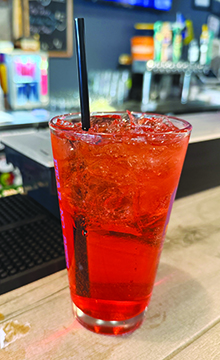
This is a drink inspired by a short story I am writing. All the characters are unnamed characters that you see at the very end of the cast credits of a television show or a movie — Bartender, or Jukebox Girl, or Nosy Neighbor. (In case you ever wondered, they have pretty fascinating backstories.)

The hero — actually the heroine — of the piece is a woman with the not very promising name of Hot Girl #2. There is no Hot Girl #1. She turns out to be much more complex and formidable than whoever named her would have ever guessed.

Her cocktail should reflect some of that complexity.

There is sweetness from an Italian liqueur. There is a not-really-in-the-mood-for-your-nonsense kick from brandy. There is lemon juice because — well, reasons. And, much like Hot Girl #2 herself, a couple of surprises.

Hot Girl #2

  • 2 ounces Pommeau – an apple brandy
  • 1 ounce Galliano – an Italian vanilla-scented liqueur in a seriously tall, skinny bottle
  • 1 ounce fresh squeezed lemon juice
  • ½ ounce grenadine
  • 3 drops rose water

Have your digital assistant play “That Girl” by Maxi Priest and Shaggy. This is a very quick cocktail to make, and this song will set a proper mood for this particular drink.

Wiggle your fingers and get to business.

Add the apple brandy, Galliano and lemon juice to several cubes of ice in a cocktail shaker. Shake thoroughly.

Strain over fresh ice in a rocks glass.

Carefully pour the grenadine over one of the ice cubes. Because it is denser than the rest of the drink, it will sink to the bottom and create a layer of red, which will fade into orange, then to the yellow color of the base cocktail.

Using a medicine dropper, add three drops of rose water to the surface of the cocktail, where it will dissipate into the air as you drink, giving the impression that you just missed a beautiful woman disappearing into a crowd.

At its heart, this is a basic utility cocktail — a base spirit, something sweet, and some sort of citrus juice. It is not unlike a brandy sour. The lemon is the dominant flavor at first taste, but the others sneak into your awareness as you sip over the course of 20 minutes or so.

Like our protagonist, the cocktail has hidden depths.

Featured photo: Hot Girl #2. Photo by John Fladd.

Goat cheese and Christmas trees

A look at Hickory Nut Farm and their goats

“When I see goats out in the field,” said Donna-Lee Woods, “I just cry for those goats inside barns because they don’t have Christmas trees. Right over there,” she said, pointing to a pile of pine and fir trees that had clearly seen better days, “there’s over 300 Christmas trees. They get dropped off from Newmarket and some of the other towns around here. People keep dropping them off all winter.”

“But the point is,” Woods continued, “the goats love them; it’s their forage. That’s what makes that healthy, alkaline [goat] milk. Every day, we give them three, four, five trees and they will eat everything right down to the white core of the trees. They use [the cores] as scratching posts all summer, and then in the fall time, we have a big bonfire.”

And in the meantime, there is cheese.

Wood and her husband, both former architects, manage a small herd of dairy goats at Hickory Nut Farm in Lee and use raw goat’s milk to make cheese, yogurt and soap, which they sell at area farmers markets.

“We also make a fudge,” Wood said, “which is a 1910 recipe. There’s no high-fructose corn syrup, so it’s not as smooth as most people expect. It’s crystal-y. The raw milk yogurt is very good, and the raw milk itself. Our soap is made with edible oils, not industrialized oils, so there are no chemicals. And you can use it as shampoo, and then you can lather it up and use it as a moisturizer. They use this sort of soap on babies with eczema because it’s so pure.”

But for the Woodses, it’s mostly about the cheese.

“Our cheeses are raw,” she said, explaining that heating goat milk during the pasteurization process breaks down some important nutrients and flavor compounds. “We don’t pasteurize. But our cheeses age for a minimum of two months at a certain temperature and a certain humidity, 54 degrees temperature and 84 percent humidity.” Maintaining those conditions can be particularly tricky in the winter, she said.

Hickory Nut Farm produces three main varieties of goat cheese: Lacey White, a firm, cheddar-like cheese with a distinct nutty flavor; Terrene, a blue-veined, “goaty” cheese that is aged longer than other varieties, and Chebar, a hard, Parmesan-like salty cheese with a buttery flavor. Woods said the only goat cheese she refuses to make is a traditional soft chevre. “Everybody makes that,” she said. “You can find it anywhere, so what is the point in making more of it?”

Woods said one of the things she likes most about selling cheese at markets is being able to talk one on one to customers, who often think they don’t like the flavor of goat cheese. They don’t understand the role pH plays in flavor, she said.

“I tell people, ‘You take a cube of the cheese, just a little cube, and eat half of it. You may not like the flavor, but swallow it, wait a few seconds, then eat the next half. You’re probably going to like it.’ Because what’s happened is the cheese has changed the pH of their palate. Our palates tend to be very acidic because of the types of food we eat.” The high pH of goat cheese neutralizes some of that acidity, Wood said. “That’s the true flavor of the cheese the second time around.”

“When people tell me they don’t like goat cheese,” Wood said, “I say, ‘Do you drink red wine?’ A lot of times they don’t because it tastes bitter to them. I tell them, ‘You probably have a tannin sensitivity because there’s a lot of tannin in red wine, just as there is in goat milk, because of what the goats eat.”

Like Christmas trees.

Cheese!
Hickory Nut Farm products are available at the farm (22 York Lane, Lee) and at the Saturday Concord Winter Farmers Market (7 Eagle Square, Concord,downtownconcordwinterfarmersmarket.com). During farmers market season, Hickory Nut Farm products will be available at several area and Boston markets.

A trio of mac

The Goat expands on the idea of traditional macaroni and cheese

Erica Fleury has given a lot of thought to macaroni and cheese. She is the owner of The Goat in Manchester, and she considers mac and cheese a very important food.

“I think it goes back to your childhood,” she said. “Everybody probably associates [macaroni and cheese] with their childhood. For people of my generation, it was our comfort food when we were kids. So I think they make that association. As a kid in the ’80s I definitely had Kraft Macaroni and Cheese, and my mom would make a homemade baked one once in a while; that was always good. And then as I got older I preferred Annie’s white cheddar.”

Today macaroni and cheese plays an important role at her restaurant. In addition to an entree portion — “It comes with a slice of fresh cornbread and it’s delicious,” Fleury said — The Goat offers a flight of different interpretations of mac and cheese. (For more on specialty flights at area restaurants, see our cover story on page 8.)

“It comes with three different types of macaroni and cheese,” Fleury said. “We have our house-made cheese sauce and we have a version with barbecued brisket, a truffle bacon version, and one with buffalo chicken with blue cheese.”

To Fleury, an ideal macaroni and cheese depends on two factors, texture and cheesiness.

“I think it has to have a homemade cheese sauce with some sharp cheddar in there, so it has a little bit of a bite,” she said. “And the pasta has to have some texture — it has to be al dente — preferably spirals. That’s what we use. And then you can add specialty ingredients. [Macaroni and cheese] definitely lets you get creative. Everybody has their own version of it and their own toppings and their own way of making it. Again, I think it goes back to how you ate it from your childhood.”

The three types of macaroni and cheese on The Goat’s flight start with a common base of the same mac and cheese, Fleury said.

“Our flight has small samples of the different versions,” she said. “When you’re eating our flight, it’s more about the toppings. So the base is the same … but you still get a bunch of different flavor profiles because you have the barbecue sauce on the brisket. We cook the brisket in-house and it melts in your mouth, but not like falling apart. There are solid pieces in there, but it’s definitely slow-cooked and delicious, but not to the point where it’s like mush, you know?” This gives the dish a contrast in textures.

“Then, the Buffalo mac and cheese has Buffalo chicken,” Fleury continued. “It’s fried chicken coated in Buffalo sauce, but then there’s the drizzle of blue cheese and also blue cheese crumbles, which gives it a complex flavor. You have a lot of different flavors going on with all the versions, but [the Buffalo chicken] definitely changes up the flavor of the whole dish for sure.”

Finally there is a version of macaroni and cheese with bacon and truffles. “It’s not super papery thin bacon,” Fleury said, “and it’s not the thicker bacon that we use on some of our other dishes. We make sure it’s crispy and then dice it up and put it on top and it has some truffle oil mixed in there and it gives another really complex flavor with everything mixing together.”

“ I think people like the flight with all the creative toppings on there, the different flavors,” Fleury said, “but mostly, I think they just really like macaroni and cheese.”

Mac & Cheese flight
The Goat (50 Old Granite St., Manchester, 222-1677, goatbarnation.com/manchester) serves macaroni and cheese on its dinner menu throughout the year, but their Mac & Cheese flight is only available during cold months, usually from January through May. The Goat’s warm-weather comfort-food flight is centered around queso cheese sauce.

Featured photo: Courtesy photo.

The Weekly Dish 26/04/02

Easter bake sale: The Assumption Greek Orthodox Church Ladies Philoptochos Society will hold an Easter bake sale on Saturday, April 4, from 11 a.m. to 2 p.m. in the Assumption church hall (111 Island Pond Road, Manchester, 623-2045, assumptionnh.org). Spinach peta, cheese peta, Greek cookies, Greek pastry, and Easter bread will be available for sale. Quantities are limited. For information call the church office at 623-2045.

Easter eats: LaBelle Winery (345 Route 101, Amherst; 14 Route 111, Derry; 672-9898, labellewinery.com) will host special Easter Sunday dining at its Amherst and Derry locations Sunday, April 5, from 10 a.m. to 3 p.m. The Bistro and Americus Restaurant will both serve the same three-course Easter menu at a set price. Dining takes place in LaBelle’s dining rooms and event spaces, accommodating all group sizes, from intimate gatherings to large celebrations. The cost for adults is $80, and an a la carte children’s menu will be available, with items ranging from $8 to $15. Advance reservations through the LaBelle website are highly recommended.

April’s martini-cupcake pairing: The theme of the Copper Door’s (15 Leavy Drive, Bedford, 488-2677, or 41 S. Broadway, Salem, 458-2033, copperdoor.com) martini and cupcake pairing for April is Strawberry Shortcake. This month’s featured martini is made from Smirnoff Whipped Cream Vodka, strawberry cream liqueur, white creme de cacao, strawberry syrup, cream and fresh strawberries with a shortcake rim for $14.75. April’s cupcake features a lemon cupcake, with a strawberry preserve filling, cream cheese frosting, fresh whipped cream, a fresh strawberry and a topping of strawberry crumble, for $11.

Wild game dinner: Join the 603 Brewery (42 Main St., Londonderry, 404-6123, 603brewery.com) to kick off New Hampshire’s Craft Beer Week with a five-course pairing dinner featuring 603 Brewery beers and a collection of game dishes. Your ticket includes a Daydreaming/603 Brewery collaboration welcoming beer poured from the cask engine, a five-course dinner and a take-home NH Pint Days 2026 collectors’ pint glass. Dishes are served as is, with no substitutions. The dinner will take place Wednesday, April 8, beginning at 6 p.m., at Cask & Vine (1 E. Broadway, Derry, 965-3454, cask.life/cask-and-vine). Tickets are $99 per person, or $79 without alcohol. To register, search “603 Brewery Wild Game Night.”

National Deep Dish Day cooking class: UNO Pizzeria & Grill (15 Fort Eddy Road, Concord, 226-8667) will host a Deep Dish Pizza cooking class and lunch Saturday, April 4, at noon. Ticket includes pizza demonstration and pizza with a salad, a beverage and a dessert. Tickets are $64.80 through unos.com/cookingclasses.

Maple madness: Averill House Vineyard (21 Averill Road, Brookline, 244-3165, averillhousevineyard.com) will continue to offer its popular Wine Tasting, Maple Wine Cream and Tour, Friday, Saturday, and Sunday, April 3 through 5. Each tour will include a tasting of two maple-infused wines, a cup of maple-infused WineCream ice cream, a full wine cellar, winery and 1830s Tasting Room Tour, and an Averill the Elephant Embossed Souvenir wine glassm, according to the event’s eventbrite.com page where you can purchase tickets for weekends throughout April.

BBQ Easter: KC’s Rib Shack (837 Second St, Manchester, 627-7427, ribshack.net) will host its All-You-Can-Eat Easter Buffet, Sunday, April 5, from 12 to 5 p.m. Expect smoked ham, brisket, pulled pork, ribs and more with side dishes. The cost for adults is $32, and $15 for children 5 to 10. Reserve online through facebook.com/kcsribshack.

Stay in the loop!

Get FREE weekly briefs on local food, music,

arts, and more across southern New Hampshire!