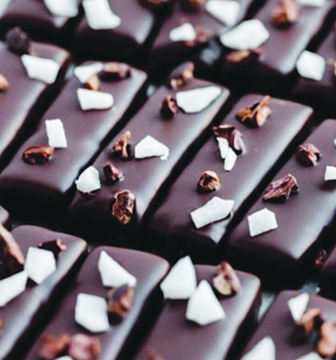
Dorothy O’Rourke runs a small candy company called Granite Bay Fudge.
“I had a plan,” she sighed. “Originally, I liked the name the New England Fudge Company, but it turns out the New England Fudge Company is actually already a company. In New York. Somebody did not do a good job checking on things. New York is not in New England! I was horrified to discover that the name I really liked was gone. So Granite Bay came out of Granite State and Bay State. I try to hide the fact that I grew up in Massachusetts, but I consider myself a New Hampshireite. That’s how we ended up in Granite Bay.”
O’Rourke strictly sells fudge, but in an impressive variety of flavors.
“At this point, I just hit 19 types,” O’Rourke said. “I get a lot of questions from people. I actually had somebody recently who asked me about dill pickle fudge and I’m going to turn that one down, hard. I’m not a believer in the weird. I’m not making jalapeno fudge and, no, I’m not making bacon fudge. Those are not what I consider fudge flavors. But on the other hand, I’ve had a lot of people asking for fruit-based fudges. Until just recently, chocolate-raspberry was my most recent, but I had a woman reach out to me and told me that she likes orange fudge. I’d never made orange fudge, but I just test drove that one, and so that’s our most recent. We do listen to requests. I added maple-walnut and chocolate-walnut. Maple and maple-walnut became huge sellers. I did not realize — I’ve lived in New Hampshire now since the mid-’80s and I had no idea how big Maple Weekend is in this state. It is huge and apparently I’m going to need to really ramp up and make a lot more maple and maple-walnut fudge this coming year because it sells at an insane rate.”
O’Rourke has found customers can be very particular about fudge.
“What I have discovered is that there are different types of fudge,” she said. “There’s the New England or American version of fudge, which is what I make. It’s the creamy version of fudge. But there’s also Scottish fudge. Scottish fudge is cooked to a higher temperature. It is a brittle, drier fudge; it’s very, very granular. We had a lot of people [at shows] asking us about our fudge and giving us some sort of funny looks. And what we realized as they tried our samples is that they were looking for that other type of fudge.”
And don’t ask O’Rourke about penuche.
“We tell people, ‘If you’re looking for penuche, you’re talking to the wrong person.’ I do not make penuche; it does not fit the family recipe. It needs to be made differently. We tell people to go hunt down other people if they’re looking for penuche fudge. My fudge, the original chocolate recipe, was my grandmother’s recipe. It was handed down by word-of-mouth. It is not written down. I was told I was not allowed to write it down. I worry sometimes that my memory might go, but at this point I make it enough that everything is memorized.”
At this time, Granite Bay Fudge does not have a website or a storefront. O’Rourke depends on her fans hunting her down at events where she is a vendor. They usually find her through social media.
“I have Instagram and Facebook posts,” she said, “but word-of-mouth has been an interesting thing. It turns out I’ve got followers. It’s been an interesting experience having people reach out to me to say, ‘Where is the next show? We really need more of your fudge.’”
“I have fudge groupies.”
Granite Bay Fudge Fudge groupies can follow Granite Bay Fudge @granitebayfudge on Instagram, or search for it by name on Facebook.
Featured photo: Bonne Richards, owner of Bonne the Baker. Courtesy Bonne Richards.
Bonne Richards has had some memorably bad gluten-free baked goods.
“I saw a gluten-free pizza yesterday that made me cry,” she said. “It was so clearly awful. I was at a meeting on the other side of the state and someone sent out for pizza and the gluten-free thing looked like it was made of Play-Doh. It was probably better to eat the box it came in.”
After baking professionally for many years, Richards has made the move to open her own gluten-free bakery.
“I’ve been in the business for a long time,” Richards said. “I was Michael Buckley’s original pastry chef at Michael Timothy’s back in the ’90s. And I’ve been working for different people and running farm bakeries, then went out on my own a couple of years ago just doing some wholesale accounts in the area. After listening to customers tell me, ‘Please, please open your own place,’ I decided to jump in and do it finally. It will be a gluten-free, dairy-free, plant-based bakery and retail market in Nashua.”
Richards’ goal for Bonne the Baker is to be a resource for customers who follow a specialized diet and, like her, have been disappointed with the choices available to them.
“It will probably break down to something like 70 percent sweet baked goods,” she said, ”and the other portion will be savory. You know — muffins, some Danishes, pastries. I’ll have some bread. Of course things like whoopie pies and cupcakes, all kinds of stuff. I’m going to do a lot of plant-based items. I have a big vegan and vegetarian following so I’m going to have a grab-and-go section that will have fresh salads, grain salads, greens, a lot of protein balls, vegan cheeses and things like vegan salamis that are hard to get.”
Richards remembers when gluten-free baked goods like that disappointing pizza were the norm. “Back in the day, at the beginning of gluten-free, the flours weren’t right,” she said. “Nobody really had a good formula for making eggs that weren’t eggs, you know what I mean? [Ingredients like that] have come such a long way and the procedures have taken a while to catch up with them. I can’t tell you how much I’ve thrown out perfecting my recipes. I’ve finally gotten to the point where I hear my favorite compliment pretty often: ‘ I cannot tell that this is gluten-free and there’s no eggs in this or dairy.’ So I’m pretty proud of that.”
Richards said the new space is promising.
“It looks so good!” she said. “I’m like, ‘Oh my god, it’s looking even better than I thought it was going to look like. It’s a fabulous space. It is so beautiful. I lucked out finding it. The City of Nashua has been so good, I can’t even tell you. And the comment out of the deputy health inspector was, ‘We want you in business’.
Richards’ original plan was to open for business on May 1, “but with paperwork, there are always issues,” she said. “I finally got my food licence. Now, we start baking and stocking the shelves and putting up my sign. The new plan is to have a soft opening on Saturday [May 9], and then the grand opening is going to be that Wednesday, May 13, which is my mother’s birthday, and she’s not here anymore, so even though it’s a Wednesday I’m going to call it Mother’s Day all weekend.”
Bonne The Baker Where: 2 Cellu Drive, Nashua, 669-4200, bonniethebaker.com When: soft opening Saturday, May 9, and grand opening Wednesday, May 13. Hours: open Tuesdays through Saturdays from 7 a.m. to 3 p.m., and Sundays 8 a.m. to 2 p.m.
Featured photo: Bonne Richards, owner of Bonne the Baker. Courtesy Bonne Richards.
• French wine, French dining: There will be a wine dinner, “La Belle Saison: A French Wine & Culinary Experience,” Thursday, May 7, from 6 to 9 p.m. at Murphy’s Taproom & Carriage House (393 Route 101, Bedford, 488-5975; 494 Elm St., Manchester, 644-3535, murphystaproom.com). Organized by Wine Not Experiences, this dinner is inspired by the fresh energy of spring in France, featuring elegant French wines thoughtfully paired with a creative seasonal menu. Tickets are $150 through winenotexperiences.com.
• Wine and love stories: Averill House Vineyard (21 Averill Road, Brookline, 244-3165, averillhousevineyard.com) will host “Pouring Over Pages: A Romance Book and Wine Pairing Event” on Saturday, May 9, from 6 to 8 p.m. This event brings together books, wine and playful fun for a memorable literary wine tasting experience. Sip delicious local wines while exploring four swoon-worthy novels, play flirty games, win prizes, and connect with fellow book lovers in the scenic vineyard setting. General admission tickets are $49.87 through the Averill House website.
• Mother’s Day tea: The Culinary Playground (16 Manning St., Derry, 339-1664, culinary-playground.com) will host a Mother’s Day Tea on Sunday May 10, from 12:30 to 2:30 p.m. Students will make a batch of berry tea cakes and compose their own tea sandwiches, then sit to dine in the kitchen. Tea, coffee and juice will be served. The cost is $65 per person at culinaryplaygroundnh.com/adults.
• A high-end Mother’s Day dinner: The Bedford Village Inn (2 Olde Bedford Way, Bedford, 472-2001, bedfordvillageinn.com) will host a three-course prix fixe Mother’s Day dinner on Sunday, May 10, with seating times from 2 to 7 p.m. The cost is $85 per adult and $45 per child. Visit bedfordvillageinn.com/bvi-holidays/#mothersday.
• A wine-filled Mother’s Day: Averill House Vineyard (21 Averill Road, Brookline, 244-3165, averillhousevineyard.com) will host a Mother’s Day high tea brunch and wine pairing Sunday, May 10, with seatings at 11 a.m. and 2 p.m. Tickets are $59 through the Averill House website.
• An artsy Mother’s Day: Arts Alley (20 S.Main St., Concord, 406-5666, artsalleyconcordnh.com) will host a Mother’s Day brunch buffet called “A Toast to Mom” Sunday, May 10, from 10 a.m. to 1 p.m. This promises to be a “relaxed and memorable afternoon filled with great food, cocktails, and time together” according to the Arts Alley website. Tickets are $55 per adult and $20 per child.
• A gardeny Mother’s Day: Birch Wood Vineyards (199 Rockingham Road, Derry, 965-4359, birchwoodvineyards.com) will host a garden-inspired brunch Sunday, May 10, with flavors, flowers and seasonal dishes. There will be three seating times. Adult tickets are $70 and children’s tickets are $30 through the Birch Wood website.
• A small-plates Mother’s Day: Fulchino Vineyard (187 Pine Hill Road, Hollis, 438-5984, fulchinovineyard.com) will host a six-course small-plate dinner Sunday, May 10, from noon to 3 p.m. Indulge in a carefully curated selection of gourmet small plates surrounded by vineyard views. Adult tickets are $60 each, children’s meals $25, through the Vineyard’s website.
• Cake and countesses: LaBelle Winery Amherst (345 Route 101, Amherst, 672-9898, labellewinery.com) will host a Bridgerton-inspired cake decorating class Wednesday, May 13, from 5:30 to 7:30 p.m. An instructor will guide you through adding beautiful icing decorations to your own 5-inch mini cake. You can add on a glass of LaBelle wine and a cheese plate to enjoy during class. You will take your cake home with you. This class starts at $74 through the LaBelle website.
Spring Craft Market offers pre-Mother’s Day shopping
One of the less obvious signs of spring is when craft shows come out of their winter quarters and blossom. Jody Donohue, the owner of Great New England Events (gnecraftartisanshows.com), is excited about this weekend’s Spring Craft Market at LaBelle Winery in Derry, which will be partly outside.
“The market will be located in four spaces,” she said. “We have the Harvest Room, we have the ballroom, a large tent on the terrace, and this year we’re also expanding into the parking lot. So we’re pretty excited about having those 18 exhibitors out in the parking lot just outside the terrace area.”
The Mother’s Day weekend event has also expanded its hours, Donohue said.
“Last year, we were one day, Saturday only, but due to the popular demand of it, we’re also extending to Friday evening, from 4 to 8 p.m. And then it’s also Saturday from 10 a.m. to 5 p.m.”
The word-of-mouth exposure from last year’s Spring Market was excellent, Donohue continued. “We’ll have 78 exhibitors,” she said, “and we received over 400 applications for those 78 spots. We have exhibitors coming from New York. We have one group coming in from Delaware. Craftspeople will be there from Vermont, Maine, New Hampshire, [and] Massachusetts, bringing their products. And our mission [statement] at GNE is “Never the same show twice, but always just as nice.” So you’re going to see some of the same exhibitors, but you’re also going to see many new products and exhibitors there with their handmade products.”
The Spring Craft Market will include craftspeople from across the craft spectrum, Donohue said. “It’s a very popular event. So we’re really excited to be offering lots of different gifts for mom for the spring, for home decor, for your outdoor decor, garden, birdhouses, and we have some specialty foods. We’ll have fudge and chocolate and all that handmade in small batches. We have six different jewelers this time coming in, We have glass jewelry coming. We’ve got some artists painting, photography, candles, fabrics, metal art, beautiful wood-turned products, from games to home decor to bowls to candlesticks.”
While some crafts will be typical of craft shows, Donohue said, others will be a surprise.
“I always like our lamp guy, Quinton,” she said. “He comes in and he’s made all these different lamps. He will find oddities and make lamps out of them. He’ll find a bubble gum machine and turn it into a lamp. He’ll use railroad ties or water pipes or rustic clocks and he’ll turn them into lamps. He’ll make little vintage [toy] cars into lamps. He even has a clarinet he turned into a lamp. He is pretty spectacular to meet and see how creative he is in designing these lamps.”
“We have a wood carver,” Donohue said. “She uses chainsaws of various sizes. She can carve into wood and make a 3D image. I had a custom one made for my house. We live on the water … so she did the water and she did some sandpipers in there for us and it just came out really well. Her work is just beautiful. She can design pretty much anything you want. She’ll do beach scenes. She’ll do lighthouses. She’ll do flowers. She’ll have a lot of flowers this time around for Mother’s Day, and they’re varying sizes. Some of them can be 8 inches and some can be 28 inches. She’s a unique crafter.”
The 2026 Great New England Mother’s Day Spring Craft Market When: Friday, May 8, from 4 to 8 p.m., and Saturday, May 9, from 10 a.m. to 5 p.m. Where: LaBelle Winery Derry, 14 Route 111, Derry, 672-9898, labellewinery.com/labelle-winery-derry. Admission and parking are free. Visit gnecraftartisanshows.com/calendar.
A look at a complex, elegant, comforting and not at all ordinary culinary star
We take vanilla for granted. According to pastry chef Addie Leader-Zavos, we use vanilla as a background flavor in so many things we eat that it’s easy to forget it’s there.
“The special thing about vanilla,” Leader-Zavos said, “is that it adds so many beautiful top notes to whatever we cook with it. You want things that are going to taste good and are going to taste good in your mouth for a long time. And vanilla has so many intricacies that it really helps make other flavors more complex, more interesting. But at the same time, because it has been used for so long and in so many contexts, it’s part of what people expect. But if it’s missing in some context, it can really feel like the flavor of the food is a little flat.”
“You know, there’s no possible way for actual natural vanilla to meet the demands that we have for it,” Leader-Zavos continued. “It only comes from three or four places in the world. And there’s only two or three species that pollinate it. A lot of vanilla is actually hand pollinated. Unless it’s grown in Mexico, there aren’t any natural pollinators.”
There are dozens of flavor compounds in vanilla, but one of the main ones is a chemical called vanillin. It is present in many species of hardwood, Leader-Zavos explained, which is one of the reasons many types of alcohol — most famously bourbon — are aged in oak barrels. “Straight bourbon has to be aged in American oak barrels and also has many of the same scent components as coconut, as cocoa butter, as oddly dill. All oak species have some amount of vanillin in them — the French varieties have the most, followed by American varieties.” This is where artificial vanilla comes from, she said.
Because vanilla extract is usually suspended in an alcohol solution, many high-end pastry chefs use actual vanilla beans, Leader-Zavos said.
“Some people kind of like the flavor of the alcohol that’s with the vanilla. I don’t as much because I think it’s a little bit distracting. I want to taste just the vanilla and not the sort of alcohol. That’s sort of a preference issue.” The alcohol in vanilla extract is one reason many recipes call for adding it after a dish has come off the heat. “The flavor compounds are really volatile in vanilla. And alcohol can carry them away as it cooks off. Generally, you want to add it off the heat, or to use gentle heat, hot enough to take care of the alcohol but not hot enough to break down the vanilla compounds — about 170°F.”
Ashley Savoy is the owner and baker of Savvy Sweets and Treats, a baking business that specializes in French-style macarons. She takes vanilla very seriously. Because people typically eat macarons slowly and focus on their flavors, the vanilla she uses has to be of the highest quality possible, she said.
“We talk a lot about quality ingredients,” Savoy said, “but people tend to forget about vanilla, which can be a mistake. It really is one of those ingredients that you want to spend your time and your money on because good vanilla really can make a big difference. So in my kitchen, in my bakery, I make all of my vanilla [extract] and my vanilla paste from scratch. It’s not bought from a store. I buy high-grade vanilla beans from places that ethically source them. It’s really quite simple to make your own vanilla. People, you know, think it’s quite complicated, but it’s really not. It’s just, it’s simply vanilla beans and vodka. It’s not anything else. You don’t even really want to use a high-end vodka because the high-end vodkas tend to have more of a flavor profile. And that’s not really what you want. You want the flavor of vanilla beans.”
“Really good vanilla has a flavor that can really make a dish go from just kind of a dish to something really special,” Savoy said, “because the vanilla really does have that much of a change based on how good it is. Once you start having real vanilla — the good stuff — you’ll start to notice the difference. You can pick out that imitation vanilla almost immediately. You know that something there isn’t quite right, and you’ll end up getting a taste for it.”
“If you’re looking for more of a pronounced vanilla flavor,” Savoy said, “a lot of times people just fall back on throwing vanilla paste in, but for a pastry cream or anything like that the best thing to really do is to infuse your milk or your cream with the vanilla [beans] before you’re making your pastry, and that’s going to give you the most flavor enhancement and it’s, again, it’s quite simple to do. You just, you heat up your milk or your cream — not to a boil — just until it starts to steam a little, and then you split your vanilla pods in half and throw them in. One is usually enough. Just give it 30 minutes to an hour, and the cream is completely infused and ready to cook with.”
Vanilla pods can be used more than once, Savoy said.
“A lot of bakers who use the vanilla beans — the pods — we save them because they have a lot to give. Even if you scrape all the seeds out, down to just the pod, the pod still can be thrown in vodka and then made into vanilla extract. It still has way more life to give.”
Ice cream
Most Americans associate vanilla with ice cream. According to Jim Richardson, the owner of Richardson’s Farm Ice Cream, there’s a reason for that: Vanilla has an affinity for dairy. The problem, he said, is finding the right vanilla.
“We use an extract,” he said. “We have tried four or five different vanillas over the course of several years, and it took a while to find one that we liked better than the others, a good, clean vanilla. There are a couple that have a sharp, bitter end to them. We’ve tried the Dare [Virginia Dare, a well-regarded brand of vanilla]. It’s expensive, but I don’t like the flavor of it. And we tried a bourbon vanilla two years back, and I wound up putting two ounces of that in a batch of vanilla ice cream just to use it up, and it was vile!”
(“Bourbon” vanilla doesn’t have anything to do with bourbon whiskey; Bourbon vanilla beans are grown in a particular part of Madagascar.)
“Over the years we’ve tried several. The one that has a consistently nice flavor — a good clean vanilla — is Edgar Weber, out of Illinois. We use almost all of their flavors because they make all natural flavors and they won’t sell it to us unless we sample it. If you want a sample to try something, you call them up and they’ll ship us eight ounces … or 12 ounces, depending on what we’re making.”
Richardson said vanilla ice cream is in such a constant high demand that he keeps two tubs of it open in the freezer at all times.
“We use it all the time,” he said. “Sometimes the two look like different colors, because [vanilla ice cream] changes color as it warms up. It also tends to be a little bit softer. With warmer ice cream, the flavor comes through more.”
By the way, when looking for vanilla ice cream you might find both vanilla and French vanilla on the menu. What’s the difference? Eggs. French vanilla uses a custard base made with eggs, which is why it has a deeper, slightly more yellow color than plain vanilla. Ice cream made without eggs is referred to as “Philadelphia-style” ice cream.
Beer
At a completely different end of the food spectrum from ice cream is beer. Brian Parda is the head of sales and marketing for Great North Aleworks, which is known for its vanilla porter.
“Our Robust Vanilla Porter dates all the way back to the beginning of Great North Airworks,” he said. “It was one of our original releases and it goes back even before the brewery. It was one of the original home-brew recipes that the owners, Rob and Lisa [North], would serve when their friends came over. If they didn’t have it on tap at home people would be outraged. And so we’ve been making it for over 10 years now and we make it year-round. As a matter of fact, a couple of summers ago we tried to pause making it for a couple months over the summer because sales will slow a little bit. But we got enough phone calls and emails and messages that we never did that again. So we now make it year-round.”
One of the reasons Great North’s vanilla porter is so popular, Parda said, is that it defies expectations.
“Porter is a darker beer,” he said. “I mean, if you hold it up to the light, it’s more brown than black. Obviously, you eat and drink with your eyes, but I think a lot of people see a dark beer and are intimidated by that. They think it’s going to be heavy and thick and rich and cloying and sweet. The porter that we brew before we add the vanilla is actually a very light drinkable beer. It’s flavorful. It has a lot of those darker flavors — kind of more reminiscent on the chocolate side than on the heavy roast, like a stout would be. It doesn’t really have the heavy coffee roast, but a little bit of coffee. I think the vanilla bridges that gap there where people kind of go from intimidated to, ‘Oh, wow, that’s actually really good.’ We get a lot of that when we’re pouring it for somebody for the first time.”
“I think that vanilla, when people smell it,” Parda continued, “it usually has a positive olfactory memory for people. You smell vanilla and you think of all kinds of great, delicious things. So yeah, maybe it’s being taken for granted or considered ordinary — like ‘plain vanilla’ — that kind of thing. But I think it’s actually kind of the special sauce, if you will, for our porter. I don’t know that it would sell as well if we made it without it.”
“When I’m sampling it, either at a store or at a beer festival,” he said, “if someone comes up to the table and they say, ‘Hey, what’ve you got?’ I’ll tell them about our IPAs [India Pale Ales — light, very hop-forward beers] and they’ll be like, ‘Oh, I don’t want anything too bitter. I don’t want anything too hoppy.’ I’ll say, ‘Why don’t you try my porter?’ and they’re like, ‘I don’t know…,’ and they get all intimidated. It’s funny, because I think the vanilla kind of shocks them and they realize, ‘Oh, maybe I could drink a dark beer.’ I sometimes describe it as like French vanilla iced coffee for people that are trying to understand it. Again, there’s just a touch of that light roast coffee flavor from the darker malt, and then that vanilla, and it’s cold. It blows their minds a little bit.”
To avoid breaking down vanillin and other flavor compounds, the vanilla is added after the actual brewing process, Parda said.
“It’s added what we call ‘on the cold side.’ After the beer’s been fermented and is getting close to being finished as we’re preparing it to be packaged is when we add the vanilla.We use a really high-quality extract. The origin of the beans is Madagascar, if you want to get specific. A couple of years ago there was a hurricane or something in Madagascar and there was a bit of a supply issue, so we explored some other brands and some other products, and none of them worked. We couldn’t change the flavor profile too much, but thankfully we were able to source enough and we continue to be able to source that same brand.”
Scent
Many of the subtle characteristics of vanilla come from its smell, something that is very important to Tamsan Tharin, the owner and chief perfumer of Essense Parfumerie.
“One of the most interesting characteristics of vanilla,” she said, “is that it has the ability to impinge equally on both sense of smell and sense of taste. Vanilla is used in so many products. It’s considered like a comfort food. People find it very, very comforting. It’s the ultimate comfort food like sugar cookies with a slight aroma of vanilla or vanilla cake. But it’s also used in products like baby products or some cleaning products. It’s put in almost all lipsticks. So people just have the sense of comfort with the smell of vanilla. As you say, they don’t necessarily recognize it as vanilla, but they’re getting these comfort feelings from it because nothing affects our feelings and our emotional states more than smell. When you smell something, it goes right to the old part of your brain, the old lizard part of the brain and the brain stem. And so we have immediate reactions.”
“Vanilla is a base note,” Tharin said, “but it plays well with everything. It mixes with everything. You can put vanilla with musks. You can add it to powdery scents like baby powder. You can add it to oriental scents, which is an amber-based, exotic, woodsy scent. It’s comforting. … People consider it sexy and they associate it with love. And again, we’ve got the comfort association as well.”
The vanilla panel Eden’s Table Farm (240 Stark Highway North, Dunbarton, 774-1811, edenstablefarm.square.site) Essense Parfumerie (Main Street, Meredith, 409-2799, essense.com) Great North Aleworks (1050 Holt Ave., No. 14, Manchester, 858-5789, greatnorthaleworks.com) Richardson’s Farm (170 Water St., Boscawen, 796-2788, richardsonsfarmnh.com) Savvy Sweets and Treats (Bow, 387-0241, savvysweetsandtreats.com)
Vanilla recipes
Vanilla Cream Pie
This is a vanilla-forward take on an Indiana-style sugar cream pie. It is extremely user-friendly, but during the final bake you need to watch it like a rattlesnake to make sure it doesn’t overcook.
One pie crust, blind baked — this means prebaked. If you’ve never blind-baked a pie crust before, watch a how-to video. It’s not difficult – you will probably want to crumple up a sheet of parchment paper and weigh it down with dried beans. I like to use chickpeas.
1 cup (198 g) sugar
¼ cup (28 g) cornstarch
2 cups (454 g) whole milk
½ cup (1 stick) butter, cubed
1 Tablespoon vanilla paste or vanilla extract
¼ teaspoon ground cinnamon
Preheat oven to 375°F.
In a medium saucepan, whisk the sugar and cornstarch into the milk. Over medium heat, bring to a simmer. The mixture will thicken considerably. Keep cooking, stirring or whisking continuously until it is thick enough to coat the back of a spoon.
Remove the sweetened milk mixture from heat, then stir in butter and vanilla.
When everything has incorporated, transfer the mixture to your pre-baked pie shell. Bake until golden brown — after 10 minutes or so, keep a close eye on the pie to make sure it doesn’t get too dark. While delicious, the pie filling is not to be trusted; it will darken suddenly and with almost no warning.
Let the pie cool, then chill in your refrigerator for at least two hours. It is very good served at room temperature, but I prefer it very cold. It is very vanilla-forward and satisfying.
Vanilla-Rum White Russian
1 ounce coffee liqueur — Kahlua is the classic base for a white Russian, but coffee-flavored brandy will work well too.
1 ounce dark rum — because the focus of the flavors in this drink is vanilla, don’t bother using a top-shelf, expensive, aged, sipping rum for this. I like Myers’s. Yes, it’s a “spiced” rum, but guess what constitutes the spices – mostly vanilla.
½ teaspoon vanilla extract — probably the best you can find. Artificial vanilla is perfectly fine for many applications, but not this one. Use the real stuff.
½ ounce Galliano — this is a vanilla-scented Italian liqueur in a really tall bottle.
2½ ounces half and half
In a mixing glass, stir all the ingredients except the cream with ice until it is chilled and combined thoroughly. Strain over fresh ice in a rocks glass.
Place a spoon against the side of the glass, and very gently pour the cream over the back of the spoon. The cream is slightly less dense than the boozy mixture and will float on top of it, making lava-lamp-looking layers. This is a good second-date, make-an-impression drink. It tastes of coffee, cream and, of course, vanilla.
Vanilla Soufflé
3 Tablespoons butter, cubed
3 Tablespoons all-purpose flour
Pinch of salt
1 cup (227 g) whole milk
1 Tablespoon vanilla paste or extract, separated – 1½ teaspoons and 1½ teaspoons
½ cup (99 g) sugar
4 egg yolks
5 egg whites
Butter and sugar to coat your soufflé dish
Preheat oven to 375°F.
Butter and sugar the inside of a soufflé dish — I like to use a generous amount of butter for this, about a tablespoon.
In a saucepan or small skillet, combine the flour, butter and salt to make a “roux.” This means that you will melt the butter and cook the mixture over medium heat for several minutes, until it darkens slightly to something like the color of a lion. Remove from the heat. Reassure the roux that you will come back to it; make sure it doesn’t feel abandoned.
In a small saucepan, heat the milk and half the vanilla, stirring until it reaches a gentle simmer. Add the roux to the milk mixture, and whisk to combine. Add the sugar, and bring the mixture back to a simmer, whisking constantly. Cook for two to three minutes, until it thickens noticeably.
Remove the mixture from heat and stir in the butter and the rest of the vanilla, combining thoroughly. Temper in the egg yolks. Return to the heat, and bring it back to a simmer, whisking constantly, then transfer the mixture to a mixing bowl, and set it aside to cool slightly. The egg yolks will turn the mixture yellow.
Beat the egg whites to stiff peaks. Stir 1/3 of the egg whites into the yellow mixture “to loosen it up.” (This is what most cookbooks say, though in my opinion that sounds a little judgmental. Who are we to tell the mixture that it needs to loosen up?) Gently fold half of the remaining egg whites into the mixture, until it is 95 percent incorporated, then fold in the remaining egg whites.
Transfer the now fluffy egg mixture to your prepped soufflé dish. Bake for 25 to 30 minutes, until it has puffed up and turned golden brown. When it is ready to take out of the oven, it will still be slightly jiggly in the center.
This is when you’ll want to take a picture of your soufflé. As it cools, it will shrink a little; if you like to post photos of your food to social media, take the picture as soon as it comes out of the oven. This will be a warm, delicate, vanilla-forward dessert that will top off your cooking confidence. Soufflés have a reputation for being temperamental. They really aren’t, but when you manage to achieve soufflé victory, you will know that you are capable of anything.
Vanilla Tapioca Pudding
This is a delicious, very old-fashioned dessert, with a caviar-like texture.
2 cups (454 g) whole milk
1 cup (227 ) heavy cream
1/3 cup (61 g) small-pearl tapioca
Pinch of salt
1 egg yolk, beaten
1/3 cup (66 g) sugar
2 teaspoons vanilla paste or extract
I Tablespoon nonfat dry milk (optional)
Vanilla tapioca. Photo by John Fladd.
Combine the milk, cream, salt and tapioca, then set it aside for 45 minutes or so, to let the tapioca pearls hydrate.
Add the sugar and milk powder, and cook over medium heat until it reaches a simmer. Cook the mixture for 15 to 20 minutes, until it thickens and the tapioca becomes tender.
Remove the mixture from the heat, and whisk in the egg yolk and vanilla. Return the mixture to the heat, and simmer it for two to three minutes, whisking continually, to make sure that the egg yolk has become completely incorporated and there are no egg pockets to turn into scrambled eggs.
Remove the mixture from the heat, and let it cool for 30 to 45 minutes, then transfer it to serving dishes, and chill overnight, or at least two hours. Serve cold with a sprinkle of grated nutmeg.
2 ounces botanical gin – This time, I went with Collective Arts Plum and Blackthorn Gin, and I do not regret it.
1 ounce fresh squeezed lemon juice
½ ounce simple syrup
Club soda to top
Fill a tall, straight-sided glass — appropriately enough, this is called a Collins glass — about three quarters full of ice, then add the gin, the lemon juice and the simple syrup. Stir the mixture with a long-handled spoon or a chopstick.
Gently add club soda until it reaches almost to the top of the glass, then stir everything again.
Hold your drink up to the light and take a couple of deep cleansing breaths. Watch the bubbles rise to the top of your drink. Take a moment to remember a time in your life when you were proud.
In my case, I think of a time, many years ago when I finished waiting tables late at night and decided to treat myself to a quick drink before I went home. As I walked to the door to the bar, I loosened my tie, wrapped my apron into a small bundle, and stuck it under my arm. I opened the door and walked into the bar, only to remember that it was College Night, and the place was packed to the rafters with kids. There were easily 15 college students between me and the bar.
I was just considering turning around and just heading home, when Curtis — a legend among bartenders — shouted at all the college kids.
“Hey! Make a hole! Workin’ man comin’ through!”
The kids fell silent and opened up a path the bar. You could tell that they didn’t know what to think:
“How strange! Who is this old guy? And, what is this ’working’ that he speaks of?”
I got to the bar, and Curtis already had my drink waiting.
I gave Curtis a crumpled handful of bills from my tip money.
He didn’t do anything cheesy like fist-bump me, but he gave me a nod.
Just a nod, but the memory of that nod has stayed with me throughout the years since and has stiffened my spine.
So, that’s what I think about as I watch the bubbles in my Tom Collins bounce their way up through the ice in my glass, and then I take a sip.
It isn’t sweet. It isn’t super-fruity. It is extremely refreshing. It’s the sort of thing a grownup might drink.