An adventure with the classic combination of peanut butter and jelly
Typically I would try to start an article on peanut butter and jelly with some sort of hook, like a story about how a Japanese princess drove off 15 ninjas with a peanut butter and jelly sandwich, or how a 5-year-old boy foiled a mugging by dropping a jar of peanut butter on a thief in an alley from the 30th-floor window of his apartment. I could tell you a personal story about the philosophical breakthrough I made while eating a spoonful of peanut butter at dawn in an Indian ashram on my 40th birthday.
The thing about those stories, aside from the fact that none of them is remotely true, is that they are unnecessary.
It has to do with the time of year.
Go into any supermarket this week, past the displays of shamrocks and Easter candy, and what do you see? End-cap displays of chicken-noodle soup. Mint Milanos. Extra-large containers of taco chip party mix.
In other words, comfort food.
It is theoretically almost spring. But we all know that even when it comes it won’t be a real, tra-la-la, skipping through the meadow, strewing flower petals type of spring.
It will be mud. Followed by slush. Followed by more mud.
If you are a person who shaves or wears makeup, you’ve seen the haunted look in your eyes in the mirror lately. Do you know what you need?
That comfort food.
And, grilled cheese sandwiches aside, what is the quintessential comfort food?
Peanut butter and jelly.
So let’s peanut butter it up, Skippy.
PB&J Bundt cake
“Cake Gunk” – equal amounts of vegetable shortening, flour and vegetable oil
- ⅓ cup (75 grams) finely chopped dry-roasted peanuts
- ½ cup (114 grams) sour cream
- 1¼ cup (213 grams) brown sugar
- ½ cup (135 grams) peanut butter
- 1¾ cup (210 grams) all-purpose flour
- ¾ teaspoon (3.3 grams) baking powder
- ½ teaspoon (3 grams) fine sea salt
- ¼ teaspoon (1.7 grams) baking soda
- 3 eggs
- ⅓ cup (76 grams) half-and-half
- 1 teaspoon vanilla – I’ll be honest here; I never measure vanilla. I add a big glug or a small glug. This recipe calls for a small glug.
- ¾ cup (255 grams) strawberry jam
- 17 or 18 (60 grams) maraschino cherries, stems removed
Preheat your oven to 350 degrees.

Prepare a Bundt pan – brush the inside surface thoroughly with Cake Gunk (see above), then dust with crushed peanuts. (“But what if I’m allergic to peanuts? Is there something else I can use?” Um, theoretically, graham cracker crumbs, but have you read the title of this article?)
Measure or weigh out the sour cream, brown sugar and peanut butter in the bowl of your stand mixer, or the bowl that you’re going to finish the cake batter in. Now leave it alone until you are ready for it.
Combine all your dry ingredients in a separate bowl. If you worry about such things, go ahead and sift them together; otherwise just stir them together with a spoon.
Beat the sour cream, sugar and peanut butter together into a fine goop. (This is a technical term. If you were using butter or shortening, this would fluff up impressively. But you are looking Betty Crocker in the eyes, knocking back a shot of whiskey and using sour cream. This Bundt cake is not for cowards. In the end you’ll be happy about using the sour cream, but for now you will have to accept that your sugar-fat mixture is not fluffy. It is goopy.)
When your goop is as light and fluffy as it is going to get, continue beating, adding the eggs, one at a time, followed by a small glug of vanilla.
At this point your mixture is pretty soupy. You’ll be happy to know that it’s time to add the dry ingredients, alternating with the half-and-half.
So what’s the big deal about alternating ingredients? It’s not like the cake is going to care, is it?
Actually, it will, but only if it’s got a dark sense of humor. If you dump too much of the flour mixture in all at once, you’ll get a face full of flour, which, theoretically, your cake batter will find hilarious. If you pour too much half-and-half in too quickly, some of it will splash out onto your counter and you will start worrying about whether you’ve thrown off the proportions of your recipe, and again the cake batter — understandably, given that you are about to bake and devour it — will feel smug about.
Scrape the sides of your bowl down to make sure that everything has gotten mixed together, then pour a little more than half of your batter into your Bundt pan.
Bonk the Bundt pan firmly on the counter twice. This is to make sure that there are no air pockets. If you want to, you could wait until you’ve added all the ingredients. In this particular recipe, it might also drive your jam and cherries downward, to what will be the top of the cake, and make visible jam inclusions. In any other cake this would be a bug. In this cake it would be a feature.
Gently spoon the jam in a ring around the Bundt pan, on top of the batter you just poured in. Place the cherries in a ring on top of the jam.
Pour the rest of the batter into your pan, making sure to cover the jam and cherries. Don’t worry about being particularly neat; the batter will level itself out.
Bake at 350 degrees for about half an hour. If you are worried about whether it is completely baked, stab it with a probe thermometer. If it reads over 200 degrees F, you’re fine. Don’t worry about it being overbaked; that’s what the sour cream is there for. It has your back.
Let the cake cool in the pan for 10 to 20 minutes, then invert it onto a plate. I find that I rise up onto my toes as I make the flip, then come down hard on my heels. I don’t know if that does anything productive, but I like to think that it lets the finished cake know that I mean business, and that I haven’t forgotten the whole flour-in-the-face thing.
This is a moist, not-too-sweet snack cake, ideal for sharing with a special friend over coffee. The peanut butter is there, in the background, but isn’t in your face. The jam brings even more moisture and the sweet fruitiness the body of the cake needs. The cherries provide a juicy pop, once per slice.
Could you serve this as an actual dessert?
Absolutely. It’d hit the plate with lightly sweetened sour cream in place of whipped cream.
Peanut butter soufflé
- 2 large eggs, separated
- ½ cup + 1 Tablespoon (120 grams) brown sugar
- ¼ cup minus 1 teaspoon (55 grams) peanut butter
- Small glug of vanilla – about 1 teaspoon
- Pinch of salt
A lot of people are intimidated by soufflés — making them, eating them, or even talking about them. They seem extra-fancy and a little fussy. And sometimes they are. There is a place for extra fancy and fussy. But do you know what is the least fussy, least fancy food in the world? Peanut butter. Let’s do this.

Preheat your oven to 350°.
Separate your eggs. Do this over the bowl to your stand mixer or the bowl you will be beating the egg whites in. Put the yolks in a separate bowl. Everyone has their own method for separating eggs. My preference is to break the shell on a flat surface, like a countertop. (This pretty much eliminates small pieces of shell in the bowl that I have to fish out.) I crack the egg open and pour it into my open hand. I keep my fingers just far apart enough that the egg white will eventually release its hold on the yolk and slip through them into the bowl. Remember to wash your hands before and after doing this.
Add the brown sugar and peanut butter to the egg yolks. Mix it well with a spoon. The mixture will be really stiff, so it will be more a matter of mashing than mixing.
Add the salt and vanilla to the egg whites, then whisk them to medium peaks. Have you ever seen a cooking show or competition where a baker beats their egg whites, then holds the bowl over their (or a competitor’s) head to show that they are stiff enough? This is what bakers call stiff peaks. That’s a little stiffer than we want for this recipe. We want them to be the consistency where the TV baker starts giggling and it is just enough to make the egg whites slowly glop onto somebody’s head.
With a silicone spatula, scoop out about a third of your egg whites and mix them into the peanut butter mixture. This is what professionals call loosening up a stiff base. Go ahead and mix everything together. As the mixture becomes more liquidy and stir-able, the doubt you’ve been feeling about your ability to pull this whole soufflé off will ease up by about 15 percent.
This next step is the closest thing to tricky. Use the spatula to scoop out about half the remaining egg whites and put them in the peanut butter bowl. Run the edge of the spatula through the middle of the mess, then sweep it around the edge of the bowl. A tiny bit of the whites will mix together with the base. This is called folding in the egg whites. Even though you can’t see it easily with the naked eye, beaten egg whites are made up of a gazillion tiny bubbles, held together by the sticky proteins in the egg white itself. Remember when your hands felt sticky and gross after separating the eggs? That stickiness is what’s holding those tiny bubbles together. Those bubbles are what’s going to lighten your soufflé and give it lift. By folding the egg whites into the mixture, instead of just stirring it, you are preserving as many of the bubbles as possible. Keep folding until the whites are mostly incorporated with the base.
At this point, your peanut butter mixture should be looking a lot lighter. Your soufflé stress will also lighten up — probably another 15 percent. Fold the rest of the egg whites into the mixture.
Gently spoon the mixture into two large ramekins and put them into your preheated oven.
Bake for approximately 30 minutes. Your oven and mine are probably different by a few degrees, so you might have to make this recipe a couple of times before you perfect the timing. The good news is that even sub-optimal soufflés are awfully good.
Pull the puffed-up soufflés from the oven and serve immediately. The now-baked bubble matrix is proud and puffy, but it will collapse within the next 10 minutes. Serve with a fruit compote; my suggestion is rhubarb (see below).
When most people think of soufflés, they tend to think of delicate, lighter-than-air dishes that require a lot of concentration to eat. These peanut butter soufflés have a little of that, especially when they first come out of the oven, but they also have a substantial, gooey quality that make them extremely comforting. A fruit compote will help give a contrast to the rich, peanut-butteriness of the soufflé itself.
Why are all the ingredients listed in cups and grams?
Cups: Everyone has measuring cups. There will probably not be any math involved. You don’t sound like a nerd.
Grams: You can measure more precisely. Flour, for instance, can take up many different volumes, depending on whether it is fluffed up, packed down, or if Mercury is in retrograde. After you add each ingredient to a bowl, you can use the tare button to zero your reading out and be ready for your next ingredient.
Fruit compote
This is the easiest thing you will cook this week. It has a “Toast” level of simplicity.
Combine equal amounts, by weight, of frozen fruit and sugar in a small saucepan. This works for almost any type of fruit, but for this particular application I like to use chopped rhubarb; it has a sour acidity to it that contrasts nicely with the gooey peanut butter.
The important thing here is to use frozen fruit. If you have fresh fruit that you want to use, chop it to a size you like, then freeze it. The freezing, while bad for the texture of whole fruit, is perfect for making jams, syrups and compotes. As the liquid inside the cells of the fruit freezes, it forms large sharp ice crystals that pierce cell walls and help the fruit give off more juice.
Cook the fruit-sugar mixture over medium heat. As the fruit thaws, the sugar will help draw out liquid. By the time it comes to a boil, the sugar has dissolved thoroughly. Stir occasionally as it cooks; you might want to help the process along with a potato masher. This is also a good way of separating out cherry pits, if that’s an issue.
When the mixture has come to a boil, remove it from the heat and let it cool. Taste it and maybe add a squeeze of lemon or lime juice to brighten it up, if it needs it. You can use this compote as is, or strain it to make syrup (see pancakes, below). The remaining pulp is excellent on English muffins, or a peanut butter soufflé, if you don’t want it so runny.
Keep in mind that raspberries and blackberries are very much more seedy than you think. You will almost certainly want to strain them and make syrup.
A peanut butter and jelly cocktail
You did a really good job with that soufflé. You deserve a reward.
- 2 ounces Skrewball Peanut Butter Whiskey
- 3 ounces Manischewitz Concord Grape Wine
- 1 ounce fresh-squeezed lemon juice
- 5 or 6 ice cubes

Combine all ingredients in a cocktail shaker and shake until thoroughly chilled.
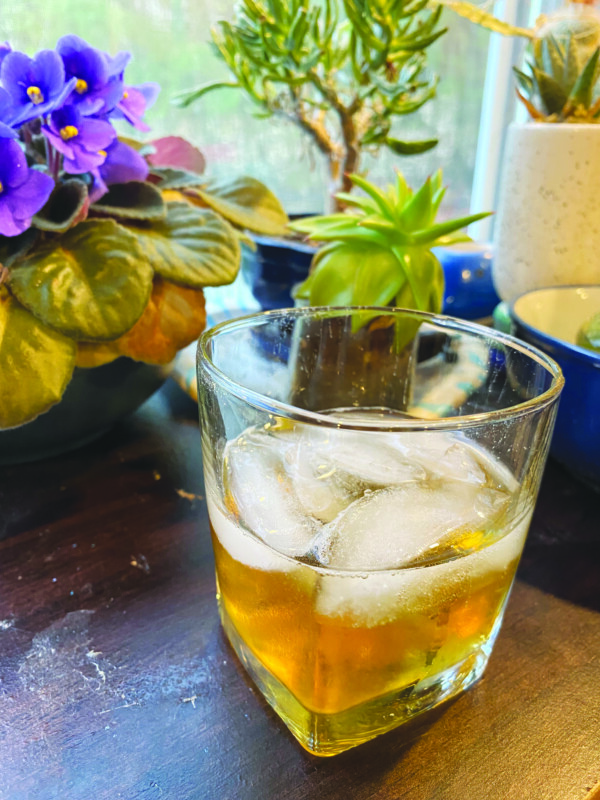
Pour, unstrained into a rocks glass. Drink, with a child-like song in your heart.
If you had to guess beforehand, you’d probably think that the Manischewitz would be a little too sweet and that the whiskey would give this drink some backbone. In fact, though the wine is nice and grape-y, the sweetness comes from the Skrewball. In fact, it might even be a little cloying, if not for the lemon juice, which steps in at just the right moment and says, “I got this, Boss.”
This is shockingly good. One of these might turn your day around. Two of them might encourage you to try a new recipe — maybe pancakes (see below). Three of them might bring on some ill-advised, late-night texts. Or a nap.
Peanut butter pancakes with blackberry syrup

So, to make these pancakes the way I really want to, we’d have to run a brunch bar in Las Vegas.
That sounds good to me; it might be our ticket out of here. Tell me more.
Well, OK. It would be really nice to have sourdough pancakes.
Ooh, I’m in. Let’s do that.
Yeah, unfortunately, the batter needs to proof for 12 hours or so. That wouldn’t be a problem in our Vegas Brunch Bar — I’m thinking we should call it Midnight at Schmitty’s — but real people almost never realize they want pancakes until about five minutes before they eat them.
I see your point. Until we get the Vegas place going, I’m going to stick with a boxed mix I like. And who’s Schmitty?
I know a guy, who knows a guy.
And—
That’s Shmitty.
Oh, OK. What about the peanut butter?
Yeah, that’s another thing that will work better in Vegas. I spread some peanut butter on a silicone sheet and froze it, then chopped it up to sprinkle on the wet side of the pancake as it cooked in the pan.
That sounds like a really good idea.
Well, it does, but a home freezer doesn’t really get the peanut butter cold enough. It freezes solid, but because of the high oil content, it melts after the first pancake. We’d have to use liquid nitrogen. That would get it cold enough that a line cook wearing snowmobile gloves and a face shield could drop it on the counter and shatter it into peanut butter shards that she could put back into a bowl of liquid nitrogen until she’s ready for them. It would make a great show.
Aaaand, most of us don’t actually have access to liquid nitrogen, so—
Uh-huh. At home, we’re stuck with using tiny jam spoons to drop dollops of the peanut butter onto the wet side of the pancake.
Does it work?
Really, really well. And then there’s the syrup.
What about it?
We could make it for customers on demand. We could have a buffet of frozen fruit for them to choose from, and they could fill up a bowl with it and we’d make it right in front of them.
And if a customer wanted something special, what could we make?
Twenty-five dollars per pancake.
Peanut butter banana cocktails
The best bananas aren’t pretty.
It’s that simple; people want pretty, yellow bananas, maybe a little bit green at the tips. The ones that don’t have a huge amount of flavor and might even be acidic enough to hurt the roof of your mouth. Ones, in short, that don’t taste very much like bananas.

This is what a delicious banana looks like.
No. Not the yellow ones on the bottom shelf.
No. Not the Reese’s Peanut Butter Cups, though we will get to the peanut butter, soon enough.
The brown bananas with blotches of yellow, sitting in front of the cash register at a convenience store. The ones that look like they have seen too much and lost the will to live. They are the ones that will actually taste like bananas.
And what will you do with one?
Banana rum
- 1 very ripe convenience-store banana. You want the sketchiest-looking one in the gas station. Pick it up, cradle it in your hands, and murmur to it, “Shhhh. It’s OK. You’re safe now.” This is patently untrue, but lulling your banana into a false sense of security will make this whole process easier.
- 2 cups white rum
Peel the banana, then muddle it thoroughly in the bottom of a large, wide-mouthed jar.
Add the rum, seal the jar, then shake vigorously.
Put the jar somewhere cool and dark. (I like to put it in the laundry room.) Shake it twice a day for a week.
After a week, strain, filter and bottle it.
This will give you a lovely, slightly cloudy rum that tastes of bananas but is not terribly sweet.
Peanut butter rum
This will use a bartender’s trick called “fat washing.” This exploits a chemical loophole: Any flavor that bonds to an oil will also bond to alcohol. So if you expose something flavorful and fatty — bacon grease, browned butter or, in this case, peanut butter — to a high-proof alcohol, given enough time, the booze will strip away some of the flavor and give it a new home.
Empty a jar of peanut butter into a non-reactive container with a lot of surface area. A glass casserole dish would be ideal for this. Spread the peanut butter over the entire bottom surface of the container with a silicone spatula or the back of a spoon.
Fill the empty peanut butter jar with medium-quality white rum. You don’t want the very cheapest stuff, but the flavor of the peanut butter will cover up any delicate flavor notes, so probably not the most interesting stuff you have either. A bottle of Bacardi or Captain Morgan will do very nicely.
Put the cap back on the peanut butter jar, and shake it to wash out any peanut butter you might have missed, then pour it into your container, to completely cover the peanut butter.
Put some sort of cover over the container — parchment paper, followed by a layer of aluminum foil, perhaps. Put it somewhere out of the way, where nobody will bump into it for a few days.
After four days, carefully pour the rum off into a new container. Filter, and bottle it. It is now delicious.
Two delicious cocktails you can make with these rums
An Elvis martini
Combine 2 ounces each of banana and peanut butter rums in a mixing glass with ice.
Stir gently, then pour into a chilled martini glass.
Garnish with a strip of bacon.
Even better: a peanut butter banana daiquiri

In a cocktail shaker with ice, add 1 ounce Banana Rum, 1 ounce Peanut Butter Rum, 1 ounce fresh squeezed lime juice, and ¾ ounce simple syrup.
Shake thoroughly, then strain into a coupé glass. Garnish with a slice of lime.
Just as with the banana you used to infuse your rum, you will want to use a lime that has seen a few too many things, one that, if it were starring in a fruit-based buddy cop movie, would say, “I’m getting too old for this.” It might be a little dried up. It might even have started to turn yellow. You want an experienced lime for this.
Your resulting cocktail will be stunningly delicious. You will be able to taste each element — the peanut butter, the banana, Grampa Lime, and the hint of sweetness that you’ve used to make everything mesh.
The world’s best breakfast sandwich
Thanks for meeting with us, Otto. We’re very excited about this project.

“My pleasure. I’ve always wanted to direct an adaptation of a Shakespeare play. Romeo and Juliet will be a good challenge for me.”
Outstanding! We’re all on the same page. We’ve made a few notes for you on the casting.
“Oh, I’ve got a casting director in mind. I’ve always worked with her and she’s always done really solid work for me.”
Oh, no doubt. We love her. She’s like family.
“And yet, you still have some casting notes for me.”
Excellent! I’m glad we’re all in agreement here. The first part we’ve cast for you — we’re really excited about this — is a bit of a coup. We’ve gotten Helen Mirren to play Juliet.
“Dame Helen Mirren?”
Like I said, we’re really excited about this. Juliet is supposed to be beautiful and Helen Mirren is one of the most beautiful women in the world.
“Yes. Yes, she is. She is also 77 years old. Juliet is supposed to be 14.”
Mirren’s a pro; don’t worry about it. You’re really going to like this next one. We’ve found your Mercutio!
“And who do you see playing him?”
A CGI Scooby Doo!
“Because—”
He’s incredibly popular. This will bring in a whole new generation of Shakespeare fans! We can’t kill him off, of course, but he’ll totally refresh the whole duel scene!
“Ruh-roh, Romeo’?”
See? This practically writes itself!
Details matter, people.
Ingredients
Assemble in the following order:
- 1 slice of white toast. You’re going to be tempted to use better bread — something with seeds, or fiber, or flavor. Save them for a more conventional sandwich. This one calls for toasted white sandwich bread.
- Natural peanut butter — the kind that separates if you don’t refrigerate it. Use the KISS principle here: Keep It Simple, Sandwich.
- Pickled jalapeños. Not fresh chilies. Not hot sauce. Pickled. Jalapeños.
- A scrambled egg. I make mine in the microwave. Beat an egg in a small bowl with a tablespoon or so of milk or cream, then cook it for 67 seconds. Will it be the fluffiest, most delicate scrambled egg you’ve ever had? Probably not, but it’s the right egg for this sandwich.
- Fresh ground black pepper and coarse sea salt.
Believe it or not, this is an excellent sandwich. The spicy acidity of the pickled jalapeños cuts the richness of the peanut butter. The egg gives it dignity and gravitas. Delicious bread would be a distraction, but the crunch of the toast pulls everything together.
“OK, but I can put cheese on it, right?”
No.
“It doesn’t really need jalapeños, does it?”
Yes, it does.
“No offense, but I don’t think I’m going to make this; it sounds too weird.”
Don’t worry about it. This sandwich will be there when you need it. Someday, you will be clawing your way back from a broken romance, or a late night out, or three hours of your life in a meeting that you will never get back, and this sandwich will be there for you.
Peanut butter and jelly sorbet
In our increasingly strident and partisan world, it’s easy to feel alone and bitter. It sometimes feels like we have nothing in common. Black is white. Up is down. Tangerine is a color. Madness!
Is there a common thread to humanity where we can find common ground?
Ice cream.
If someone says that they don’t like ice cream, do not trust them. I’m not saying that they are absolutely, 100 percent, reptilian aliens in a skin suit, but you should really not take the chance.
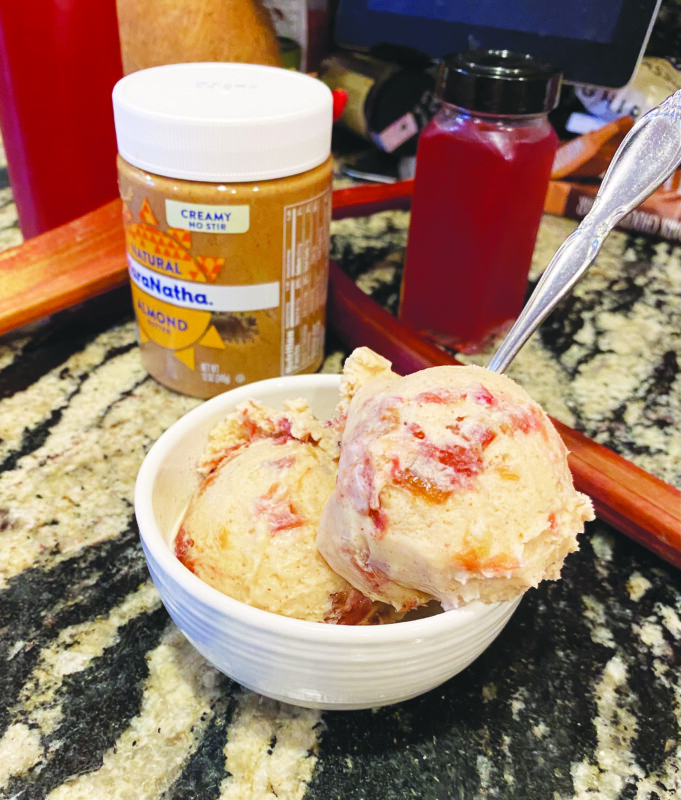
This is technically a sorbet, meaning that it is made without dairy, so we can’t call it ice cream, but it’s frozen and smooth and peanut buttery. It is a riff on a recipe from David Lebovitz’s The Perfect Scoop.
Ingredients
- ¾ cup (180 grams) smooth peanut butter
- ¾ cup, heaping (180 grams) brown sugar
- 2⅔ cup (660 grams) unsweetened almond milk. I like the vanilla-flavored kind. (Dairy purists can use half-and-half.)
- Pinch of salt
- A small glug (see above) of vanilla
- Jelly or jam for ribbon

Add peanut butter, brown sugar, almond milk, salt and vanilla to a blender. Blend everything until it is completely mixed and takes up slightly more room in the blender jar.
Chill the mixture for several hours.
Freeze and churn in your ice cream machine, according to the manufacturer’s instructions. (Or according to what the spirit of Mr. Peanut told you in the dream you had after eating all that questionable cheese from the back of the cheese drawer.)
As you spoon the sorbet into whatever dish you will be freezing it in, alternate between gobs of sorbet and spoonfuls of jelly. I have found that jellies with bright, acidic flavors work best; seedless raspberry is good. I haven’t tried lime marmalade yet, but I have high hopes for it.
Harden in your freezer for several hours.
This sorbet is exactly what it purports to be. It is cold and intensely flavored with peanut butter. The jelly ribbon gives contrast in taste and texture. It is refreshing, both physically and emotionally.