Binge-watching and beer

Beer can be a critical component to pair with Netflix

The problem is that when one episode on Netflix ends, you’ve got less than five seconds to shut off the television before the next episode starts. If you haven’t made a conscious effort to have the remote in your hand the second the episode ends, you have missed your chance.

And once the next episode starts, forget about it.

That’s where I’ve found myself over the past couple weeks, cranking out episodes of the show Broadchurch on Netflix as if my life depended on it, as if I were playing a crucial role.

I couldn’t stop. The plot, the characters, those amazing British accents — the show had full control over me. (Did I watch it with subtitles because sometimes, just maybe, I have trouble understanding what exactly is being said with those heavy accents? Maybe. I don’t regret it.) The show first aired on ITV in Britain between 2013 and 2017.

I’m a sucker for murder mysteries, in show or book form, and I just feel that Netflix really takes advantage of me. Every night I’m thinking about how I can maximize my viewing time and considering just how much sleep I really need — or don’t need.

Anyway, binge-watching shows isn’t a new concept but I think it’s safe to say the practice has become more commonplace as we’ve all maintained a heightened state of isolation in our homes over the past year.

I think you need some beer to help you watch. Still, you can’t binge-watch an intense murder mystery show and drink a bunch of beers. Well, OK, you can — I’m not the boss of you — but the characters are relying on you to help them solve the case and you’re no help if your senses aren’t sharp.

I think you do need a little something to help you deal with the intensity. For me, that means a nice, rich stout or porter that I can sip slowly as I try to predict whodunnit. You might be in for a long night so you don’t want something that’s going to just knock you out. You just need something to take the edge off.

If you’re binge-watching something more lighthearted, like, say Schitt’s Creek, I think you can be a little more liberal with your drinking. But, frankly, I don’t think you binge-watch a comedy in the same way you just can’t stop watching something more serious. But that’s really your call.

Here are five beers to support you through your next binge-worthy show.

Smoke & Dagger by Jack’s Abby Craft Lagers (Framingham, Mass.)

This is lighter than you’d expect but it is packed with layers of richly flavored roasted malts. This is perfectly balanced and welcoming.

Geppetto by Schilling Beer Co. (Littleton)

This milk stout brewed with coffee is a decadent brew that hits you with big notes of chocolate and a little bit of roasted coffee too, as you might expect. It’s got a little sweetness as well.

Boneshaker Brown Ale by Moat Mountain Brewing Co. (North Conway)

This is a wonderful brown ale featuring notes of chocolate, roasted nuts and caramel in a fairly light package.

Maritime Lager by Newburyport Brewing Co. (Newburyport, Mass.)

You don’t have to think about this beer; you can just drink it and enjoy the show, and sometimes that’s all you need.

Oatmeal Stout with Honey by Throwback Brewery (North Hampton)

Don’t let the honey throw you off; while this has just a touch of sweetness, this beer is really all about delicious roasted malts and big notes of chocolate.

What’s in My Fridge
Budweiser by Anheuser-Busch
Am I allowed to drink Budweiser without people throwing things at me? I’m not sure. It’s been a long time and the Budweiser drinking experience was pretty much as I’d remembered it — crisp, clean, not especially flavorful, but also not at all off-putting. It’s a beer. Relax, everybody, it’s a beer and it’s fine. Cheers.

Featured photo: Photo by Jeff Mucciarone.

A drink named…

During the 1920s and 1930s, if you were young and had the means, Paris was the place to be.

The war had ended — at least everyone thought so. In the boom times of the Roaring Twenties the arts flourished like they never had before. The French embraced jazz, experimental art and edgy literature. Unencumbered by Prohibition, Parisians were extremely open-minded about cocktails (and indeed, many other fun things as well). American authors and artists moved there in droves.

They stayed through most of the ’30s. The Great Depression hit France as hard as anywhere, but things seemed just as bad at home, and again, there were cocktails. And if you were young, and beautiful, and American in Paris in the 1920s and ‘30s, the place to be was Harry’s New York Bar, on the Rue Daunou. Hemingway drank there. George Gershwin composed An American in Paris there.

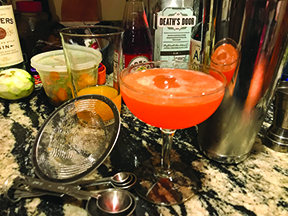
And then there were the drinks. Harry’s claims to have invented the bloody mary. Also the Sidecar and the French 75. And this one.

What’s that? What’s it called? Um — er —

HEY! Look over there! Is that an oscelot?!

Anyway, the thing to keep in mind when you are making this particular drink — Excuse me? What’s it called? Darling, let’s keep this pure and special. Let’s not complicate things with too many questions.

As I was saying, the thing to keep in mind when making this particular drink is that while it is, at its core, a relatively straightforward cocktail, it lends itself to more and more elaborate ingredients and techniques. It is easy to slip down a rabbit hole of obsession. As I did.

The Recipe:

1 1/2 ounces mid-level gin (I’ve been drinking Death’s Door lately)

1 1/2 ounces fresh squeezed tangerine juice (OK, you’re going to use orange juice. You know it. I know it. All I’m saying is that I made this with tangerine juice and it is good that way.)

1/2 teaspoon absinthe (Seriously, no more. Absinthe is a very serious player and she is not here for your nonsense.)

1/3 ounce (2 teaspoons) Oleum Saccharum — see below. (Again, let’s face reality. You’re going to read about OS, nod, then probably not make it. Admittedly, it’s a bit of a project. You can replace this with the same amount of grenadine, which will also give your final drink a lovely color.)

1 ounce lime juice (This was not called for in the original recipe, but this drink benefits from extreme cold and a little extra acidity.)

1) Shake all ingredients over ice until skull-shrinkingly cold.

2) Strain into a chilled coupé glass.

3) If you insist on a garnish, then apply one high-octane cocktail cherry with stem. (I’ve been liking Luxardo lately).

This is a lovely cocktail that looks sophisticated and paces itself well. In spite of having just a few ingredients, its flavor is complex. It takes thought and reflection to sort out the fruitiness of the juice and the licorice notes from the absinthe. It lends itself to thoughtful consumption. Is it too sweet? Is it sweet enough? Seriously — licorice? Is the tangerine juice assertive enough? Should I have gone with the orange juice that Harry suggested? What if I played around with ruby grapefruit juice? These questions are to be expected if you’ve made this well. I like to think of it as an intellectual’s cocktail.

And that, my friend, that is how you make a Monkey Gland. Yeah, I know. Would you like another?

Oleum Saccharum
Oleum Saccharum is at its heart a homemade syrup of citrus oil and sugar. It requires you to use a technique called maceration, which is not as naughty as what you’re thinking, but in this case just as self-indulgent. It is the name for extracting juice or oil from fruit with sugar.
Using a vegetable peeler — the Y kind works better for me than the type that looks like a paring knife with a glandular condition — remove the outermost layer of rind from some well-scrubbed citrus fruit. In my case, I used a combination of tangerine and lime rind. (See above.) If you can, try not to get any of the white pith that is beneath the rind; it will add a bitter note to your syrup. (Unless you’ve gotten sucked down the rabbit hole and want to play around with bitterness. In that case, you’re on your own.)
The recipes I’ve found call for 200 grams of rind to 150 grams of sugar. I never have that much fruit rind available; just use a 4:3 ratio (that’s 1 to .75). Alternately, if you are the type of person who plans and thinks ahead, you could save rind in your freezer until you’re ready to make a batch of this.
Combine the rind with sugar and let it sit for about six hours, stirring or shaking occasionally.
After letting it macerate (stop giggling), use a small funnel to pour your oleum saccharum into a tiny bottle. If you leave the rinds in the funnel to drain for an hour or so, you can get a few more precious drops. Store it in your refrigerator until you’re ready to use it.

Featured photo: What’s in a name? Photo by John Fladd.

Wine with Valentine’s Day

Celebrate with chocolate and red wine

How to celebrate Valentine’s Day? With red wine and chocolate, of course! The wine should be rich with fruit to the nose and palate but not too “jammy.” It should have subtle tannins and be “just a little dry” to counter the sweetness of the chocolate.

The chocolate should be among the best you can find, with a cocoa content of 70 percent or higher, because dark chocolate contains a higher concentration of antioxidants and nutrients compared to chocolate with a lower percentage of cocoa. So a good red wine with excellent chocolate is a must not just for Valentine’s Day but for the entire month.

A great wine to pair with a dark chocolate is a 2015 Stewart Merlot by Stewart Cellars, originally priced at $39.99 and on sale at the New Hampshire Liquor & Wine Outlet at $19.99. Michael Stewart, founder of Texas MicroSystems, a Houston-based company that produced personal computers and servers for the telecommunications industry, and a lover of fine wine, settled in Napa Valley in 1999. He and his wife, Anne, entered the wine business by purchasing a majority interest in the Juliana Vineyard in the eastern section of Napa Valley. Since then, Stewart Cellars has become a family venture with their children, James and Caroline, along with Caroline’s husband, Blair, joining in the enterprise. Stewart Cellars, a very small production winery, is noted for its cabernet sauvignon, sourced from grapes grown in the finest vineyards in St. Helena and Atlas Peak.

This merlot has a dark, thick (almost opaque) purple color, with the characteristic orange rim, and strong notes of cherry and plum to the nose, less dominant to the tongue. The tannins are subtle and the taste is long. California merlots tend to be more fruit forward than merlots grown elsewhere. Typically raspberry and blackberry with strong mocha and chocolate notes prevail through complex nuances of leather and tobacco. Unfortunately, with the release of the movie Sideways, entire vineyards of merlot were pulled, resulting in a paucity of the grape in California. Fortunately, this wholesale destruction of this superior varietal did not affect the plantings in Bordeaux, and now, almost 20 years later, merlot can be appreciated as the third most popular wine in the U.S. after cabernet sauvignon and red blends.

Now to the question of what kind of chocolate to pair with this luscious wine! Local candy makers, including Granite State Candies, Van Otis and Dancing Lion, which uses Jivara chocolate from Ecuador, offer superlative dark chocolate. Locally available, and wonderfully delicious, is Divine 70 percent cocoa chocolate, sourced from São Tomé, a volcanic island off the coast of Africa, and Lily’s 70 percent cocoa chocolate, traded in compliance with Fair Trade Standards, sweetened with stevia, an extract from a South American shrub.

So settle back, relax, appreciate the labor that went into this wonderful pairing of a rich, full-bodied wine, with the full mouth feel of a smooth, dark chocolate.

Featured photo: Courtesy photo.

Super Bowl and beer

Five beers to enjoy during the big game

I know you’re sullen because the Patriots aren’t in the Super Bowl. Hey, I am too, but there is still technically a game and it might be worthwhile to watch, even if you can’t get together with a bunch of friends and family like you might in normal times.

It’s still the Super Bowl and if times were less defined by Covid-19, you’d probably be drinking beer during the game. You still can! And I have some suggestions that might just make the game and the overall experience a little more palatable.

With the Patriots not participating, I think that gives you an excellent opportunity to spend a little more time pondering your beer than you would otherwise. If the Pats are in the game, your friends could probably fill your glass with Malibu Rum instead of beer and you wouldn’t notice because every fiber of your being would be tuned in to the game.

So, OK, silver lining, you can chill out a little bit.

Here are five New Hampshire beers you should drink during the Super Bowl (OK, maybe not all of them, but honestly, maybe, because where are you going?):

Alexandr by Schilling Beer Co. (Littleton)

Let’s start with something light, crisp, clean and easy. This Czech-style Pilsner is a perfect brew to sip as you take in a little of the pre-game analysis and theatrics — and with some apps. Pilsners get a bad rap sometimes as a beer that lacks flavor. True, no Pilsner is going to hit you square in the jaw like a big IPA, but they’re not meant to. That doesn’t mean this brew — and other craft-brewed Pilsners — doesn’t have plenty of character.

Ragged Mountain Red Ale by The Flying Goose Brew Pub & Grille (New London)

This red ale is smooth, malty and, honestly, kind of dangerous, because it goes down awfully easy. The rich amber pour is intriguing, as the beer’s body is really quite light, but not so light that you can’t appreciate the complexity. A great beer to have in your hand at kickoff and to eat Super Bowl food with.

New England Gangsta by Earth Eagle Brewings (Portsmouth)

We’re going to start to crank things up a little now, because, presumably, the game is starting to get a little more serious now that the players and the fans have gotten over the initial round of butterflies. But this West Coast-style IPA doesn’t crank it up so much that you’re going to knock yourself out. You’ll get some citrus and some pine on this with some pleasing residual bitterness. This is on the lighter side as IPAs these days go, but you’ll have plenty of hop character to consider as you critique the play-calling.

No Other Place Sour by Lithermans Limited Brewery (Concord)

OK, you got through the first half and you got through the halftime show, for better or worse, and now you need to wake up your taste buds. This’ll do the trick nicely. This fruited gose is going to hit you with bright, tart cranberry flavor in a low-alcohol package, which is exactly what you need right now.

Draken Robust Porter by Kelsen Brewing Co. (Derry)

The game isn’t over but it’s time to wind down. I think stouts and porters are great for doing just that. There’s no rush. You can sip them slowly and appreciate their rich, complex flavors. The Draken is full of roasted malt flavor and big on chocolate and caramel, and I think maybe some coffee, too? This is a great choice to enjoy as you watch the final minutes play out and to sip as you take in the trophy presentation ceremony.

What’s in My Fridge
Winter Lager by Samuel Adams Brewing Co. (Boston, Mass.)
When you haven’t had one of these in a long time, this brew is sort of eye-opening. It’s nice and easy to drink with a little sweetness and spice as you’d expect — just a perfectly enjoyable beer. Cheers!

Featured photo: Pick up some beer for the Super Bowl. Courtesy photo.

Zombies!

One fairly common New Year’s resolution is to read more classics of literature. I didn’t actually make that resolution this year, because I really don’t need any more sources of failure and self-recrimination. But that said, I’m probably ahead of the game and have read more classic literature during the first few weeks of this year than many people who did make that resolution.

To wit, 1951’s The Holiday Drink Book.

I did rather well for myself over the holidays and was given several antique cocktail books, this being easily the most festive.

Is it dated? Yes. Does it include dated references to ingredients — claret or sauterne, for example — that we don’t use anymore? Undoubtedly. Does it include unfortunate illustrations of leprechauns, cannibals and serving wenches? Um, yes. That, too.

That said, given the first few weeks of this new year, I think we could all use a stiff drink. And if you are looking for a stiff drink, I say, go to the source — the 1950s, the era of the Three-Martini Lunch. And, if you are looking for a stiff drink from the 1950s, you could do worse than go with the grandfather of all stiff drinks, a Zombie. The Holiday Drink Book puts it rather well: “In appearance and effectiveness the Zombie is the king of all table drinks.”

I’m a big believer in sticking strictly to a recipe the first time I make something. It drives me crazy when someone omits all the butter from a recipe and replaces half the flour with oat bran, then complains that their muffins taste cardboardy. It’s a good idea to cook what the recipe’s author had in mind before messing with it too much.

But you do need to draw the line somewhere.

Did I use four types of rum in my test Zombie, as specified? I did. Did I garnish it with fresh mint leaves and a dusting of powdered sugar? Yes.

But here’s where The Holiday Drink Book and I parted ways: Their recipe calls for papaya juice.

Now, I don’t want to hurt your feelings if you happen to be a papaya, but certain harsh truths need to be recognized. Papaya is a trash fruit. If fruit cocktail and oatmeal had a torrid half-hour in the alley behind a bar, the result would be something very much like papaya. So I had to play with the recipe a bit. Ultimately, this is what I came up with:

The Purple Zombie

The juice of one lime – approx. 2 oz.
1 oz. pineapple juice
1 oz. frozen grape juice concentrate – the deeply purple kind
1 oz. golden rum
2 oz. dark rum – I used Meyers’s
1 oz. white rum – I went with Mr. Boston
½ oz. apricot brandy

Enough over-proof rum to float on the surface of the cocktail – in my case, Gosling’s Black Seal 151-proof dark rum

4 up-market cocktail cherries – right now, I really like Luxardo.

Fresh mint leaves to garnish

1) Combine the first seven ingredients in a cocktail shaker with ice. Shake until very cold. I like to include one of the spent lime halves, as well. I don’t know for a fact that it improves the flavor, but I like to give limes the vote of confidence. They are the hardest-working members of the citrus family, and I like to make them feel needed.

2) Remove the lime half, then pour the contents of the shaker — ice and all — into the most garish tiki glass you own.

3) Float ½ an ounce or so of the 151 over the top of the drink. Pour it over the back of a spoon, much like you would the whiskey in an Irish Coffee, so it stays on the surface.

4) Garnish with snobby cocktail cherries and fresh mint. If your mint leaves are large, chiffonade them (cut them into ribbons).

Three important points about The Purple Zombie:

a) The mint leaves totally make this drink. Somehow the herbiness of the mint plays very well off the dominant taste of the cocktail, which is the rum. Don’t skip the mint.

b) Do skip the powdered sugar. I’m not entirely sure what they were thinking with that one.

c) “Wait a second. You got all snobby about papaya, then replaced it with frozen grape juice concentrate? What kind of beatnik hypocrite are you?” What can I say? It works. The drink needs some sweetness to balance the alcohol and the grape juice concentrate does that very well while adding to the fruitiness. Why not just grape juice? It isn’t quite sweet enough. You need to go with the hard stuff.

Plus, it turns your Zombie purple.

Am I saying that drinking a Zombie will remove any of the heavy weight that the past year has put on your shoulders? No. But I am saying that if you approach it right, a good Zombie might give you the emotional shoulder pads to allow you to claw your way through to February.

Featured photo: Photo by John Fladd.

A blend of flavors

How grape varietals come together in wine blends

Courtesy photo.

Most wines produced today are made up of a blend of wines from different casks or vats. Fundamentally the goal of blending wines is for the final product to be greater than the sum of its constituent parts. These “parts” could be wines from different grape varieties, or simply distinct parts within the same vineyard.

Wines exposed to or without oak barrels, or different vintages and other variations, such as percentages of each wine component, can make up a blend. Blending is a skill developed by experience, requiring a fine palate and the foresight of how the different flavors will work together.

Champagne and American sparkling wine is a blend. It can be a blend of different chardonnay wines, or a chardonnay blended with pinot noir. This blend results from the process of making the wine, as new wine is added to the bottle during the dosage. A white wine such as sauvignon blanc will often have sémillon added to it to quiet the acidity and citric notes of the sauvignon. Even Prosecco, the wine from a particular region in northeast Italy, is made mainly from the glera grape but can have up to 15 percent chardonnay, pinot bianco, pinot grigio or some less familiar native grapes to add to its sweetness and complexity.

Chianti, the darling of Italian restaurants with red-checkered tablecloths, gets its name from the hills that stretch south from Florence to Siena. While the main grape is 80 percent sangiovese, up to 20 percent canaiolo, cabernet sauvignon and merlot are added to provide the wine with a silkier texture, finer finish and more fruit flavors than 100 percent sangiovese wine can offer.

Bordeaux is more than a world-famous wine region; it is a wine empire, with 463 square miles of vineyards (half the size of the state of Rhode Island) and 57 appellations of grape growers, vineyard owners and numerous cooperatives. Bordeaux is well-known for its red wine, the blends made from cabernet sauvignon, merlot, cabernet franc and petit verdot combined in varying percentages based on the estates’ locations, soils and weather of the growing season, an intricate balance that changes from year to year. The cabernet franc is lighter than the lead cabernet sauvignon and, when added, contributes a finesse to the more robust leading grapes of cabernet sauvignon and merlot.

Blends do not always have to be traditional or formulaic. In an exclusive offer to the New Hampshire Liquor & Wine Outlets, Frog’s Leap Vineyards owner John Williams presents his 2018 Granite Red Blend (originally priced at $54.99, reduced to $19.99). While almost all the wines produced and bottled by Frog’s Leap Vineyards are estate grown, sometimes, due to weather or the estate’s production in a given year, they will supplement with purchased grapes. For the 2018 Granite Red Blend, Frog’s Leap used carignan grapes from a Mendocino County vineyard planted in 1942. Typically the carignan grape is used in blends, as it has a tannic, rustic quality. It has a dark red color and produces a wine with notes of the dark red fruit of cherries and plums. While this blend of mostly carignan along with some cabernet sauvignon lacks a long finish, it is the perfect wine for the weeknight dinner.

In the New Hampshire Liquor & Wine Outlet’s website under Education is a window titled “The Tasting Room.” As part of their “90 Days Around the World” promotion, there is an hour-long Zoom interview with John Williams from November ― “Wines of Frog’s Leap with John Williams.” It is highly entertaining and informative as John is an endearing personality who presents his philosophies of making wine, protecting the environment and living life to the fullest. It’s worth checking out.

Featured photo: Rory and John Williams. Courtesy photo.

Stay in the loop!

Get FREE weekly briefs on local food, music,

arts, and more across southern New Hampshire!