Among a trove of tribute acts, the ’60s British Invasion is well represented. What sets The Brit Pack apart is that their target isn’t one band or decade but a wide breadth of music from across the pond. Sure, they’ll crank up “Satisfaction” or “Twist and Shout” with alacrity, but a typical set list will also include Led Zeppelin, Oasis or Adele.
Consisting of four Berklee grads, The Brit Pack reflects not just the first wave led by the Beatles and Rolling Stones, but a representation of artists that came in the ensuing years — the British Occupation, if you will.
“You get a whole journey through all of these bands,” guitarist Mark Johnson said recently. “That same energy a tribute act would give you, but with every single band you might know from the British Invasion through the modern days.”
Occasionally they veer away from strictly British, playing “Go Your Own Way” — though Fleetwood Mac’s makeup is similar to theirs. Johnson and drummer Will Haywood Smith are U.K.-born like Mick Fleetwood and the two McVies, while Matt Nakoa and Bryan Percival serve as the group’s Lindsey Buckingham and Stevie Nicks.
In a joint interview with Nakoa, Johnson offered some logic-bending to explain the inclusion of “Boys Are Back In Town” by Thin Lizzy.
“They’re a good Irish band,” he conceded, “but we figured they were close enough to the U.K. … there’s probably some English blood in that band.”
Since forming in 2011, they’ve gone where the audience takes them, even when that finds lead singer Nakoa channeling Johnny Rotten, as happened when they played one fan’s wedding. This led to a secret side project called The Sex Beatles.
“We deliver classics in the Sex Pistols manner,” Johnson said.
The bit was born in the days of playing late-night residencies in their New York City home base.
“Bleecker Street and the Village … there’d be beers flying over the drum kit and random people sleeping on the stage,” Johnson said. “These days it’s a raucous show, but you won’t get hit by a flying amp or anything.”
While covering well-known songs, the group tries to put itself in the mindset of bands like Led Zeppelin or The Who.
“We improvise and really capture the essence of the songs, but we’re not doing it exactly like the record, because they wouldn’t have done it exactly like the record,” Nakoa said. “We own the music as if it was our own; unfortunately, we don’t get compensated that way.”
When they first set out, “It was the usual suspects, ‘Satisfaction’ and ‘Hard Day’s Night’ — but we were talking about doing Oasis and stuff,” Johnson said. “Through the years, people just keep requesting songs and we’re like, that’s a good idea, and there are times where we’re driving somewhere in the car and we hear a record and say, these guys are British — or at least somebody in the room when the record being made was British.”
“What’s so great is it’s a liberal interpretation,” Nakoa said. “We’re only going where the audience tells us we should be going. I mean, we go where the reaction is.”
Asked to name some favorite songs from their set, Johnson quickly answered, “anything Queen or Zeppelin, for the simple reason that it’s really fun to play.” He voiced gratitude for having a capable band of friends and singled out Nakoa, whom he also supports as a solo artist.
“When you’ve got a singer who can do this stuff as well as he does … as a performer, and as an audience member, it’s really a joy to be around,” he said. “It’s also very rare to get a chance where you can play it with a band this good. … I just enjoy playing with these guys, because they make it sound so cool.”
The Brit Pack When: Sunday, March 6, 7:30 p.m. Where: Rex Theatre, 23 Amherst St., Manchester Tickets: $23 at palacetheatre.org
Peter Dinklage is the poet who woos with his words but fears he repels with his looks in the Joe Wright-directed Cyrano, an uneven but interesting adaptation of a stage musical.
Peter Dinklage has, of course, been charming as all heck since before he was fan favorite Tyrion Lannister on Game of Thrones so it’s kind of a “nerd girl takes off glasses to reveal she’s a supermodel”-level suspension of disbelief that women in general and Roxanne (Haley Bennett) in particular, portrayed here as kinda flighty and romantic in a way that would seem to make her attuned to men who adore her, wouldn’t be smitten with the titular Cyrano.
But people are also singing and dancing in the streets, so it’s one of a few things you gotta just go with here.
You probably know the outlines of the story: In olden days France, noted poet, wit and swashbuckling dueler Cyrano loves Roxanne, an orphan who needs one of those advantageous marriages to stay financially solvent but who dreams of True Love. And she thinks she’s found it when she falls in love at first sight with Christian (Kelvin Harrison Jr.), a new guy in Cyrano’s regiment. She rushes to tell her dear friend Cyrano about this romantic thunderbolt — breaking Cyrano’s heart just a little because he clearly hoped that maybe her romantic realization was her love for him. But Cyrano is so in love and so friendzoned that he agrees to help Roxanne meet Christian and look after him as the new guy in the army barracks.
Christian, who was also enchanted when he first saw Roxanne, is delighted with Cyrano’s help. But he doesn’t have the words to win Roxanne over, so he takes help from Cyrano — using Cyrano’s sincere love letters to Roxanne (Christian doesn’t quite realize how sincere) and the lines Cyrano feeds Christian when he talks to Roxanne from beneath her window balcony, Romeo & Juliet style. Cyrano is willing to do it because he feels like his height gives him no chance with Roxanne.
So, basically, these two guys are olden days catfishing Roxanne but as they are both pretty decent we’re OK with it? Her bigger problem is her relationship with powerful noble De Guiche (Ben Mendelsohn). He’s a vindictive, grabby jerk whom she’s reluctantly been hanging out with and he has the power to put both Cyrano and Christian in harm’s way.
“Nimble” was how I found myself thinking of this movie’s wordplay and general mood (and Dinklage’s overall performance), especially in scenes between Roxanne and Cyrano or Christian and Cyrano, where the dramatic irony gives us a Cyrano’s-eye-view at everybody’s thoughts and feelings and gives an extra bit of double-edged wit to his lines. It’s subtle and delicate in a way that gives a lightness even to heartbreak. These elements also at times feel stagey in a way that I think would work if it were on an actual stage, with an audience’s laughter and responses serving as the setting of this party and pulling it all together. On screen, you sometimes get punchlines going out into the quiet void (especially if you tend to go to emptier screenings). It’s sort of — missing something. The movie isn’t quite as rooted in a real world as, say, In the Heights but it isn’t on a literal stage the way the Hamilton filmed version was (to use two Lin-Manuel Miranda plays as an example). I feel like if it were presented in a way that could give us some of that live theater energy it would make the first chunk of the movie more of a musical-theater good time.
The second chunk of the movie is tonally quite different, with the love triangle taking a back seat, at least in terms of on-screen action, to Cyrano and Christian at war. This section of the movie includes a surprisingly earnest and affecting song called “Wherever I Fall.” It’s a really heartrending moment of men facing battle, fairly certain they’re going to die, and thinking of the people they’re leaving behind. The three on-screen singers taking the lead on the song include Glen Hansard of Once fame. But this really grab-you-by-the-throat moment does not include either Dinklage or Harrison, an odd choice that puts you in the story of the men in the song but pulls you out of the story of the movie itself. The movie frequently does odd little things like this or the way that Cyrano and Roxanne are positioned in the shot of some of their more emotional scenes that undercut some of the emotion we should be getting from the relationships that make up the core of the movie.
For all this unevenness, the performances of that core trio of characters are thoroughly engaging. Bennett is hampered with some flightiness in her character (but is given some really great costuming and makeup; the movie’s sole Oscar nomination is for costuming) but manages to make her Roxanne seem appealing enough as a person that it is believable that both of these nice-seeming dudes would be so gaga for her. Harrison is sweet in exactly the right way; I feel like in the stories that have riffed on this idea, that character tends to be painted a little more meatheaded than he is here. Here, Christian is a nice guy you are also rooting for. Of course, above all we root for Dinklage, who is just thoroughly appealing and attention-grabbing throughout, even when the movie doesn’t fully build the case for whatever it’s doing with his character. B
Rated PG-13 for some strong violence, thematic and suggestive material, and brief language, according to the MPA on filmratings.com. Directed by Joe Wright with a screenplay by Erica Schmidt, Cyrano is two hours and four minutes long and distributed by MGM in theaters.
A deep dive into the nostalgic treat and its many sweet variations
It started as a way to raise money for her daughters’ synchronized swim teams — Heather Pfeifer of Goffstown made whoopie pies and presented them at bake sales to rave reviews. Eventually, she began serving pumpkin maple whoopie pies at the annual Goffstown Pumpkin Regatta; last year she sold out of nearly 1,000 before the event was over.
“People [in town] were going up to me and being like, ‘Are you the pumpkin maple whoopie pie lady?’ or they’d say, ‘They’re so good, where can I get them?’” Pfeifer said, “and I was just like, ‘Well I don’t know, I can bake some if you want.’ … I was cooking out of my kitchen for fun, but so many people were requesting where they could get them. So I started pursuing that.”
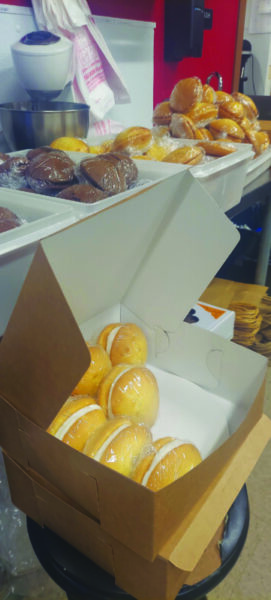
Pfeifer is now the owner and founder of Granite State Whoopie Pies and takes weekly pre-orders of the nostalgic treat in all kinds of flavors. She works out of the prep kitchen at White Birch Eatery in Goffstown, mostly on Mondays and Tuesdays when it’s closed for the day, and accepts requests to make any of her whoopie pies gluten-free, dairy-free or vegan.
Photo courtesy of Granite State Whoopie Pies of Goffstown.
With a regular offering of classic chocolate and vanilla or peanut butter, as well as two new special flavors released every two weeks, Pfeifer is proving that the whoopie pie can lend itself to all sorts of fun variations. Currently, she’s celebrating St. Patrick’s Day with chocolate and mint grasshopper and chocolate mocha Irish cream whoopie pies, while other flavors she’s previously dabbled in have included black forest, milk and cookies, red velvet, and peanut butter and jelly. Sometimes she’ll incorporate local ingredients — her maple bacon whoopie pie, for instance, featured bacon crumbles from Shaker Road Provisions of Loudon, while just last month she made chocolate milk stout whoopie pies using the Summit stout from Goffstown’s Mountain Base Brewery.
“I have a list of probably about 50 or 60 flavors … and more come to mind every day,” she said.
Similar whoopie pie flavor experimentations have been going on in the kitchen of Angela’s Pasta & Cheese Shop in Manchester. There you’ll find all kinds of whoopie pie flavors on the shelf, and you never know what bakers Laura and Adam Rexford will come up with next, like lemon poppy strawberry, Fireball whiskey pumpkin, tiramisu, pineapple upside-down cake and more.
“This year, people have been buying whoopie pies like crazy,” Laura Rexford said. “I can’t tell if it’s that we’re being more adventurous with flavors, or if people just want more comfort foods. … I feel like a whoopie pie is so much easier to eat than a cupcake, because of the distribution of cake to frosting. It’s almost like a sweet hamburger. The frosting is more contained.”
From the treat’s delicious creamy filling to the cakes surrounding it — which Pfeifer calls the “whookies,” or “whoopie cookies” — we take a look at how some local whoopie pies are made, and also attempt to trace back its origins as a New England staple.
Flavors and fillings
Today, the most common whoopie pie filling features a vanilla or marshmallow buttercream. Jordyn Hotchkiss of The Cat’s Pajamas, a home bakery based in Weare, said hers have a mixture of butter, confectioner’s sugar, marshmallow Fluff and a little bit of vanilla. The filling for her peanut butter whoopie pies uses those same ingredients, in addition to creamy peanut butter, kosher salt and milk — both flavors are stocked weekly at the Weare Real Food Farmers Market.
Pfeifer’s whoopie pies, meanwhile, have a roux-based filling, or a milk and flour thickener that’s mixed with granulated sugar, vanilla, butter, Crisco and a little bit of salt.
“I would equate the flavor … to almost like a Devil Dog,” she said. “The granulated sugar actually melts right into the roux … and what it does is it whips up so nice and fluffy, but it’s not overpoweringly sweet. … It creates this very light and creamy filling. It’s a more traditional way, but it’s not the most common way because it’s not the most shelf-stable.”
Pfeifer described her “whookies” as a thicker version of a muffin top, with a proper consistency resembling a brownie batter and a total baking time of around 10 to 12 minutes. Her roux is made first so that it has time to cool down once the cakes are baked.
Depending on the flavor she’s working with, additional ingredients are added to either the cakes or the filling. As for the diet-friendly options, she’ll substitute oat milk and plant-based butter for the dairy-free pies, and Bob’s Red Mill brand 1-to-1 flour blend for the gluten-free pies.
Photo courtesy of Angela’s Pasta & Cheese Shop in Manchester.
At Angela’s, classic chocolate and vanilla or peanut butter whoopie pies are always in stock, each of which is made with a house buttercream recipe. Those are sold individually, or you can try one of the shop’s themed duo packs — last month’s, dubbed “The Romance Package,” featured candied maple bacon and raspberry Frangelico-flavored whoopie pies. Currently available is the “Luck of the Irish” whoopie pie duo, with crème de menthe and milk chocolate Irish cream flavors. The shop also puts out bite-sized miniature whoopie pies in an assortment of flavors, sold in packs of a dozen each.
“Those have had a huge response,” Rexford said. “I think people feel a little less guilty about the mini whoopie pies, because you can just pop them in your mouth. They’re like little Munchkins.”
In Hooksett, The Cake Fairy has been baking whoopie pies since before it even had a storefront, back when it had a booth at the Deerfield Fair, manager Brianna Lucciano said.
“My mom would make these behemoth whoopie pies, like the size of a man’s hand, and people would walk around the fair with them, and others would say, ‘Oh, my gosh, where did you get that?’” she said. “It got to the point where we’d get a delivery, and people were just taking them out of the box because we couldn’t even get them on the table fast enough.”
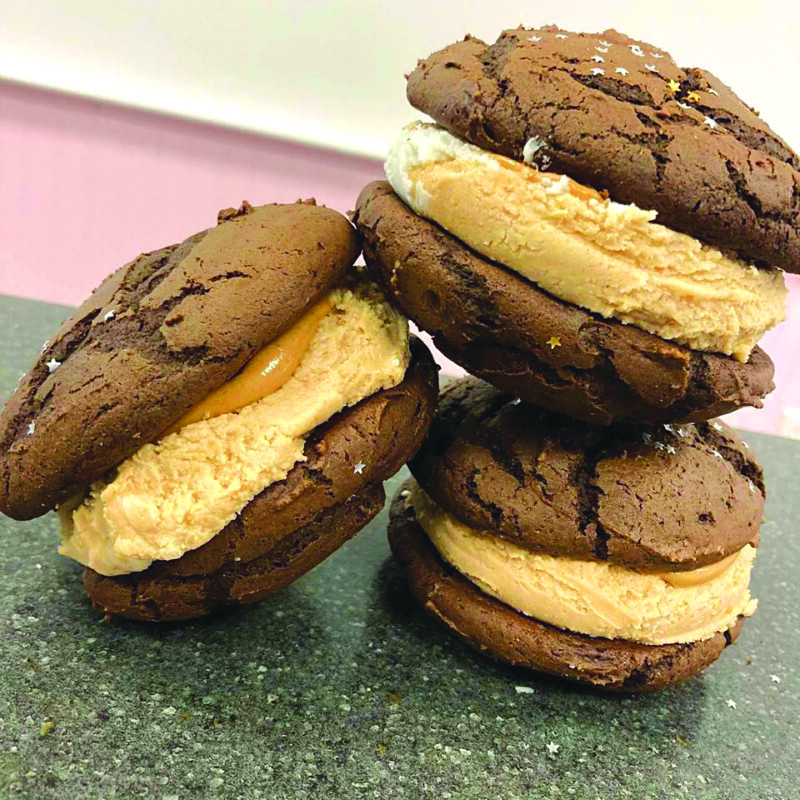
They no longer sell at the fair, but you can still get that familiar gigantic “Deerfielder” whoopie pie at the bakery, along with a few smaller sizes. In addition to the classic, there’s a Funny Bone whoopie pie with a chocolate cake and peanut butter filling, and a Boston cream whoopie pie with a vanilla cake, chocolate ganache and a custard buttercream.
Photo courtesy of The Cannoli Stop at The Candy Shop in Concord.
At The Cannoli Stop at The Candy Shop in Concord, owner Melinda Sergi has a regular assortment of fillings for her whoopie pies, from vanilla or chocolate cream to raspberry, peanut butter or pistachio. But she also takes things a step further by making whoopie pies with any one of the shop’s more than 50 flavors of cannoli fillings — those options run the gamut from cake batter and cookie dough to red velvet, bubble gum, cotton candy, salted caramel and more.
Lemon cake whoopie pies are part of the regular lineup of products at Fabrizia Lemon Baking Co., an online-only bakery based in Salem featuring uniquely crafted limoncello-infused treats. Also in Salem, Chatila’s Sugar Free Bakery offers an assortment of sugar-free and dairy-free whoopie pie flavors using a fluffy French creme-based filling.
Competing claims
Multiple U.S. states claim to be the birthplace of the original whoopie pie. Two of those states in particular — Pennsylvania and Maine — are notably linked by their Amish heritage, Pfeifer said.
While there are several theories, according to at least one edition of The Oxford Companion to American Food and Drink, an encyclopedia edited by Andrew F. Smith and published by Oxford University Press, it’s generally accepted that the first whoopie pie originated around the era of the Great Depression. The story goes that the cakes were made from a leftover batter, contributor Susan McLellan Plaisted writes, and, according to Amish legend, kids would find the cream-filled treats in their lunch bags and yell “whoopie!” with delight, giving them their name.
A bakery in Lewiston, Maine, called Labadie’s claims to be “the home of Maine’s first whoopie pie,” with a recipe dating back to 1925, according to its website. Another possible clue into how the treat became so popular in New England involves the Massachusetts-based Durkee Mower Co., the manufacturer of marshmallow Fluff. According to its website, an episode of a 1930s weekly radio show called “Flufferettes” promoted The Yummy Book, a book of various recipes using Fluff as the cornerstone ingredient — one of those was, of course, for whoopie pies.
Photo courtesy of Sully’s Superette in Allenstown.
But who exactly was the first to create the sweet treat, and where, is likely lost to history.
“It’s like saying who made pizza first,” Lucciano said. “In reality, it’s a form of chocolate cake and a delicious filling. We all had the same ingredients, but whose grandmother did it first?”
Both Pennsylvania and Maine hold annual whoopie pie festivals — Maine’s is set to return on June 25 to the town of Dover-Foxcroft, featuring samples from various bakers across the state, while Pennsylvania’s is held at the Hershey Farm Restaurant & Inn in Lancaster County in September. Since 2011, the whoopie pie has been honored as Maine’s official “state treat.”
While there are no large whoopie pie-centered festivals in the Granite State, Pfeifer does have a few upcoming local appearances where you can go to enjoy her whoopie pies. Find her at Mountain Base Brewery on Thursday, March 17, from 4 to 8 p.m., serving her classic, peanut butter, grasshopper and Irish cream flavors. Then on Saturday, March 19, she’ll be participating in the Downtown Concord Winter Farmers Market from 9 a.m. to noon. More events are in the works for the coming weeks and months.
Whoopie pies at home
A simple whoopie pie recipe uses ingredients easily within reach in your kitchen.
“It’s a process … because you have the two separate parts of it,” Hotchkiss said. “I use Crisco, sugar, eggs, milk, vanilla, flour, baking soda, baking powder, cocoa powder and a little bit of salt, and that’s just for the cake itself. … The oven actually gets preheated to 425, so it’s a bit of a hotter bake, and they only have to bake for about 10 minutes each.”
When baking them at home, Hotchkiss said, it’s important to make sure the cakes are spaced out enough so that they don’t spread into each other. She places either a silicone baking sheet or a piece of parchment paper on the baking pan to prevent sticking and help with their removal.
“Generally, once I get the cake part of it all done, I let them cool for a few minutes and then I start with my filling,” she said, “because they need to be fully cooled before you put them together; otherwise the filling will just start to melt. … Personally, I love having Fluff in them.”
Rather than spreading the filling over both cake halves, Hotchkiss said she likes to scoop it on just one and pushes the two parts together to finish the whoopie pie.
“It just makes for a good ratio, in my opinion,” she said. “Everyone has their own viewpoint of how much cream to cake there should be … but for the most part they’re relatively even.”
The pies remain fresh when wrapped for roughly a week, or you can freeze them.
“A friend of mine actually discovered that they freeze really well, so that was good to find out,” Hotchkiss said. “So if you don’t want to eat them right away, they can go in the freezer and then, when you’re ready to eat it, it will thaw out no problem.”
Where to get whoopie pies
Check out this list of local bakeries, shops, homestead bakers and other businesses offering homemade whoopie pies, from the classic chocolate and vanilla or peanut butter to all kinds of unique flavors. Some have them on hand all the time, while others will rotate their whoopie pies out with other pastries and treats from their bakery case — be sure to contact each establishment directly for the most up-to-date availability on their products.
• Angela’s Pasta & Cheese Shop (815 Chestnut St., Manchester, 625-9544, angelaspastaandcheese.com) offers both large-sized whoopie pies and mini pies that are sold by the dozen, and you never know which flavors bakers Laura and Adam Rexford will be working on next. Classic and peanut butter are usually available, while other options have included lemon poppy strawberry, Fireball whiskey pumpkin, tiramisu, pineapple upside-down cake and more. Angela’s has also recently begun offering themed duo packages of whoopie pies — the current one available, a St. Patrick’s Day-themed duo called “Luck of the Irish,” features crème de menthe and milk chocolate Irish cream flavors.
• Baked Downtown Cafe & Bakery (1015 Elm St., Manchester, 606-1969; 249 Sheep Davis Road, Concord, 856-8871; bakeddowntown.com) offers classic, peanut butter and seasonal whoopie pie flavors.
• The Bakeshop on Kelley Street (171 Kelley St., Manchester, 624-3500, thebakeshoponkelleystreet.com) offers classic and brown sugar maple whoopie pies, as well as several specialty flavors throughout the year, like pumpkin, red velvet, pineapple upside-down cake and a Bailey’s-filled chocolate Guinness whoopie pie for St. Patrick’s Day.
• Bearded Baking Co. (819 Union St., Manchester, 647-7150, beardedbaking.com) offers multiple sweets treats out of its bakery case, usually including whoopie pies.
• Benson’s Bakery & Cafe (203 Central St., Hudson, 718-8683, bensonsbakeryandcafe.com) offers classic whoopie pies, in addition to seasonal specials for flavors.
• Bite Me Kupcakez (4 Mound Court, Merrimack, 674-4459, bitemekupcakez.com) has a variety of pastries and sweet treats out of its bakery case, usually including whoopie pies.
• The Black Forest Cafe & Bakery (212 Route 101, Amherst, 672-0500, theblackforestcafe.com) offers classic whoopie pies, as well as seasonal specials.
• Buckley’s Bakery & Cafe (436 Daniel Webster Hwy., Merrimack, 262-5929; 9 Market Place, Hollis, 465-5522; buckleysbakerycafe.com) offers whoopie pies with whipped marshmallow frosting at both locations.
• The Cake Fairy (114 Londonderry Turnpike, Hooksett, 518-8733, cakefairynh.com) offers whoopie pies in a variety of flavors, like classic, Funny Bone, Boston cream and more, all in several sizes. The “Deerfielder” size is a throwback to the bakers’ days selling oversized whoopie pies at the Deerfield Fair, manager Brianna Lucciano said.
• Candia First Stoppe Country Store (285 Old Candia Road, Candia, 483-4888, candiafirststop.com) offers classic whoopie pies in small and medium sizes, as well as larger whoopie pies that are made to order.
• The Cannoli Stop at The Candy Shop (239 Loudon Road, Concord, 224-9706, thecannolistop.com) offers whoopie pies with a variety of fillings, from vanilla or chocolate cream to raspberry, peanut butter or pistachio. You can also order whoopie pies with any one of the shop’s more than 50 cannoli fillings, like cookie dough, red velvet or salted caramel.
• The Cat’s Pajamas (available at the Weare Real Food Farmers Market, 65 N. Stark Hwy., Weare, catspajamasnh@gmail.com, and on Facebook @catspajamasnh) offers classic and peanut butter whoopie pies, as well as a pumpkin whoopie pie that’s available seasonally.
• Chatila’s Sugar Free Bakery (380 S. Broadway, Salem, 898-5459, sugarfreebakery.net) has several sugar-free whoopie pie options, like classic, pumpkin spice, red velvet and more.
• Crosby Bakery (51 E. Pearl St., Nashua, 882-1851, crosbybakerynh.com) has whoopie pies available most days, as part of its lineup of freshly baked pastries and sweet treats.
• The Crust and Crumb Baking Co. (126 N. Main St., Concord, 219-0763, thecrustandcrumb.com) usually offers three or four whoopie pie flavors to choose from daily, like classic and salted caramel, as well as a blueberry cake with lemon filling and a raspberry cake with coconut filling. Ice cream-filled whoopie pies are also available seasonally.
• Dulces Bakery (87 Amherst St., Manchester, 606-2613, find them on Facebook @dulcesbakerynh) offers multiple options on its pastry menu, usually including whoopie pies.
• Duston’s Bakery & Deli (153 Portland Ave., Dover, 742-2506, dustonsmarket.com) has classic whoopie pies, as well as pumpkin seasonally, in addition to a few other flavors.
• Fabrizia Lemon Baking Co. (Salem, fabrizialemonbakingcompany.com) offers lemon cake whoopie pies, baked with Fabrizia Spirits limoncello worked into the batter. They’re wrapped two per pack and available for online ordering only.
• Frederick’s Pastries (109 Route 101A, Amherst, 882-7725; 25 S. River Road, Bedford, 647-2253; pastry.net) offers several flavors of whoopie pies, including dark chocolate and chocolate chunk cookie. Miniature whoopie pies are also available.
• Good to the Last Krumb (Hudson, find them on Facebook @goodtothelastkrumbnh) offers multiple sweet treats available for pre-order, including whoopie pies. They can also usually be found at Mack’s Apples (230 Mammoth Road, Londonderry) and Estey’s Country Store (9 Old Nashua Road, Londonderry).
• Granite State Whoopie Pies (Goffstown, granitestatewhoopiepies.com) offers classic and peanut butter whoopie pies, as well as a selection of two specialty flavors that rotate out every two weeks, available for pre-order by the dozen as regular or miniature sizes. Currently available are chocolate and mint grasshopper and chocolate mocha Irish cream whoopie pies. Any flavor can also be made gluten-free, dairy-free or vegan. Weekly orders are due by Friday for pickup the following Wednesday through Saturday, between 7 a.m. and 1 p.m., at White Birch Eatery (571 Mast Road, Goffstown). Single-serve pies are also available for purchase there, as well as at Little Red Hen Farm & Homestead (85 Norris Road, Pittsfield). Find owner and founder Heather Pfeifer with her whoopie pies at Mountain Base Brewery (553 Mast Road, Goffstown) on Thursday, March 17, from 4 to 8 p.m., and at the Downtown Concord Winter Farmers Market (7 Eagle Square) on Saturday, March 19, from 9 a.m. to noon.
• Harvey’s Bakery and Coffee Shop (376 Central Ave., Dover, 742-6029, harveysbakery.com) offers several specialty pastries and sweet treats, including whoopie pies.
• It’s All Good in the Kitchen (184 N. Broadway, Salem, 458-7434, itsallgoodgf.com) is a specialty gluten-free bakery offering a wide array of treats, usually including whoopie pies.
• Just Like Mom’s Pastries (353 Riverdale Road, Weare, 529-6667, justlikemomspastries.com) offers dozens of traditional and specialty whoopie pie flavors and flavor combinations.
• Klemm’s Bakery (29 Indian Rock Road, Windham, 437-8810, klemmsbakery.com) offers a wide array of pastries and sweet treats daily, usually including whoopie pies.
• Purple Finch Cafe (124 S. River Road, Bedford, 232-1953, purplefinchcafe.com) offers several specialty flavors of whoopie pies that are usually rotated out, from chocolate chip with vanilla to red velvet, maple cream and more.
• The Red Arrow Diner (61 Lowell St., Manchester, 626-1118; 112 Loudon Road, Concord, 415-0444; 137 Rockingham Road, Londonderry, 552-3091; 149 Daniel Webster Hwy., Nashua, 204-5088; redarrowdiner.com) offers classic whoopie pies, as well as red velvet and pumpkin whoopie pies that are available seasonally.
• The Red Blazer Restaurant & Pub (72 Manchester St., Concord, 224-4101, theredblazer.com) offers both large and small whoopie pies on its dessert menu, as well as a whoopie pie cake on its bakery menu, featuring chocolate cake layered with the classic whoopie pie filling and finished with chocolate ganache and a white chocolate drizzle.
• Sully’s Superette (39 Allenstown Road, Allenstown, 485-9955; 10 N. Mast St., Goffstown, 497-8176; sullyssuperette.com) offers classic whoopie pies at both locations.
• Wild Orchid Bakery (836 Elm St., Manchester, 935-7338, wildorchidbakery.com) has a rotating selection of pastries and sweet treats out of its bakery case, including whoopie pies.
• Zizza Authentic Pizzeria (653 Elm St., Milford, 249-5767, zizzapizza.com) offers multiple flavors of whoopie pies on its dessert menu.
Featured photo: Funny Bone whoopie pies from The Cake Fairy in Hooksett. Courtesy photo.
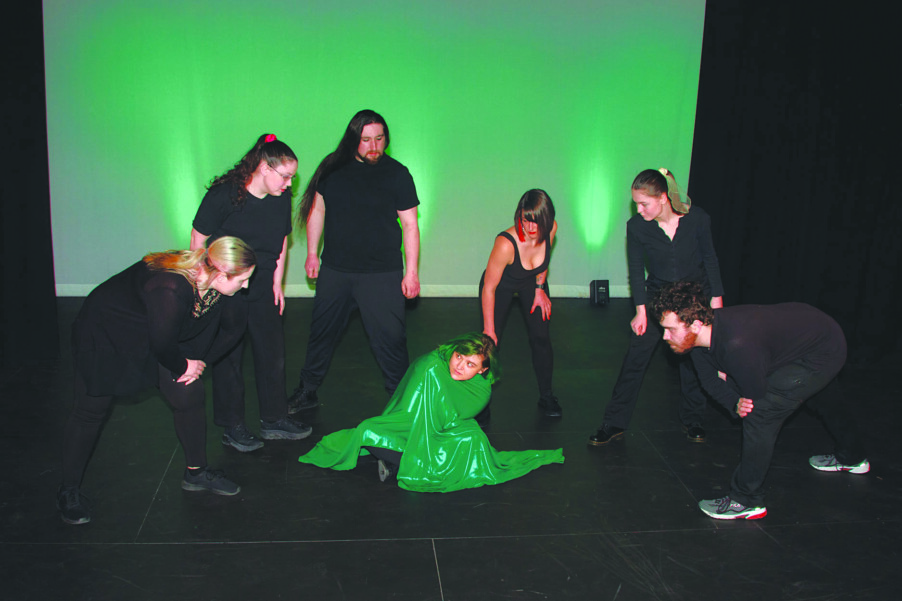
Seven actors, seven sins — that’s the idea behind Deadly, the newest all-original production from Cue Zero Theatre Company.
“It’s an original movement piece that takes the classical deadly sins and kind of examines them through a more modern lens, with an interesting twist [that makes them more] accessible and relatable,” Cue Zero founder Dan Pelletier said.
The production was written and is directed by Merrimack native Crystal Rose Welch, and it’s set entirely to music, with no spoken words.
“I think we assume that verbal language is the most important thing [but] people can communicate in other ways,” she said. “I wanted to create theater that felt accessible when words aren’t accessible, for when the feelings are too big.”
Welch said movement theater is a relatively new and misunderstood form; most people think it’s like dance, but it’s not.
“You are crawling and dragging and basically embodying the emotions,” Welch said.
Welch came up with the idea for the play back in 2016, when she was still in college.
“It’s changed and evolved a lot. There’s a whole different soundtrack because copyright is awful,” she laughed.
The way that the seven deadly sins are expressed is pretty different from her original idea too; it began as a production about one person experiencing all of the sins, Welch said.
“I think having just more experience in life and the world [helped it evolve]; since I came up with it I have graduated college, I’ve fallen in love and gotten married … we’ve been through a pandemic,” she said. “[I’ve realized] no one person is experiencing all of the ‘sins,’ and there is no ‘sin’ — that’s just a dirty word to make you feel guilty.”
The way the “sins” are portrayed, then, is designed not to show the “bad” sides of people, but to show the struggles that all humans go through.
Pelletier, for example, is sloth.
”We look at it kind of through the lens of depression, so my character … ends up coming off looking lazy and slothful but you see it’s because of how beat down and exhausted [he] becomes from the challenges of life,” Pelletier said. “The depression to the outside observer looks like sloth but it’s due to this serious mental illness.”
Gluttony is portrayed through alcoholism, and technology plays a big role in lust. But the emotions behind people’s behaviors is the real message.
“Fear [for example] is something we all feel in different ways,” Welch said. “We have a song about what it is like to live with social anxiety, so someone comes to ask for directions [and the character] is freaking out. I wanted to use movement to show a modern version of something that is actually deadly, something that divides us and keeps us away from community and keeps us from feeling our best.”
Pelletier said the soundtrack of modern music adds to the show’s emotional vibe and helps make it “a very exciting, very high-energy piece.” And relying on movement rather than spoken word allows plenty of room for the audience to have their own feelings.
“It tells a story, but we leave some things where people can interpret them in their own way,” he said.
And that’s exactly what Welch is going for.
“I want to help people process emotions and open doors for conversation — this, this is what I feel. That’s how I feel when I’m scrolling through the news and I’m just getting more and more depressed,” she said.
Despite the intense emotions, though, Welch said the production is not doom and gloom.
“I want people to be open to feeling things and not be afraid that this show is going to wreck them for the night,” she said. “You shouldn’t leave this feeling worse. If people are looking for some hope, this show can provide it.”
Deadly Where: Granite State Arts Academy, 19 Keewaydin Drive No. 4, Salem When: Friday, March 4, and Saturday, March 5, at 7:30 p.m., and Sunday, March 6, at 2 p.m. Cost: $15, for in-person or livestream More info: cztheatre.com
Information from the New Hampshire Department of Health and Human Services.
Covid-19 news
State health officials reported just 93 active hospitalizations due to Covid-19 on Feb. 23 — that’s down from more than 400 back in early January and also the first time since the early fall that it has dipped below 100. “The omicron surge is decreasing, both in New Hampshire and nationally,” state epidemiologist Dr. Benjamin Chan said during a press conference that day. “As population immunity has increased, there’s also been a notable decline … in the severity of disease from Covid-19, and largely due to the availability of vaccines.” In response to the continued downward trend of cases and hospitalizations, Chan announced new updates to the state’s mask recommendations. “At this point … we are no longer recommending universal face masks for people in indoor, public locations, unless a person is required to wear [one] for their specific situation,” he said. Chan noted that this change does not apply to certain situations where face masks are still required under federal guidance or regulations, such as while someone is on board public transportation or when inside of a health care facility.
As of Feb. 25 there were 2,130 active infections and 92 hospitalizations. The state averaged 290 new cases per day over the most recent seven-day period, a decrease of 27 percent compared to the week before. All 10 counties remain at substantial community transmission levels.
Governor veto
Last week, Gov. Chris Sununu vetoed HB 319, which would have required students in the university and community college systems of New Hampshire to pass the United States Citizenship and Immigration Services civics naturalization test. In his veto letter, Sununu said that last year he passed SB 320, which implements a similar civics competency exam for high school students that goes into effect in 2023 “and will help continue the Granite State tradition of a citizenry actively engaged in self-government. As such, House Bill 319 would serve to address the lack of civics education only in out-of-state public post-secondary students. House Bill 319 would also represent the first time the legislature has imposed a universal graduation requirement for students at our public colleges and universities. I am concerned that this would create a precedent for future legislatures to mandate extreme requirements.”
State settlements
New Hampshire is expected to receive its full share of settlement funds — approximately $115 million paid over 18 years — following the final approval of the $21 billion opioid agreement with the nation’s three major pharmaceutical distributors: Cardinal Health, Inc., McKesson Corporation., and AmerisourceBergen Corporation. According to a press release from the New Hampshire Attorney General’s Office, the defendants will start releasing funds to a national administrator on April 2, and states will start getting funds in the second quarter of 2022. Under state law, all of the funds will be used for opioid abatement purposes to support treatment, recovery, harm reduction, and other strategies to address the opioid epidemic, with 85 percent of those funds going directly into a dedicated opioid abatement trust fund, the release said.
The State has also entered into a settlement agreement with the Monsanto Company, Solutia Inc., and Pharmacia regarding polychlorinated bi-phenyl contamination of state waters and other state property. According to a press release, the old Monsanto Co. marketed and sold numerous products containing PCBs knowing that PCBs caused harm to human health and the environment from 1929 to at least 1977. This caused 104 state water bodies to be impaired with PCBs and has required the state to issue numerous fish advisories. Monsanto has agreed to pay $25,000,000 to resolve this case, and the State will get $20,000,000 of that after paying attorneys’ fees, the release said.
Lottery app
The New Hampshire Lottery has launched a new mobile app, allowing players to check their tickets, find retail locations, stay up to date on new promotions and customize the app to their preferences to show their favorite games and winning numbers. According to a press release, the app is available on iOS and Android devices, giving users an easy way to stay up to date with the latest news from the New Hampshire Lottery, including winning numbers, jackpot amounts, current scratch ticket games and results. A Ticket Checker lets players see if they are winners by scanning the barcode from the bottom front of scratch tickets and Powerball, Mega Millions, Lucky For Life, Tri-State Gimme 5, KENO 603 and other games, the release said. Players can also purchase Fast Play tickets from any Lottery vending machine by scanning the QR code.
No Russian spirits
On Feb. 26, Gov. Chris Sununu issued Executive Order 2022-2, an order instructing all of the state’s Liquor & Wine Outlets to immediately remove all Russian-made and Russian-branded spirits from store shelves until further notice. The order is one of several similar measures taken by state governors as a show of solidarity with Ukraine against Russia’s invasion of the country just days earlier. “New Hampshire stands with the people of Ukraine in their fight for freedom,” Sununu said in a statement on social media. Brands include Stolichnaya, Russian Standard and Hammer and Sickle — according to a statement from the New Hampshire Liquor Commission, sales have been suspended at each store per the governor’s order, and updates on each product’s availability will be provided “as the situation evolves.” Visit liquorandwineoutlets.com.
Dining with dogs
Sununu also signed SB 17, an act relative to permitting dogs in outdoor dining areas of restaurants, last week. The bill will go into effect on April 25, according to a report from NHPR. It allows restaurants to permit dogs in outdoor dining areas alongside their owners if the restaurants follow certain guidelines, like putting up a sign so patrons know where dogs are allowed, taking food safety measures, ensuring dogs are under their owners’ control, and not allowing restaurant staff to play with or pet the dogs.
Travel board
State Division of Travel and Tourism director Lori Harnois has been elected to serve on the U.S. Travel Association’s Board of Directors. According to a press release, Harnois will serve a two-year term beginning this month. “It is an honor to be elected to serve in this capacity,” Harnois said in a statement. “I’m looking forward to being more involved in national issues … and elevating New Hampshire’s presence on a national level.” Based in Washington, D.C., the U.S. Travel Association represents all components of the travel industry and produces research in the form of travel data, analysis and insights to keep the industry and lawmakers informed. According to the release, the newly elected directors will convene for the first time in person at a meeting in Washington, D.C., in April.
The Raymond Coalition For Youth is partnering with Unite Us to expand Unite Us in New Hampshire, a coordinated care network that aims to address the unmet needs of people and families throughout the state. According to a press release, Unite Us helps connect people to mental and behavioral health services, youth and family resources, and financial assistance. By partnering with Unite Us, the Raymond Coalition For Youth will offer a central point of contact where health care providers, social service organizations and individuals can access and refer people to needed services while monitoring progress.
The public is invited to the Manchester Land Use Code Code-a-Palooza on Monday, March 7, and Tuesday, March 8, at the Palace Theatre’s Spotlight Room. Put on by the City of Manchester and Town Planning and Urban Design Collaborative, the event is a chance for residents to talk with community members, city staff and planners to share ideas, hopes and concerns about the future of the Queen City’s sustainability, character, housing, and development, according to a press release. A schedule of meetings can be found at manchesternh.gov/landusecode.
Rev. Andrew Armstrong, Senior Minister of The First Church Nashua, plans to travel approximately 2,000 miles from Nashua, Iowa, to Nashua, New Hampshire, to raise awareness and funds for repairs to the 129-year old church bell tower. According to the press release, the church has started a GoFundMe page to support Armstrong’s ride and the restoration of the historic New England landmark.
Their kitchen is very like mine: a coffee maker, bowl of fruit, and a shelf of spices, under a window that looks outside. On their counter is a small TV or computer screen. Yes, it almost exactly mirrors my kitchen here in New Hampshire, but theirs is in an apartment building in Kyiv and one whole wall of their kitchen has been blown out from a Russian missile yesterday morning.
Their family is very like mine. Together today, we are three generations: my wife, our son and our daughter-in-law, and our two grandchildren. They are having breakfast at our house, stopping here on the way to Logan airport for a two-week vacation. I’ve been playing number games with my grandson and our granddaughter is learning to say “Aloha.” As a family, we look very much like them, but they, with their small children, are taking shelter in a subway station as the air raid sirens wail and the sounds of nearby shelling shakes the benches they are sitting on. I see joy and expectation in the face of my grandchildren and fear in the faces of that Ukrainian family. Mine knows where they are going. They have no idea where or when they will be safe.
Their neighborhood is very like mine. The houses are along a tree-lined street with cars parked outside. My neighbors are cleaning up after a snow storm, grumbling when the town snowplow deposits a plug of ice at the end of their newly cleared driveways. But the family outside Lviv is outside trying to halt a line of Russian tanks making its way through their otherwise quiet neighborhood.
Their neighbors are very like mine. Across my street lives a physician, next door is the owner of a construction company, further down is a retired school superintendent and a business executive, and beyond the owner of a tech company. Even in Covid times, we gather in one of our driveways to share a beverage in the evening and catch up on local news. But in Kharkiv, the neighbors gather to collect empty bottles — just like the ones we have — to make Molotov cocktails. And there, too, the counterparts of my neighbors — a physician, a builder, an executive, a retired superintendent, don makeshift uniforms and take rifles into their hands, many of which have never even held a weapon before. Why? Because their country means so much to them.
Empathy is the very human capacity to feel as another person might. The Russian invasion of Ukraine is like no other war in my experience. I do not read about it in a newspaper 24 hours later. Instead, it is broadcast live into my kitchen as it is happening and through those media relays from Ukrainian kitchens, families, neighbors and neighborhoods so very like mine, I am drawn deeply into their plight because it is now so possible to imagine what such a conflict would entail in my otherwise safe life.
They are fighting for democracy and their country. They are also fighting for us. We must help in any way we can.