General counsel returns from public leadership program
Mary Ann Dempsey, general counsel for New Hampshire’s Judicial Branch, was named the 2022 recipient of the Caroline and Martin Gross Fellowship, awarded by the New Hampshire Charitable Foundation. Dempsey talked about the experience in which she spent three weeks in July participating in the Senior Executives in State and Local Government program at Harvard University’s John F. Kennedy School of Government.
What is your background and current role in public service?
After law school, I started my legal career as a law clerk with the New Hampshire Judicial Branch, which is where I am now. I did a two-year clerkship. I went into private practice for 12 years. Then, Attorney General Mike Delaney, in 2011, asked if I’d join the New Hampshire Attorney General’s Office to head the civil bureau. That was my return to the public sector and working in state government. The civil bureau team would represent all of the state government, including the state agency, in litigation, helping them with client counseling and things of that nature. I was at the AG’s office for approximately three and a half years when Gov. Hassan asked if I’d serve as her legal counsel for the second term of her gubernatorial administration, so I moved over to the governor’s office for two years. … When Gov. Hassan was elected a U.S. senator, that’s when I came back to the judicial branch, in 2016, to be in the role I’m in now, which is as the general counsel.
What is the history of the fellowship?
It’s a three-week intensive program for state and local government leaders throughout the country. … The group consists of elected officials, law enforcement, city and county folks and then some state people who work in state governments, such as myself. … Martin Gross and Caroline Gross were both very active in public service in New Hampshire, so they created this fellowship to provide the funding for one person from state or local government in New Hampshire to attend the Harvard Kennedy School executive education program.
What led you to apply for it?
Judge Tina Nadeau, who is the Chief Justice of the Superior Court, was selected by the Charitable Foundation approximately 10 years ago to participate in the Harvard Kennedy program. I work closely with her, and she has been such a proponent of the program and the skills that it helps to develop, so she had encouraged me for a few years to apply. It wasn’t until this year that it was a good year for me to do so, and I was lucky enough to be selected.
What exactly did you do during those three weeks?
The program [runs] Monday through Friday, all day, with lectures from Harvard Kennedy professors in specialized areas. Then, you work in groups, and you work on projects. The whole goal is to teach individuals new skills and how to address policies, how to move programs forward and how to engage in dialogue with folks who may have a different view of a policy or a program from you. It’s an executive leadership program that’s designed to help individuals engage in tough discussions to either have a more comprehensive program or to be able to have opposing viewpoints in a respectful and professional way.
What were some educational highlights from the program?
One of the classes that was really impactful for me was a crisis management program which teaches skills to mitigate against a crisis, whatever that crisis might be — any unexpected issue that disrupts the flow of business — and how to essentially be prepared for the unknown. It’s a difficult concept for most of us to think about, but after Covid, every single business, public and private, has had to live through a situation like that, so it’s so relevant in terms of how to make sure your organization is able to continue operations, projects and necessary work. That was incredibly interesting to me. There was another class on how to engage in informed communication, both with constituents and with members of your team. … One program was about power dynamics in the sense of understanding the different groups that you may work with in your role in government and how to interact with each [in order to] make a successful team engaging in that type of work.
How are you planning to apply these new skills to your work in New Hampshire?
One example I can give is [that] the judicial branch is working on the centralization of our mental health docket, specifically our involuntary emergency admissions. It requires interaction with other members of the state government, with hospitals and with advocacy groups. That’s a perfect project to use these skills to help make sure that we’re all talking the same language, that we have common goals and that we can make productive steps throughout a complex process to bring it across the finish line.
Is there anything else you took away from this experience?
It was, without a doubt, the most diverse group of individuals that I’ve probably been in a classroom setting with since college. The conversations were so enlightening and enriched by having folks with different experiences, different backgrounds, diversity in jobs, diversity in race, diversity in geography.
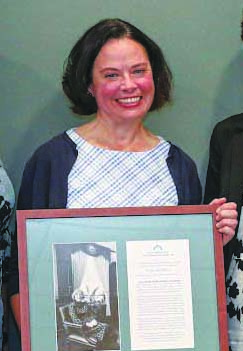
Featured photo: Mary Ann Dempsey. Photo by Cheryl Senter.