New cafe on canal

Fresh Chef Press brings organic local food

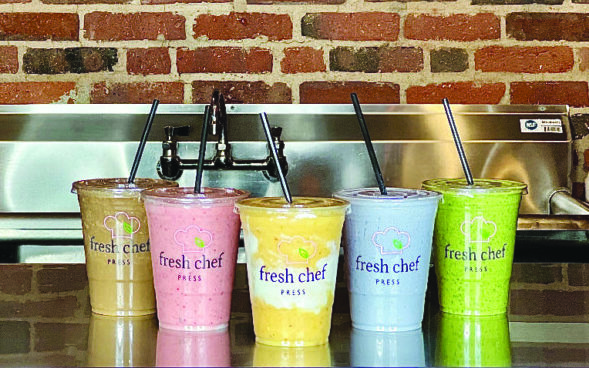
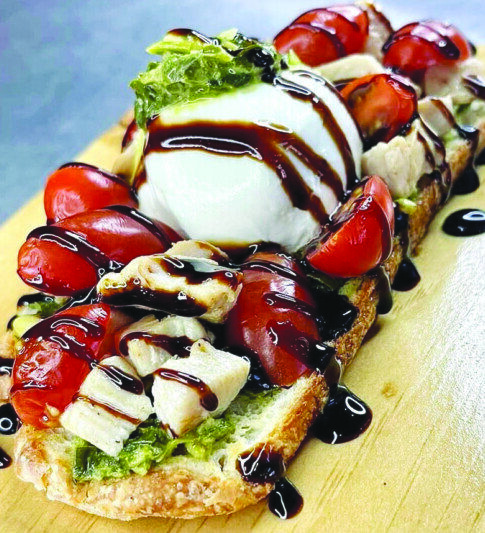
On April 25, 2022, Abbey Morrison transitioned her meal prep business from Fresh Chef Meal Prep to Fresh Chef Press, a cafe on Canal Street in Manchester, with her friend and business partner Shauri Gilot-Oquendo. The cafe serves smoothies, salads, bowls, coffee, toast and sandwiches all made with local organic ingredients.

“We were doing [meal prep] … before we got presented with an opportunity to open a cafe on Canal Street,” Morrison said. “We didn’t really have this [plan] that we were going to open a location in this amount of years. It kind of just fell into our lap [from] hard work [and] after a while people see that you’re committed to the cause.”
Photos courtesy of Fresh Chef Press.

Morrison’s interest in food and nutrition can be traced back to when she was diagnosed with high cholesterol at age 7. She began seeing a nutritionist to change her diet and learned about what food can do for your body in the process, an avenue she continued down at Johnson & Wales University.

“I wanted to do the same thing for other people, so I went down the route of culinary nutrition and worked with different chefs around the world to see how they do it,” she said. “I got to experience everything and bring it back to my home city and help people here.”

After running Fresh Chef Meal Prep for 3 years, Morrison got presented with the opportunity to fill the space that formerly housed Green Bike Smoothie Bar. She decided to go in along with Gilot-Oquendo to open Fresh Chef Press with the aim to serve food that is both nutritious and delicious while also helping local businesses and the environment through the use of reusable and biodegradable materials.

“We try to locally source as much as possible to help our local farms and support small businesses,” Morrison said.
Such businesses include McQuesten Farm and Charmingfare Farm, where they get their produce, Amherst Garden, where they get honey, and Hometown Coffee.

Their commitment to offering local and healthy food extends beyond the doors of their cafe with their POS fridge where customers can buy peanut butter, honey and oat power ball energy bites, a variety of hummuses, dressings and pesto, the same that are used in the cafe and all made in-house.

“It kind of plays off our meal prep,” Morrison said. “We try to make it as easy as possible for you to be healthy at home too.”
Photos courtesy of Fresh Chef Press.

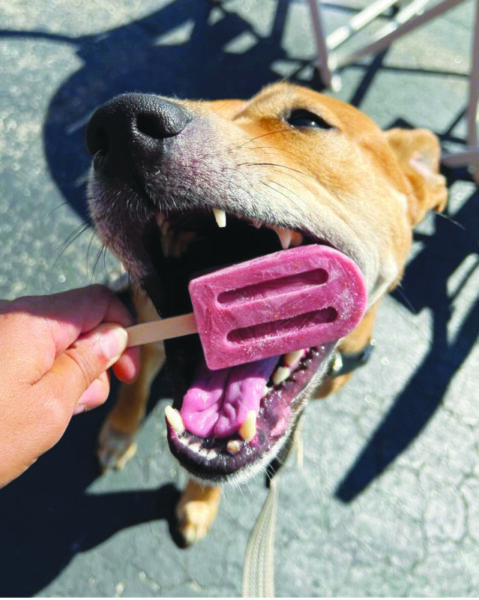
In addition to providing nutritious food for people, they feed their furry friends with pup-sicles and excite bites.

“A lot of the same things that are really good for people, like blueberries, they have a lot of antioxidants and cancer-fighting stuff in them, are really good for dogs,” Gilot-Oquendo said. “All clean and organic stuff for our pups as well.”


“Since we’re in downtown Manchester, a lot of people are walking with their dog,” Morrison adds. “The fact that they can come down and grab something for them and their pup I think is what separates us.”

Featured photo: courtesy of Fresh Chef Press
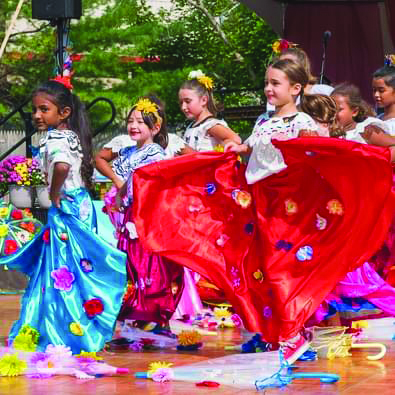
Celebrate diversity

Multicultural Festival will return to Concord

Celebrate the cultures that make New Hampshire special through food, music, dancing and art at the Concord Multicultural Festival on Sunday, Sept. 24, from 11 a.m. to 5 p.m. at Keach Park.

The free festival began in the mid 2000s when many refugees were coming to the capital, as Concord was a refugee resettlement city, according to festival director Jessica Livingston.

“It was created as a way to introduce the community to the new community members who were being settled here from other countries,” she said. “A group of community leaders … decided to create a festival that would help connect people.”

Courtesy photo.

The festival has expanded over the years. In the international flag parade that was added to the festival around six or seven years ago, 40 countries were represented at first; the number is now over 70

More than 70 vendors will be at the festival selling crafts like African baskets, jewelry, wood carvings, instruments, clothing and shoes, and running activities like face painting, coloring and painting kindness rocks.
The overall favorite, according to Livingston, is the food, with community members making Mexican staples like tamales and horchata, dishes from Afghanistan like pashto samosa, and restaurants like Maddy’s Food Hub, with African, Caribbean and Italian food and Batulo’s Kitchen.

“[Batulo’s] specialty is sambusa … but this year since she has her own restaurant she’s now going to branch out and do a little more,” Livingston said. “She’s [making] rice plates with veggies or chicken …, home-baked bread, yellow split pea soup … fried potatoes [and] mandazi, which is an African fried dough.”

After the flag parade and opening ceremony, there will be live performances throughout the whole festival, with Japanese drumming, Hawaiian hula dancing, Nepali and Hindi folk and classical music, Irish dancing performed by In the Field Irish Dancers, and a Brazilian carnival performance by SambaViva.

“Our mission is about creating a welcoming community for everybody who is here regardless of where you’re from or how long you’ve lived here,” Livingston said. “It’s about bringing people together over shared love for food, music and art and connecting as a community [to] get to know each other in a fun way.”

Featured photo: Courtesy photo.

Treasure Hunt 23/09/21

Dear Donna,
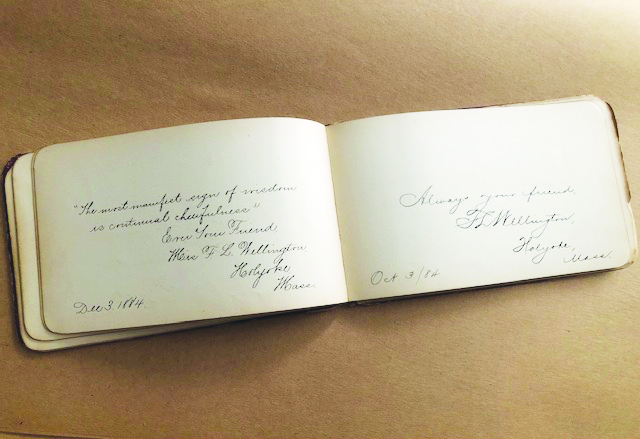
I picked this small autograph book up a few years back. It’s 5”x7” and has about 60 autographs from Holyoke, Mass., 1884. I’m done enjoying reading it, so now I’m looking for a new home. Can you give me a value on this? Thank you for any help, Donna.
Alex

Dear Alex,
Autograph books were a very popular thing in the Victorian era. Earlier ones can also bring high values.

With autographs you’re looking for any significant ones of known people, events in time, drawings, etc. The more content the better, and hand drawings as well.

If it’s just a school autograph book with multiple friends signing it. I think there are collectors for just that as well. The values seem to run in the $25-$40 range. Again, though, if there are drawings or small paintings on pages etc., could be more.

Alex, I hope this helps finding your book a new home. Thanks for sharing with us.

Donna Welch has spent more than 35 years in the antiques and collectibles field, appraising and instructing. Her new location is an Antique Art Studio located in Dunbarton, NH where she is still buying and selling. She is a member of The New Hampshire Antiques Dealer Association. If you have questions about an antique or collectible send a clear photo and information to Donna at footwdw@aol.com, or call her at 391-6550.

Invasives: What are they? What can you do about them?

See a culprit, dig it out

I’m lucky. Unlike many houses built in the 1800s or early 1900s, mine had no invasive plants when I bought it in 1970, probably because it was built as a creamery, or butter factory. Decorative plants were not needed. Most older houses are plagued with plants brought from Asia or Europe by well-meaning people who did not know that, once imported, those handsome plants might not have any predators that could keep them under control. Most of our native insects will not eat foreign plants.

Plants including Japanese knotweed, Asian bittersweet, goutweed, purple loosestrife, yellow pond iris and multiflora roses have thrived in New England, and all are nearly impossible to get rid of, once established. Unfortunately, I now have four of the six mentioned above. But no Japanese knotweed or bittersweet, thankfully (they are two of the worst).

Plants including Japanese knotweed, Asian bittersweet, goutweed, purple loosestrife, yellow pond iris and multiflora roses have thrived in New England, and all are nearly impossible to get rid of, once established. Unfortunately, I now have four of the six mentioned above. But no Japanese knotweed or bittersweet, thankfully (they are two of the worst).

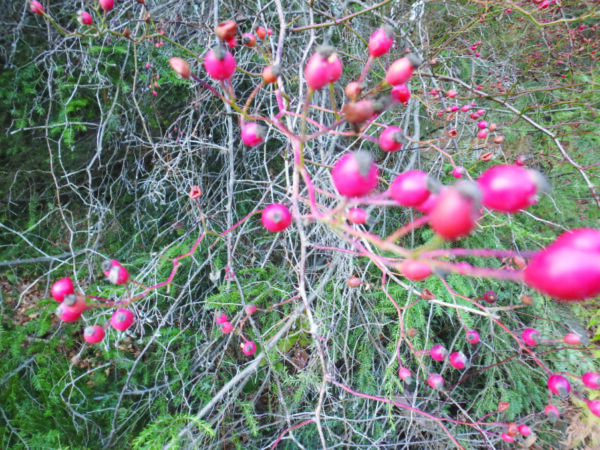
Multiflora rose hips are eaten by birds, but the plants are invasive and should be removed. Photo by Henry Homeyer.

The multiflora rose was introduced from Asia in the 1860s as a vigorous ornamental rose and as a source of rootstock for grafted roses. In the 1930s it was widely introduced as erosion control and alongside highways — a mature planting is so dense it can prevent cars from going over median strips. But the birds liked the rose hips — the seed pods — and it escaped cultivation.

So what am I doing to eliminate it on my property? I am digging it out. Most effective for one- or two-year-old plants, I am using a curved, single-tine hand tool called the CobraHead (www.cobrahead.com) to carefully excavate the roots until I can lift the plant out.

First, I dress appropriately: jeans, long-sleeved shirt, a hat with a brim, and heavy winter leather work gloves. This culprit wants to hurt anyone trying to uproot it. I cut off the branches, just leaving a foot or so to grab onto when pulling it out. Then I loosen the soil and pull weeds around it. The roots radiate outward from the stem like spokes on a bike. I loosen each root and tug gently when they are small enough to remove.

First, I dress appropriately: jeans, long-sleeved shirt, a hat with a brim, and heavy winter leather work gloves. This culprit wants to hurt anyone trying to uproot it. I cut off the branches, just leaving a foot or so to grab onto when pulling it out. Then I loosen the soil and pull weeds around it. The roots radiate outward from the stem like spokes on a bike. I loosen each root and tug gently when they are small enough to remove.

I’ve read that just cutting back the stems to ground level will stimulate the roots to send up new shoots everywhere, causing a bigger problem. There is no easy answer. Invasive plants are always difficult to remove — usually a scrap of root can generate a new plant or several.

Buckthorn is another invasive that is common along streams and at the edges of fields. As with multiflora rose, cutting it down stimulates the roots to send up new shoots. The best way to eliminate it is to starve the roots: Take a pruning saw and cut through the bark and the green layer of cambium beneath that. Go all the way around the trunk, then repeat 6 inches above the first cut, and repeat. This will not kill the tree until the third year, but this slow death will not stimulate the roots to grow. Best done in winter or fall after leaf drop.

Since buckthorn is often multi-stemmed, it can be difficult to use that method. Do it up high enough that you can get your saw in between the stems. But I’ve done it, and it works.

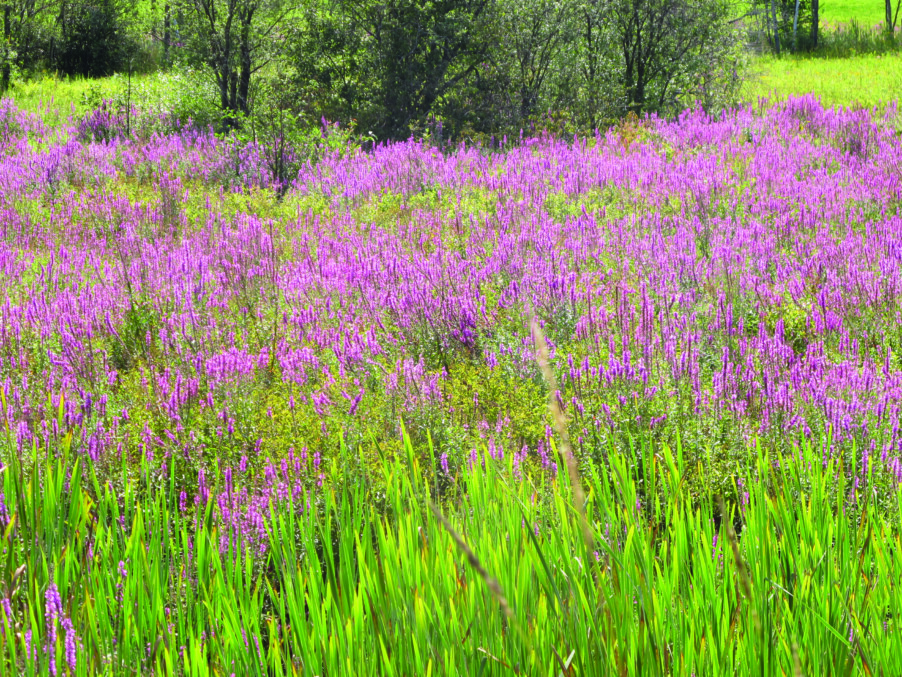
Purple loosestrife is blooming now in swamps and wet places — it is gorgeous but outcompetes many of our native wetland plants that feed pollinators and other animals. Like many invasives, it produces huge numbers of seeds and these seeds don’t all germinate the next spring — many stay dormant for years. I’ve read that multiflora rose seeds can stay viable up to 20 years — a good reason to clear plants out when young.

My approach to purple loosestrife is to dig out new, young plants. I recognize them by their square stem, the leaf shape and the color of the stem, which is often reddish. But for big established plants I just use a curved harvest knife to slice off the foliage once or more than once each summer. This prevents seed production and reduces plant energy.

As regular readers of this column know, I only use organic techniques in the garden. This means no chemicals including herbicides. From what I have read, most herbicides will not kill the invasives mentioned in this article. They will set them back considerably, depending on the age of the plant and the dose of the chemical. But learning to recognize all the invasives is best. And if one appears on your landscape, get rid of it immediately! And remember, persistence is important.

Henry is a lifetime organic gardener living in Cornish, N.H. He presents at garden clubs and libraries around the region, and is the author of four gardening books. Reach him at henry.homeyer@comcast.net.

Featured photo by Henry Homeyer.

Sculptures on the hill

Andres Institute of Art holds international sculpture symposium

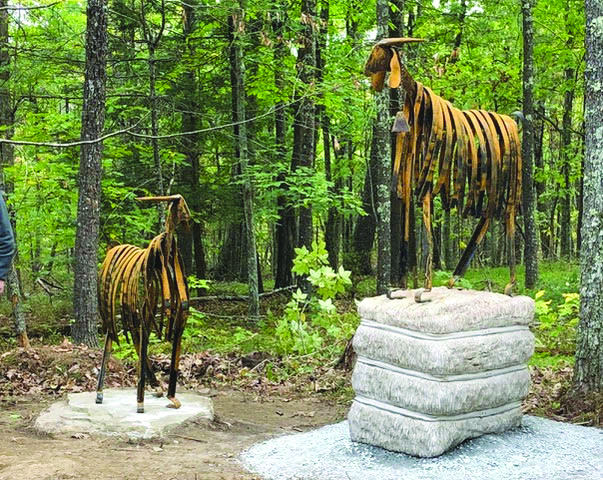
Three artists from different parts of the world will have three weeks to craft a sculpture along the 12-mile trail of the Andres Institute of Art in Brookline for the annual Bridges and Connections Sculpture Symposium. There will be multiple events at the Institute throughout the artists’ residencies, including dinners with the artists and a closing ceremony on Sunday, Oct. 8, when attendees can view their sculptures.

The Andres Institute of Art was established by Paul Andres and John Weidman in 1998 and has been holding the symposium since 1999, according to Gail Bloom, the president of the Institute.

“This year we’ve added [events] because we’re celebrating the 25th anniversary,” she said. “We have the opening ceremony, there will be a meet and greet with the artists … a showcase … [and] during the course of the three weeks we’re going to have two dinners.”

There are currently 98 sculptures throughout the sculpture park. This year’s symposium artists who will be adding to the collection are Ivona Biocic Mandic, from Croatia; Renubala Kashyap Rajput, from India, and Finn Cossar, from Australia.

“I’ve always created things whether it be sculptures or playing around with bits of wood,” Cossar said. “I’ve always been drawn to certain materials like rocks or metal or copper.”

After high school Cossar studied screen and media to pursue a career in film. When the film industry shut down due to the pandemic, he used the time to focus on his passion.

“Since there was no work for film I thought why not have a crack at doing the sculptures, which is what I always wanted to do … [and] I’ve always loved doing,” he said.

During the pandemic, Cossar made two large works, including a stone and metal tensegrity sculpture, which he says were very well-received.

“Ever since then I’ve been trying to push myself and create better and better works,” he said. “I think I really found my feet over the last couple of years and I’ve become more confident making large works, entering them into festivals, being recognized by local councils and meeting new artists, so I think I really found something that resonates.”

While camping, Cossar was contacted by the directors of the Swell Sculpture Festival in Australia, who told him about the sculpture symposium at the Andres Institute of Art.

“Immediately I jumped in my car and drove down to the town, where I had internet, and quickly filled out my portfolio,” he said. “I think it was two days later I got a call from Natasha, who’s the creator of Swell, and she said, ‘Pack your bags, you’re going to America,’” he said.

For Cossar, an artist’s residency and America are both new experiences.

“I have no idea what to expect,” he said. “[When] putting yourself in a completely new creative biome [I think] something amazing will come of it. … When you get creative minds together and share their creativity and create something beautiful that lasts for lifetimes, I think that’s extremely special. I’m extremely appreciative and I’m very much looking forward to it.”

Bridges and Connections Sculpture Symposium at Andres Institute of Art

Symposium artist showcase
When: Saturday, Sept. 23, 3 p.m.
Where: Andres Institute of Art (106 Route 13, Brookline) Welcome Center
Cost: Free

Dinner with symposium artists
When: Friday, Sept. 29, 6 p.m. (doors open at 5:10 p.m.)
Where: Andres Institute of Art (106 Route 13, Brookline) Welcome Center
Cost: $38

Cedi’s Tasty Treats Food Truck and music by kNowhere Kids
When
: Saturday, Sept. 30, 4 to 7 p.m.
Where: Andres Institute of Art (106 Route 13, Brookline). Music in the Welcome Center.

Panel discussion: Art in the public sphere
When: Saturday, Oct. 7, 3 p.m.
Where: Andres Institute of Art (106 Route 13, Brookline) Welcome Center
Cost: Free

Closing ceremony
When
: Sunday, Oct. 8, 1 p.m.
Where: Andres Institute of Art (106 Route 13, Brookline)
Cost: Free.

Quality of Life 23/09/21

Animals needing shelter

In just a few weeks the Animal Rescue League of New Hampshire (ARLNH) has faced an overwhelming surge of animals, including 15 animals from a home in Bedford, 24 cats from a home in Merrimack and 15 cats from a home in Colebrook, with an additional 26 animals coming to the shelter individually. According to a press release, ARLNH is now grappling with resource strains due to this influx. As the number of animals in its care continues to fluctuate, ARLNH notes the overall growing demand for shelter services and longer stays for animals.

QOL score: -2
Comment: Donations can be made at rescueleague.org.

More Wi-Fi

Delta Dental Stadium, home to the New Hampshire Fisher Cats, the Double-A affiliate of the Toronto Blue Jays, now has free Wi-Fi for spectators. According to a press release, this upgrade was facilitated through a collaboration with Consolidated Communications, equipping the stadium with Fidium Fiber Internet service and high-performance equipment.

QOL score: +1
Comment: The Wi-Fi addition joins a series of upgrades at the stadium, including infrastructural enhancements and facility renovations, according to the release.

Help for kids

CMF Kids, an initiative by Crotched Mountain Foundation dedicated to supporting communities and children with disabilities from underprivileged backgrounds, has announced a $1,000,000 investment spread over three years. According to a press release, this investment will benefit four new school partners: Nashua, Manchester, Warren and Newport. The schools will use the funds in various ways, from professional development programs and adaptive playground equipment to infrastructure expansion and consulting services for special education. Alongside school support, CMF Kids is also collaborating with community programs, offering services like music therapy, adaptive aquatics and more to help children with disabilities partake in vital extracurricular activities. Visit cmfkids.org.

QOL score: +1
Comment: The Nashua district plans to use its investment for special education professional development programs, aiming at trauma-informed care. According to the release, this initiative will be specifically used by elementary school teachers and paraprofessionals to effectively reduce challenging student behaviors.

Wellness programs

Mount Pleasant Elementary School in Nashua was granted $2,300 by the American Heart Association’s youth programs, the Kids Heart Challenge and American Heart Challenge to acquire physical education equipment. The grants aid in bolstering school wellness programs. Laura Short, a physical education teacher at the school, was commended for her commitment to teaching heart-healthy habits. The Association’s initiatives, beyond funding, emphasize whole-body wellness in schools, blending physical activities with key life-saving skills.

QOL score: +1
Comment: According to the U.S. Department of Health and Human Services’ 2018 Physical Activity Guidelines, only 20 percent of kids in the U.S. achieve the recommended levels of physical activity.

QOL score: 85
Net change: +1
QOL this week: 86

What’s affecting your Quality of Life here in New Hampshire?
Let us know at news@hippopress.com.

Stay in the loop!

Get FREE weekly briefs on local food, music,

arts, and more across southern New Hampshire!