I recently went to Brattleboro, Vermont, to meet with the organizers of Edible Brattleboro. It is an informal group of people who believe that “access to fresh healthy food is a right for all, regardless of means. This serves as the basis of the work we are doing, and we do our best to eliminate barriers to benefitting from our work, and thus everything we offer is free.”
The prime movers behind this movement are Tom Green and Marilyn Chiarello, who have been working to turn empty spaces and lawns into places for food production. Both are retired school teachers. Marilyn saw a TED talk by Pam Warhurst in 2015 and decided that something similar could be done in Brattleboro.
That first year Edible Brattleboro approached the local food cooperative and asked for a strip of land between the parking lot and the Whetstone Brook. The Coop agreed, and volunteers built a 4- by 8-foot raised bed. They have since expanded this space, growing strawberries, tomatoes, herbs and more. Volunteers plant, weed and water as needed. Anyone can help themselves to the free food; there are no questions asked.
By now there are gardens and fruit trees all over town that were started by Edible Brattleboro. I went around with Tom and Marilyn and looked at some of their projects. Three cherry trees are planted in front of the town hall, and other fruit trees are planted on school property. Another garden is at an addiction recovery center, Turning Point, where there are raised beds in the front lawn.
Another garden is at the Root Social Justice Center, at the edge of their parking lot. Volunteers made container gardens using food-grade plastic 55-gallon drums using designs Tom found online. They have water reservoirs so that water wicks up into the soil in the drums, and daily watering is not needed. Tom also got some one-cubic-meter “intermediate beverage containers” that originally held sugar syrup. Again, he fitted them with water reservoirs to avoid daily watering.
Edible Brattleboro has had good luck getting small grants to support their activities. Although not a 501(c)3 themselves, they work under the auspices of Post Oil Solutions, a local nonprofit that sponsors them. But they will work with any organization that will help in their efforts.
Often low-income residents do not have the tools they need to garden. Fortunately, in Brattleboro that is not a big issue as the town library has a “lending library” of tools and kitchen equipment that they furnished with a grant from the Vermont Foodbank. The library’s grant included money to purchase a simple wooden structure in their parking lot to house the tools, and a part-time librarian to check out tools at specified times. For beginning gardeners, having a source for the basic tools can be an important saving.
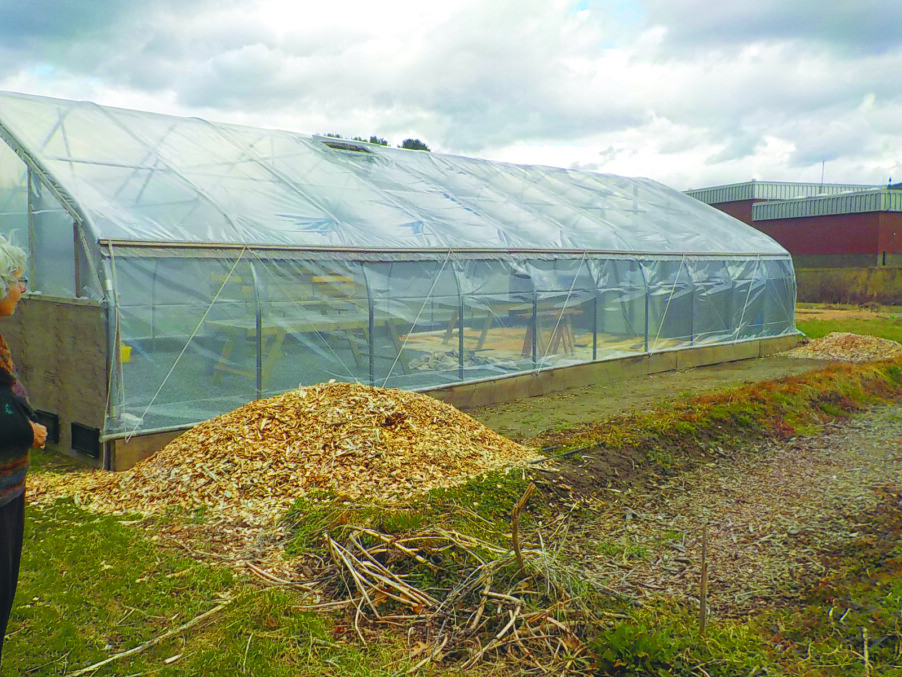
We also visited a large greenhouse for extending the season and growing things like tomatoes and peppers in a controlled environment. Tom Green and volunteers put it up this winter, and they look forward to using it shortly. It sits on space offered by the Brattleboro Retreat Farm, a nonprofit.
There is a weekly farmers market in Brattleboro and Tom and Marilyn couldn’t say enough good things about the generosity of the farmers. At the close of the market each week volunteers from Edible Brattleboro visit the market and collect produce donated by farmers. They got a grant to buy a large refrigerator to hold perishables, and have an outdoor “Share the Harvest” table the next day at Turning Point.
So what can you do? All communities have both gardeners and people in need. What is needed in most towns are people like Tom and Marilyn. People with a commitment to helping, time, and organizational skills. Except for Tom’s work building the green house and large self-watering containers, no special skills were needed for what they have done.
Some sort of organizational structure is needed. I like the idea of joining up with an existing nonprofit so that grants and donations can be made to a certified 501(c)3, allowing donors to take tax deductions. That also lets people know that their money will be used properly.
There are organizations you could link up with, perhaps. You probably already know about soup kitchens and food banks in your town or a nearby town. So you could plant a little extra this year with the idea of sharing. Or you could help to organize others in your area to join with you.
Churches are another good place to start gardens. They generally have lawns in full sun, and people who want to help others. The soil in any lawn generally needs improving, but I bet most farmers would be delighted to donate some compost or composted cow manure to add to the soil. Garden centers are generally willing to donate some seeds or seedlings when the time comes, or perhaps a few bags of compost. So all you need is people power. I bet you will be gratified at how willing others will be to help.
Featured photo: Volunteers built this greenhouse that was paid for by a grant. Photo by Henry Homeyer.
If you love your local bookstore, this Saturday, April 30, is your chance to support it — and get some good deals, exclusive merchandise and prizes — during national Independent Bookstore Day.
“Independent bookstores are the hearts of the communities they serve,” Michael Herrmann of Gibson’s Bookstore in Concord said. “We’re glad for this opportunity to thank everyone who makes it possible for us to be here.”
At Gibson’s, thank-yous will come in the form of raffle prizes and the chance to earn discounts and a tote bag of Advanced Reader Copies.
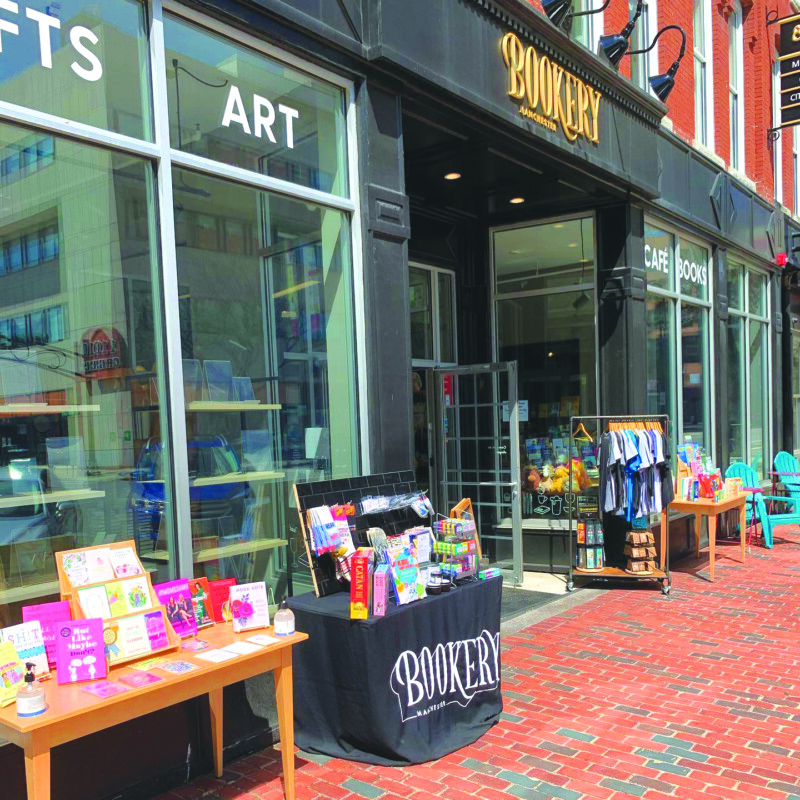
The Bookery in Manchester is celebrating the day with games, contests and giveaways.
“I think there’s been more of an awareness even in the past few years about the importance of local businesses,” Bookery events coordinator Lily Foss said. “People think we’re a dying breed but we’re still very much vibrant. … We have the pleasure of bringing in authors and [hosting] other special events.”
Saturday will bring a performance from magician DaSean Greene at 11:30 a.m., and Foss said they’re thrilled that he’s coming back.
“The kids absolutely loved him,” she said. “They were all crowded around him.”
The Bookery will also have a special Indie Bookstore Day tote bag and special merchandise for sale, and they’ll be giving away small prizes with the “very popular prize wheel,” which people can spin if they purchase a certain amount, Foss said.
“People get so excited,” she laughed. “No one has ever refused to spin.”
Toward the end of the day, Foss — a former Jeopardy! contestant — will be hosting a literary trivia event that she said is a combination of Jeopardy! and pub trivia, with people playing on teams. She said she went through the online “J-Archive” and compiled an entire game’s worth of literary trivia from various shows throughout the years.
“It has been tested by customers and booksellers to make sure the questions aren’t too hard or too easy,” she said.
Foss is also including one question from her own stint on Jeopardy!. She said she was the youngest contestant that night by at least 10 years, and she was at a disadvantage with categories like “90s Pop Culture.” But it was worth the experience: “It was my 15 minutes. … And I got $1,000.”
“I’ve been wanting to bring trivia here for a while,” she said, “so I’m really looking forward to that. And we do serve libations … coffee, tea, beer, wine and canned cocktails, so it will have that pub trivia [atmosphere].”
Independent Bookstore Day is one of the biggest days of the year for local booksellers, as they thank their customers and their customers thank them for offering a bookstore experience that you can’t get at chain stores.
“As we struggle to return to something that looks like normalcy, it’s more important than ever to celebrate community,” Herrmann said.
“It’s such a fun day,” Foss said. “It’s just a big party, celebrating our customers [and] thanking them for choosing us.”
Celebrate Independent Bookstore Day
The Bookery, 844 Elm St. in Manchester, will be open from 9 a.m. to 7 p.m. with prizes, games and exclusive Independent Bookstore Day merchandise. Magician DeSean Greene will perform at 11:30 a.m., and Literary Trivia will be held at the end of the day.
Gibson’s Bookstore, 45 S. Main St., Concord, will be open from 10 a.m. to 6 p.m. It will be doing double stamps all day (two stamps for every $10 on your Frequent Buyer Stamp Card), a tote bag of Advanced Reader Copies for every $100 spent, and a raffle ticket for every book purchased, with raffle items that include a Gibson’s Bookstore merchandise bundle, a Personalized Shopping Experience and an Indie Bookstore Day merchandise bundle. Bonus: If you wear any Gibson’s Bookstore merch (shirts, hats, pins, etc.) now through April 30, you will get a full stamp card, good for 20 percent off an entire transaction.
Toadstool Bookshop, 375 Amherst St., Nashua, will be open from 9 a.m. to 7 p.m. and will be celebrating with cake and refreshments, according to the store’s Facebook page. There will also be an Advanced Reader Book Table set up for people to browse and select books for $1 each, which will be donated to the Nashua Soup Kitchen and Shelter.
Featured photo: This aluminum shovel is lightweight and good for cleanup. Courtesy photo.
The latest from NH’s theater, arts and literary communities
• Wizard spoof: Cue Zero Theatre Co. presents Puffs, or Seven Increasingly Eventful Years at a Certain School of Magic and Magic at Granite State Arts Academy (19 Keewaydin Drive, No. 4, Salem), with showtimes on Friday, April 29, and Sunday, May 1, at 7:30 p.m., and Sunday, May 1, at 2 p.m. The show is a parody about a certain wizarding school. “It’s a familiar story with a unique twist,” actor Anna Mae told the Hippo earlier this month. “While new stories are always fun, it’s nice to sometimes return to what is familiar and find appreciation for it in new ways. People will recognize many of the major plot points, and I think they’ll really enjoy seeing it from this new perspective.” Tickets cost $15 ($16.25 with online fees). Masks and proof of vaccination or a negative Covid test taken within three days of the performance are required for admittance. The show is also available to livestream for $15. Visit cztheatre.com or email cztheatre@gmail.com.
Dreamcatcher workshop Head to Canterbury Shaker Village (288 Shaker Road, Canterbury) for a Make Your Own Dreamcatcher workshop on Saturday, April 30, from 2 to 3:30 p.m. Native American artist Lenny Novak will instruct the workshop and discuss the history, meaning, stories and lore of dreamcatchers before teaching participants how to create them in the Ojibway web tradition using natural wood hoops, webbing, beads and feathers. The cost is $25 for Village members and $40 for non-members. Registration is required. All materials will be provided. Call 783-9511 or visit shakers.org.
• ’60s gala: Get your tickets now for the Currier Museum of Art’s (150 Ash St., Manchester) Gala Celebration, happening on Saturday, May 14, from 6 to 10 p.m. The event will include live music, gourmet food, a sponsored cocktail hour, live auction and fundraising program, all inspired by the museum’s current special exhibition, “Warhol Screen Tests.” In the mid-1960s, American multimedia artist Andy Warhol had shot more than 400 short, silent, black-and-white films of his friends at his studio in New York City. He referred to the films, which were unscripted and played in slow motion, as “film portraits” or “stillies.” The exhibition, which is on display now through July 3, features 20 of those films, provided by the Andy Warhol Museum, played in loops across four large-scale projections. Gala attendees must be age 21 or older. Wearing 1960s attire in the spirit of the exhibition is welcome. Tickets cost $350 per person. A limited number of tickets is available for admittance to both the gala and an exclusive pre-gala reception at the Chandler House; those cost $500 per person. Call 669-6144 or visit currier.org.
Iron Melt There’s still time to register for the Andres Institute of Art’s Remote Spring Iron Melt; registration is open now through Saturday, April 30. Traditionally, the public created custom designed iron tiles onsite. For the remote event, participants pick up a mold from the Institute (106 Brookline Road, Hollis) — pickup dates are Thursday, April 28, and Saturday, April 30, between 10 a.m. and 2 p.m. Drop-off dates are the same as pickup dates, plus Thursday, May 5. Designs will be poured at Green Foundry in Maine on Saturday, May 7, and available for pickup on Thursday, May 12, and Saturday, May 14. The cost is $40 per mold, or $30 for AIA members. Visit andresinstitute.org or call 673-7441.
• Ceramics by hand: The League of NH Craftsmen Meredith Fine Craft Gallery (279 Daniel Webster Hwy., Meredith) will host a two-part ceramic hand-building class on Saturday, April 30, from 10 a.m. to noon, and continuing on Sunday, May 14, from 10 a.m. to noon, at Xavier Ceramics studio in Center Harbor. At the first session, participants will hand-build a planter, vase or container, which the instructor and studio owner Ann Xavier will fire in her kiln. Then, at the second session, participants will glaze their pieces, which will be fired again and ready to take home. The cost is $70, plus a $35 materials fee paid to the instructor on the day of the first session. Space is limited, and registration is required. Call 279-7920 or visit meredith.nhcrafts.org/classes.
Surreal paintings A special exhibition featuring the work of Arghavan Khosravi is on view at the Currier Museum of Art (150 Ash St., Manchester). The artist’s surrealist paintings explore themes such as exile, freedom and empowerment, and allude to human rights issues, particularly those affecting women and immigrants. They’ll remain on display through Monday, Sept. 5. Admission is $15 for adults, $13 for seniors age 65 and up, $10 for students, $5 for youth ages 13 through 17, and is free for children age 12 and under and for members. Hours are Thursday, from 10 a.m. to 8 p.m.; Friday through Sunday, from 10 a.m. to 5 p.m., closed Monday through Wednesday. Call 669-6144 or visit currier.org.
• Fiddles for a cause: The New Hampshire Fiddle Ensemble will perform at the Exeter Town Hall (9 Front St., Exeter) on Saturday, April 30, at 7 p.m. to benefit the New Hampshire Children’s Trust. The group consists of more than 100 musicians between the ages of 9 and 89, playing fiddles, guitars, banjos, mandolins, basses, harps, cellos and horns, and singing. Tickets cost $16 for adults, $14 for seniors and students and $12 for children ages 13 and under. Masks or proof of vaccination are required for admittance. Visit nhfiddleensemble.org.
ART
Exhibits
• “IMPACT! ABSTRACT! Exhibition featuring the abstract work of six local artists, including Ann Saunderson, who works in acrylic, mixed media, oil and cold wax and monotype; Daniela Wenzel, who does oil painting, assemblage, ink drawing, driftwood pyrography and improvised quilt-making; Kate Higley, who does printmaking; Ethel Hills, who works in acrylic; and Grace Mattern, who does mixed media collage. Twiggs Gallery (254 King St., Boscawen). On view now through May 28. Gallery hours are Thursday through Saturday from 11 a.m. to 4 p.m., and Sunday from noon to 4 p.m. Visit twiggsgallery.wordpress.com or call 975-0015.
• “APPEAL OF THE REAL: 19TH CENTURY PHOTOGRAPHS OF THE ANCIENT WORLD” exhibition features photographs taken throughout the Mediterranean to record the ruins of ancient Egypt, Greece and Rome. The Currier Museum of Art (150 Ash St., Manchester). On display now through June 12. Museum admission costs $15 for adults, $13 for seniors age 65 and up, $10 for students, $5 for youth ages 13 through 17 and is free for children age 12 and under and museum members. Current museum hours are Thursday, from 10 a.m. to 8 p.m.; Friday through Sunday, from 10 a.m. to 5 p.m., closed Monday through Wednesday. Call 669-6144 or visit currier.org for more information.
• “WARHOL SCREEN TESTS” In the mid-1960s, American multimedia artist Andy Warhol had shot more than 400 short, silent, black-and-white films of his friends at his studio in New York City. Warhol referred to the films, which were unscripted and played in slow motion, as “film portraits” or “stillies.” The exhibition will feature 20 of those films, provided by the Andy Warhol Museum, in loops across four large-scale projections. The Currier Museum of Art (150 Ash St., Manchester). On display now through July 3. Museum admission costs $15 for adults, $13 for seniors age 65 and up, $10 for students, $5 for youth ages 13 through 17 and is free for children age 12 and under and museum members. Current museum hours are Thursday, from 10 a.m. to 8 p.m.; Friday through Sunday, from 10 a.m. to 5 p.m., closed Monday through Wednesday. Call 669-6144 or visit currier.org for more information.
• “ARGHAVAN KHOSRAVI” Artist’s surrealist paintings explore themes of exile, freedom and empowerment; center female protagonists; and allude to human rights issues, particularly those affecting women and immigrants. The Currier Museum of Art (150 Ash St., Manchester). On display now through Sept. 5. Museum admission costs $15 for adults, $13 for seniors age 65 and up, $10 for students, $5 for youth ages 13 through 17 and is free for children age 12 and under and museum members. Current museum hours are Thursday, from 10 a.m. to 8 p.m.; Friday through Sunday, from 10 a.m. to 5 p.m., closed Monday through Wednesday. Call 669-6144 or visit currier.org for more information.
• “ECHOES: ABSTRACT PAINTING TO MODERN QUILTING” exhibition features abstract paintings inspired by the bold colors, asymmetry, improvisational layout, alternate grid work and negative space in composition of modern quilting. Two Villages Art Society (46 Main St., Contoocook). On display now through May 14. Visit twovillagesart.org or call 413-210-4372 for more information.
“NATURE AT NIGHT: PAINTINGS BY OWEN KRZYZANIAK GEARY” Two Villages Art Society (46 Main St., Contoocook). On display from May 27 through June 18. Visit twovillagesart.org or call 413-210-4372 for more information.
• ART ON MAIN The City of Concord and the Greater Concord Chamber of Commerce present a year-round outdoor public art exhibition in Concord’s downtown featuring works by professional sculptors. All sculptures will be for sale. Visit concordnhchamber.com/creativeconcord, call 224-2508 or email tsink@concordnhchamber.com for more information.
Call for Submissions
• SCULPTURE SUBMISSIONS The City of Concord and the Greater Concord Chamber of Commerce’s Creative Concord Committee are seeking sculptors for the city’s fifth annual “Art on Main” Outdoor Sculpture Exhibition, a year-round outdoor public art exhibit set up in Concord’s downtown. Professional sculptors age 18 and older (with preference for New England-based sculptors) are invited to submit up to two original sculptures for consideration. The selected sculptors will receive a $500 stipend, and their sculptures will be on display and for sale from June 2022 through May 2023 (30 percent commission taken by City of Concord). The deadline for entries is Friday, April 29. To apply, visit concordnhchamber.com/creativeconcord, call 224-2508 or email tsink@concordnhchamber.com.
Fairs and markets
• CRAFTSMEN’S FAIR The annual nine-day outdoor craft fair hosted by the League of New Hampshire Craftsmen features hundreds of craftspeople with vendor booths, plus special craft exhibitions, demonstrations, hands-on workshops and more. Sat., Aug. 6 through Sun., Aug. 14. Mount Sunapee Resort, 1398 Route 103, Newbury. Call 224-3375 or visit nhcrafts.org for more information.
• CONCORD ARTS MARKET The juried outdoor artisan and fine art market runs one Saturday a month, June through October, from 10 a.m. to 3 p.m. Market dates are June 11, July 30, Aug. 20, Sept. 17 and Oct. 15. Rollins Park, 33 Bow St., Concord. concordartsmarket.net. The first market will be held on Saturday, June 11. Visit concordartsmarket.net/summer-arts-market.html for more information.
Special events
• REMOTE SPRING IRON MELT Participants may pick up a mold from the Institute, scratch their design at home, then drop off their scratched molds back at the Institute. Andres Institute of Art, 106 Brookline Road, Hollis. Pickup dates are Thurs., April 28, and Sat., April 30, between 10 a.m. and 2 p.m. Drop-off dates are the same as pickup dates, plus Thurs., May 5. Online registration is required and is open now through Sat., April 30. Designs will be poured at Green Foundry in Maine on Saturday, May 7, and available for final pickup on Thursday, May 12, and Saturday, May 14. The cost is $40 per mold, or $30 for AIA members. Visit andresinstitute.org or call 673-7441.
• SPRING OPEN STUDIOS Art Up Front Street Studios & Gallery, 120 Front St., Exeter. The artists’ collective features seven working artist studios. Sat., May 7, and Sun., May 8, from 10 a.m. to 4 p.m. Call 418-6286 or visit artupfrontstreet.com for more information.
• CURRIER MUSEUM OF ART GALA CELEBRATION Event will include live music, gourmet food, a sponsored cocktail hour, live auction and fundraising program, all inspired by the museum’s current special exhibition, “Warhol Screen Tests.” Currier Museum of Art’s (150 Ash St., Manchester). Sat., May 14, from 6 to 10 p.m. Gala attendees must be age 21 or older. Wearing 1960s attire in the spirit of the exhibition is welcome. Tickets cost $350 per person. A limited number of tickets is available for admittance to both the gala and an exclusive pre-gala reception at the Chandler House; those cost $500 per person. Call 669-6144 or visit currier.org.
Workshops and classes
• “BLACKSMITHING BASICS” Beginner level workshop. Sanborn Mills Farm(7097 Sanborn Road, Loudon). Fri., May 20, through Sun., May 22, from 8 a.m. to 4 p.m. each day. The cost is $375. Call 435-7314 or visit sanbornmills.org for more information.
• “INTRO TO 3D PRINTING” Port City Makerspace (68 Morning St., Portsmouth). Wed., June 8, from 6 to 9 p.m. The cost is $25 for members of the makerspace and $45 for nonmembers. Call 373-1002 or visit portcitymakerspace.com for more information.
• ART CLASSES Art classes for teens and adults, including Pottery, Stained Glass, Intermediate Watercolor and Clay Hand Building. Studio 550 Art Center (550 Elm St., Manchester). Five-week sessions. Classes met for two hours a week. Call 232-5597 or visit 550arts.com for the full schedule and cost details.
• DRAWING & PAINTING CLASSES Art House Studios, 66 Hanover St., Suite 202, Manchester. Classes include Drawing Fundamentals, Painting in Acrylic, Drawing: Observation to Abstraction, Exploring Mixed Media, and Figure Drawing. Class sizes are limited to six students. Visit arthousestudios.org or email arthousejb@gmail.comfor more information.
• GENERAL ART CLASSES Weekly art classes offered for both kids and adults of all skill levels and cover a variety of two-dimensional media, including drawing and painting with pastel, acrylic, watercolor and oils. Classes are held with small groups of three to eight to five students. Diane Crespo Fine Art Gallery (32 Hanover St., Manchester). Kids classes, open to ages 10 and up, are held on Thursdays and Fridays, from 4:15 to 5:45 p.m. Adult classes are held on Thursdays, from 6:30 to 8:15 p.m., and Saturdays from 10:30 a.m. to 12:15 p.m. Tuition is pay-as-you-go at $20 per student per class, due upon arrival. Call 493-1677 or visit dianecrespofineart.com for availability.
THEATRE
Classes/workshops
• STORYTELLING WORKSHOPS Monthly workshop series hosted by True Tales Live storytelling showcase. First Tuesday (except November), from 7 to 8:30 p.m., virtual, via Zoom. Registration is required. Visit truetaleslivenh.org for more information.
Shows
• THE PRODUCERS A mainstage production of the Palace Theatre (80 Hanover St., Manchester). Now through May 15, with showtimes on Friday at 7:30 p.m., Saturday at 2 and 7:30 p.m., and Sunday at noon. Tickets cost $39 to $46. Call 668-5588 or visit palacetheatre.org.
• PUFFS! OR SEVEN INCREASINGLY EVENTFUL YEARS AT A CERTAIN SCHOOL OF MAGIC AND MAGIC Cue Zero Theatre Co. presents. Granite State Arts Academy (19 Keewaydin Drive, No. 4, Salem). Showtimes on Fri., April 29, and Sun., May 1, at 7:30 p.m., and Sun., May 1, at 2 p.m. Tickets cost $15 ($16.25 with fees). Masks and proof of vaccination or a negative Covid test taken within three days of the performance are required. The show is also available to livestream for $15. Visit cztheatre.com or email cztheatre@gmail.com for more information.
• LAST GAS Produced by the Community Players of Concord. Concord City Auditorium, 2 Prince St., Concord. Fri., May 6, through Sun., May 8. Tickets cost $18 for adults, $16 for youth ages 17 and under, $16 for seniors age 65 and up. Visit communityplayersofconcord.org or call 224-4905 for more information.
• AN INSPECTOR CALLS Presented by New Hampshire Theatre Project. West End Studio Theatre (959 Islington St., Portsmouth). May 6 through May 22, with showtimes on Friday and Saturday at 8 p.m. and Sunday at 2 p.m. Tickets cost $30 ($33.26 with fees) for general admission, $26 ($29 with fees) for seniors, students and veterans and must be purchased in advance. Masks are required in the theater. Visit nhtheatreproject.org or call 431-6644.
• THE PLAY THAT GOES WRONG Presented by the Manchester Community Theatre Players. Manchester Community Theatre Players Theatre, located at the North End Montessori School (698 Beech St., Manchester). Showtimes on Fri., May 13 and May 20, and Sat., May 14 and May 21, at 7:30 p.m. Tickets cost $20 and must be purchased in advance. Masks and proof of vaccination are required to enter the theater. Visit manchestercommunitytheatre.com or call 327-6777.
• CHILDREN OF THE GRIM Presented by Bitter Pill. Players’ Ring Theatre (105 Marcy St., Portsmouth). May 13 through June 5, with showtimes on Fridays at 7:30 p.m., Saturday at 2:30 and 7:30 p.m., and Sunday at 2:30 p.m. Tickets cost $28 for adults and $25 for seniors age 65 and up and students. Masks and proof of vaccination or a negative Covid test are required. Visit playersring.org or call 436-8123.
• THE BALD SOPRANO Produced by the Community Players of Concord. The Hatbox Theatre (located inside the Steeplegate Mall, 270 Loudon Road, Concord). Fri., June 17 through Sun., June 26. Showtimes are on Friday and Saturday at 7:30 p.m., and Sunday at 2 p.m. Tickets cost $22 for adults, $19 for students, seniors and members and $16 for senior members. Visit hatboxnh.com or call 715-2315 for more information.
• TRUE TALES LIVE Portsmouth-based storytelling showcase. Monthly, last Tuesday (no shows in July and August), from 7 to 8:30 p.m. Shows will be held in person (Portsmouth Public Media TV Studio, 280 Marcy St., Portsmouth) starting in April, and returning to the Zoom format for the winter, starting in November. Each month’s showcase is centered around a different theme. The series is free and open to all who want to watch or participate as a storyteller. Pre-registration for attendees is required for Zoom shows but not required for in-person shows. Visit truetaleslivenh.org and email info@truetaleslive.org if you’re interested in being a storyteller.
Classical
• “THE MUSIC OF JAMES BOND” Symphony New Hampshire presents. The performance will include Themes from 007, a Medley for Orchestra and themes from other spy film favorites, including Mission Impossible, Pink Panther and Raiders of the Lost Ark. Sat., May 7, from 7:30 to 8:50 p.m. Keefe Center for the Arts (117 Elm St., Nashua). Tickets cost $20 to $60 for adults, $18 to $55 for seniors age 65 and up, and free for children with a paying adult. Visit symphonynh.org or call 595-9156 for more information.
• SPRING POPS – BROADWAY AND MORE The New Hampshire Philharmonic Orchestra performs. Seifert Performing Arts Center, 44 Geremonty Drive, Salem. Sat., May 21, at 7:30 p.m., and Sun., May 22, at 2 p.m. Visit nhphil.org or call 647-6476 for more information.
And more advice on how to make your garden healthier, hardier and more exciting
By Matt Ingersoll and Angie Sykeny
news@hippopress.com
There are all kinds of unique and cost-effective ways to make your garden stand out. Here are some ideas gathered from discussions with local gardening experts on how to get started.
Healthier soils
Most fruits and vegetables grow best in a well-drained sandy loam soil, rich in organic matter with a pH level (a measure of acidity) between 6.5 and 6.8. Exceptions are potatoes, which have a different pH requirement, and blueberries, which need a pH level of between 4.5 and 5.
Nate Bernitz, public engagement program manager for the UNH Cooperative Extension, recommends gardeners test their soil for pH levels before using it, ideally at least six months before planting to allow enough time to amend it properly. The UNH Cooperative Extension offers soil testing that includes pH, nutrient analysis and other overall recommendations for gardeners.
“For soil that is poorly drained, which can happen when there’s a lot of clay in the soil, adding organic matter from a source such as compost will help improve drainage,” he said. “Likewise for very sandy soil that does not retain water very well, compost … will help improve water retention ability.”
In a more established garden, Bernitz said, soil should ideally be kept covered throughout the year. During the winter a cover crop such as oats will do a great job of protecting the soil, while a mulch such as weed-free straw or chopped leaves gets the job done during the growing season.
Composting
Composting not only benefits your garden bed but also is great for the environment. Around 35 percent of household waste that commonly goes into municipal landfills is organic material that can be composted, said Ron Trexler, advanced master gardener with the UNH Cooperative Extension, and immediate past president and current vice president of the Hooksett Garden Club.
“There’s really no wrong way to do it. It’s basically just taking organic material and keeping it in a pile. [If you] keep the pile aerated and moist, then the stuff will decompose,” Trexler said.
Everything from leaves and grass clippings to food scraps from your kitchen can all be compostable. There are many types of compost bins that you purchase, but Trexler said anything that can be used to keep your compost materials in a stackable pile in a corner of your yard is all you need.
“You don’t want the pile covered, because you want air to get in there,” he said. “So it’s OK if rain gets in there, [and] it doesn’t matter whether the pile sits in the sun or sits in the shade. … The other thing is the pile tends to get compacted over time, so by turning it over and sticking holes in it or poking it with something, that helps to get some more into the pile, because that’s what it’s going to need in order to decompose properly.”
A compost pile can take anywhere from a couple of months to a few years to be usable, depending on how you manage the pile.
“Once your compost is finished, it smells like nice, rich dirt. It doesn’t have any odor to it at all,” Trexler said. “When everything is broken down, you can just take and sprinkle that in your garden or around your trees or out in your lawn … and let those plants get the advantage of all those nutrients that you just created.”
Mulches
A mulch can be any material spread on a soil surface, but Bernitz said some are better than others. Mulches are broadly categorized as being organic or inorganic — organic, he said, simply refers to whether it contains a natural material from a living source that will decompose. Examples include wood chips, bark mulch, grass clippings, pine needles, shredded leaves, straw, hay and sawdust. Inorganic mulches, on the other hand, come from either synthetic or non-living sources and can range from plastic to rock.
“Bark mulch isn’t usually the first choice for the vegetable garden, but is often a great option for trees, shrubs and flower beds,” Bernitz said. “Plastic mulch can be used in a vegetable garden, but for most gardeners, they will be better off using organic mulches around anywhere you are growing plants. … I wouldn’t recommend using stones or rocks as a mulch for plants in most instances. … Inorganic mulches tend to increase the temperature of the soil, which can increase plant stress.”
Bernitz added that, aside from adding soil amendments and organic matter, it’s important to kill weeds in your garden area.
“It’s best to do a very thorough job of killing perennial weeds before starting a new garden, as it’s harder to eliminate stubborn weeds in an established garden,” he said. “There are a number of strategies, including tilling the soil and laying down thick black plastic, tarps or cardboard.”
Hügelkultur (raised garden beds)
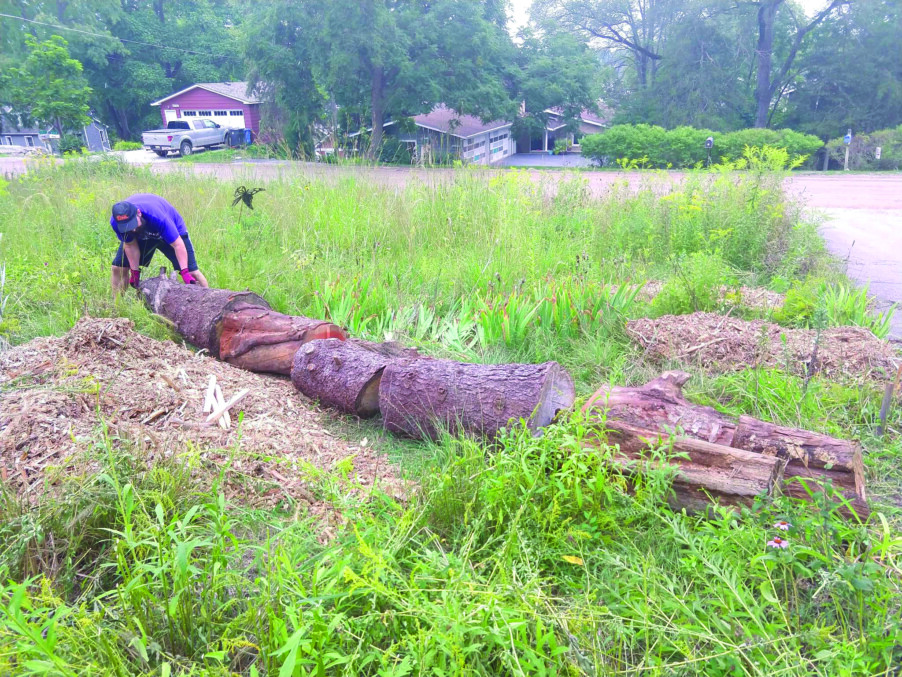
Hügelkultur, named for the German word meaning “hill culture,” is a cost-effective and sustainable gardening technique in which a raised mound is created using piles of logs, sticks, leaves and other organic material, which is then topped with a layer of your soil.
“Generally you have the bigger things at the bottom and the smaller things at the top,” said Ann Kinne of Manchester, a local botanist. “The logs … help to provide nutrients over a very long amount of time, and also, when it rains, they’re going to hold in all of that water like a sponge instead of just kind of draining away.”
The technique is not limited to any one specific type of garden — a hügelkultur bed can be started at any time of the year and will very gradually sink over time, depending on its size.
“It’s a good way of improving soil quality, [and] it’s really good for water retention,” Kinne said. “If you have an unsuitable spot for growing a lot of things, you can put one of these down, and there you go. An instant garden that takes care of itself and creates its own little ecosystem. … The other thing is that weeds have a pretty hard time taking root in them.”
Koi/goldfish ponds
With the right amount of regular maintenance, koi or goldfish ponds can make beautiful additions to your backyard garden. Sean Radomski is the one-man show behind Aquatopia, a Bow-based business launched in 2010 that specializes in both residential and commercial water garden installation features, including ponds big and small, as well as waterfalls and fountains.
“My goal essentially is to make a pond that looks like it’s been there forever, and then design it around that, so most of the time it’s going to be on an existing flower bed or on a certain section of lawn,” Radomski said. “A koi pond has certain size requirements that have to be considered, because koi fish … can get quite large, so they need to have enough room to swim around in.”
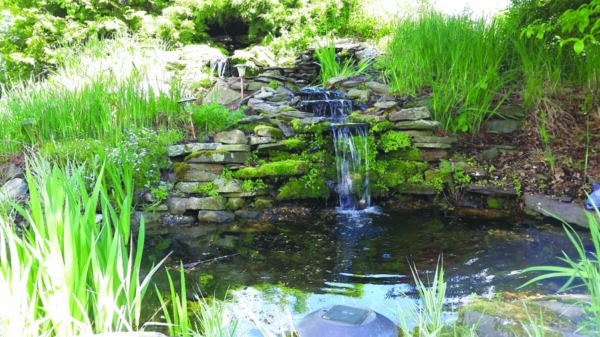
Garden waterfall. Courtesy of Aquatopia in Bow.
Most koi ponds he builds tend to be about 16 feet long by 20 feet wide, with water that’s at least two to three feet deep. Start to finish, a typical koi pond is usually installed within four or five days after its placement is selected and the materials are ordered. The fish themselves can also be part of the package as an option.
“Every project is different and unique … but it’s typically a pretty quick process once we’re in and out,” Radomski said. “We always try to [be] as low impact as possible, so we don’t come in guns blazing, ripping and tearing everything up.”
On average, Radomski said, koi ponds are right around the $10,000 mark to install. Part of his business also involves winterization and maintenance of ponds after they are built.
“The fish will actually hibernate in the pond,” he said. “We put an aerator in the pond for the wintertime, and that keeps a hole open in the ice so that respiration is still going to occur.”
Waterfalls
Waterfalls hold nearly all the elements and features of a koi or goldfish pond — minus, of course, the responsibility of taking care of the fish.
“One of the first questions I ask someone … is if they want a pond because they want that water sound or they want to have fish,” Radomski said. “I would say 50/50, people don’t realize that the pondless waterfalls exist. They don’t want to have fish, they just want that waterfall sound.”
Like ponds, waterfalls can come in a wide variety of custom designs and sizes, though they are generally less expensive by comparison. Waterfall designs feature a basin that’s backfilled with gravel, where the water goes through an underground vessel and recirculates.
“Most of the time, people already have an existing slope in their backyard that they want to kind of dress up,” Radomski said. “That’s extremely common, or maybe they have a blank spot in their yard that they want to liven up. … A waterfall will also create much more volume of sound than a fountain ever will, so if they really want a lot of volume, they’ll ask for a waterfall instead.”
Fountains
Garden fountains are much smaller, but the possibilities are endless, Radomski said.
“They can be everything from just a small little bubbling boulder, which is basically a rock with a hole drilled into it, to more elaborate concoctions,” he said. “A lot of people want the fountain to be on the front walkway entrance …or somewhere with a small space, because they just want that little bit of water sound but not necessarily the length [or size] of a pondless waterfall.”
Most garden fountains start at around $1,500 and average about $2,500 to install. Like waterfalls, fountains recirculate the water flow to create the sound, and require much less regular maintenance and winterization than ponds.
“Most people typically will maintain their own fountains and waterfalls themselves, although we do have a pump exchange service for those that just don’t want to mess with it,” Radomski said.
Wildflowers/native plants
Planting wildflowers is a great way to give your garden some diversity in color. Trexler said growing them effectively is all about understanding what their requirements are, as well as the time of year when each plant is expected to bloom.
“There are charts that show … the growth conditions that those particular plants thrive in [and] the times of year they bloom, so you want to figure out what’s a spring bloomer, a summer bloomer and a fall bloomer. … A mix of the different seasons will give you some nice color, otherwise what you’ll have is maybe some color just for a couple of months out of the year and then the rest of the year it’s just green.”
Pansies, violets and bulbs like daffodils and tulips are all among those that are blooming this time of year, Trexler said. Daylilies and bee balms bloom toward the middle of the summer, while asters and chrysanthemums are among the late-season bloomers, usually around September or October.
“If you go to a nursery or a garden center where you’d buy these plants, they’ll have charts that show you what the bloom time is and some information about what conditions the plant likes,” he said.
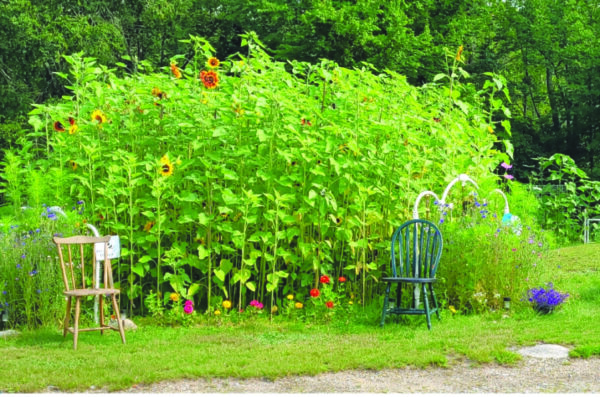
Grow a mini sunflower field. Photo courtesy of Jen Kippin.
Mini sunflower field
Transform a vacant grassy area of your yard into a miniature sunflower field.
Hooksett gardener Jen Kippin started her sunflower field during the pandemic, she said, “to bring happiness to the neighborhood.”
“There were so many people in my neighborhood walking, riding bikes and walking their dogs,” she said. “[The sunflower field] is right on the street, so everyone can see it going by.”
Kippin’s field is approximately 25 feet by 60 feet in size and features a mix of sunflower varieties, including chocolate, rose and Mexican sunflowers, along with an autumn mix, white Italian, dwarf and more.
Create a mulched path through the field “for easier cutting and fun exploring,” she said.
A sunflower field is easy to maintain; just water it daily — no weeding required — and enjoy.
Herbs
If you want to grow something with a more practical use than flowers, but less intensive than fruits and veggies, herbs may be that happy medium you’re looking for. You can plant them in pots, raised beds or even your kitchen window, and if they’re perennials, as many herbs are, you only have to plant them once, and they’ll continue to blossom year after year.
“There are so many benefits to growing your own herbs,” said Amanda Paul of Wild Way Farm in Deering. “Not only are they easy to grow and usually to maintain, but they are also healthy for your body.”
Some of the most versatile herbs, Paul said, include thyme, which is “basic and useful in most dishes;” oregano “for delicious pizza and other tasty Italian dishes;” and sage to “complement your favorite Mediterranean dishes or add to stuffings … or Italian seasonings.”
“Store-bought herbs just don’t compare to fresh harvested herbs,” Paul said. “They are far fresher … and you will have flavorful additions for your favorite dishes in your very own garden.”
Edible landscape
Create a garden that looks good enough to eat with edible landscaping techniques.
“The reality is, we can’t eat lawns,” Paul said, “so maybe you try adding some aesthetically pleasing and productive edible plants to your ornamental flower gardens.”
Paul defined edible landscaping as “interplanting vegetables, herbs, berry bushes and even fruit trees to diversify aesthetic, incorporate color and increase the yield of edible plants.”
Research and careful planning are necessary for creating a successful edible landscape; you’ll need to make sure that the plants you choose are compatible with each other and share similar requirements for soil, sun and water.
“This is referred to as ‘companion planting,’” Paul said, “and it can increase yield and flower production, support pollinators by means of nectar or pollen, and even repel unwanted pests.”
Swiss chard, lettuces, kale, cabbages, parsley and summer squash work well for borders and bedding. Protect your roses or other prized plants by surrounding them with pest-deterring edibles, like onions, garlic and chives. Purple eggplants and colorful pepper varieties, Paul said, are a tasty way to “add statement color” and make your landscape pop.
Container gardening
You can grow just about any type of plant in a container — among the keys, Trexler said, are good drainage and proper soil, and grouping different plants that have the same growing requirements in the same container.
“Other than trees and shrubs, there isn’t really any type of plant that you can’t grow in a container,” he said. “It would just matter how large a container, so depending on the growth habit of that plant … would just be how large a container that you would use. So for instance, if you didn’t have a big yard but you wanted to grow tomatoes to use in your cooking, you can grow those in a container. … I would say you’d maybe a four- or five-gallon size for those.”
Unless you’re growing something from seed, Trexler said, a window that gets adequate light is a great place to put a plant that likes the sun. A shade plant, on the other hand, performs better when placed by an east- or north-facing window so that it doesn’t get direct sunlight.
Aphids, which look like small, pear-shaped insects, and fungus gnats, which resemble tiny flies or mosquitos, are common pests that you have to watch out for indoors. But there are some things you can do to manage their potential invasion.
“Fungus gnats like moist soil … so by letting the top of your soil dry out, that’s kind of using a mulch of some sort on the top, and that also helps to inhibit their proliferation,” Trexler said.
Pot potatoes
You don’t have to be a farmer to grow your own potatoes; a pot, a potato and a sunny spot are all you need.
“There is a whole science of how to grow potatoes … but don’t get bogged down by it,” Pelham gardener Angel Cassista said. “The thing about plants is that they want to grow. … You just need to give them a chance.”
To start, leave a potato in a cool, dark area for a couple weeks, then bring it back into the light, which will prompt the potato’s “eyes” to sprout. When the potato has one to three eyes that are about half an inch long, it’s ready to be potted. Pick up a 3- to 5-gallon bucket, drill some holes in the bottom, fill it with dirt and “you have a potato pot,” Cassista said.
“The potato harvest might not be epic every time,” she said, “but they will have a richer taste than the ones you’re used to buying from the grocery store.”
The best thing about pot potatoes, Cassista said, is that they’re as beautiful as they are tasty.
“I put mine prominently around the patio,” she said. “They grow big and green and bushy with lacey dark leaves … and will have white or purple or pink flowers. … They’re gorgeous, so don’t hide them.”
Heirlooms
“Heirloom plants,” according to Paul, is a term used to describe “an age of a particular cultivar.”
“Some say 50 years. Some say 100 years. Some say 1945 to 1951 is the latest a plant could have originated to be considered an heirloom,” she said, “but, by definition, heirlooms must be open pollinated varieties bred and stabilized for growing and desired traits.”
Open pollinated varieties self- and cross-pollinate through wind, insects and themselves by carrying pollen from one plant to another.
The primary advantage of heirlooms is that, with care, the seeds can be saved and used each year, and even passed on through generations, but there are other benefits, too.
“Heirlooms are usually packed with flavor, are hardier and have adapted over time to the environment in which they’re grown,” Paul said. “I grow heirlooms almost exclusively for these reasons.”
Indoors to outdoors
The growing season in New England is short and finicky, but you can increase your chances of having a successful crop by starting your seeds indoors around two to eight weeks before the last frost of spring.
“Each plant has a different level of concern regarding frost exposure. … You can check your almanac for the last frost in your area, or ask your gardening neighbors,” Cassista said. “You’ll know when it is time to transplant your seedlings when the weather is warm enough for your plants.”
While they’re growing indoors, keep the seeds by a sunny window, or, better yet, Cassista said, use a grow light.
“Most houses are too dark to grow well, even the brighter ones,” she said. “Invest a little bit of money. … You can just buy a light and put a grow bulb in it.”
After being transplanted outdoors, plants may go through “transplant shock,” where their growth appears to slow down or stop, but don’t let that deter you from starting your plants indoors, Cassista said; the plants have a better chance of surviving transplant shock than they do of surviving the New England growing season being planted from seed outdoors.
“The name is more dramatic than the actual thing,” she said. “It’s a minor setback. The plants recover.”
Critter deterrents
There are a number of safe, easy ways to deter unwanted critters from your plants.
Goffstown gardener Jane Turcotte suggested putting rubber snakes — the more brightly colored, the better — in and around your garden, which work well for scaring off rabbits, birds and deer.
“I’ve seen deer approach, catch sight of a fake snake and take off like a shot,” she said.
Make sure you place them in a way that looks natural so that they’re convincing.
“I lay them across the tops of my fencing or coil them in, on or around containers,” Turcotte said.
If you’re looking to protect your fruit, put out painted red rocks in the weeks prior to the fruit’s harvest. Birds will believe the rocks are fruit at first, but after multiple disappointments, they will stop trying to eat the rocks.
“By the time your fruit is ready, birds will have the idea that bright red things aren’t food,” Turcotte said.
If you’re willing to try something a bit outside of the box, Turcotte said, the most effective way to keep critters away is with human urine.
“Wild animals are highly sensitive to smells and know, evolutionarily, that humans are a threat and predators, and that our smell means danger,” she said.
Keep a “dedicated jar in your bathroom” to collect your “vermin deterrent,” then pour it around the perimeter of your garden every few days.
Weeds
Weeds aren’t always a bad thing. Paul said that some native weeds are beneficial to the ecosystems in which they grow as they help to keep the soil healthy, improve growing conditions and promote desirable pollinator activity in your garden.
“I actually love weeds,” Paul said. “So many get a bad reputation simply because we’ve been groomed over time to think that anything but perfectly manicured lawns is unacceptable.”
Some weeds that Paul said she “doesn’t mind as a gardener” include clover, which have “flower-like tops” and reduce the need for irrigation by helping to maintain soil moisture; dandelions, which are “refreshingly pretty yellow flowers after long drab winters” and facilitate pollinators during early spring, when blooming flowers are still scarce; yarrow, which contribute white and yellow blooms and are “commonly grown as an ornamental;” and milkweed, which produces “beautiful and fragrant flowers” and is known for attracting monarch butterflies.
Trellises
One of the many vertical gardening techniques involves using a trellis, which is not only great for growing in smaller spaces but also makes harvesting easier and keeps produce up off the ground.
“Some crops need something to climb, like pole beans and peas,” Bernitz said. “Some crops don’t need a trellis but benefit from growing on a strong trellis, including squash, cucumbers and even melons. … Tomatoes also benefit from support.”
A trellis can be crafted from a wide variety of materials, but typically will consist of two vertical supports with mesh, netting or fencing running between them. Bernitz said a trellis may need to be supported by stakes to ensure it doesn’t tip over from strong winds.
“Some gardeners love archways built from cattle panels and anchored at either end, [and] some like using string suspended from wood or bamboo in various creative ways,” he said. “You can buy pre-made trellises … or use materials lying around your home and yard.”
Heavier items like certain gourds and winter squash would need to be individually supported on a trellis if being grown vertically, Bernitz said. Cucumbers, zucchini and other lighter crops don’t need to be supported individually, but benefit from growing on a trellis.
Stones
Stones can be a simple and inexpensive way to embellish your garden.
Stacy Lamountain of Moose Meadow Flower Farm in Litchfield calls it “hardscaping.”
“Whether you place a big boulder in an ornamental bed or use [stones] to line the edge of a pond … they bring another texture to the landscape,” she said.
Try building a garden pathway with broken slate slabs that allow greenery to grow through the cracks, Lamountain said, or a “faux broken down stone wall” with single stones and small stacks of stones “artfully scattered, as if the wall fell apart.”
“It’s an art piece of hardscape, a design element in the yard and a habitat for local critters,” she said. “Win-win.”
Stones can have a practical use as well.
“Grit, or small stones mixed into potting soil or even into clay soil, can significantly help with drainage so that the plants don’t get soggy bottoms and rot,” Lamountain said.
Dragon garden
Get creative with themed gardens. Kippin, for example, is working on a “dragon garden” with her grandsons.
“I wanted to create a sense of fantasy and fun,” she said.
She ordered seeds for as many plant varieties with the name “dragon” in them as she could find: dragon tongue, dragon egg, purple dragon and snapdragon.
“The grandboys and I will be building a small castle with rocks we’ve collected from all over the yard,” she said. “I want this garden to be fun and creative, and nothing more.”
Fairies and gnomes
Fairies, gnomes and other figurines can add a touch of whimsy to your garden.
“With the joy and beauty that a garden brings, it’s no wonder we find gardens a magical place and pretend they are home to mini people,” Lamountain said.
Garden figurines are accessible for all budgets and spaces, she said. You can often find inexpensive ones at a dollar store, or more unique pieces at country stores, gift shops or antique shops. Miniature figurines can be placed in patio gardens and other small spaces, or put inside a terrarium.
“Terrarium plants are all the rage right now, so there is an endless supply of tiny plants to create a world for fairies and gnomes right inside your home,” Lamountain said.
Finally, figurines are a great way to introduce “hesitant little gardeners” to gardening, Lamountain said, and encourage them to “play outside and create fairy lands.”
“My children love playing among the fairies and gnomes,” she said. “They make the homes of the fairy under trees, bushes and even in their sandbox.”
Featured photo: Hugelkultur (raised garden beds). Photos courtesy of Ann Kinne.
Catch Brad Aikens and Friends at the Millyard Brewery (125 E. Otterson St. in Nashua; millyardbrewery.com, 722-0104) tonight from 6 to 8 p.m. Find more live music at area restaurants, pubs and more in our Music This Week listing, which starts on page 34.
Saturday, April 30
It’s a day of races.
The Dirty Paws 5K to support the Pope Memorial SPCA will kick off at 9 a.m. at the shelter (94 Silk Farm Road in Concord) and loop through the grounds of St. Paul’s School. Register online for the run/walk (for humans and dogs) at popememorialspca.org/dirtypaws5krun through Thursday, April 28, at 5 p.m.; onsite registration is also available on the day of the event. Registration is free for kids 13 and under and costs $25 for teens, $35 for 19+ in advance and $35 for teens, $40 for adults on the day.
Or run on the Londonderry Rail Trail to support the Aviation Museum of New Hampshire (27 Navigator Road in Londonderry; aviationmuseumofnh.org, 669-4877). The “Run the Rail Trail 5-Miler” starts at 9 a.m. at the museum. Registration costs $30 in advance and $35 on the day. Participants may register online at www.runsignup.com and search for “Aviation Museum,” according to a press release.
Sunday, May 1
The Mt. Kearsarge Indian Museum (18 Highlawn Road in Warner; indianmuseum.org, 456-2600) opens for the season today from noon to 4 p.m.. Admission costs $9 for adults, $8 for seniors and students, $7 for children ages 6 to 12 and $26 for a family (two adults plus children).
Sunday, May 1
The Nashua Choral Society will present “Made for You and Me, Songs of America,” its free springtime concerts in Greeley Park (at the Bandshell, 100 Concord St. in Nashua) today at 3 p.m. (The rain date will be Sunday, May 15, at 3 p.m.) The lineup will include patriotic songs, folk songs, sea shanties and a tribute to those in the armed forces, according to a press release, which recommends bringing a lawn chair or a blanket.
Sunday, May 1
The New Hampshire Jewish Film Festival is selling virtual tickets to a bingefest of the six-episode television showLabyrinth of Peace, set in Switzerland at the end of World War II. Tickets cost $24 for the season-long run, which will stream for ticket-holders starting today through Sunday, May 15. See the trailer to the drama and purchase tickets at nhjewishfilmfestival.com.
Wednesday, May 4
Ben Folds will bring his “Ben Folds: In Actual Person Live For Real Tour” to the Chubb Theatre at the Capitol Center for the Arts (44 S. Main St. in Concord; ccanh.com) tonight at 8 p.m.; doors open at 7:30 p.m. Tickets cost $55 through $75.
Thursday, May 5
Colin Mochrie & Brad Sherwood of Whose Line Is it Anyway? fame will bring their “Scared Scriptless” improv show to the Palace Theatre (80 Hanover St. in Manchester; palacetheatre.org) tonight at 7:30 p.m. Tickets cost $49 to $75.
Save the Date! May 7 & May 8 Monster Jam! comes to Southern New Hampshire University Arena (555 Elm St. in Manchester; snhuarena.com, 644-5000) on Saturday, May 7, with shows at 1 and 7 p.m. and on Sunday, May 8, at 1 p.m. Tickets start at $18.
Some of the physical, cultural and social barriers to nature have been broken down with the grand opening of the All Person Trail at The Nature Conservancy’s Manchester Cedar Swamp Preserve. According to a press release, the purpose of the newly constructed trail is to bring people of all abilities and backgrounds closer to nature even when they’re in the midst of the state’s largest city. The 1.2-mile trail officially opened on Earth Day after three years of planning and construction. It winds through the preserve’s diverse habitats, including wetlands and rock formations dating back to the Ice Age. It is flat and even, allowing for easy walking and use of assistance-providing devices like wheelchairs and strollers, the release said. There are benches along the trail, along with illustrated panels that highlight the sights, sounds and smells of the preserve; there’s also an app-based audio tour in both English and Spanish. The parking area includes accessible parking spaces and a nongendered, family-friendly portable toilet, according to the release.
Score: +2
Comment:Also beginning today, a new stop on the Manchester Transit Authority’s bus route provides much-needed transportation to and from the preserve, located in the Hackett Hill area of Manchester. Riders can now take the Route 11 bus to the “All Persons Trail” stop.
Spotlight on New American youth
Refugee youth will get their chance to shine at the New Americans Got Talent Show, happening Thursday, April 28, from 5 to 8 p.m. at the Bank of NH Stage in Concord. According to a press release, the event is being put on by Overcomers Refugee Services and Project S.T.O.R.Y. The performers are ages 7 to 20, and they’ll be presenting talents like musical performances, dancing, athletics, cup stacking and public speaking. “Local celebrities” will be on the judges panel, and the top three performers will win cash prizes of $500, $300 and $200, the release said. Attendance is free, but donations benefitting refugee youth programs are welcome at OvercomersNH.org. RSVP at outreach@overcomersnh.org.
Score: +1
Comment:“This talent show is important to me and the kids because the kids get a chance to show their talents and perform,” Fred Nshimiyimana of Project S.T.O.R.Y, said in the release. “I think that’s really great because here in America, a lot of refugee kids haven’t had the chance to show off their skills and talents.”
Support for first responders
The New Hampshire Fisher Cats have a new charitable initiative called the First Responders Fund, created to support the families of New Hampshire Police and Firefighters in need. According to a press release, the fund will officially launch as part of First Responders Night at Northeast Delta Dental Stadium on Thursday, Aug. 11, and 50 percent of the proceeds from individual tickets sold that night will benefit the fund, as will the in-game 50/50 raffle and boot pass collection. The Fisher Cats Foundation will also make a $2,500 donation and contribute a portion of the funds from the annual Granite State Baseball Dinner, the release said.
Score: +1
Comment: “Oftentimes, first responders find themselves in need of help also. This initiative will help our members overcome some unforeseen obstacles in their personal lives,” Manchester Fire Chief Andre R. Parent said in the release.
Police impersonation scam
Last week the Manchester Police Department sent out a public alert after several people called to a report that a person claiming to be a Manchester Police Officer had called and demanded money. According to a press release, the scammer uses the name of an officer who really works at the Manchester Police Department and tells the person they owe thousands of dollars in court fees. The caller also tells the victim that they will be arrested if they hang up.
Comment: -1
Score:Always contact your local police department directly to verify any calls like this that seem suspicious, the release said.
QOL score: 72
Net change: +3
QOL this week: 75
What’s affecting your Quality of Life here in New Hampshire? Let us know at news@hippopress.com.