• Agave dinner: Unwined Wine Boutique (1 Nashua St., Milford, 213-6703, unwinednh.com) will host an Agave Dinner on Tuesday, July 15, beginning at 6 p.m. This will be a five-course dinner crafted to complement Unwined’s favorite tequila and mezcal picks. Weather permitting, dinner will be served on the deck. Tickets are $125 each through eventbrite.com.
• Make pasta: There will be a hands-on cooking lesson at Tuscan Market (Tuscan Village, 9 Via Toscana, Salem, 912-5467, tuscanbrands.com) Wednesday, July 16, from 6 to 8 p.m. Learn to make Pasta ala Bolognese. A server will be available so attendees can order food and beverages during the class, which will be added to the final bill. This class is open to pasta enthusiasts age 14+. Tickets are $71.21 and are available through eventbrite.com.
• Picnic with bees: The New Hampshire Beekeepers Association will hold its Muster Field Picnic at Muster Field Farm Museum in North Sutton on Saturday, July 26, from 10 a.m. to 3:30 p.m., featuring guest speakers and a smoker contest. Thanks to a donation from the Pemi-Baker Beekeepers Association, the picnic is free to all regardless of club membership. Bring a veil, a chair, and a side dish or dessert. RSVP is required; register for the picnic at nhbeekeepers.org.
• Wine ice cream: Averill House Vineyard (21 Averill Road, Brookline, 244-3165, averillhousevineyard.com) is now serving WineCream, which its website describes as “your new favorite frozen indulgence … perfect for sunny days, girls’ nights, or a romantic treat under the vineyard lights.” Flavors include Strawberry Zinfandel wine swirled with vanilla cream and cheesecake bites, Mango Maple Moscato wine swirled with mango chunks and vanilla cream, and Peach Chardonnay wine with almond cream & peach slices.
I have a half dozen of these rolls. All are pennies from the 1930s through 1960s. Not sure if I should open them up or leave them. With pennies not being made any more, I was hoping you could point me in a direction to evaluate them.
Ed
Dear Ed,
Your rolls of pennies I can say are worth more than 50 cents each now. I think it’s also safe to say, not opening them.
Ed, what you need to do is find a local coin dealer/collector, someone you feel comfortable with. I would think at that point, they would open them. I found rolls with similar aged pennies in the $20+ range. Now it really depends on contents in your rolls. But just one rare or hard to find one could change everything. You could have a treasure.
After I got my first evaluation, I think I would always get a second opinion as well. Whether they are $20 for all or much more, you want the best offer. Ed, if you need assistance, you can call me and I can refer you in a couple directions. I hope you have a treasure!
• The Hillsboro Summer Festival in Grimes Field (29 Preston St., Hillsborough) takes place Thursday, July 10, to Sunday, July 13. The carnival opens Thursday at 6 p.m. with carnival rides, trivia night and the beer tent. On Friday, July 11, the carnival opens at 5 p.m. and the night features a K9 show, a 5K road race and live music. The carnival opens at 2 p.m. on Saturday, July 12, and features live music, a magic performance, Women’s Skillet Toss (4:30 p.m.), a K9 show and fireworks at 10 p.m. The festival finishes up on Sunday when the carnival opens at noon, the same time as the Hometown Parade, and the day’s activities include a kids’ cupcake eating contest (at 1 p.m.) and a pie eating contest (1:30 p.m.). See hillsborosummerfest.com.
• The Raymond Town Fair will take place Friday, July 11, through Sunday, July 13, at the Raymond Town Common (Epping and Main streets, Raymond), according to the event’s Facebook page. Friday’s fun includes a Firemen’s Parade at 7 p.m. On Saturday, a children’s parade is at 10 a.m., a motorcycle show will run from 4 to 6 p.m. and fireworks are slated for 9:30 p.m. On Sunday, a dog parade takes place at 11 a.m. and a show of New England’s Native Animals is at 11:30 a.m. Throughout the event there will be live music, and on Saturday and Sunday the fair will feature a World War II living history event, a post said.
• The American Independence Museum (1 Governors Lane, Exeter) will hold its American Independence Festival on Saturday, July 12, from 10 a.m. to 4 p.m. in downtown Exeter. The day will feature the arrival and live reading of the Declaration of Independence, historical reenactments and colonial-era artisan demonstrations as well as colonial-era games, music and dances. Visit independencemuseum.org.
July is a great month for blossoms — on trees, shrubs and perennials. Here are a few of my favorite July plants.
The most dramatic of my July bloomers are my Itoh peonies. These are hybrids of herbaceous and tree peonies that were developed in the mid-20th century by a Japanese plant breeder named Toichi Itoh. Unlike their parents, the blossoms of the most commonly sold ones are yellow, not pink, red or white. In fact, I’ve never seen anything but yellow ones for sale.
I have a “Garden Treasure” Itoh, and counted 46 buds on it earlier this summer. The stems of Itoh peonies are stronger than on ordinary peonies, so I don’t feel the need to support them. The blossoms on mine are 5 to 7 inches in diameter. And instead of blooming all at once, they bloom over a period of several weeks. These perennials are very pricey, but worth every dollar. And they last well in a vase.
Another favorite July bloomer is a small tree called Stewartia. I only got mine four years ago as it is a Zone 5 plant, and I was previously in a cold Zone 4 location and unwilling to take a chance on it. I’m still here in Cornish Flat, N.H., but our winters “ain’t what they useta be,” so I got one four years ago. It has a plethora of 1-inch creamy-white flowers with yellow centers that are lightly fragrant, and exfoliating bark with patches of gray, orange, white and brown that is pleasing all year. I plan to prune mine to keep it around 12 feet tall, though it could go to 20 feet tall or more if I let it.
Then there is sea holly (Eryngium amethystinum). This was a challenge for me to grow. Not because it is delicate, but because it really only thrives in dreadful soil — sandy, infertile and dry. My soil is normally high in organic matter, moist and great for most plants. The flowers are blue, numerous and spiky — and great in dried arrangements. Florists love it. If you have crummy soil, this is for you. Never fertilize it!
This year my two wisteria vines started blooming on June 19, though they usually do not bloom until July 4. For decades gardeners in northern climates lamented they could grow wisteria but couldn’t get any blossoms. That is because those vines bloom on buds set the previous summer. But ‘Blue Moon’ and ‘Amethyst Falls’ bloom on new shoots that grow in the spring. Wisteria need trellises or supports and are vigorous growers. In southern climates some wisteria can be invasive, spreading out everywhere, but I have never had a problem with mine. They produce hundreds of blue flowers, though to me, the blossoms smell vaguely of cat pee. Blue Moon re-blooms again for me later in the summer, though not profusely.
By now we’re all aware that native trees and shrubs support our birds and pollinators. According to research done at the Mount Cuba Center, a botanic garden and research center for native plants in Delaware, the best of the hydrangeas is a native one called ‘Haas Halo’, a variety of Hydrangea arborescens, or smooth hydrangea. I have it, and love that caterpillars eat the leaves. After all, it takes 6,000 to 9,000 caterpillars to feed a clutch of chickadees from hatching to fledging. It blooms well in shade, and is fast growing.
For exuberant perennials that spread, bloom well in July in sun or part sun, and serve as great cut flowers, it is hard to beat the clustered bellflower (Campanula glomerata). Yes, some people consider it a thug as it can spread by root or by seed, but I find it easy to remove if it oversteps its welcome. The clusters of small blue-violet blossoms form 2-inch balls on 24-inch stems and are a delight to grow.
I grew up in Connecticut, where the mountain laurel (Kalmia latifolia) is the state flower. There it grows in the wild under the high canopy of oaks and other deciduous trees. It has small, dark evergreen leaves that look good all winter. The small blossoms are usually pink to white with stripes of pink, though now growers have varieties that are deep pink or even red. It does best in acidic soil. It will grow in full sun to full shade, but flowers best with moderate amounts of sunshine. Mine get morning sun only.
Another flower I love is called Knautia macedonica, a perennial with no common name. Unlike most perennials, it blooms all summer, producing wine-red 1-inch flowers on thin stems. Each flower resembles a tiny dahlia or double peony. It loves sun and rich soil, but blooms in part shade, too. Not a great cut flower, but a worthy addition to any garden.
A great shade perennial I grow for its foliage is called ‘Sun King’ Aralia. This plant has bright yellow-green leaves that just pop in a full or part shade garden. Mine gets bigger every year. Now, five years old, it stands almost 5 feet tall and more than 5 feet across. It’s in rich, fairly dry soil and gets some morning sun.
So if July in your garden is just ho-hum, get thee to a garden center and try something new.
Henry can be reached by email at henry.homeyer@comcast.net. His articles appear near the beginning of each month.
Center For The Arts, located in the Sunapee region, has a wide reach. This distinction will be apparent during the annual Arts Week, which opens July 11. Along with bucolic paintings and photographs at a “Naturally New England” juried show in the historic Livery, there will be a film about barn preservation, and a songwriter’s circle.
“We dabble and focus on not only the visual, but performing and literary arts, which is super different — I don’t know of many that really address all three of those things,” Dana Stahlheber, CFA’s Executive Director, said recently. “I love that, I think it’s really special … the performing arts and music piece is just so beautiful.”
Stahlheber will moderate the July 19 Behind The Lyrics event ($15/$20) with Tom Pirozzoli, Click Horning, Grace Rapetti and Colin Nevins. The four will, she said, “share their storytelling and how they go about writing their music, and then they’ll play a song. It’s an open discussion and sharing on … the creative process that they use to come about their songs.”
A Friday evening kickoff party ($45/$55) at Prospect Hill Antiques marks the event’s official start. After a temporary tenancy at the still-closed Anchorage Restaurant, a Bow craft brewer has moved its Sunapee outpost to the first floor of the gallery. “It’s a wonderful marriage,” Stahlheber said.
Prospect Hill’s upper level remains a gallery store.
“We’re going to be up there for a good portion of time, with art from the’ Naturally New England’ artists up there,” she said. “But down the stairs on the first floor is the Hoptimystic Brewery now. There’s a little mini porch out front that you can sit on and look at the bubbling brook that goes by.”
Guests will receive tickets to sample beer, enjoy live music and explore art. Some artists will speak about their work or demonstrate their process, adding an educational and interactive layer to the evening. As Dana notes, “We’re raising funds at this point for a community arts campaign,” a sign of how much the organization has expanded in just the past year.
The 14th annual Arts in the Harbor happens July 12 from 10 a.m. to 4 p.m., a gathering of crafters, artists and artisans under tents, with fine art and crafts for purchase such as oils, acrylics, watercolors, monotypes, pastels, drawings, photography, block prints, sculpture, pottery, fine jewelry, gold and silver work, weaving, fiber arts, wood, metal, stone and sculpture.
On July 13 at the Livery, located at 58 Main St. on the approach to the harbor, there’s a showing of Jim Westphalen’s film Vanish – Disappearing Icons of a Rural America ($15/$20), along with an art exhibit dedicated to the many barns, meetinghouses and historic buildings that are quietly disappearing from New England’s landscape.
The Livery itself is a testament to the importance of preservation. Once an old structure, it has been revitalized into a jewel of the community, frequently hosting music and art events. For example, on Friday, July 11, Grammy-nominated singer songwriter Ari Hest will perform, a show that’s not affiliated with Arts Week ($20, thelivery.org).
Stahlheber urges the curious to “come and make a weekend of it,” noting that while Sunapee may be a bit off the beaten path, that’s part of its charm. It remains laid-back, scenic and accessible, with a medium bowl of porridge feel — just right. Yes, parking in the harbor can be tight, and shuttle solutions are still under discussion, but the slower pace and close-knit vibe make up for logistical challenges.
Sunapee Arts Week When: Friday, July 11, through Sunday, July 20 Where: Sunapee Harbor and other locations Tickets: centerfortheartsnh.org
Featured photo: LiveryFalls By Jay Fitzpatrick Courtesy photo.
Lemonade is one of a few iconic summer foods that connect us and help us find common ground.
In addition, lemonade has life lessons to teach us:
Lesson #1 – Beauty isn’t even skin-deep
Phil Mastroianni is something of a Lemon Philosopher. His company, Fabrizia Spirits, in Salem, has been producing high-end limoncello for almost 20 years, and he is somewhat enthusiastic on the subject of lemons. According to Mastroianni, when it comes to lemons, what you see is not always what you get.
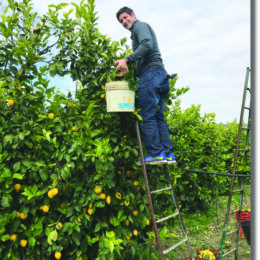
Nick Mastroianni picking lemons at Fabrizia Spirits’ grove in Sicily, Italy. Courtesy photo.
“The fascinatingly frustrating truth of the matter,” Mastroianni said, “is, no matter how beautiful a lemon looks, you cannot tell how good the essential oils will be inside the rind. The ugliest lemon, with marks and blemishes and scars, can sometimes have as much beautiful lemon oil as a perfectly shaped bright yellow lemon.”
In fact, he said, there are vast differences between different varieties of lemon. In Italy, where his company gets its lemons from, “there’s a different variety of lemon about every 50 miles you drive. There are real peculiar varieties that are popular in Sicily and other parts of Italy. If you happen to live in that town or region, well, why would you buy the other lemons that are 50 miles further away?” In the U.S., by contrast, “you essentially can buy two varieties of lemons, the Eureka lemon and the Lisbon lemon, … Both of those lemons, while they do have good juice, and they’re bright yellow, they do just have a different flavor of what we call in the limoncello industry olio essenziale, which means essential oils in English.”
To make the best lemonade, Mastroianni said, and to get the most lemony flavor, you need to consider the structure of a lemon itself.
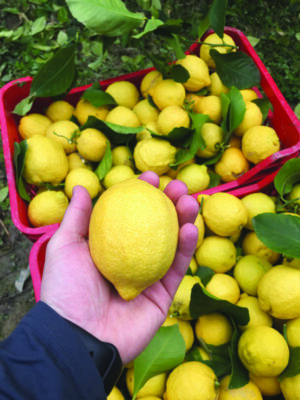
Sicilian lemons. Courtesy photo.
“On the inside, you have your flesh of the lemon,” he said, which is where the juice comes from. “Then, working outward, you have the pith of the lemon [the bitter, white part under the skin], which does range. I don’t know why some have more than others. And then you have the outer peel, which is where the essential oils are stored.” The oils, he said, are where most of the lemon flavor comes from. “You’ll get as much flavor by zesting or dicing up finely the lemon zest than if you just were to juice it and get the juice in there.”
Mastroianni suggested that to pick the best lemons for lemonade, shoppers should look at the size of the different lemons.
“If you want lemon that’s less tart,” he said, “the larger the lemon, the less tart the juice is going to be, because there’s just more water watering down the tartness inside that lemon.” He also suggested giving lemons the fruit equivalent of a massage. “This is general knowledge, but if you roll the lemon on your counter, what I’ve seen in practice is a good amount of juice will go to the middle. It sort of loosens up the juice. When you cut the lemon and you put it in your juicer, you’re going to get a lot more juice to come out a little bit easier.”
Lesson #2 – You get out of lemonade what you put into it
Catherine Urbaniak makes her living selling lemonade. She and her husband, Greg, own The Stand “Shaken not Stirred” at the Merrimack Premium Outlets, a full-time stand that only sells lemonade.
“Only lemonade,” she said, “any variation that we can of lemonade. We stick to real fruit, no syrup.”
Urbaniak’s advice for making great lemonade is to use great ingredients.
“I recommend that you don’t skimp on the type of product that you’re using,” she said. “Some people, you know, they don’t want to add all the sugar or they try to modify it in that way. But if you’re trying to make a really good old-fashioned original New England-type lemonade, you have to use all the real ingredients.” Many recipes for lemonade call for using simple syrup as a sweetener, because it mixes easily with the water and lemon juice, but Urbaniak said she thinks that’s a mistake.
“We use sugar,” she said. “If we have our way, it’s extra fine, but it’s actual sugar.”
Choosing the right lemons for lemonade comes with experience, Urbaniak said.
“You can pretty much touch a lemon and know that it’s going to be a good lemon or really tough lemon. For the most part with a touch you can tell a thin-skinned lemon versus a thicker-skinned lemon. And you want a nice good juicy lemon. It’s not going to last long on your counter, but the thinner the skin, the more the juice. It’s not so much the bigger the lemon, because sometimes the bigger the lemon the thicker the skin. If I put down three or four lemons, different variations, and someone picked them all up, they’d be like, ‘That’s the one.’ You just know it when you touch it. But again, you have to touch a ton of lemons to finally be able to see that.” As with dating, she said, you have to squeeze a lot of lemons before you know the right one.
Lesson #3 – Don’t worry
As of September 2021, it has been legal for children under the age of 14 to sell lemonade without a license. House Bill 183, titled “Exempting persons under the age of 14, who are selling soft drinks on family owned or leased property, from city, town, or village district licensing requirements,” was signed by Gov. John Sununu on July 30 of that year.
So your kids can rest easy.
Lesson #4 – A solid foundation is adaptable
According to Megan Barry, of Waterworks Cafe in Manchester, one of the great things about lemonade is how well it lends itself to additional flavors.
“We use fresh squeezed lemon and lime juice,” she said, “with all of our fun flavors, including passionfruit and mango, which are new. If we have an excess of, say, produce or something like that, we’re always trying to make new simple syrups so we can make refreshers and add some sparkling soda to make it, like, a little bubbly. We’re able to be creative with it over here.”
Barry said that lemonade works well with other summertime flavors.
“Watermelon is a big one,” she said, “especially during the summertime. The watermelon has been so fresh. We made our watermelon simple syrup, added fresh squeezed lime juice, as well as our lemonade mix, and then hit it with a little bit of that club soda. It was a big hit among customers as well as employees. We couldn’t stop drinking it. It was so good. The thing is, we can’t buy watermelon syrup. That’s something you have to make.”
“The staff’s favorite is the raspberry,” Barry said. “Mango has been a huge hit. And actually, another one of our most popular is actually made with our lavender syrup. It’s delicious. With lemonade, it’s out of this world.”
Choose a ripe, medium-sized watermelon. Look for one with a pronounced pale spot — this shows where the melon rested on the ground when it was growing in the field. If possible, find one with stripes that are two fingers wide. Cut the melon in half with a large, serrated knife. Scoop out the flesh with an ice cream scoop, and transfer it to your blender. Puree the melon until it is completely liquified. Pour it through a fine mesh strainer. In a medium saucepan, combine six cups of the juice with the sugar. Cook over low heat, until the sugar is completely dissolved. Reduce the heat, and simmer until the juice is reduced by half — about an hour and a half. Remove from heat, and let it cool completely before using. It will thicken more as it cools.
Lesson #5 – Sometimes we must muddle through
Kelly Klocek is the co-owner of Squeeze the Day NH, a lemonade and limeade food truck based in Londonderry. She agrees that lemonade is a fantastic canvas for flavors but has a different outlook on squeezing lemons.
“We started off hand-muddling,” Klocek said. [Muddling is a bartending technique where aromatic ingredients are crushed in the bottom of a cup with a stout stick.] “We don’t squeeze the lemon juice out. We actually slice the lemon and we slice it right into the cup. We’ve had bigger events now [where] we can’t keep up with the hand-muddling, so we made a muddler ourselves and it kind of smashes the lemon in the cup. So it keeps all the lemon zest and everything, all the oils from the lemon, everything about the lemon in that cup. It gives it a stronger lemon flavor, and I think that’s what everyone really likes. And then we just add the sugar to it, ice and water and that’s it. We shake it up and we serve it out the window.”
Klocek said this classic mixture pairs well with many other flavors.
“The other thing you can do with our lemonade is that we have 17 flavor options and you can mix and match any of those flavors in your lemonade,” she said. “We’ve had every combination. We started off only with four flavors and customers suggested other flavors to us and that’s how we added to our menu. One of our top sellers right now, which I didn’t think would be possible, would be lavender. Lavender lemonade. It’s crazy. That and our prickly pear.”
According to Klocek, one of the keys to a great lemonade that gets overlooked is the ice. To properly chill lemonade, she said, smaller pieces of ice work better than big cubes.
“We use a, it’s like not a full cube, but it’s not crushed either,” she said. ”We like it broken up. We are eventually going to be looking into using nugget ice cubes because we’ve definitely noticed that the smaller ice cubes are just much better with the drink.”
Klocek admitted there is one drawback to muddling lemons for lemonade: the seeds.
“We’ve noticed that some of our competitors like to promote the use of boba straws, the really wide ones. We tried that once and we didn’t like it, because we kept sucking up the seeds. We’ve gone with a classic, smaller straw and we haven’t seen much of a problem with that. It helps with kids as well because they hate getting the seeds.”
Lavender Simple Syrup 1 cup (200 g) sugar 1 cup (8 ounces) water 2½ Tablespoons (3 g) dried lavender 1 Tablespoon fresh squeezed lemon juice
Combine the sugar, water and lavender in a saucepan, and cook over medium-low heat. Bring to a low boil, and cook for another 10 minutes. Remove from heat, and stir in the lemon juice. Let the lavender steep for 20 minutes or so, then strain with a fine-mesh strainer. Gently press on the flower buds to squeeze extra flavor out.
Lesson #6 – Build a better lemonade and the world will beat a path to your door
Erin Doonan is the owner of Pours and Petals Mobile Bar and Catering in Concord, a boutique catering company known for its lemonade.
“I absolutely love lemonade,” she said. “That is really what inspired me to start my business in the first place. I think lemonade really makes people happy. It’s like the one drink that we have found that just satisfies everyone’s sweet tooth. Everyone likes lemonade. You rarely find people that don’t. It also brings a feeling of nostalgia and happiness back to people. I also think it’s really hard to find places that have really good lemonade around here. That’s really what we’re trying to bring to people. You don’t have to go to a fair to get a good lemonade; we’re going to bring that lemonade to you.”
Doonan’s lemonade starts from a standard recipe with simple, but high-quality ingredients.
“Our base lemonade is homemade,” she said, “and we make it with pure lemon juice and cane sugar and water. It’s as simple as that. People ask if we have a secret ingredient. We don’t. We just have our special ratio that we use, so we make that and then we add a bunch of different all-natural flavors that we have. We have a mix of muddled fruits like strawberry-basil and raspberry-lime and then we also have organic simple syrups that we use to flavor the lemonades.”
Lesson #7 – Follow your dreams
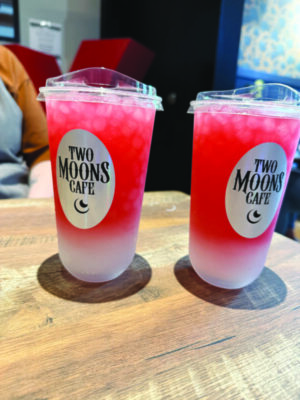
Pink Pony Club lemonade. Photo by John Fladd.
Meg Wright’s lemonade recipe came to her in a dream.
Wright is the owner of Two Moons Coffee & Curiosities in Manchester’s Millyard. One of her biggest sellers this summer is a Chappell Roan-themed lemonade called Pink Pony Club, made with watermelon juice, fresh mint and sparkly luster dust.
“Over the past couple of days,” Wright said, “we’ve gone through seven gallons of it.”
“It’s a stack drink,” Wright said. “We use nugget ice, which helps layer the colors. Because the lemonade is a little more dense, and the watermelon juice is a little more watery, the layer of ice just balances it out. I dreamed about it; that’s kind of how I come up with ideas — I dream of things.”
The secret to a Pink Pony, Wright said, is fresh watermelon juice.
“I love watermelon,” she said, “but I don’t like the gross syrupy watermelon because it’s not real. It’s very disingenuous. So I just was like how do I do this? So I came out at home with my Vitamix, trying it out and it worked out great.”
Wright filters her watermelon juice twice.
“The first time you filter it, you just get a pile of pink glop,” she said. “And then we strain it again through a coffee sieve and it gives you just the juice. It gives you just the good flavors and nothing else.”
Lemonade from Betty Crocker’s Picture Cook Book (McGraw Hill Book Co., 1950)
“As American as circus day — saves lemons, gives flavor.”
Combine in saucepan – 1 cup sugar, 1 cup water, rind of two lemons, cut into pieces. Stir over low heat until sugar is dissolved. Boil about 7 minutes. Cool. Add – 1 cup lemon juice (5 to 6 lemons), 4 cups ice water. Pour over ice in pitcher or tall glasses. Amount: 6 to 8 servings.