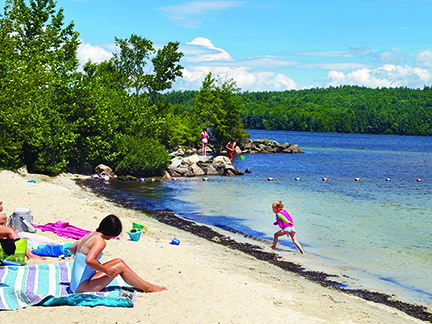
Spend some summer at NH’s lakes, beaches and caves
New Hampshire’s summers are getting hotter, stickier and, this year especially, wetter. It’s the kind of weather that makes a person start eyeing every pond, quarry and roadside dam as a potential escape hatch. The good news is that the Granite State is, without much exaggeration, one of the best places in the country to jump into a body of water.
The state routinely ranks among the nation’s top three to five for water clarity and water quality, according to Amy Smagula, the Chief Aquatic Biologist with the state’s Department of Environmental Services, as well as Director of the Jody Connor Limnology Center.
Smagula has spent 29 years with NH DES — starting as an intern, running the Exotic Species Program for years, and now overseeing 13 staff and 22 programs that monitor lakes, ponds, rivers and beaches across New Hampshire. If anyone’s an authority on where it’s safe to swim this August, and how to know where it isn’t, it’s her.
“New Hampshire has very good water quality overall,” Smagula said by phone recently — with a caution: “However, these are natural systems, so things do happen.”
Both the National Weather Service and the Old Farmer’s Almanac expected this summer to run hotter than average, and so far that’s happened. Overall, summers here are trending warmer and more humid — which makes this less a lifestyle diversion than a genuine survival guide.
In other words, a pool membership or a $50 water park ticket isn’t required to cool off in the dog days of August. New Hampshire is stitched with public lakes, ponds and rivers. Getting wet isn’t a necessity, either, with a trio of genuinely strange and wonderfully cold cave systems left behind by the last Ice Age.
But natural water isn’t a chlorinated backyard pool, so a little bit of homework — the kind Smagula and her team at NHDES have made pretty easy — helps ensure a cool-down doesn’t turn into a rash, a stomachache, or worse.
Where to swim
Before picking a spot, begin with the NH Healthy Swimming Mapper. It monitors roughly 70 bodies of fresh water and 16 coastal beaches for bacteria. It’s updated at least once a day, and during bloom season sometimes multiple times a day, for fecal bacteria and cyanobacteria samples as they come back from the lab.
NHDES (des.nh.gov) introduced this oh-so-useful tool a few years ago, and Smagula calls the current version “the best iteration that I’ve seen of it.” It’s the closest thing New Hampshire has to a real-time weather report for water safety, and it’s free.
However, Smagula stressed that the mapper can’t cover everything.
“We can’t possibly sample 950 lakes and ponds and 11,000 miles of rivers and streams every single day in New Hampshire,” she said.
That’s why it’s essential that swimmers conduct what Smagula calls a “self-risk assessment.”
That’s a 30-second check before jumping into any body of water, mapped or not. Steps include scanning the sand for waterfowl or pet waste, then looking at the water itself. Is it clear, or does it look like a shaken snow globe, with flecks or scum floating in it?
Ask Smagula what she wishes she could correct about how people think about lake safety, and she doesn’t hesitate: the assumption that every beach is being watched.
“Anybody anywhere in the state could jump into a surface water,” she said — and plenty of people do, at ponds and river bends that appear on no list or map at all.
The other misconception is subtler: that showing up and jumping in is itself the plan.
It isn’t, in her view — the plan is showing up, looking around, and deciding.
“We have many beaches around the state that they could go to if the beach that is their first choice has something going on with it,” she said, “so they can have a plan B to go to another beach if they need to.”
Science aside, talking with Smagula reveals a sentiment that has little to do with algae counts or cell thresholds, that New Hampshire residents genuinely love their lakes. This dedication helps shape how the state agency charged with overseeing them approaches its task.
“A lot of people spend a lot of time growing up on lakes, going to camps on lakes, living on lakes, visiting lakes,” she said. “They’re meaningful to people.” Beyond that, tourism and recreation are a real economic engine for the state, one that depends on keeping the water clean enough to jump into.
All about algae
Cyanobacteria, commonly called blue-green algae, are native and normally present in trace amounts in nearly every water body in the state. However, they’re only a problem when they bloom. Even then, not every bloom is toxic, and NHDES has a reliable testing program to suss out potential danger.
“When we see a bloom, we collect a sample,” Smagula said. “Our threshold in New Hampshire is 70,000 cells per milliliter.” Above that density, the risk that toxins are present becomes significant enough to matter.
One more wrinkle is that blooms move.
“A place could be really unsafe in the morning because of high cell density, and then the wind blows,” Smagula said. “It shifts the bloom to another part of the lake.” Cyanobacteria cells can float, so a lake can look clean at 9 a.m. and develop a visible scum by afternoon, especially after hot, still weather.
Most blooms in New Hampshire last from an hour to a few days, but some lakes with heavier nutrient loads have bloomed for what amounts to an entire summer. The good news, reports Smagula, is that the algae gods have been kind so far.
“This has been a really quiet summer,” she said. “We don’t have any [active blooms] right now.”
With that in mind, here’s the list.
Per nhstateparks.org, this information is current for the 2026 season. Most beaches have no lifeguards, so it’s swim at your own risk. Costs at all parks are $2 for ages 6 to 11, $4 or $5 for ages 12 and up, free for NH residents 65 and older.
Bear Brook State Park — Beaver Pond & Catamount Pond (157 Deerfield Road, Allenstown / 485-9874)Hours: Open daily June through September
New Hampshire’s largest developed state park at over 10,000 acres offers two swimming areas: Beaver Pond, with a campground beach, and Catamount Pond, which offers a day-use area and pavilion. Canoe and rowboat rentals are available at both ponds on weekends. Pets are allowed in the campground and on trails, not on the beach. The park is also home to the NH Antique Snowmobile Museum, a cool indoor option for a break from the sun.
Clough State Park — Everett Lake (455 Clough Park Road, Weare / 529-7112) Hours: 9 a.m.–7 p.m. (through early Sept.); 9 a.m.–5 p.m. (Sept. 8–Oct. 13)
A 900-foot sandy beach on 150-acre Everett Lake, formed by a dam on the Piscataquog River. The park store rents boats, paddleboards and floats, and sells snacks and ice cream. No pets on the beach. Carry in, carry out — no trash receptacles on site. Weekend and holiday reservations are strongly recommended, as the beach can reach capacity. Note: GPS can be wonky, and it’s recommended to use Everett Dam Road in Weare as a destination.
Contoocook Lake — Lake Contoocook (Squantum Road, Jaffrey / 532-8100) Hours: 11 a.m.–5 p.m. daily (lifeguard hours); facilities open 8 a.m.–dusk
A classic small-town public beach on clear, quiet Contoocook Lake at the foot of Mount Monadnock, making it a popular post-hike cool-down destination. There’s a lifeguard on duty during posted hours, bathrooms, picnic tables, a concession stand, a covered pavilion and changing rooms. No floatation devices, alcohol, glass containers or loud music. Non-residents park at Humiston Field (31 Howard Hill Road) and walk approximately 0.8 miles to the beach.
Ellacoya State Park – Lake Winnipesaukee (280 Scenic Drive, Gilford / 293-7821) Hours: Daily 9 a.m.–6 p.m., After Sept. 20, unstaffed and weekends only through Oct. 24
A 600-foot sandy beach on the southwest shore of New Hampshire’s largest lake, with views across the water to the Sandwich and Ossipee mountains, one of the few state park beaches with a lake view on that scale. It offers picnic pavilions, an accessible bathhouse and a playground. Parking is limited and fills fast on nice weekends and holidays, but reservations can be made up to 30 days ahead. Pets are not allowed anywhere in the park.
Greenfield State Park – Otter Lake (52 Campground Road, Greenfield / 547-3497) Hours: Open daily late June through mid-October; generally 10 a.m.–7:30 p.m.
Reopened last year after renovations, this 400-acre park sits on the shore of Otter Lake. Its Picnic Beach has a small sandy swim area, picnic tables with grills, restrooms, and a small store selling snacks and camping supplies. Kayak and canoe rentals available. The park is the state’s largest campground, so it sees traffic, but the lake itself remains undeveloped and peaceful. It’s close enough to Mount Monadnock to pair a morning hike with an afternoon swim.
Kingston State Park – Great Pond (124 Main St, Kingston / 642-5471) Hours: Daily 9 a.m.–5 p.m., weekends 8 a.m.–7 p.m., through Labor Day
Situated in the state’s southeastern corner, its beach is flanked by two bath houses, one near the park office, another by the store, along with picnic tables, a playground, and a snack stand. On nice weekends the beach routinely fills to capacity by mid-morning, so an early arrival or an online day-use reservation (nhstateparks.org) can be worth it. No alcohol or smoking anywhere in the park; no pets on the beach or in the picnic area.
Mt. Sunapee State Park – Lake Sunapee (86 Beach Access Road, Newbury / 763-5561) Hours: 9 a.m.–6 p.m. through Oct. 24.
The state beach sits on Lake Sunapee with a view of the mountain’s base, with a wide grassy lawn, a bathhouse, a store, a playground, and canoe/kayak rentals. Hiking trails leave from the beach area up toward Lake Solitude and the summit, making it an easy pairing of a morning hike and an afternoon swim. A restricted boat launch is on site. The beach reliably sells out by late morning on nice summer weekends and holidays, so reserve ahead if you can.
Pawtuckaway State Park — Pawtuckaway Lake (128 Mountain Road (Main Entrance) or 7 Pawtuckaway Road, Nottingham / 895-3031)Hours: 8 a.m.–7 p.m. daily
An 800-acre glacial lake with a 600-foot sandy beach, playground and new restroom building, set against a densely forested 5,500-acre park. The beach faces west and gets full afternoon sun. The beach area reaches capacity by mid-morning most summer weekend days, so arrive early. Canoe and kayak rentals are available at the camp store. Alcohol and pets are prohibited in the beach area. Oh, and prepare to untether — there is limited to no cell service inside the park.
Silver Lake State Park – Silver Lake (138 Silver Lake Road, Hollis / 465-2342) Hours: Friday, Saturday and Sunday, all season long, 9 a.m.–5 p.m.
An 80-acre park with a 1,000-foot beach curved along a 34-acre lake. Only open Friday through Sunday during the season, so a weekday drive out will find it closed. The park store rents canoes and kayaks, also selling snacks, ice cream and beach supplies. A short loop trail starts at the beach, with more hiking into the adjoining Spalding Town Forest. The restrooms are portable toilets rather than a bathhouse this year. No pets, no alcohol.
Wadleigh State Park – Kezar Lake (78 Wadleigh State Park Road, North Sutton / 927-4724) Hours: Open 10 a.m.–5 p.m. through Labor Day
Tall pines and hemlocks shade the picnic grove right up to the sandy beach on Kezar Lake. Canoes and kayaks are available to rent, and paddlers can cross to a small island loaded with wild blueberries, or follow a 3-mile loop trail around the lake with views of Mount Kearsarge. Amenities include a bathhouse, picnic tables, a playground, a baseball field across the street, and a boat ramp near the entrance. No pets.
Wellington State Park – Newfound Lake (614 West Shore Road, Bristol / 744-2197) Hours: Daily 8 a.m.–6 p.m. through Sept. 20, weekends only through Oct. 11
One of New Hampshire’s deepest, clearest lakes, Newfound is the largest freshwater swimming beach in the entire state park system. A peninsula nature trail runs along the shore with picnic areas, fishing spots, and views across to Cliff and Belle Islands; longer trails connect out to Mt. Cardigan, Welton Falls, and the Sugarloafs. The snack bar sells ice cream and beach gear, and there are volleyball and horseshoe courts. No pets.
Wentworth State Park – Wentworth Lake (297 Governor John Wentworth Hwy., Wolfeboro / 569-3699) Hours: 9 a.m.–6 p.m. through Labor Day
Allen Albee Beach is a small, quiet 50-acre beach on the north shore of Wentworth Lake, often called the quiet sister of Lake Winnipesaukee, which it connects to. Amenities are simple, with picnic tables, flush toilets, and a group-use area, which makes it a good pick on a summer weekend when the bigger Lakes Region beaches are full with the seasonal crowds. No pets.
Where to hit the beach
New Hampshire’s ocean coastline is the shortest of any non-landlocked state. But there are still 16 beaches and a separate NHDES program monitoring them for the same bacteria that show up in the state’s lakes. Smagula’s title covers fresh water, but she’s monitoring the coastal side while the state looks for a new beach program coordinator.
She says the calculus for salt water isn’t much different: Watch for crowds and waterfowl congregating on the sand, since both can signal higher bacteria levels, check the mapper, and run the same self-risk assessment.
Hampton Beach State Park 160 Ocean Blvd., Hampton / 227-8722 Hours: Parking area 8 a.m.–midnight; lifeguards on duty 9 a.m.–5:30 p.m. (10:15 a.m.–4:45 p.m. Sept. 2–Oct. 5).
New Hampshire’s best-known coastal attraction, it’s also been recognized by the Natural Resources Defense Council as a “Superstar Beach” for consistently clean water. It pairs a mile of wide sand with a boardwalk full of arcades, ice cream stands, restaurants and shops. In other words, it’s a festive, resort-town beach rather than a quiet escape. Beach amenities include a bath house and food vendors, with metered parking.
Jenness State Beach 2280 Ocean Blvd, Rye / 227-8722 Hours: Parking area 8 a.m.–midnight; lifeguards on duty 10:15 a.m.–4:45 p.m. daily through late August.
A half-mile stretch of sand in Rye, Jenness is a favorite among surfers and local families who prefer it to Hampton’s larger crowds. The beach has a small bathhouse with restrooms and outdoor showers, plus a snack bar in season. Its consistent wave breaks make it one of the seacoast’s more popular surf spots outside of lifeguard hours. Street-side metered parking lines Route 1A. It offers a more laid-back, neighborhood feel while still being fully equipped for a day at the shore.
North Beach 920 Ocean Blvd, Hampton / 227-8722 Hours: Parking meters active 8 a.m.–10 p.m.; lifeguards on duty 10 a.m.–5 p.m. daily through mid-to-late August.
The northern end of Hampton Beach State Park along Ocean Boulevard, North Beach is quieter than the Main Beach strip a mile south, with fewer commercial distractions. It’s a favored spot for surfers and long-boarders thanks to its more open swell. Parking is metered street-side along the seawall, with head-in-only spaces from 6th to 19th Street and no overnight parking. Facilities are limited compared to Main Beach, making it better suited to visitors who want sand and surf without the boardwalk scene.
North Hampton State Beach 27 Ocean Blvd., North Hampton / 227-8722 Hours: Parking area 8 a.m.–midnight; lifeguards on duty 10:15 a.m.–4:45 p.m. daily thru late August.
A small, low-key beach in North Hampton, this spot draws mainly local residents and surfers rather than tourists. It has minimal amenities — no boardwalk, concessions or bath house — just sand, surf, and roadside parking along Ocean Boulevard. Pets are prohibited here year-round, unlike most other state beaches. Its modest size and quieter crowds make it a good choice for visitors seeking a simpler, less commercial beach day on the seacoast.
Odiorne Point State Park (Rye) 570 Ocean Blvd, Rye / 436-7406 Hours: Typically 8 a.m.–8 p.m. in summer, shorter in spring and fall; check current schedule before visiting.
The largest stretch of undeveloped shoreline on the New Hampshire coast, Odiorne Point offers tide pools, salt marsh, and a mostly rocky and pebble shoreline rather than open sand. Swimming is allowed in a designated area but unguarded, so it’s swim-at-your-own-risk. The park includes walking trails, picnic areas, WWII-era bunker remnants, and the Seacoast Science Center. It’s better suited to exploring tide pools, birdwatching and picnicking than traditional beach lounging, appealing to visitors who want nature and history alongside ocean views.
Rye Harbor State Park (Rye) 1730 Ocean Blvd, Rye / 227-8722Hours: Parking area open 8 a.m.–8 p.m. daily.
Rye Harbor is more working harbor than swimming beach, with a boat ramp, commercial wharf, and public dock alongside picnic tables and salt-water fishing access. Whale-watching and deep-sea fishing charters depart nearby. There’s no lifeguarded swimming area, so it’s best for anglers, boaters, and anyone wanting harbor views and sea breeze rather than sand time. Its small size and working-harbor character make it a quick, scenic stop rather than a full beach-day destination.
Seabrook Beach (Seabrook) Runs along Ocean Boulevard/Route 1A in Seabrook Beach village. Call 474-3252.Hours: Open year-round; no official gate hours, though parking is restricted seasonally.
New Hampshire’s southernmost coastal beach, Seabrook Beach sits in a quiet, largely residential beach town backed by protected dunes. From Memorial Day weekend through mid-September, beachfront parking is limited to residents with a permit, so most visitors park along Route 1A and walk to public access points. The vibe is low-key and cottage-community rather than commercial, with fewer amenities than Hampton just to the north. It suits visitors looking for open sand and a quieter, small-town coastal feel.
Wallis Sands State Park 1050 Ocean Blvd., Rye / 436-9404 Hours:Parking area open 8 a.m.–midnight; lifeguards on duty 10 a.m.–5 p.m. daily, June 1–September 1.
Wallis Sands offers a 700-foot sandy beach that widens to about 150 feet at high tide, making it one of the more spacious swimming spots on the seacoast. It has a full bathhouse with showers and restrooms, a snack bar, a playground, and lifeguard coverage through the summer. Day-use parking reservations are available online, which helps manage the popular summer crowds. Its combination of amenities and swimmable sand makes it a solid family-friendly choice between the busier Hampton Beach and quieter Jenness Beach.
Into the Earth: NH’s caves
If checking a bacteria map before swimming sounds like too much homework for a beach day, here’s a pivot: New Hampshire has three genuinely excellent cave systems, all of them naturally, permanently, gloriously cold, no water-quality mapper needed.
All three cave systems are, geologically speaking, cousins — talus caves formed when retreating glaciers left massive granite boulders stacked against each other roughly 10,000 to 20,000 years ago. According to Dr. Simon Pendleton of Plymouth State University, a few factors keep these caves cold through summer. One is thermal mass.
“It takes them a long time to heat up or cool down, so the boulders themselves act like cold packs well after the cold winter temperatures have gone,” he wrote in an email. “The boulders also insulate the cold air pockets below them very well from the warm air temperatures.”
In nearby Polar Caves Park, boulders and trees also minimize solar radiation, which keeps the talus field shaded, he continued. “Also, the air in these boulder pockets is cold coming out of the winter and this cold air is denser than the warm summer air above it, which prevents mixing and keeps cold air trapped … in the voids between boulders.”
Asked about the effects of climate change on these geological marvels, Pendleton said warmer air will affect cold boulder pockets, “but due to all the factors keeping them cool, the impact will be muted.”
Polar Caves Park (705 Route 25, Rumney, 536-1888, polarcaves.com) is the state’s original cave attraction. Family-owned since 1922, it’s unmistakably built around a single selling point: cold. Nine glacially formed granite boulder caves sit beneath Hawk’s Cliff in the Baker River Valley, linked by a network of boardwalks and stairs.
The deepest of them, aptly named the Ice Cave, holds frozen water even while temperatures rise outside. The others have self-explanatory names like Fat Man’s Misery, Lemon Squeeze, Orange Crush and Polar Pinch. Bypass routes exist at every cave for anyone who’d rather not squeeze through granite. Wear closed-toe shoes with real traction, and bring a light layer even on a 90-degree day — the cold air is the entire point.
Open daily from mid-June through Labor Day weekend (Wednesday through Sunday in the shoulder seasons); tickets run about $24.50 for adults and $15.50 for youth ages 4-11 when booked online, with kids 3 and under free.
Lost River Gorge and Boulder Caves (1712 Lost River Road, North Woodstock) offers a different flavor of the same phenomenon: a place where a river literally disappears underground. A one-mile wooden boardwalk winds through Kinsman Notch past nearly a dozen glacially formed boulder caves, including Lemon Squeezer and Bear Crawl, along with cascading waterfalls and towering rock walls.
Plan on 1.5 to 2 hours to enjoy a shaded gorge and dark cave interiors that create a genuine micro-climate much cooler than the surrounding forest. The site is only closed during lightning,. Thanks to bypass routes throughout, most of the trail can be walked without entering a cave — but why skip chilling? Gemstone panning, a nature garden, a gift shop and café round things out.
Open daily through October, though the current schedule runs Monday and Thursday through Sunday (closed Tuesday and Wednesday); tickets run $25 online, $29 walk-up, with kids 3 and under free.
Loon Mountain’s Glacial Caves (60 Loon Mountain Road, Lincoln, 745-8111) Ride the White Mountain Express, New Hampshire’s longest enclosed gondola, up to the summit of Loon Peak, then walk a short distance to explore boulder caves formed by the same Ice Age geology as Polar Caves and Lost River. Cave access is included with a Skyride ticket, making this a genuine two-for-one — mountain views and underground chill in a single trip.
Athletic footwear is required, and the caves can close temporarily during or after wet weather when the rocks get slick, so check the Loon Mountain Report before heading out. The gondola can accommodate folded wheelchairs, walkers and strollers. One practical note: Missing the last gondola means a hike down, so keep an eye on the clock.
Open daily from late May through mid-October, with the gondola typically running from 10 a.m. to 5 p.m. Window tickets are about $45 for adults (ages 13–64), purchase online a day early to drop the price to $35.
Top 10 things to keep in mind
- Do a risk assessment, every time. Before wading in the water, look at the beach for animal or waterfowl waste, and check the water for scum, film or flecks that resemble a shaken snow globe.
- New Hampshire’s water is genuinely excellent. The state consistently ranks in the top three to five in the country for water clarity and quality.
- It’s not all watched. New Hampshire has roughly 950 lakes and ponds and 11,000 miles of rivers and streams; the state actively monitors about 70 freshwater beaches and 16 coastal beaches. Exercise good judgment for the rest.
- The Healthy Swimming Mapper (des.nh.gov/water/healthy-swimming/healthy-swimming-mapper) is invaluable and is updated at least once daily for bacteria and multiple times a day during active cyanobacteria sampling.
- Cyanobacteria are normal until they’re not. There are trace amounts almost everywhere. The concern is when they bloom and cross the state’s safety threshold of 70,000 cells per milliliter. Then toxins become a real possibility.
- Blooms float and can move around. Within hours, wind can push a bloom from open water onto a beach, or clear a beach by blowing it elsewhere. Most blooms last from an hour to a few days; the worst last 90 to 120 days.
- If you swim into a bloom, get out immediately, move away quickly and then shower without delay — dogs too. Watch for skin rashes, gastrointestinal upset, headache, dizziness or fatigue. Seek medical attention if symptoms escalate.
- Rivers aren’t exempt — look below. They rarely get water-column blooms, but benthic cyanobacteria mats — fuzzy, dark green or blackish carpets on the river bottom — are a growing concern, and they can produce the same toxins.
- Be part of the monitoring system. NHDES’s Look, Check, Report campaign relies on the public, so anyone who spots a suspected bloom can fill out a report and trigger an inspection.
- Hold off after heavy rain. Bacteria can survive outside a human or animal for about 24 hours. Waste, runoff and sewage overflow wash downhill into the nearest body of water during a storm.