Meet crémant

Another French sparkling wine

When thinking of sparkling wines two immediately come to mind: Champagne and prosecco. Champagne is typically reserved for celebratory events and prosecco has generated a following because it is light and not complex, to be enjoyed in an afternoon or with dessert, without the guilt of spending a lot of money. But if you want complexity derived from a blending of a variety of grapes, along with the added boost of notes of fresh bread, and possibly a sweetener, you must turn to a Champagne, a cava or a crémant. In this column we will discuss crémant, as the other sparkling wine from France.

Crémant, made in the same method as Champagne, can be produced in eight different wine regions of France, including Alsace, Bordeaux, Loire, Bourgogne and Jura. Sparkling wine labeled as Champagne can only come from the Champagne region of France. Both Champagne and crémant are produced from grapes that are hand-harvested and both require a second fermentation in the bottle, with the lees (sediment of yeast), which helps to give the wines their natural fizz. Both have a second dosage of sugar or wine before they are corked and both are aged for a minimum of 12 months before they can be sold. The regulations for Champagne are very strict, while the guidelines for crémant may be a little more relaxed; however, crémants can still have the great quality of Champagnes and are growing in popularity.

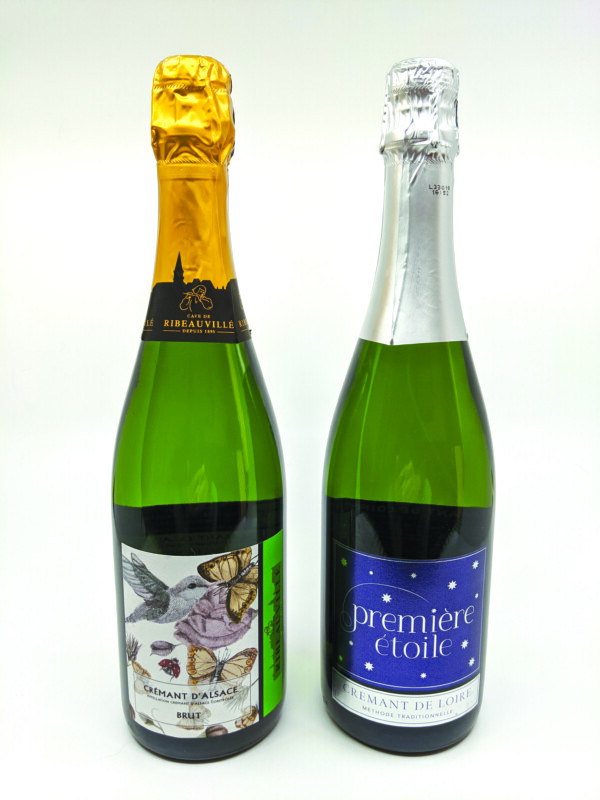
Crémant d’Alsace means the “Sparkling Wine from Alsace.” This region makes up approximately 45 percent of all crémant production, producing approximately 40 million bottles annually, making this the largest contributor toward the crémant production of France. Our first wine, a Cave de Ribeauvillé Crémant d’Alsace Brut Le Comte (originally priced at $49.99, reduced to $17.99 at the NH Liquor & Wine Outlets) has a pale yellow color with a slight citric nose. The bubbles rise consistently and do not fade in the glass. The first taste is of green apples and is slightly citric, but vanilla and the yeast of brioche comes through in a full creamy mouth feel.

Alsace, located on the Rhine River plain and the border of Germany and Switzerland, has alternated between French and German control over the centuries. Wines produced here tend to be influenced not only by the cooler climate but also by German tastes. Varietals grown include riesling, gewurztraminer, muscat and pinot gris. It is logically expected that riesling is the predominant grape of this crémant produced by Cave de Ribeauville, the oldest wine co-operative in France, originating in 1895 and containing over 650 acres of vineyards.

Our second crémant is from the Loire Valley, home to kings and castles. The river flows through central France and the valley is referred to as “the Garden of France” due to the abundance of vineyards, fruit orchards, and vegetable fields in its banks and hillsides. There are several wine regions producing muscadet on the Atlantic Coast, to Sancerre and Pouilly-Fumé, southeast of Orleans that run along the course of the river. Comte de Saint Aignan Crémant de Loire Brut Première Étoile (originally priced at $28.99, reduced to $14.99 at the NH Liquor & Wine Outlets) produced by Fournier Père & Fils, is a blend of 60 percent chenin blanc, 35 percent chardonnay and 5 percent cabernet franc. The grapes for this sparkling wine come from the Crémant-de-Loire appellation of the Valley, including Anjou, Saumur and Touraine, in the heartland of the Loire Valley.

The color is light gold (almost clear) with persistent but sparse bubbles. The nose is slightly nutty with notes of dark honey. To the mouth, there are bold citric notes, leading one to think that sauvignon blanc is included in the blend, as it is in crémant blends of Bordeaux — but it isn’t. The nose and taste of the chardonnay in this blend is more pronounced than in a typical Champagne, which may influence the taste buds of some more than those of others. The finish is long, perhaps in part owing to the presence of the chardonnay.

Each of these wines can be enjoyed as an aperitif or served with fish and seafood, and perhaps enjoyed with fruit and cheese. They are versatile.

Featured photo: Photo by Fred Matuszewski.
The Chestnut Club

This column is an intervention for my editor and her aversion to a certain liqueur.

We Americans don’t deal well with bitterness.

The taste of bitter things, that is. We are fine with it as a character trait, but bitter tastes have a steep acceptance curve for us. Other cultures are much more accommodating to it. The Chinese concept of candy is more likely to be bitter than sweet. The British brew beers and ales that would make an American face collapse in on itself. But offer one of us an oil-cured black olive (the best kind of olive, by the way), and most of us will shrink back in horror.

“But, but that tastes like … leather!”

Yes. Yes, it does.

And this aversion makes a certain amount of sense, evolutionarily speaking. Long ago, we developed the ability to taste bitter things to help us avoid toxins in the wild. If a new berry or caterpillar tasted astringent or bitter, our ancestors knew to spit it out. But that logic breaks down in our modern world. There are huge numbers of us — granted, not so much in New Hampshire — who challenge ourselves to eat the spiciest foods we can stand. Sweating and gasping until we feel light-headed from a literal pain response? Fine. Bitterness? “What? Are you CRAZY?”

Intellectually, we accept that delicious, well-nuanced foods need a mixture of basic flavors. Bake a batch of cookies without salt, and they will just taste wrong. We love sweet-and-sour pork and chocolate-covered pretzels. Bitterness has a place at the table.

Which brings us to Campari.

Campari is a bright red, extremely bitter liqueur from Italy. You have seen it at the liquor store, or behind the bar at most upscale joints, but probably don’t have any around your house. It is the dominant ingredient in a Negroni.

To be fair, it is not universally loved. Some cynical critics have referred to it as “The Raisins of Booze.” [Editor’s note: As in “Why are there raisins in this cookie? This did not need raisins,” but with an otherwise perfectly good cocktail and Campari.] And yet, the fact remains that it is one of the best complementary counterbalances to sweet juices or syrups in mixed drinks. It is a team player; nobody is going to drink a glass of the stuff.

Actually, hold that thought.

Sound of footsteps going into the kitchen, various bartendy sounds, a brief moment of silence, then a gasp of shock and the sound of a tiny glass hitting the floor. More footsteps returning.

Yeah. I can’t recommend that.

BUT, I stand by my assertion that Campari deserves the space on your shelf where you are keeping that bottle of Crystal Head vodka that you bought on a whim that time and can’t bring yourself to open. (Open it and drink it, already. It’s vodka. It tastes like vodka.)

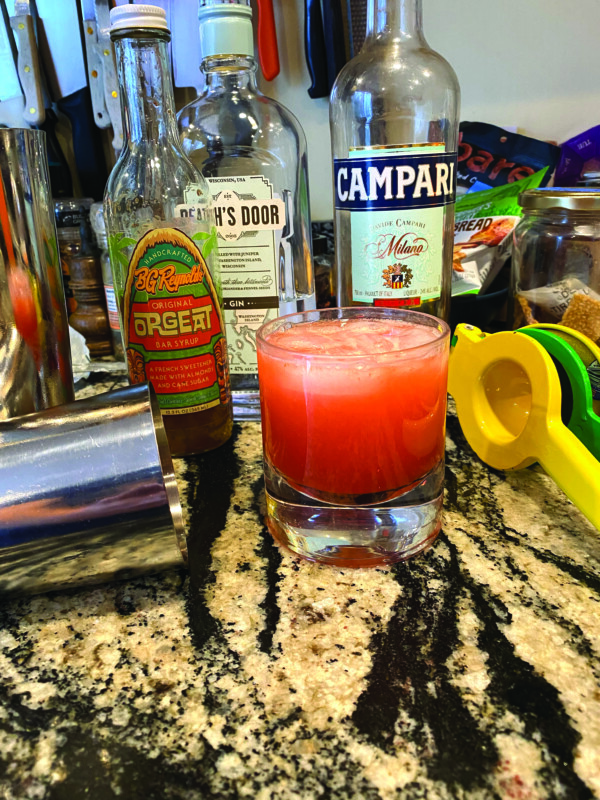
A case in point is a classic drink — the Chestnut Club (sometimes known as the Chestnut Cup), a modern classic developed in a California restaurant of the same name. It balances sweetness in the form of orgeat (an almond-infused syrup pronounced “or-szott”, as in, “It is unclear at this time whether the victim was stabbed or shot”), astringency from gin, sourness from lemon juice, and, of course, bitterness from Campari.

Chestnut Club

2 ounces gin (lately I like Death’s Door, out of Wisconsin.)

2 ounces Campari (Yes. Do it. God hates a coward.)

2 ounces fresh squeezed lemon juice

1 ounce orgeat

1. Combine all ingredients with 4 or 5 ice cubes in a shaker.

2. Shake until it is very cold — at least until condensation forms on the outside of the shaker.

3. Pour, without straining, into a rocks glass.

4. Drink sincerely, without irony, and, if possible, while sitting in a leather chair in an oak-paneled library with a taxidermied tiger head on the wall.

This drink is delicious. The flavor comes in waves. You really can taste each individual ingredient. It implies fruitiness, without actually embracing a Tiki mandate. It feels as if it should be too sweet and frivolous to take seriously, but it’s not.

Do you know why?

Campari, people.

Featured photo: Chestnut Club. Photo by John Fladd.

Jeff Martin

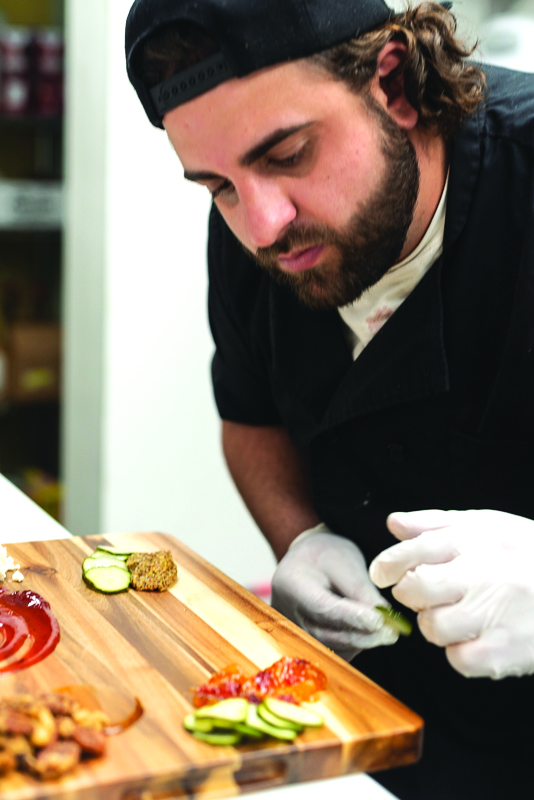
Jeff Martin of Nashua is the executive chef of Industry East Bar (28 Hanover St., Manchester, 232-6940, industryeastbar.com), which opened in early February. Industry East features an eclectic cocktail menu with syrups, juices and other ingredients made in house, along with a food selection that includes flatbreads, charcuterie boards and shareable plates, from duck confit-stuffed popovers to braised short rib toast points. A native of Litchfield, Martin got his start in the industry working as a dishwasher at Woodman’s Seafood and Grill at Mel’s Funway Park while in high school — he later went on to study culinary arts at Nashua Community College. He was the sous chef at The Birch on Elm prior to Industry East’s opening, and has also held cooking jobs at the Bedford Village Inn and the Vesper Country Club in Tyngsborough, Mass.

What is your must-have kitchen item?

I’d probably have to say either my chef’s knife or a pair of tongs.

What would you have for your last meal?

I am a huge steak lover, so a big fat juicy rib-eye … and probably a nice glass of bourbon.

What is your favorite local restaurant?

Savannah Kitchen in Newmarket. A shout out to my buddy Ian Gage, who’s the executive chef out there. They do a lot of really great stuff there. There’s a pork belly dish with barbecue sauce and apple slices that is unreal.

What celebrity would you like to see ordering from your menu?

I’m going to say Guy Fieri.

What is your favorite thing on your menu?

The duck confit-stuffed popovers, which I’m super proud of. We make them fresh every day.

What is the biggest food trend in New Hampshire right now?

It’s been going on for years but vegan and plant-based items have become really popular.

What is your favorite thing to cook at home?

Honestly, when I get home from being in the kitchen all day, I’m either ordering out or I’m eating frozen pizzas or Cheez-Its.

Homemade popovers
From the kitchen of Jeff Martin of Industry East Bar in Manchester

2 cups all-purpose flour
2 cups whole milk
4 eggs
Salt and pepper

Mix flour, salt and pepper together. Heat the milk to about 120 degrees. Pour the milk slowly into the eggs to temper them. Mix the dry ingredients with the wet ingredients to form the batter. Pour them over into a popover pan about halfway up. Bake at 395 degrees for 15 minutes, then bring the temperature down to 350 degrees and bake for 15 additional minutes.

Featured photo: Jeff Martin

Egg-ceptional eats

Crack’d Kitchen & Coffee coming to Salem

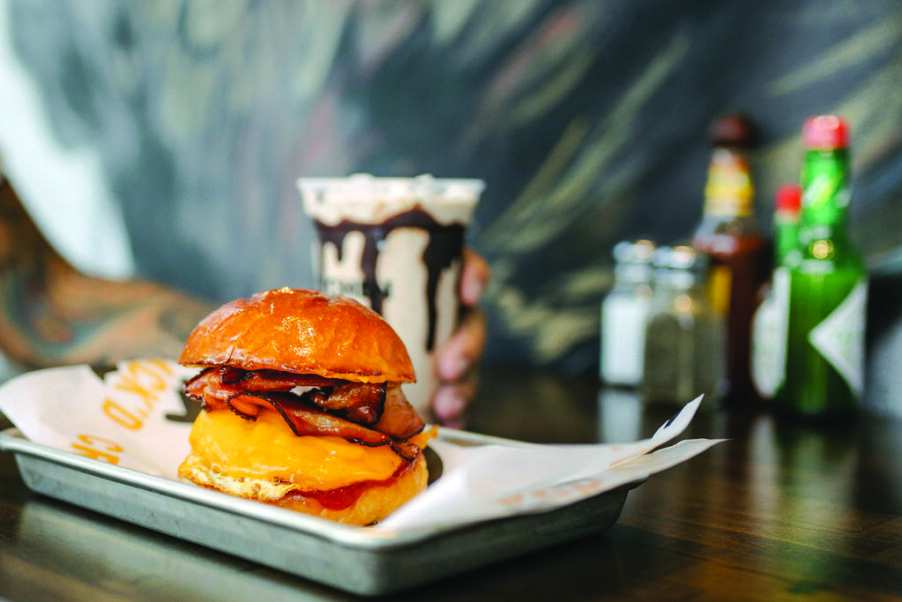
Inspired by their love of breakfast sandwiches, Alan Frati and Danny Azzarello found success in 2019 with Crack’d Kitchen & Coffee, a fast casual concept specializing in locally roasted coffees, smoothies, bowls and eclectic breakfast options like loaded hash browns and egg sandwiches with creative toppings. After two years in Andover, Mass., Crack’d will open a second spot in Frati’s hometown of Salem on Monday, April 19.

“We felt like there was a big opportunity to kind of do a chef-driven breakfast concept that could be done fast. That was really the foundation for what we did,” Frati said. “Our bacon is local from North Country Smokehouse here in New Hampshire, our eggs are all cage-free and organic, our bread is baked fresh daily and delivered seven days a week. … We wanted to find a concept that fit into people’s hectic lifestyles but wasn’t full of frozen, processed foods.”

Frati and Azzarello, along with their respective wives, Meghan and Emma, who also have hands in the business, had been looking at a few other potential spots in Salem to expand. Then early last fall, Azzarello said, he and Frati were approached by Jay Gee’s Ice Cream on South Broadway — the Wayback Burgers restaurant in the adjoining storefront next door, they learned, had closed and would not be reopening.

Other than being in a slightly smaller space than its Massachusetts counterpart, Crack’d will carry much of its established brand to Salem with a few of its own touches unique to the Granite State. The eatery features an open-kitchen concept, plus a high-stool breakfast bar overlooking the window and a large outdoor patio space.

“We definitely love the fact that we can appeal to everybody,” Frati said of the menu. “Our chef-driven breakfast sandwiches are sort of our core items, and those are very indulgent … but we have healthier options too, so grain bowls, salads, smoothies, things like that.”

Egg sandwiches are available all day. They can be anything from a simple bacon, egg and cheese sandwich on a brioche bun or bagel, to more elevated options like the Porker, featuring house sausage, maple mustard and caramelized onions; and the Early Bird, which has roasted turkey, Swiss cheese and a house sauce called “Bam” sauce.

“Every single item has a story or something looped to it. It’s not just on there because we need it,” Azzarello said. “The Bam sauce originated late one night. It was probably 1 o’clock in the morning and we were trying to create a sauce that kind of replicated almost like a Russian or Thousand Island dressing. We mixed our ketchup, maple mustard and honey Sriracha and then added some mayo and relish. We tasted it and we were like, ‘Bam, this is it!’”

There are also specialty breakfast sandwiches of the month — Frati said the first one out of the gate at the new Salem location will likely feature flavors inspired by Cinco de Mayo.

The lunch menu at Crack’d includes burgers, sandwiches, grain bowls featuring a quinoa rice blend, and “mac bowls” that are made with egg noodles and a house cheese sauce.

Smoothies, teas and espresso drinks are all part of the drinks menu. Coffees, including several of their own proprietary blends, are sourced from Hometown Coffee Roasters of Manchester.

“We have something like 35 different options that you can get,” Frati said. “We do some real fun stuff like cereal milk, which is Cinnamon Toast Crunch that’s steeped in milk overnight. We use that to make some really creative and fun drinks.”

Crack’d Kitchen & Coffee
Opening Monday, April 19. Visit their website or social media channels for updates.
Where: 327 S. Broadway, Salem
Anticipated hours: Monday through Saturday, 7 a.m. to 4 p.m., and Sunday, 7 a.m. to 2 p.m.
More info: Visit crackdkitchen.com, find them on Facebook and Instagram @crackdkitchen or call 212-1511

Feautred photo: The Live Free or Die breakfast sandwich. Photos courtesy of Crack’d Kitchen & Coffee.

Fresh catch

Mexican-style seafood grill opens in Nashua

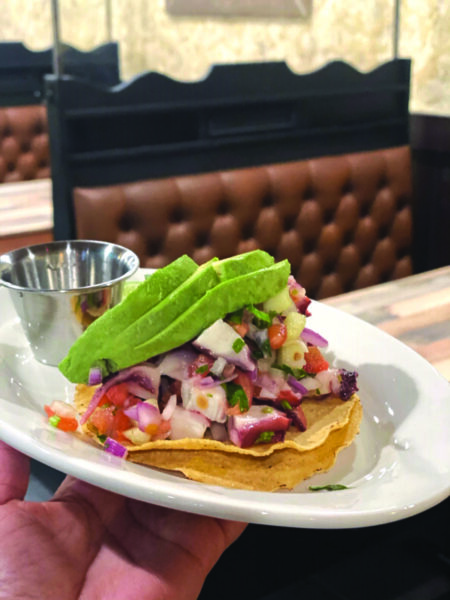
Tostada de pulpo (octopus ceviche tostada). Photo courtesy of Riviera Nayarit.

Off the Pacific coast of Mexico, the Riviera Nayarit is a destination renowned for its beaches, resorts and abundance of seafood. A new eatery has brought that culture to Nashua, offering a menu heavy on harder-to-find Mexican-style seafood dishes and a beach-like ambiance to match.

Sharing a name with the popular tourist spot, Riviera Nayarit Mexican Style Seafood and Grill opened on West Pearl Street last month, with walls painted ocean blue and sand beige and framed photos of Riviera Nayarit’s beaches at several of the booths.

Owner Karla Gutierrez, who also operates Mi Jalisco Mexican Grill in Manchester and has helped open a few other Mexican restaurants in the Granite State with friends and family members, said Riviera Nayarit is a concept that has been years in the making.

“The gastronomy of Mexico is huge. There are hundreds and hundreds of different styles,” said Gutierrez, who was born in Nayarit and came to the United States with her family at the age of 9. “My menu here is … how we do seafood on that part of the coast. A lot of people venture into what they know, like the mussels, the oysters and the dips, but I have a huge variety.”

The pescado zarandeado for instance, which Gutierrez referred to as Riviera Nayarit’s house dish, features a whole red snapper that’s fileted, grilled and marinated in house. It’s one of several plated dishes served with rice, beans or fries, a salad and either flour or corn tortillas.

“A lot of people have been loving that I’m using snapper, which is so hard to get up here,” she said. “It’s definitely something you have to try if you haven’t.”

Aguachiles, or dishes featuring marinated shrimp and vegetables in varying degrees of spiciness, are also among the eatery’s staples. One option, the aguachile Sayulita, adds octopus.

Ceviche, or fish cooked in lime juice with cilantro, onions and cucumbers, is also available in several versions. You can order ceviche with shrimp, catfish or octopus, or try a fancier option like torre de marisco, which translates to “seafood tower.” That dish is a combination of shrimp, octopus, scallops and other seafood that is stacked with layers of tomato, cucumber and onions.

The Baja tacos, featuring three per serving with grilled fish or shrimp, cabbage and a chipotle cream sauce, have been among the restaurant’s top sellers out of the gate, as have been the shrimp empanadas, the oysters and the steamed mussels.

If you’d prefer something a bit more familiar, or you’re simply not a seafood lover, Riviera Nayarit has other options too, like street tacos, fajitas, quesadillas and salads with chicken, steak or mixed veggies, plus nachos with a variety of toppings to choose from. Extensive selections of Mexican beers, micheladas, specialty margaritas, martinis and other house cocktails like cantaritos, mojitos and Mexican mai tais are also available.

Riviera Nayarit Mexican Style Seafood and Grill
Where
: 116 W. Pearl St., Nashua
Hours: Tuesday through Thursday, 4 to 10 p.m.; Friday, 4 to 11 p.m.; Saturday, 11 a.m. to 11 p.m., and Sunday, 11 a.m. to 9 p.m. (hours may be subject to change)
More info: Visit rivieranh.com, find them on Facebook or call 521-8602

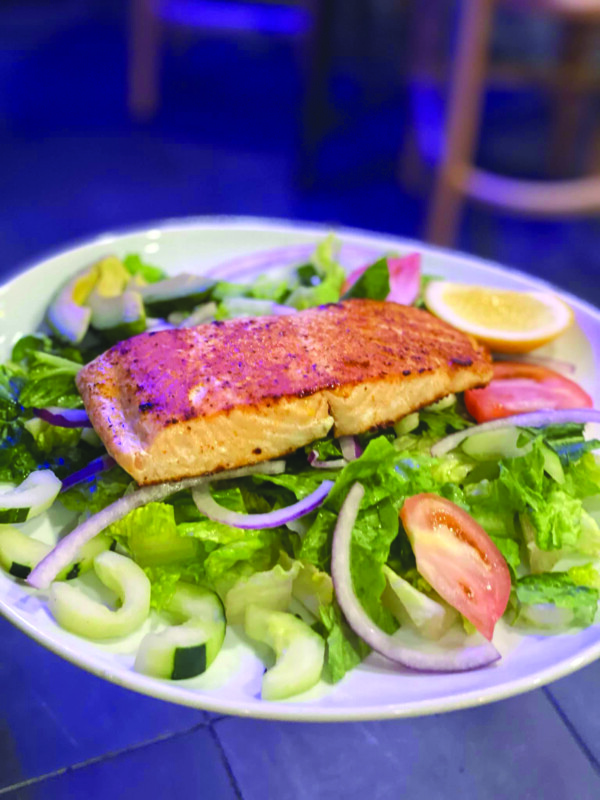
Feautred photo: Grilled salmon. Photo courtesy of Riviera Nayarit.

The Weekly Dish 21/04/15

News from the local food scene

Greek meals to go: Join Holy Trinity Greek Orthodox Church (68 N. State St., Concord) for its next boxed Greek dinner to go event on Sunday, April 25, from noon to 1 p.m. Now through April 21, orders are being accepted for boxed meals, featuring baked haddock, rice pilaf, a vegetable and a dinner roll, for $20 per person. The event is drive-thru and takeout only — visit holytrinitynh.org, email ordermygreekfood@gmail.com or call 953-3051 to place your order. Assumption Greek Orthodox Church (111 Island Pond, Manchester) is also hosting its next drive-thru food fest on Saturday, April 25, from noon to 2:30 p.m., with orders being accepted now through April 21. That menu will feature baked haddock dinners with rice pilaf, Greek-style peas and carrot medley, plus other available a la carte items like spinach petas and pastry platters featuring baklava and assorted cookies. This event is also pickup only (stay in your car; no walk-ins). Visit foodfest.assumptionnh.org.

Tastee Kone reopens this week: Soft-serve ice cream shop Tastee Kone (272 Route 101, Amherst) will reopen for the season on Friday, April 16, owner Jill Jones confirmed. In addition to 30 different flavors of soft-serve, including chocolate, vanilla and chocolate and vanilla twist, Tastee Kone also serves hot dogs and all types of sundaes and razzles, or soft-serve flavors mixed with a variety of candied ingredients. One of the most popular offerings, Jones said, is the almond milk swirl, a vegan alternative with different flavors changing every three days. Tastee Kone is open Monday through Saturday from 11:30 a.m. to 8 p.m., and Sunday from 2 to 8 p.m. Find them on Facebook or call 203-3270.

Anniversary brews: Derry’s Daydreaming Brewing Co. (1½ E. Broadway) is celebrating its first full year in business with the release of its Anniversary Ale on Friday, April 16, at 4 p.m., featuring a blend of its Russian imperial stout, barleywine and Belgian strong dark ale that has been aged in a whiskey barrel. Owner and founder Andy Day will also be presenting a new beer series this week based on a Dungeons & Dragons campaign — Fierce Princess, a German Pilsner brewed with rye and spicy peppers, will roll out on Thursday, April 15, at 4 p.m., followed by three more releases in the series expected to be ready every four months. Visit daydreaming.beer. In Manchester, Candia Road Brewing Co. (840 Candia Road) is releasing a crushable session IPA called Lil’ Conez on Saturday, April 17, at noon, a collaborative brew with Bill and Alli Seney of the Manchvegas Brew Bus in celebration of the bus’s third anniversary. Visit candiaroadbrewingco.com.

Gibson’s selling Bread & Chocolate gift certificates: Gibson’s Bookstore in Concord is helping to sell gift certificates redeemable at its Main Street neighbor Bread & Chocolate, which is expected to remain closed through at least the end of this month following an unexpected family medical emergency. You can visit gibsonsbookstore.com/bread-chocolate-gift-certificate to purchase a gift certificate in multiple amounts from $5 to $200 per recipient. Certificates will be mailed to you, with all of the money collected going toward Bread & Chocolate. The downtown bakery, which has long been a spot known for its cakes, tarts, Danishes, cookies and other pastries, has been closed since late March. Follow Bread & Chocolate on Facebook @breadandchocolateconcordnh for updates on their reopening plans.

Stay in the loop!

Get FREE weekly briefs on local food, music,

arts, and more across southern New Hampshire!