Local fields, bogs and other natural spots for autumn stroll
By Zachary Lewis
zlewis@hippopress.com
Looking to spend a few hours in some place calm and full of nature, not screens? Here are a few places to take a refreshing walk in the great outdoors.
New Hampshire Audubon’s Massabesic Center trails
Where: 26 Audubon Way in Auburn
More info: nhaudubon.org/lands/sanctuaries/massabesic-wildlife-sanctuary
Kimberly Whiteman, Massabesic Center Director for New Hampshire Audubon, spoke to the Hippo about the trails at Lake Massabesic as well as other Audubon locations and a couple of other areas around Manchester.
“I am primarily based here in Auburn,” Whiteman said. “I also work out in Concord occasionally with the management team and staff. We’re a big family here at New Hampshire Audubon.”
What are the Massabesic trails like? “We have a network of trails that connect to Manchester Waterworks trails. So on our peninsula there are about 7 miles of walking trails depending on which route you take. New Hampshire Audubon really only stewards directly about a mile of those trails primarily through our field. Our fields and our sanctuary are not dog-friendly and we don’t permit bicycles or motorized vehicles, to help protect the integrity of the wildlife sanctuary, but Manchester Water Works trails do allow bicycles, horses and leash dogs and we let folks use our parking lot to access those trails as long as they hit them from the main road and not through our sanctuary.”
The 49-acre sanctuary was acquired in 1993 and features trail access to Lake Massabesic, as well as a variety of upland habitats including mixed forests and open fields, according to the organization. The fields are managed for grassland nesting birds, while nest boxes are actively managed for tree swallows and eastern bluebirds
It is a common practice to name trails after colors.“We currently have two trails that we really have named, the Yellow Trail and the Red Trail, which you can connect to from the field trails,” she said.
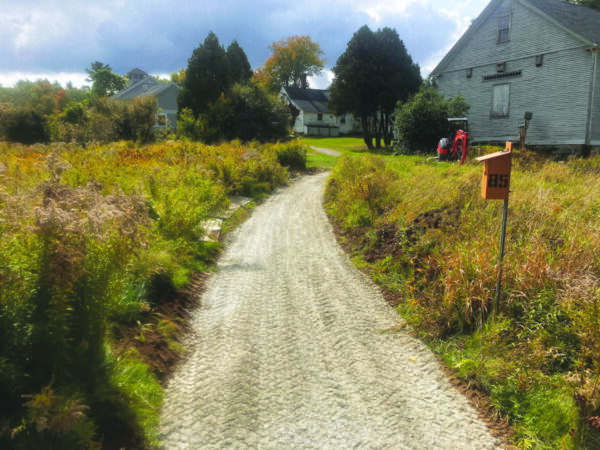
The Massabesic Center is creating a new trail with wheelchair accessibility that should be finished by May 2025. “That’s going to be great because it’s going to provide wheelchair access and stroller access through the field,” Whiteman said. “We’re calling it ‘all persons’ because things that are accessible for folks in a wheelchair are also accessible for folks with strollers or [those who] just need an easy, flat surface for whatever reason. It’s so important to have access to nature.”
There are interesting sights around Massabesic.
“The Red Trail goes through our field here to the lake to a point called Blueberry Point. And it gives you great views over the water,” she said. “You’ll pass an old osprey blind on the way, which is a really cool building that has fun facts about ospreys. It used to overlook an osprey nest that was blown down in a storm several years ago, but it still gives you great views of wildlife on the water.” The whole loop is a manageable size at “about a mile and a half round trip,” according to Whiteman.
“The Yellow Trail goes out to Battery Point, which culminates in a view of the lake, of course, but also there’s an old historical structure … there’s old ruins out there. We have found a few artifacts related to farming. An old horse bit, stuff like that. There’s an eagle nest on Lake Massabesic, so we’ll see them flying over periodically. We have had bobcat sightings here over the past few months,” she said.
Lots of animals, such as otters, are at Massabesic. “We had babies in our pond about two years ago and we had a family of weasels that were living around this building vicinity last summer that our camp kids got to see. So that was really cool,” she said.
Birds are plentiful at the Audubon among the mammals. “We do see a Baltimore oriole nest in this elm tree almost every year. This year there was a really cool tree that had obvious signs of porcupine. Porcupines will eat wood just like beavers do. When you’re hiking the trails and you keep your eyes open you start noticing those little hints of wildlife activity which are really cool to see,” Whiteman said.
It’s a spot for hawk lovers too. “There is a pair of red-shouldered hawks that nest here every year and they tend to stick around in the winter, which is unusual. So we’ll get folks that see the e-bird records and notice there’s red-shouldered hawk sightings and they’ll come in and question us about it because they don’t believe it. I wouldn’t classify it as a rarity, but it’s not common,” she said. Visitors can catch them if they take the Red Trail.
McLane Center
Where: 84 Silk Farm Road, Concord, 224-9909
More info: nhaudubon.org/lands/sanctuaries/silk-farm-wildlife-sanctuary
The Audubon at the McLane Center has trails at its Silk Farm Wildlife Sanctuary.
“I want to say like three loops, including Wendy’s Loop, their all-persons trail, which was completed about a year ago. They’ve got a good network too, and their trails also connect to trails that aren’t owned by New Hampshire Audubon. You can probably hit up 6 or 7 miles of trails out there as well,” Whiteman said.
In addition to Wendy’s Loop there are the Great Turkey Pond Loop and Field Loop as well as Old Orchard Trail and West End Farm Trail, which is more than 7 miles long. “These trails follow the same kind of stipulation of only foot traffic,” Whiteman said.
“Their all-persons trail was completed a year ago, so they have a mile-long loop that is completely wheelchair-accessible and is also great because it takes you through so many different habitats,” Whiteman said.
One trail of particular interest is the Great Turkey Pond Loop. “That takes you out to the lake [and] is beautiful. So you start in the pollinator meadow and there’s just a smorgasbord of bees and butterflies and meadow birds and great plants out there. You can see the milkweed and sunflowers and then you’ll start going into the understory where you get a mix of forest birds like warblers and not a birder. I know we’ve had wood thrushes out there,” she said.
The extraordinary wildlife sightings continue. “Then you’ll go under an American Chestnut Reforestation Area, which is really neat to see. And then if you hang a right and go off the All Persons Trail, that’ll take you down to Turkey Pond, where you can see wildlife like beavers. We get eagle sightings there,” Whiteman said.
Charismatic megafauna drop by too. “McLane has had a bobcat sighting almost daily for the past week and we actually had a moose, a young bull moose, go through McLane Center about a month ago,” she said.
Ponemah Bog
Where: Rhodora Drive, Amherst
More info: nhaudubon.org/lands/sanctuaries/ponemah-bog
According to NH Audubon, the name “Ponemah” is derived from the Ojibwe language and refers to the “land of the hereafter.” The 75-acre Ponemah Bog Wildlife Sanctuary came under the protection of New Hampshire Audubon in 1979 through Dr. and Mrs. Homer McMurray and local friends of the Sanctuary.
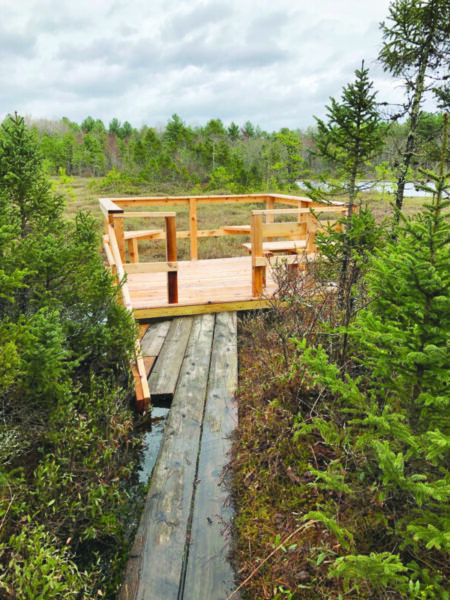
The Ponemah Bog Wildlife Sanctuary features a 3-acre pond surrounded by a floating sphagnum moss mat and encircled by upland oak-pine woods, according to The Nature Conservancy.
“It is a prime example of a bog,” Whiteman said. “Your typical New Hampshire bog. So the boardwalk is not wheelchair-friendly but it is flat. It’s just two boards that are next to each other across the bog mat. But they’ve got wonderful examples of carnivorous sundews, and we do have the same stipulation there that we have at all of our sanctuaries. We ask folks to just use their eyes and leave no trace … when they’re visiting and not disturb wildlife, which is also why we don’t permit dogs.”
Evidence of critters is easily found. “You can probably see, you know, fox scat on that boardwalk, especially in the wintertime when the tracks are really visible, the scat’s visible, you’ll get raccoons and foxes up on the boardwalk at Ponemah,” she said.
Nature is never closed.
“The McLane and Massabesic are open year-round. Our buildings have hours Wednesday through Saturday from 11 to five.The trails of all of our sanctuaries are open every single day of the year from sunrise to sunset. We’re all free to visit,” Whitemand said. “We have another center in Hebron, the Newfound Center, which is seasonal from about Memorial Day to Labor Day.”
Manchester Cedar Swamp
Where: Hackett Hill section of Manchester, on the west side of the Merrimack River; the public parking lot is on Countryside Boulevard.
More info: nature.org/en-us/get-involved/how-to-help/places-we-protect/manchester-cedar-swamp-preserve
The Manchester Cedar Swamp Preserve is 640 acres and is the largest conservation area in the city, according to The Nature Conservancy.
There are 1.8 miles of trails. That includes the universally accessible Cedar Swamp All Persons Trail. Visitors can encounter shady hemlock groves, giant rhododendron patches and “the globally rare Atlantic white cedar swamps that are the preserve’s namesake,” with some trees that are more than 450 years old.
“[The Nature Conservancy] installed that trail,” Whiteman said. “We have taken field trips out there with our staff because it’s a beautiful trail. It was done with a big budget and as much as we can learn from that trail and implement those ideas into our trail, we’re all meeting the same goal with providing access to nature.”
The trail contains tidbits of historical information along the way. “So they’ve got some really great signage, interpretive signage about the history of the land and how it relates to indigenous features and the wildlife. Their trail’s a lot longer than ours are. They’ve got great bridges and benches.”
Other little but practical touches make the Manchester Cedar Swamp Preserve a nifty adventure. “One of the things I really love about the Nature Conservancy’s trail at Cedar Swamp is that they have a boot scrubber as you’re entering their trail and some signage about protecting the property from invasive plant species, seeds that can travel in on your shoes. They encourage people to scrub their shoes before they hit the trails, which is really neat.”
Livingston Park
Where: 244 Hooksett Road, Manchester
More info: manchesternh.gov/Departments/Parks-and-Recreation/Parks-Facilities/Parks/Livingston-Park
Livingston Park comprises 131 acres in Manchester’s North End and is a great option for those with furry friends or all-person access. “That’s something that I like to tell people,” Whiteman said. “When they’re looking for all-persons access in the area, and they have dogs.”
The park includes a playground and athletic fields, as well as Dorrs Pond, which is where the walking trail is. The trail loops around Dorrs Pond and offers a small sampling of wildlife.
“The unpaved walking and running trail loops around Dorrs Pond [are] approximately 10 feet wide and 0.9 miles long. The trail includes elevated boardwalks through wetlands and access to fishing and boating,” according to the City website.
“It’s really busy with people there. My observations have primarily been like waterfowl and small rodents like squirrels, chipmunks, things like that that are really well-adapted to people,” Whiteman said.
Whiteman hopes Granite Staters go to as many trails as possible. “If somebody hasn’t come out to hike them, come on out and hike all of those trails, you know, not just New Hampshire Audubon’s, but it’s good to get a feel of different wildlife in your community. What you’re going to see at Livingston is going to be different from what you’re going to see here [at Massabesic] and what you’re going to see in Concord.”
“It’s crazy just how much wildlife you can see in the heart of Manchester. You don’t expect to think that there’s otters or beavers right in your backyard,” she said.
Beaver Brook Association
Where: 117 Ridge Road, Hollis
More info: 465-7787, beaverbrook.org
Brandon Rackliffe has been the Natural Resource Manager at Beaver Brook for about 11 years.
“We’re a nonprofit and privately run,” Rackliffe said. “It’s just all open for the general public to come and hike. We do have classes here as well, so you can join and take part in classes as well as summer camp and home-school programs”
He estimates the trail mileage there at “roughly, we’ve always said about 35 miles.”
Rackliffe oversees trail maintenance at Beaver Brook. “Everything is well-defined and easily accessible,” he noted. “Nothing is too bad that you have to be an expert to hike it.”
You can pick your starting point. “We have seven or eight parking lots that you can park at, different trailheads. I highly recommend picking up a map before you come or before you start a hike and definitely planning ahead. That way you don’t take the wrong turn or anything like that. Everything is well-marked.”
Depending on the trail, visitors could bring a bike or even their horse.
“We do have hiking-only trails as well as multi-use trails, which entail biking and horses as well, but we don’t allow anything motorized, including e-bikes,” Rackliffe said. “Every trail has a name. They’re marked in either yellow triangles or blue rectangles that indicate either multi-use or hiking only, and everything also has trail plaques.”
With all the trail options, plenty of maintenance work is called for. “We have a wonderful group of volunteers that take over and take ownership of certain trails to maintain and monitor. And those volunteers are the heart and soul of Beaver Brook. They really put in their time and effort to help maintain some of the trails to an extent,” he said.
“Quite a few of our trails are popular, our parking lots pretty much always have somebody in them any time of day. … our main campus, where our office is, the Cow Lane is probably one of the premier trails that we have here.” Portions of Cow Lane, Wildflower Trail and Lower Meadow Trail allow for wheelchair access.
Visitors are offered a glimpse into the state’s past. “A lot of our trails are old wood roads, you know, historical wood roads back in the day when Hollis was a much smaller town. So you can see evidence of old cellar holes and things like that, old bridge crossings or anything of that nature.”
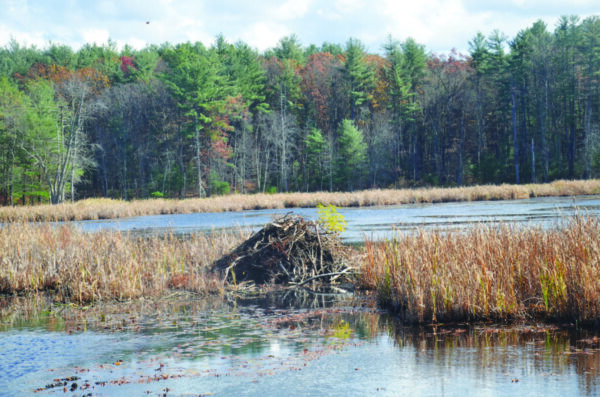
Wildlife is varied here, Rackliffe said, “anything from deer to bear to moose, along with the small mammals and birds and things like that. We have all kinds of frogs, blue herons. I’ve seen all kinds of ducks. I’ve seen rare ducks in some of our ponds, plenty of bobcat. I’ve seen those plenty of times kicking around.”
According to Rackliffe, every trail offers something of interest, “which would be why we made the trail there in the first place. There’s a Jeff Smith trail that runs nine miles from Pepperell all the way up to Beaverbrook. We own the last third or half of the trail. And that runs through many other organizations. Everything is protected under easement.”
Gardens are also open at Beaver Brook. The Maple Hill Gardens are at the main campus, and tours and presentations are available with a reservation. These are 13 themed gardens, a natural play area, a demonstration compost court, picnic areas and a wildflower trail, according to the organization.
Mine Falls Park
Where: There are multiple parking lots at and near the park, with one entry at Whipple Street
More info: nashuanh.gov/491/Mine-Falls-Park 589-3370
According to the City of Nashua, the park’s name came from an island underneath the waterfalls that allegedly contained a lead mine in the 18th century.
The park trails were added to the New Hampshire Heritage Trail system, which is 130 miles and follows the Merrimack River from Massachusetts to Canada.
There are six color-coded trails that vary in length around the park. The longest is the Blue Trail at 2.94 miles and the shortest is the Orange, which comes in at 0.38 miles. The Green is 1.96 miles long and the Red Trail is 1.40 miles. The Purple and Yellow Trails are both under a mile.
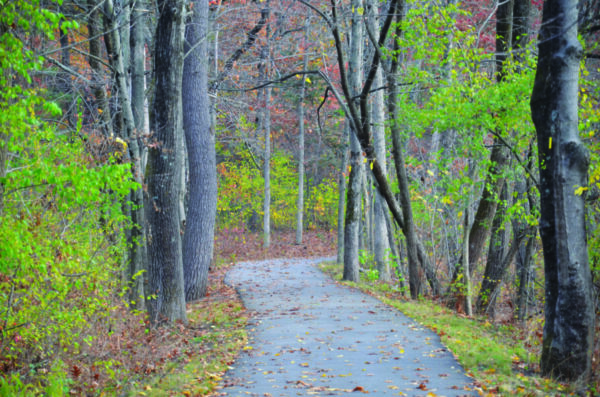
Patty Bernard and her husband Alan are frequent visitors to the trails at Mine Falls Park. “We like coming here because they have a lot of paved trails. It’s great because he has his motor scooter now,” she said. “So it gets him out and about. This is nice scenery. You’ve got the river, and then sometimes we go to the dam, the picnic table’s there, and we’ll pack a lunch, sit by and watch people kayak, canoe, boating, just to change the scenery.”
Wildlife is a part of that scenery. “We see turtles, beavers, nothing major now,” she said.
The paths take you straight through Nashua. “They put the first high school up and that’s what started everything and made it all connected. One in North Nashua, so you can actually walk from one to the other if you had to,” Alan said. “It’s a good distance.”
Multiple entrances add ease of access as well. “There’s different entrances to the park, which is nice. You can get access from downtown Nashua; over by the high school, Nashua South; over by Hannaford — that’s where we pulled in, over by Hannaford,” Patty said.
Mine Falls Park has many options for getting outside. “Great for dog walkers.We used to bike the trails, which was pretty cool,” she said.
“It’s a fun place to go. I mean, we’re still doing it,” Alan said.
“Every chance we get,” Patty added.
Rail Trail in Derry
Where: Hood Park, 4 Rollins St., Derry
The Rail Trail criss-crosses all across New Hampshire, and Derry contains a 3.6-mile paved chunk of it that crosses through trees and wetlands, according to Trail Link at traillink.com.
The trail quickly enters into a wooded area and eventually crosses Beaver Brook over a stone arch bridge. The middle of the bridge is known as Lover’s Leap, although the origin for that name is unknown.
The paved section of trail ends in Hood Park and its pond contains multiple species of fish and is stocked annually with brook trout and rainbow trout. The trail along the west side of Hood Pond continues on a dirt path for another 0.3 mile until the path ends.
The Derry Rail Trail connects to the Windham Rail Trail on its south side and in the future will connect with the Londonderry Rail Trail, according to the Southern New Hampshire Planning Commission.
Hikers can park at Hood Park or at the Merchants Row lot in Derry, which has two-hour free parking and is more accessible for those using mobility aids or strollers.
Douglas Lowney, a resident of Methuen, is a big fan of the Derry Rail Trail. “Look at the beauty,” he said in reference to the lake and woodland covered path around him. “It’s like this the whole time. It doesn’t matter what time of year you’re here. It’s lovely. … I try to come three or four days a week. It’s like heaven.”
Lowney rides what he calls “a stand-up bike. I ride this about 20 miles I guess. It’s paved all the way. It goes all the way to Salem. And then it goes all the way down [Route] 28 past Walmart.”
Wildlife abounds as well. “See the beaver down there?” he asked.
The trail is perfect for those looking for the tranquility as well as the awesomeness of nature. “There’s all sorts of beautiful things here. In the fall, this is spectacular. It’s like it’s on fire,” Lowney said. The leaves “come tumbling down into the waters like it’s snowing. It’s beautiful. And the folks that take care of this trail do a good job,” he said.
No matter how Lowney is feeling, the Derry Rail Trail is restorative for him. “Even when I don’t feel good, I’m actually good when I come here. It’s very therapeutic.”
White Park
Where: 1 White St., Concord
More info: concordnh.gov/Facilities/Facility/Details/White-Park-21
According to the the City of Concord, White Park came to life in 1884 when the land it sits on was conveyed to the city by Armenia White for her late husband Nathaniel, who was a founder of The American Express Co., and the park itself was designed by architect Charles Elliott in 1888.
The Park extends from Eastman Baseball Field to the Monkey Around Playground, with various walking paths and a big loop around White Park Pond, which is filled with lots of ducks, koi fish, and frogs. The Pond becomes an outdoor skating rink during the winter months.
The Monkey Around Playground is the largest in Concord. It’s a giant wooden castle structure that is a lot of fun for little Granite Staters.
A couple of Franklin Pierce School of Law employees, Rachael Lefurge and Alexa Bobinski, were enjoying the park on a gray November weekday.
“I really enjoy walking around. It’s a nice break from my work day. There’s always a lot of people walking around. It’s really nice to work with the pond on a beautiful day,” Lefurge said.
“Yeah, I feel like it’s very beautiful no matter what season it is. It’s always very pretty. There’s always a lot of people here and wildlife,” Bobinski added.
“I usually see ducks,” Lefurge said. Even when the ducks eventually leave the Pond, the trails will still be filled with dogs and squirrels.
“It’s nice to get up and walk around a little bit and have some nice scenery just in the middle of Concord,” Bobinksi said.