Great New England BBQ & Food Truck Festival returns
Following a successful 2020 event despite social distancing regulations in place, the Great New England BBQ & Food Truck Festival is back, this year adding even more local food and beer vendors, games and activities. The third annual event is happening on Saturday, Aug. 14, at the Hampshire Dome in Milford, and will include food trucks, an afternoon of live local music, multiple craft and artisan vendors, a cornhole tournament and more.
“We were extremely happy with the outcome last year. I think people were so relieved to be able to get out safely and comfortably,” festival organizer Jody Donohue said. “We’re using both the inside and outside of the [Hampshire] Dome this year, so we have more space than before.”
Food trucks will be set up around the perimeter of the dome’s parking lot, with a diverse array of offerings, including several local to New Hampshire and others coming from nearby New England states. Prime Time Grilled Cheese, for example, has been an attendee favorite since the festival’s inception with its specialty grilled cheeses and “dessert” sandwiches like grilled s’mores and Fluffernutters. They’ll be back this year, along with Jayrard’s Java Cafe, a mobile trailer specializing in premium Costa Rican coffees and organic teas; and Sweet Crunch Bakeshop & Catering Co., which features freshly baked cookies.
New to this year’s festival are The Lobster Roller, a food trailer based in Gloucester, Mass., selling lobster rolls and New England-style clam chowder; and the Totally Thai Food Truck, which hails from Peterborough and serves up pad Thai, spring rolls and chicken satay. Other specialty eats and drinks will include fresh kettle corn popped on site, freshly squeezed lemonade, gourmet baked potatoes, and a plethora of barbecue options from brisket to pulled pork.
A “libations tent” will be in the center of the lot, featuring craft beers from local purveyors, like Frogg Brewing of Marlborough, Martha’s Exchange of Nashua, and Able Ebenezer Brewing Co. of Merrimack. Homemade sangria from Dave Bourgault of The Hills Restaurant at Milford’s Hampshire Hills Athletic Club will also be poured.
Around 50 vendors will be selling their goods both indoors and outdoors for the duration of the festival, from specialty foods to crafts and artisan products.
Live music will be featured all day long, starting with Peter Pappas from 11 a.m. to 1:30 p.m., followed by Brian Weeks from 1 to 4 p.m. and Robert Allwarden from 4 to 7 p.m. The crew from 106.3 Frank FM will also be there between noon and 2 p.m., doing a live broadcast and offering photo opportunities with their promotional van, Donohue said.
A kids zone that was eliminated from last year’s festival amid safety concerns is due to make a return this time around, featuring bounce houses, face-painting, henna tattoos and more. A cornhole tournament is planned too, likely taking place around 2 p.m. indoors on the dome’s turf field, with warmups at 1 p.m. According to Donohue, interested participants can sign up that day at $15 per player, for a chance to win a cash prize.
Third annual Great New England BBQ & Food Truck Festival
When: Saturday, Aug. 14, 11 a.m. to 7 p.m. Where: The Hampshire Dome, 34 Emerson Road, Milford Cost: General admission tickets are $5 in advance and $10 at the gate (free for attendees ages 14 and under). Food and crafts are priced per item. Cornhole tournament tickets are $15 per player. More info: gne.ticketleap.com/foodtruckfest to purchase advance tickets online Free parking is available on site. Masks are optional. Socially distanced seating will be provided, but attendees are welcome to bring their own blankets. No pets are allowed.
Participating food vendors
• Barry’s Hot Sauce (barryshotsauce.com)
• Coco’s Coffee (cocoscoffeenh.com)
• Dandido Sauce (dandidosauce.com)
• Extreme Concessions, Inc. (find them on Facebook)
• The Greatest BBQ of New England (greatestbbqofnewengland.com)
• Get Baked Potato Co. (getbakedpotato.com)
• Jayrard’s Java Cafe (jayrards.com)
• La Chula Truck (find them on Facebook)
• Little Charlotte’s Kettle Corn (find them on Facebook @charlotteskettlecorn)
• The Lobster Roller (thelobsterroller.com)
• Local LunchBox Truck (find them on Facebook)
• Mak’n Ends Meat Food Truck (find them on Facebook @maknendsmeat)
Summer Haze group art exhibition at Concord studio
Diverse pieces that capture the essence of steamy summer days will be on display during a group art exhibition at Jess Barnett Art Studio in Concord. The art is hanging now through Sept. 3, with an opening reception on Friday, Aug. 13, when the artists will be in the gallery to talk about their work.
The Summer Haze exhibition features pieces from five artists and is the first group exhibition Barnett has hosted since she opened her studio in November 2019.
“Covid kind of put a damper on [the studio opening],” Barnett said, “so this is really exciting to be able to have the group show.”
Earlier this year Barnett put out a call for entries to New England artists, asking for submissions that were based on the Summer Haze theme.
She ended up working with artists from New Hampshire and Massachusetts, plus one from New York, and between the five of them — Barnett included — there are about 10 to 12 pieces in the exhibition.
“It’s a good size for the gallery,” Barnett said. “It was pretty easy to fit everything in there and make [it] look good next to each other. It takes up one wall of the gallery, and then I have [my work] hanging on the other walls.”
Barnett’s pieces include a couple of new paintings that she hasn’t shown yet, including an abstract painting called “Lilac Season,” plus a couple of older pieces that go well with the theme, she said.
The exhibition is diverse, Barnett said, with paintings, drawings and glass art.
“I can’t really do installation art [because of space], so I wanted to have two-dimensional pieces and glass,” she said.
Karen Mehos, a glass artist from Boscawen, produces mainly stained glass and small glass works. She’s showing a glass bowl called “Small Town Sunset,” featuring a cityscape against a sunset background. It was made by melting glass in a kiln, using colored glass powders on a clear glass base, fusing them together into a flat disk in the 1,450-degree kiln, then softening them with heat again before using a ceramic mold to give it shape.
“It’s pretty innovative and cool how she did that, and she made it just for the show,” Barnett said.
Kathy Bouchard from Nashua has two acrylic paintings of kimonos in the show.
“It’s a cross between realistic and abstract,” Barnett said. “Her art is just really cool.”
The other two artists are Jason Michael Rielly of New York and Lorna Ritz of Massachusetts. Rielly’s art represents both the abstract and expressionism genres of artistic style, Barnett said. She said the work he put in the exhibition highlights these styles and communicates strong emotion, mood and vibrancy.
“They’re almost floral, but more abstract,” she said.
Ritz is a third-generation abstract expressionist-impressionist who paints landscapes.
“I paint the changing seasons as they occur, the light that emanates from seasonal color combinations that occur in landscape,” Ritz wrote about her work.
All of the work in the show is for sale, and for those who can’t make the reception and meet the artists, there will be labels with the artists’ information on the pieces for anyone who wants to learn more about them and their work.
For the reception, Barnett will be giving out a small gift bag with a piece of art to everyone who attends, and she encourages the general public to check it out.
“It’s a very laid back atmosphere. [We] aren’t snobby art people,” she said.
Barnett said she hopes to have more group exhibitions in the future, and she will invite artists of all levels, even those who are just dipping their toes into art, to participate.
“I just really feel that everyone, if they want to, should experiment with art,” she said. “Art can be a really good release for people to express emotion. … You don’t have to go to art school [to be an artist].”
Summer Haze group art exhibition
Where: Opening reception Friday, Aug. 13, from 7 to 8:30 p.m. When: Jess Barnett Art Studio, 4 Park St., Suite 216, Concord. The reception is free, and light refreshments will be served. RSVPs are encouraged on the gallery’s Facebook page but are not required. The exhibition will be hanging through Sept. 3.
Featured photo: The Summer Haze exhibition is on display now at Jess Barnett Art Studio. Courtesy photo.
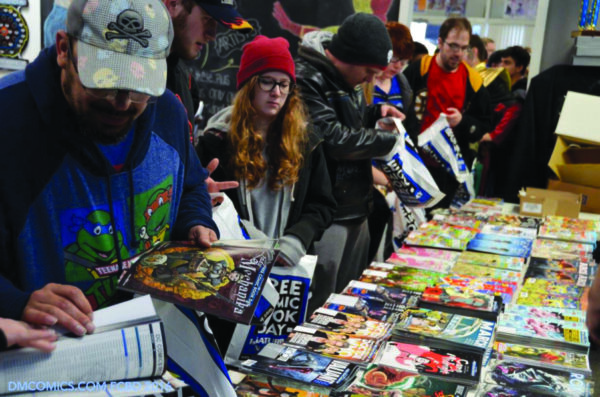
The wait is finally over for comic book lovers as Free Comic Book Day returns on Saturday, Aug. 14, for the first time since 2019. The annual worldwide event, postponed from its traditional date on the first Saturday in May, invites comic book shops to hand out free comic books created specially for that day and host comic-related fun like cosplay contests, door prizes, special guests and more.
Each participating local shop is doing things a little differently, so whether you’re looking to just pop in, grab your free comic and go, or don your best cosplay and spend the day celebrating all things comics, New Hampshire has a FCBD experience for you.
Customers pick up their free comics at a previous Free Comic Book Day at Double Midnight Comics. Courtesy photo.
Diversity Gaming in Hooksett, a new comic book and gaming shop that opened a month before the pandemic, is keeping the focus on the comics for its first FCBD. Owner Erik Oparowske said he placed a large order of free comics to ensure that every customer who wants a free comic can get the one they want quickly and easily. He said he’s expecting the shop to “go through most, if not all” of the comics he ordered.
“We wanted to provide an option for people who may not have half an hour to stand in line,” Oparowske said. “For us, it’s about getting the comics into people’s hands.”
Merrymac Games and Comics in Merrimack will have five comic artists on site promoting and discussing their comic books with customers.
“It adds a little something extra to the event [beyond] the free comics,” manager Bob Shaw said, “and it allows people to meet artists without having to go to a comic convention, which is nice because conventions can be really crazy and crowded, and a lot of people aren’t comfortable enough to start going to them again.”
Famous for its FCBD costume contest that typically attracts more than 100 participants, Double Midnight Comics, which has shops in Manchester and Concord, has decided to hold off on the contest this year and “keep it low-key,” co-owner Chris Proulx said, with plans to resume its usual FCBD festivities in 2022.
“We’re encouraging people to come in, shop a bit and head home with their haul,” Proulx said. “It’s a bummer not having the big event for the second year in a row, but safety is our focus this year.”
New Hampshire’s largest FCBD celebration, the Rochester Free Comic Book Day Festival, will return full-scale, with local comic creators, a scavenger hunt, vendors, prizes, a costume contest and more at businesses and venues all over the city.
“We’re doing Free Comic Book Day just like we’ve always done it in the past, nothing different at all,” said Ralph DiBernardo, owner of Jetpack Comics in Rochester, which hosts the festival in partnership with the city. “Everybody is excited to have a semblance of normalcy to life again.”
Oparowske said he looks forward to including more FCBD activities, like the ones at Jetpack, at Diversity Gaming in the future.
“I love that Jetpack and Double Midnight and places like that have that big, carnival-like atmosphere,” he said. “I hope that, once we’ve been here longer and are more firm in the community, we can do something a little like that.”
There are 51 Free Comic Book Day titles this year: 12 “gold” titles, which are available at all participating shops, and 39 “silver” titles, of which certain ones are available at select shops. The selection typically includes a mix of independent, standalone stories; spin-offs of movies, television shows, video games and established comic book series; and samplings or previews of existing or upcoming titles.
Comic book fans can pick up not only this year’s FCBD comics but also ones from 2020, which were released and distributed by comic book shops in batches over the course of nine weeks as part of “Free Comic Book Summer,” a reworking of FCBD held in lieu of the one-day event that year. Since Free Comic Book Summer took place at the height of the pandemic, the 2020 titles went mostly under the radar, and many comic book shops still have stacks of them that they’re hoping to give away at this year’s FCBD.
“I tried doing a free comic book drive-up last year. I got 12 people,” Shaw said, “so I’m still choking on last year’s Free Comic Book Day stuff that never got distributed.”
“I guarantee there is stuff people missed out on [in 2020], so it will be new to them this year,” Proulx added. “Everyone will leave with a nice stack of comics … from both this year and past years.”
Rochester Free Comic Book Day Festival Cosplay Contest. Courtesy photos.
Though thankful to be able to host Free Comic Book Day in its traditional format again, some comic book shop owners and staff are concerned that the rescheduled August date will affect the turnout.
Shaw said this year’s event and the new date haven’t been advertised on a national level nearly as prominently as in years past.
“There hasn’t been the same kind of buzz about it that you usually hear,” he said. “I think there will be a lot of people saying, ‘Oh, I didn’t know [FCBD] was today.’”
“We’ve had tons of customers asking us when [FCBD] is going to be,” Oparowske added. “There’s been a lot of confusion.”
But, Shaw said, it’s not always easy to predict what the turnout will be — it could go either way — and despite all of the variables that may determine whether people come out or not, there is one thing the comic book shops will always have going for them on FCBD: “People love free stuff, and that’s never going to change,” he said. “You can count on that, no matter what.”
Comics vs. Covid
When Gov. Sununu called for non-essential businesses to shut down in March of last year, local comic book shops were prepared for the worst.
“We went into panic mode,” DiBernardo said of Jetpack Comics. “We thought we would be shutting down for the foreseeable future.”
Now, about a year and a half later, many shops are not only surviving, but thriving, thanks to their innovative sales strategies and dedicated customer base.
Shaw said that once Merrymac Games and Comics shifted their business online, their sales numbers weren’t much different from before the pandemic.
“Honestly, the only change for us was that we didn’t have customers in the store,” he said. “We were still fulfilling and shipping out orders every day.”
For Jetpack, DiBernardo said, the ability to offer curbside pickup was the shop’s saving grace. He went from fearing that he would have to let half of his staff go, he said, to having to pay his staff overtime to keep up with the large volume of online and curbside pickup orders.
“Curbside pickup changed everything for us,” he said. “It gave us a goal — something that we could do. Once we figured out how to do it and we hit our stride with it, it went great for us.”
The shutdown was especially tough on Diversity Gaming, which had opened just a month earlier and therefore didn’t qualify to receive the state or federal financial aid that was being offered to small businesses. Oparowske said he owes the shop’s survival to the community.
“Even though we were the little babies on the block, people had already really embraced us and were excited about our presence here during that first month,” he said.
The popularity of online sales during the pandemic has led many comic book shops to make it a permanent part of their business model.
“We found that it was a big boost for us, and it still is,” DiBernardo said. “We’re seeing the same amount of online sales now that we were seeing a year ago.”
While comic book shops may not be considered an essential business on paper, Proulx said, they are essential to many people on a personal level.
“People needed distractions from the pandemic,” he said, “and we were there for them with comics.”
Find a comic
Local comic book store staff shared comic book and graphic novel recommendations for all kinds of readers.
Best comic for someone who “isn’t a comic book person”
Ice Cream Man by W. Maxwell Prince and Martin Morazzo. A horror anthology series for fans of The Twilight Zone or Black Mirror. Recommended by Jill Stewart, comic book manager at Double Midnight Comics.
Star Wars: The High Republic by Cavan Scott A series of stories from the Star Wars universe for fans who want to get some background on where the upcoming movies might lead. Recommended by Erik Oparowske, owner of Diversity Gaming.
Stray Dogs by Tony Fleecs and Trish Forstner A dog wakes up in a strange house with no recollection of how she got there and a feeling that something terrible has happened. Recommended by Ralph DiBernardo, owner of Jetpack Comics.
Best comic for adult comic book nerds
Reckless by Ed Brubaker and Sean Phillips Crime noir set in 1980s Los Angeles. Recommended by Chris Proulx, co-owner of Double Midnight Comics.
Unsacred by Mirka Andolfo A risque take on heaven and hell. Recommended by Erik Oparowske, owner of Diversity Gaming.
King in Black by Donny Cates and Ryan Stegman A new twist on old characters and the making of a new god for the Marvel Universe. Recommended by Ralph DiBernardo, owner of Jetpack Comics.
Crossover by Donny Cates, Geoff Shaw, Dee Cunniffe and John J. Hill The series sets fictional characters from different comic books in real-world modern-day Denver, Colorado. Recommended by Kyle Litchfield, staff at Jetpack Comics.
Best comic for teens who are too cool for superheroes
Radiant Black byKyle Higgins and Marcello Costa A superhero story for a new generation, this series offers a more realistic look at what would happen if teens really had superpowers. Recommended by Ralph DiBernardo, owner of Jetpack Comics.
Life is Strange by Emma Vieceli Based on the video game of the same name, this series follows a photography student who has the magical ability to rewind time. Recommended By Erik Oparowske, owner of Diversity Gaming.
BRZRKR by Matt Kindt, Keanu Reeves and Ron Garney Actor Keanu Reeves writes this story of the next movie that he wants to star in. Recommended by Ralph DiBernardo, owner of Jetpack Comics.
Best comic for young aspiring comic book creators
Strange Academyby Skottie Young, Humberto Ramos and Edgar Delgado Dr. Strange of the Marvel Universe establishes a new academy for the mystic arts to train the next generation of magic-users. Recommended by Kyle Litchfield, staff at Jetpack Comics.
Red Room byEd Piskor This cyberpunk tale for teens is about a subculture of criminals who livestream murders for entertainment. Recommended by Ralph DiBernardo, owner of Jetpack Comics.
Best comic for kids who don’t like reading
Dog Man by Dav Pilkey The protagonist in this kids graphic novel series is part man and part dog-police officer and -superhero. Recommended by Chris Proulx, co-owner of Double Midnight Comics.
Batman Fortnite Zero Point by Christos Gage, Donald Mustard and Reilly Brown A collaborative comic between DC and the popular video game Fortnite that rewards readers with exclusive content for the game. Recommended by Ralph DiBernardo, owner of Jetpack Comics.
Miles Morales: Spider-Man by Saladin Ahmed and Javier Garrón Miles Morales balances school, parents and life as a teen — who also happens to be Spider-Man. Recommended by Seth Deverell, staff at Diversity Gaming.
Best graphic novels
Days of Future Past by Chris Claremont A look at the X-Men dystopian future that formed the basis for the movies. Recommended By Erik Oparowske, owner of Diversity Gaming.
Something is Killing the Children by James Tynion IV and Werther Dell’Edera. Children in the town of Archer’s Peak are mysteriously going missing, and the few that survive return with stories of terrifying monsters. Recommended by Ralph DiBernardo, owner of Jetpack Comics.
Participating Comic Book Shops
For more information about Free Comic Book Day, visit freecomicbookday.com.
• The Comic Store, 115 Northeastern Blvd., Nashua, 881-4855, facebook.com/thecomicstorenashua. Hours are 10 a.m. to 6 p.m.
• Collectibles Unlimited, 25 South St., Concord, 228-3712, collectiblesunlimited.biz. Hours are 10:30 a.m. to 5 p.m.
• Diversity Gaming, 1328 Hooksett Road, Hooksett, 606-1176, diversitygaming.store. Hours are 11 a.m. to 11 p.m.
• Double Midnight Comics, 245 Maple St., Manchester, 669-9636; 67 S. Main St., Concord, 669-9636, dmcomics.com. Hours are 10 a.m. to 6 p.m. There will be sales and raffles.
• Escape Hatch Books, 27 Main St., Jaffrey, facebook.com/escapehatchbooks. Hours are 11 a.m. to 7 p.m.
• Jetpack Comics, 37 N. Main St., Rochester, 330-9636, jetpackcomics.com.The store partners with the City of Rochester to host the Rochester Free Comic Book Day Festival. Festivities including a scavenger hunt, cosplay competition, special guest comic book artists, vendors and more will take place at the store and at various locations throughout the city starting at 10 a.m.
• Khaotic Comics, 590 Central Ave., Dover, 834-9177, khaoticcomics.com. Hours are 11 a.m. to 3 p.m. The store will have special guest comic book artists, food and an appearance by Spider-Man.
• Merrymac Games and Comics, 550 DW Highway, Merrimack, 420-8161, merrymacgc.com. Hours are 10 a.m. to 9 p.m. Special guest comic book artists will be at the shop from 10 a.m. to 4 p.m.
• Newbury Comics, 777 S. Willow St., Manchester, 624-2842; 310 D.W. Highway, Nashua, 888-0720; 436 S. Broadway, Salem, 890-1380, newburycomics.com. Hours are 10 a.m. to 9 p.m.
• Nex-Gen Comics, 122 Bridge St., Unit 3, Pelham, 751-8195, nexgencomics.wordpress.com. Hours are 11 a.m. to 9 p.m.
• Stairway to Heaven Comics, 109 Gosling Road, Newington, 319-6134, stairwaytoheavencomics.com. Hours are 10 a.m. to 4 p.m. Special guest comic book creators will be at the shop.
Information from the New Hampshire Department of Health and Human Services
Covid-19 news
State health officials announced 96 new positive cases of Covid-19 on Aug. 9. The state averaged 168 new cases per day over the most recent seven-day period, an increase of 62 percent compared to the week before. As of Aug. 9, all but three counties in the state were at substantial levels of community transmission.
Body cameras
Last week the Executive Council approved a $3.4 million contract to equip New Hampshire State Police with body cameras, according to a press release. The use of body cameras was one of the recommendations made by the New Hampshire Commission on Law Enforcement Accountability, Community and Transparency, which was established through Executive Order by Gov. Chris Sununu in June 2020 and charged with developing recommendations for reforms deemed necessary to enhance transparency, accountability and community relations in law enforcement, the release said. “This effort provides yet another layer of transparency and accountability in our continued efforts to further bolster public trust in the incredible work done by New Hampshire’s law enforcement officers, who set the gold standard for the rest of the country,” Sununu said in a statement following the contract approval.
Juvenile justice
A new advisory group that will update and replace the State Advisory Group for Juvenile Justice has been formed, Gov. Chris Sununu announced last week. According to a press release, the New Hampshire Juvenile Justice Reform Commission will “assist the state in aligning New Hampshire’s juvenile justice system with advances in scientific understanding of adolescent development and youth offenders.” The group’s primary role is to advise the state on its use of federal juvenile justice grants and supporting compliance with federal juvenile justice requirements. The original advisory group had been in place for more than 20 years, created by Gov. Jeanne Shaheen, and the formation of this new group is an effort to bring in fresh perspectives and ideas, the release said. “The Department continues to transform the state’s juvenile justice system to be a more proactive one that identifies and addresses youths’ needs before at-risk youth become involved with the courts,” said Joe Ribsam, director of the Division for Children, Youth and Families. The advisory will include representatives from the juvenile justice system, including those working within the court system, organizations that work with children and youth, people working in education, youth mental and behavioral health providers, and those who have been or are currently involved with the juvenile justice system. Anyone who meets those requirements and is interested in serving on the commission should email a letter of interest and resume to apply.governor@nh.gov.
Housing Commission
Last week the Manchester Board of Mayor and Aldermen approved the creation of a city Housing Commission, following the recommendations made by the Mayor’s Affordable Housing Task Force. According to a press release, this commission will be responsible for following up on recommendations made by the Task Force and continuing its work by “recognizing, promoting, enhancing, encouraging, and developing a balanced and diverse supply of housing to meet the economic, social and physical needs of the City of Manchester and its residents.” It will work with city departments and boards to develop plans for the future while meeting the city’s current housing needs, Mayor Joyce Craig said in the release. The commission will be made up of five members and two alternates. Anyone interested should send a resume and statement of interest to mayor@manchesternh.gov.
Bias trainings
Last week, Manchester School District Superintendent Dr. John Goldhardt issued a statement in response to requests for public records regarding staff trainings that cover the topics of diversity and bias. “Manchester School District values community members’ desire to better understand our students’ education, which is why we are happy to share the professional development options our teachers and staff get to choose from,” Goldhardt wrote in the statement. A list of those trainings and their descriptors was included with the statement. Trainings on the list were: Safe Schools: Social & Behavioral > Cultural Competence & Racial Bias; Youth Equity Stewardship (YES!): Diversity, Equity and Inclusion; Learning for Justice: What Is White Privilege, Really?; Better Lessons: Bias and Privilege: Self-Reflecting and Using our Power for Change; and City Year: Implicit racial bias and cultural competence, as well as a list of Amplify curriculum materials. Links to most of the trainings were included unless the material is no longer accessible. “It should be noted that all training shared in this list … was voluntary and in place prior to the June 25, 2021, enactment of the Right to Freedom from Discrimination in Public Workspaces and Education law,” Goldhardt wrote in the statement.
Mental health care
The New Hampshire Department of Health and Human Services announced last week that it will be requesting an amendment to the Substance Use Disorder Treatment and Recovery Access Research and Demonstration Waiver from the Centers for Medicare and Medicaid Services. According to a press release, the goal of the proposed amendment is to add coverage for short-term inpatient and residential treatment services for beneficiaries with Serious Mental Illness and to allow Medicaid to pay for short-term stays in Institutions for Mental Disease for beneficiaries ages 21 to 64 with SMI. This would help reduce the use of ERs by Medicaid beneficiaries with SMI while they await mental health care in specialized settings, improve the availability of crisis stabilization services, and improve access to community-based services for Medicaid beneficiaries with SMI, the release said. Prior to submitting the amendment request, DHHS is seeking comment from the public until Tuesday, Aug. 31, at dhhs.nh.gov/sud-imd.
Evictions on hold
The New Hampshire Circuit Court, which just recently resumed eviction proceedings, has paused them again in six counties, in cases that are covered by the Centers for Disease Control and Prevention’s partial eviction moratorium. According to a press release, as of Aug. 4, Belknap, Cheshire, Grafton, Hillsborough, Rockingham and Strafford counties are covered by the moratorium, which was put in to place for counties that are considered to have substantial or high risk of transmission of Covid-19. All landlord-tenant cases arising out of those counties that were previously stayed by the moratorium — that is, where a tenant has provided a declaration in compliance with the CDC order to their landlord — will be stayed again,” the release said. All other courts will continue processing and holding hearings in all landlord-tenant cases.
Ann Scholz, who lives on Pleasant Lake in Deerfield and Northwood, has been awarded the 2021 John F. Morten Memorial Award for Exemplary Lake Stewardship. According to a press release from NH Lakes, Scholz was nominated by nine people and unanimously chosen by the NH Lakes selection committee, for the “countless hours she has volunteered over the past seven years preparing grant applications, meeting with town officials, and working with state agencies to implement projects to protect the lake from polluted runoff water.
The YMCA of Greater Nashua will use the $100,000 it was awarded from the Centers for Disease Control and Prevention to fund outreach and education efforts to build vaccine confidence among city communities that haven’t been vaccinated for Covid-19 and have not consistently received annual flu vaccines. According to a press release, the YMCA will partner with Harbor Care, which hosts regular vaccine clinics at its High Street location, to have two part-time community health workers provide vaccine education at community events in Nashua over the next year. The funds will also be used to recruit and train 13 Vaccine Ambassadors who want to help spread the word about the importance of vaccinations.
The 38th annual Gail Singer Memorial Blood Drive will be held on Tuesday, Aug. 17, and Wednesday, Aug. 18, at the DoubleTree by Hilton Hotel at 700 Elm St. in Manchester. According to a press release, the Red Cross is experiencing an emergency need for donors, and this blood drive honors the memory of Gail Singer, who died in 1984 of leukemia.
It seems that many conversations and topics are so controversial these days that we find ourselves avoiding them. Sadly, the topic of the Covid-19 vaccine has turned out to be one of them. If, however, we are going to end the pandemic, we need to have the conversation.
Recently, somebody who is not vaccinated made the argument to me that because I am vaccinated, I should not care whether or not he/she gets vaccinated. Here is why I care. The pandemic will not end until we reach herd immunity, and we will not reach herd immunity until enough of the population receives the vaccine. To assume that we will reach herd immunity by allowing the disease to progress organically throughout the country and world is a foolish and dangerous proposition, one that has already cost more than 600,000 lives in the United States alone.
By refusing a vaccine, people are at high risk of becoming infected with Covid-19, becoming hospitalized, impacting the health care system, and continuing to increase the spread of Covid-19 in our community, our state, and in the United States. When the spread becomes significant enough, the health care system becomes overwhelmed, creating issues for those affected with Covid-19 and impacting people with other illnesses as well. Additionally, if you become infected, you will likely infect others with the virus, if not my grandchildren who are too young to receive the vaccine, then possibly somebody else’s young children or grandchildren, or immunocompromised family member.
Science has provided us with a vaccine that can end the pandemic. These vaccines are safe, highly effective, and readily available at no cost to residents in the United States. The number of myths and pieces of misinformation spreading about these vaccines is mind-boggling. Rather than rely on social media for medical information, can we all commit to finding factual information before making a decision? A good place to start is a conversation with your physician.
Getting vaccinated is an individual choice, but it’s a choice that has a significant impact on those around you. Educate yourself first. Then make your decision.
Ace Aceto thinks that right now is a great time to be a comedian — even hecklers are deferential.
“At one show, someone was yelling stuff out, just excited to be there,” he said by phone recently. “I shut him down [by] making light of it. He came up to me after, saying, ‘Man, I’m sorry, I didn’t mean to mess with you. I was having a good time.’ I’m like, ‘I get it; you weren’t yelling ‘Boo,’ or ‘This guy sucks,’ or anything like that.’”
Aceto’s standup career started in another golden age. In the 1980s, the Boston comedy scene, led by standups like Steven Wright, Lenny Clarke and Barry Crimmins, haloed its way through New England and to his home state of Rhode Island. Mixing a catalog of impressions with stories of his Catholic upbringing, he found his footing at Periwinkles comedy club in Providence.
In 1991 the Comedy Channel, later to merge with Ha! and become Comedy Central, held a contest at Periwinkles, with a dozen winners getting time on the network, including Aceto. Seeing himself on television made him euphoric.
“I was like, ‘Oh, my God, this is a real thing,’” he said.
He hasn’t looked back; in 2015, Aceto was inducted into the Rhode Island Comedy Hall of Fame.
The past year presented many challenges for Aceto and his brethren, and he adapted even when it seemed a bit crazy.
“If someone two or three years ago said, ‘I’ve got this great show — you’re going to be up on a platform in a parking lot and people are going to be in their cars,’ you’d be like, there is no freaking way I’m doing that,” he said. “Or ‘Hey, we’re going to be outside at a vineyard with Christmas lights up all over the place.’ I’ve done a couple of vineyards with maybe 80 people in a little courtyard, and everyone is just there to have fun.”
While agreeing that the pent-up need to laugh is causing a spike in its appeal, “comedy constantly ebbs and flows,” Aceto said. “I don’t know if anything will come close to that Big Eighties boom, because there’s also a million people calling themselves comics these days, and none of the late night shows have comics on anymore.”
Back in the day, “that was your goal, to get on The Tonight Show with Johnny Carson or Leno or Letterman; you used to chase that TV credit,” he said. “Now it matters how many followers you have on YouTube or TikTok or social media. Because from a club owner’s point of view, they’re trying to put [butts] in the seats.”
This mindset can backfire, Aceto said.
“There’s a guy on TikTok guy who always does Owen Wilson, Vince Vaughn and Mark Wahlberg, the same three guys, in different scenarios. ‘Here’s Mark Wahlberg and Vince Vaughn fighting over who’s going to pay the bill at the restaurant.’ He does an amazing job, but could that carry a 45-minute standup set?”
Even though the clock can’t be totally turned back, “I think we’re going to see another boom in live comedy,” Aceto said. “People have been sick of watching it on Netflix and Zoom. They want to see that live aspect to it. I’ve got a lot of friends in bands who have seen more fans come out than ever, as people are starting to appreciate what they took for granted.”
With fellow standup Scott Higgins, Aceto hosts Behind The Funny, a podcast focused on the craft now in its fifth year.
Aceto appears Aug. 7 at Chunky’s Pub and Cinema in Manchester, a show booked by comedy impresario Rob Steen.
“I’ve known Ace since we were 19 or so doing comedy,” Steen said. “He has worked hard and is super funny and mostly he is squeaky clean, which is rare in comedy. I’m excited to have him on my shows; he is a consummate professional.”
Ace Aceto When: Saturday, Aug. 7, 8:30 p.m. Where: Chunky’s Pub & Cinema, 707 Huse Road, Manchester Tickets: $20 at chunkys.com