Wherein an intrepid cheese-lover attempts several daring experiments with cheese that lead to delicious and unexpected results
Goat cheese, part 1
It was the thyme that pulled me down the rabbit hole.
I had always said that the title of my first cookbook would be I Don’t Have Thyme For This. Over the years, though, as I’ve done more and more cocktail recipe development, I began to suspect a better title would be, It’s Cocktail Thyme! It’s a great title — cheerful, to the point, a little stupid — in short, much like me.
As I honed my bartending skills and got a better sense for flavor combinations, one small but nagging problem kept raising its head: I had never actually developed a cocktail using thyme. To be fair, it always seemed a bit of a formality; thyme is delicious, cocktails are delicious, it shouldn’t be too tricky to bring the two of them together.
Eventually, I decided to tackle the project and looked up thyme in The Flavor Bible.
I tend to think of thyme as a pretty ubiquitous herb. I mean, I don’t really use it, but you see fancy chefs on TV using it all the time.
The Flavor Bible would beg to differ.
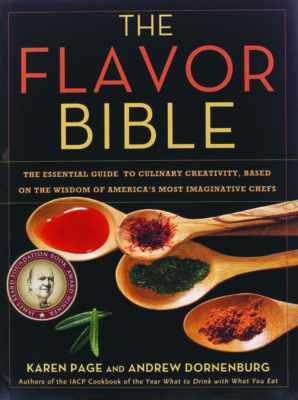
The Flavor Bible
The Flavor Bible by Karen Page and Andrew Dornenburg (Little, Brown, and Co., 2008) is an excellent handbook for anyone playing mad scientist in the kitchen. Essentially, it is the result of a very, very comprehensive poll of extremely thoughtful chefs of what flavors they like to pair with particular ingredients. This book gives you a good idea of what the professional consensus is about any given pairing. If, for instance, you wanted to use coffee in a dish, one or two chefs might suggest pairing it with barbecue sauce. Almost all of them, though, would suggest using it with chocolate. It gives you a sense of which combinations are classics and which are a little more avant-garde.
Overwhelmingly, the most popular pairing that chefs recommend with thyme is goat cheese.
Goat cheese.
How absurd. Clearly, that wouldn’t work in a cocktail. What kind of depraved thrill-seeker would drink a goat cheese cocktail? I would have to try something else.
What else do the chefs suggest to go with thyme?
Carrots, cod or eggplant.
So — goat cheese, huh?
One problem with using goat cheese in a drink is that you can’t just drop a dollop of it into a cocktail shaker and expect it to mix well with the other ingredients. The fat in the cheese would be reluctant to mix with the other liquids without some sort of emulsifier to help it along.
You’ve heard the expression that oil and water don’t mix. Not only is this true, but it can make life difficult for a cook. A good example of this is salad dressing. A classic oil-and-vinegar dressing does not want to mix and must be shaken together vigorously, and used immediately, before it starts to separate. An emulsifier is some ingredient that helps the oil play nicely with other liquids. The classic example is a beaten egg. The fat in a raw egg yolk will latch onto oil molecules readily, while the proteins in the egg white will provide a bridge to water-based fluids.
A goat cheese-based cocktail is a big ask to begin with, without bringing a raw egg on board.
Another approach might be to go in a milkshake direction — a sort of savory mudslide, perhaps. Unfortunately, I didn’t think of that at the time and got distracted by sort of a culinary sleight-of-hand: fat washing.
The basic theory behind fat-washing is that almost any compound that is fat-soluble is also alcohol-soluble. For the past few years, high-end bartenders have been using that chemical loophole to flavor bourbon with bacon, or rum with brown butter. The secret, apparently, is to mix an alcohol with a fatty food, then raise the temperature of the mixture to a couple of degrees above the melting point of the fat you are trying to liberate flavors out of. If you give the fat and alcohol time to get to know each other better, flavors can be exchanged. Goat cheese-infused alcohol is feasible, if you are patient enough.
After several spectacular failed attempts and panicked telephone calls to food scientists (I’m not kidding) I eventually cracked it.
Step 1: Choose a base alcohol
After a lot of thought, I decided to use gin for my experiment. It seemed like the herbal ingredients in a gin would complement the flavor of goat cheese and serve as a bridge to the thyme in a finished cocktail. But which gin?
I asked Andy Harthcock, the owner of Djinn Spirits in Nashua. He seemed a little confused when I told him that I wanted to infuse goat cheese into gin.
“Don’t you mean the other way around?” he asked. (Which actually sounded like a good idea, but I decided to focus on one dangerously ill-conceived project at a time.)
I assured him that I actually was planning to flavor gin with the cheese. He admitted that this was a first for him, but on reflection he had some thoughts about how to go about it.
“You probably don’t want a really high-end gin for this,” he told me. “Any subtle flavors are going to be totally blown out by the goatiness of the cheese.” He advised me to try a heavily botanical gin. “I think you’re probably going to have to eat a round of cheese with several different labels and see which ones stand up to ‘The Goat.’”
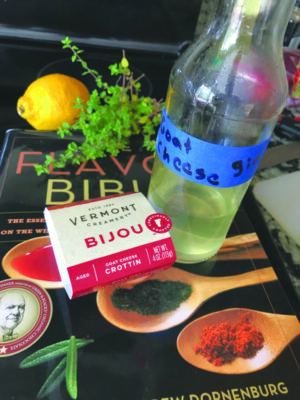
So, I did.
After comparing eight different gins, I discovered that Harthcock was right – the two most botanical gins held up to the flavor of the goat cheese the best; in this case, Djinn Spirits’ Original Gin and Drumshanbo Gunpowder Gin. The Djinn gin was extremely botanical and was able to meet the cheese on equal terms. The Drumshanbo isn’t especially botanical but has its own very forceful personality. Either of them would work well.
Step 2: Choose a cheese.
After some trial and error, it turns out that you will need the strongest, “goatiest” cheese available. In this case, I went with Bijou Crottin by Vermont Creamery.
Step 3: Combine the gin and stinky cheese in a zip-lock bag and smoosh it up — a technical term — until it is thoroughly combined. Grope it shamelessly.
Step 4: Heat the mixture to 120°F (49°C) — the melting point of goat cheese — and leave it at that temperature for four hours. A sous vide tank would make this much easier, but you can do much the same thing with a plastic cooler and a thermometer, replacing hot water every 20 minutes or so to keep the water temperature fairly constant.
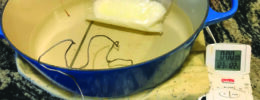
Sous vide
A sous vide water bath is a piece of equipment originally developed for use in scientific and medical labs. It keeps a tub or pot of water at an exact and consistent temperature. You could bathe a bag of lamb chops at 135º, for instance, and walk away secure in the knowledge that it would cook to a perfect medium-rare, and stay there.
Step 5: After a four-hour soak, remove the bag of cheese gin from its bath and put it in a bowl somewhere out of the way for 72 hours. Once or twice per day, you might want to smoosh the bag around in your hands to remix the infusion and keep the cheese in solution.
Step 6: On the big day, thank your bag of gin for working so hard for you, then strain it through a fine-mesh strainer. There will be a surprising amount of cheese solids — or casein — left behind.
Step 7: Filter the cloudy liquid through a coffee filter.
Goat Cheese Gin Recipes:
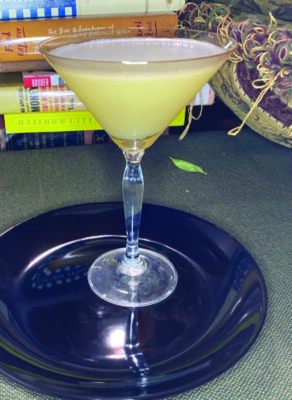
The Relentless March of Thyme
Ingredients
- 2 ounces goat cheese gin (see above)
- 1 ounce fresh squeezed lemon juice
- ½ ounce thyme syrup (see below)
- 2 sprigs of fresh thyme
Combine all ingredients, with ice, in a cocktail shaker. Shake brutally, until you hear the ice shatter.
Strain into a martini glass.
This is a goat-forward, thyme-y, martini-like cocktail. It has a bit of sweetness from the thyme syrup, but it has a clean, cold taste that picks up on the multi-stage nature of the gin and comes in waves.
Thyme Simple Syrup
Ingredients
- 1 cup white sugar
- 1 cup water
- 10 grams / ⅓ ounce fresh thyme (about half a plastic clamshell package from the produce department at the supermarket)
Combine the sugar and water in a small saucepan, and bring to a boil. Let the syrup boil for 10 or 15 seconds to make sure that all the sugar has been dissolved into solution.
Remove from heat, add the thyme, and cover with a plate. Let the thyme steep for 30 minutes.
Strain into a bottle and store in your refrigerator.
Die Goat-erdämmerung
Ingredients
- 2 ounces goat cheese-infused gin
- 1 ounce thyme simple syrup
- 1 ounce lemon syrup (see below)
- Plain seltzer
Add gin, thyme syrup and lemon syrup to a cocktail shaker, with ice.
Again, shake brutally, until the ice shatters, or the world ends.
Pour, with the ice, into a tall glass and top with seltzer. Stir gently.
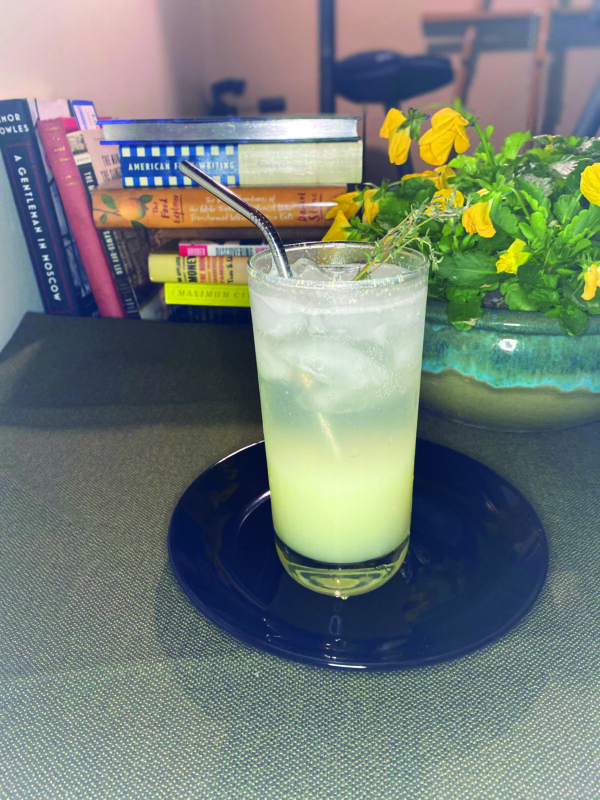
This take on goat-cheese gin is sweeter and more amiable than its martini-ish baby brother. Instead of shouting, “HEY!! GOAT CHEESE!!” at you, it soothes and persuades you: “Oh, this is lovely. Oh, there’s some lemon; you like that, don’t you? What’s that in the background? Thyme, you say? Oh, that’s perfect. You know, this is just goaty enough.” It is perfect for dedicating your first weekend of deck-sitting.
Lemon Syrup
Zest some lemons — any amount; don’t let some recipe order you around on this.
Juice the lemons into a small saucepan. Add an equal amount of white sugar, and bring to a boil.
Remove from heat, add the zest, and allow the mixture to steep, covered, for 30 minutes.
Strain, bottle and refrigerate.
“OK,” one might say, “so this whole goat cheese gin thing is very clever and sounds fun, but what if I’m in a cheesy mood, but don’t want to take a leave of absence from work and get a degree in Laboratory Science to make something? “
Ah! You’re in luck!
Goat cheese. part 2
One of my go-to sources for baking recipes is the King Arthur website. Every bread, brownie or pizza crust that they post a recipe for has been rigorously tested and is pretty much bullet-proof. One of my favorite aspects of their recipes is that the amount of each ingredient is listed by volume (cups, etc.) and by weight (ounces and grams). I find that weighing ingredients is easier and more accurate than scooping them with measuring cups.
One of their most recent projects has been something called a Basque cheesecake.
Cheesecake-making can be nerve-wracking. You want your cheesecake to be done all the way through, but not overly baked. You worry about it heating unevenly and developing a crack across the top. You worry about whether you should have used a water bath or not, and if you did, should you have heated the water up first? And then, when you finally finish baking, cooling, and depanning it, you will serve it to someone who shrugs and says, “Yeah. It’s OK,” because it doesn’t fit their mental model of what a cheesecake should be. And then you have to worry about hiding a body.
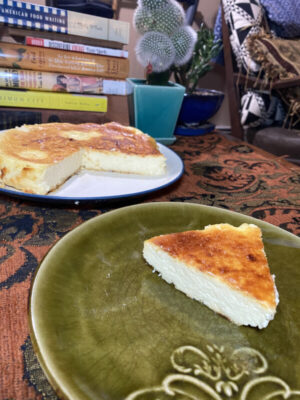
A Basque cheesecake, on the other hand, is meant to be rustic-looking. You are supposed to bake it at an unreasonably high heat, until the top is deeply, deeply caramelized; it’s supposed to look over-baked.
This makes its deliciousness somewhat surprising and gives it a bigger impact.
I’ve taken the original recipe and tweaked it to accentuate its cheesiness. I’ve replaced cream cheese with a mild goat cheese and dramatically reduced the sugar in this recipe by about a third, to make its tartness pop. It is easy. It doesn’t take long. It is a tremendous confidence-booster.
Basque Cheesecake
Ingredients
- 24 ounces / 685 grams soft, mild goat cheese
- 7 ounces / 200 grams white sugar
- 5 eggs
- 6 ounces /170 grams heavy cream
- ½ teaspoon coarse sea salt
Heat oven to 500º.
Line a springform pan with parchment paper.
Combine all ingredients in a blender, then blend for five minutes.
Pour into the springform pan, trimming off any excess parchment paper.
Bake for approximately 45 minutes, until dark.
Cool for at least one hour, then remove from pan.
Eating this tart, crumbly cheesecake is a meditative experience. It is delicious. The sharp taste of the goat cheese provides a mouth-watering sourness that seems a little citrusy, but is also emphatically not. The pared-down nature of this dish makes it perfect for paying very close attention to every bite, and leaving you fully in the moment.
And now perhaps you’re thinking: “That does sound good, but my mother-in-law is famous for her cheesecake, and I’m afraid that if I made this, word would get to her, she would take it as some sort of criticism, and my quality of life would degrade significantly. Do you have something else?”
OK. As it turns out, yes I do.
Digital scale
Once you get used to it, a digital scale becomes an indispensable tool in your kitchen. When you need to add multiple ingredients to a bowl or a saucepan, for instance, you can put the container on the scale, then add each ingredient by weight, using the tare function to zero out the scale and avoid doing math. You stop having to wonder what “tightly” or “loosely” packed means in a given context. Your baking becomes much more consistent.
Smoked cheddar
One of my great passions is shopping at flea markets. I have a particular fondness for finding obscure cookbooks. Our kitchen shelves long ago ran out of room to hold all of them, and I am about three volumes away from filling a bookcase in the living room. Their mere existence is something of a trial for my wife, who feels that by taking up valuable space but never actually being cooked from, they are openly mocking her.
“Can we get rid of some of these?” she asks me two or three times a year. “Are you ever going to actually make any Bengali street food?”
“You never know, Baby,” I reply with an air of mystery. “You never know.”
And the scary thing for her is that she doesn’t know. She could be going through her day, not suspecting a thing, then suddenly catching a whiff of the exotic but slightly alarming scent of asafetida from the kitchen.
Last week’s purchase was the promisingly titled Adventures in Cooking by Rasmus Alsaker, M.D., published in 1927.
I was fully prepared to navigate old-fashioned recipes calling for vague measurements, like “a knob of butter, the size of a pullet’s egg,” or “a medium oven.” Doctor Alsaker was a man of science, though, and his measurements were precise. What I was not prepared for was his enthusiasm for pimientos. At a rough estimate, he calls for pimientos in approximately 5,000 recipes. I don’t know what was going on pimiento-wise in 1927, but I have used our own relative pimientolessness as license to modify his recipe for the very promising-sounding:
Cheese Crumb Pudding
Ingredients
- 2 cups / 110 grams bread crumbs. (I feel like you could blitz Triscuits in the food processor in lieu of fresh bread crumbs.)
- 2 cups / 250 grams shredded, smoked cheddar. I went with an Australian brand called Old Croc, and I was not disappointed.
- ½ teaspoon dry mustard
- ½ teaspoon freshly ground black pepper
- 3 Tablespoons jarred salsa (This is playing pinch hitter for the pimientos.)
- 2 eggs
- 1 cup / 225 grams whole milk
- ¼ teaspoon paprika
Heat oven to 375º.
Generously butter a 9×9” baking dish.
Mix the mustard, pepper and paprika together in a small dish.
Spread 1/3 of your crumbs over the bottom of the baking dish. Look at them critically. Do they look cold and lonely?
Cover them with a blanket of cheddar — half the cheddar. Sprinkle half of the seasoning on top of the blanket. You know — like a blessing.
Repeat, with another layer of crumbs, the rest of the cheddar, and the rest of the seasoning. Top with a final layer of crumbs.
Mix the milk, eggs and salsa; gently pour over the top of the guys you already have in the baking dish.
Bake for 30 minutes.
Allow to cool for 10 minutes before serving.
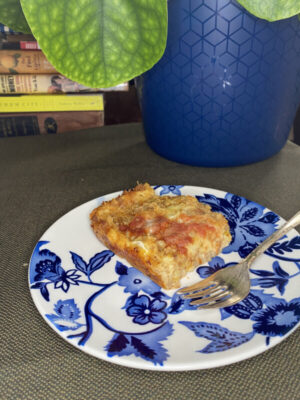
The center of this savory pudding is tender, custardy and smoky. The edges are where it really shines though. If you are, like all good Americans, a fan of brownies from the edge of the pan, the chewiness of the pudding border will be something of a revelation. You could describe this as being a bit like a very good macaroni and cheese without the macaroni.
Or, in the words of my own sullen teenager, “Why didn’t you ever tell me you could cook something like this?”
But perhaps you’re thinking: “I can’t make that. Mercury is in retrograde.”
OK, now you’re just messing with me, but I’m going to call your bluff.
Electric whisk
Most recipes that call for a custard will include very finicky instructions on how to temper beaten eggs with hot milk, then whisk the warmed-up egg mixture back into whatever you are cooking. Then comes possibly the most frustrating cooking instruction ever written: “cook, stirring constantly, until the custard coats the back of a spoon.” I don’t know what kinds of cooking prodigies can actually manage that. I’ve been trying to perfect that particular maneuver for over 20 years and I can still never tell when I’m closing in on “soupy scrambled eggs” territory.
The game-changer for me was finding a whisk with an integrated thermometer in it. Some research revealed that ice cream base should be heated to approximately 175º, so now I can just whisk my custard thoroughly until I hit that temperature.
Blue Cheese
Honey-Roquefort Ice Cream
Ingredients
- 8 Tablespoons / 120 grams clover or wildflower honey
- 4 ounces Roquefort or blue cheese
- 2 cups / 500 grams half & half
- 4 egg yolks
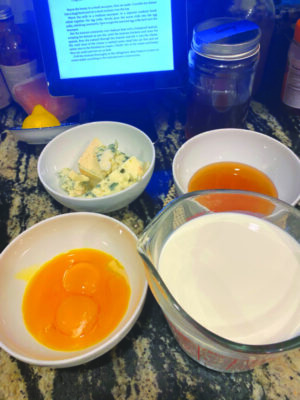
The brilliant thing about this recipe — aside from its unexpected excellence — is that it only has four ingredients.
Crumble the blue cheese into a bowl, in small pieces.
Combine the honey, half & half and egg yolks in a small saucepan.
Whisking constantly, heat the custard (because that is what this is — a loose custard) over low heat until it reaches 173º. (We’re actually shooting for 175º, but the temperature will continue to rise a few degrees after you remove it from the heat.)
Pour the very warm custard through a fine-mesh strainer, over the blue cheese.
Whisk until the blue cheese almost completely dissolves. It is OK if there are a few small, surprise pieces of cheese left in the mixture.
Chill the mixture, then churn in your ice cream maker, according to the manufacturer’s recommendations.
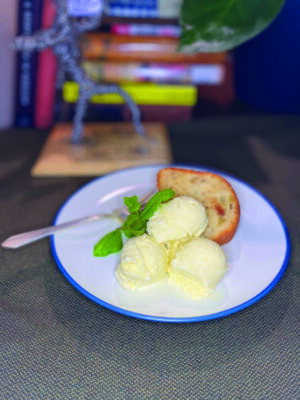
You may have heard that some avant-garde chefs have been experimenting with savory ice creams. This is not one of them. This is a fully sweet dessert ice cream that just happens to be blue cheesy. The honey provides a muskiness that complements the earthy, salty flavor of the cheese. It is possibly the most creamy ice cream you have ever tried.
Do you have to be stout of heart to try it? Do you have to look Adventure in the eye and shake its hand?
Yes, and yes. But you will enjoy this, and you will come out the other side of the experience slightly changed.
But you know what would make this honey-ish, cheesy ice cream even better?
Cake.
Consulting The Flavor Bible again shows that a great many chefs like the combination of apples with blue cheese. Who am I to argue with a great many chefs?
Apple Bundt Cake
Ingredients
- 3 Granny Smith apples, peeled and diced — about 440 grams
- 3 cups / 360 grams all-purpose flour
- 1 teaspoon baking soda
- 2 teaspoons ground cinnamon
- ½ teaspoon freshly grated nutmeg. If you’ve never grated your own nutmeg, try it. You’ll never go back to pre-ground again.
- ½ teaspoon salt
- 1½ cups / 360 grams sour cream
- 1½ cups / 275 grams white sugar
- ½ cup / 64 grams brown sugar
- 3 eggs
Heat your oven to 325º.
Paint the inside of your Bundt pan with Cake Goop (see sidebar)
Whisk together the flour, baking soda, cinnamon, nutmeg and salt.
In another bowl, mix the sugars and sour cream. Mix in eggs, one at a time.
Mix in the diced apples by hand.
Pour mixture into your pre-gooped Bundt pan. Lift the pan and bonk it on your counter 10 times.
Bake for 70 minutes or until it reaches an internal temperature of 200º F.
Remove from the oven. Let it cool for 20 minutes, then remove from the pan.
This is an outstanding Bundt cake. The apples are tart and still a tiny bit crunchy. The cake itself is rich but not too sweet. The nutmeg and cinnamon shine through.
And it is extremely good with blue cheese ice cream.
But still, perhaps, you say: “That does sound good. Unfortunately, I’m not allowed in the kitchen since the Lasagna Incident.”
I hear you; we’ve all been there. I’ve got you covered.
Bundt cake
Bundt cake might be the Cake Lover’s ideal cake. At its best it is moist, flavorful, not too sweet, and free of frosting distractions. That goodness comes at a cost, however; it presupposes that you can get your cake out of the pan. There are few heartbreaks in life on a par with inverting a Bundt pan only to find that you’ve left half a cake in it.
This can, happily, be avoided. For months, I have been hearing rumors online about “Cake Goop.” It is a mixture of equal parts solid shortening, vegetable oil and flour. Word on the street was that if you paint the inside of your Bundt pan with this stuff, your cake won’t stick.
It’s true.
Haloumi
There is a Greek sheep’s-milk cheese hidden away in the specialty cheese section of your supermarket called haloumi.
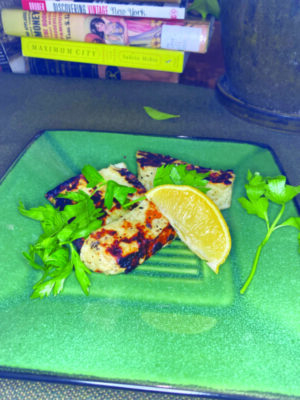
In many ways, it is much as you’d expect it to be — salty, mild-flavored and fairly modest. If you taste a little, it might seem a little chewy, but not outrageously so. If it were a person, it would be named Melvin.
You wouldn’t suspect him of hiding a superpower.
Haloumi has an extremely high melting point. Oh, you could force the issue and make it melt, but you would probably need a blowtorch to do it. At temperatures that would frighten other cheeses out of the room, haloumi hums softly to itself and minds its own business.
So nicely in fact, that you can charcoal-grill it.
Charcoal-grilled Haloumi
1. Light the charcoal in your grill.
2. Thoroughly grease a grill pan. Use an oil with a high smoke point. This means one that won’t catch on fire when things get serious. Use any oil you would fry with. I like ghee — clarified butter — but shortening or peanut oil would also work really well.
3. Open packages of haloumi and cut it into finger-sized pieces.
4. Make a cocktail and go back outside to watch the coals.
5. When the coals are red and white and feeling all right, grill the haloumi over them in the pre-greased grill pan. Turn the cheese frequently with tongs. It will only take a few minutes to char-grill them beautifully.
6. Serve with a fresh parsley and a squeeze of lemon juice. A salad would be nice, too.
When I was a kid, once a year — usually on July 4 — my church would hold a big auction. It was the church’s big fundraiser for the year. One year my mom gave me $3 to bid with and I won a mystery box of books. There were a couple of really great pulp adventure novels from the ‘30s in it, as well a truly unexpected piece of literature that I’m pretty sure my mom wouldn’t have approved of, that was extremely educational. It was the high point of my summer.
The men of the church would man the grills — giant 50-gallon barrels split down the middle with industrial grating thrown over the top. They would risk serious burns and smoke inhalation to grill hot dogs, burgers and quarter-chickens. The smoke, barbecue sauce and the constant threat of danger made that the best chicken I ever had.
What does that have to do with grilled haloumi?
Not much, except that this will also make you very, very happy. The smoke and salt and mild char on the cheese will be a bit of an epiphany. The acid from the lemon juice will add just the tang it needs to put it over the top.
It might even get you kitchen privileges again.
At last, you might think, “I’m feeling a bit overwhelmed. All this cheesiness is just a little exotic for me. I’ve had a rough week and I’m feeling a little fragile. You said ‘grilled cheese’ and you got my hopes up.”
I understand completely.
Blowtorch
You know that blowtorch we talked about a couple of minutes ago? It turns out that a plumber’s blowtorch is the perfect tool for lighting charcoal without leaving a lighter-fluid taste behind.
Colby-jack
Do you know who else does?
Marcie Pichardo, the owner of Prime Time Grilled Cheese,a restaurant in Manchester specializing in grilled cheese sandwiches. She spends a lot of time thinking about cheese — according to her, approximately 18 hours a day.
Cheese might be the glue that keeps society from splintering apart, she says. “Cheese holds things together. In the house I grew up in, cheese is the thing that held us together as a family. It’s the glue that holds a recipe together.’
According to Pichardo, the key factor to consider when you are putting together a grilled cheese sandwich is consistency. “That’s the most important reason why we choose a particular cheese for a sandwich,” she says. “Think of a pizza. If you put cheddar on it, it would taste good, but it would go everywhere! That’s why you go with a mozzarella.”
She agrees that the Platonic ideal of a grilled cheese sandwich involves (1) white sandwich bread, (2) American cheese (“It’s gooey in the middle and crispy on the outside.”) and (3) being grilled in butter. “That’s the benchmark,” she says.
She’s not wrong.
Platonic ideal
The concept of a “Platonic ideal” states that for every concept, there is a perfect theoretical example of it that all real world examples are measured against — the most perfect blue sky, the most exquisite jazz trumpet solo and the most grilled-cheesiest grilled cheese sandwich.
And yet, I’d like to submit an idea for your approval:
A grilled colby-jack on pumpernickel, with caramelized onions.
You know how to make a grilled cheese sandwich. I know you know. You know that I know that you know.
Still…
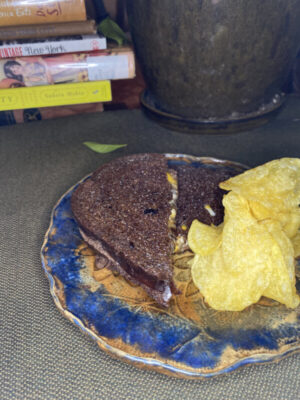
Butter one side of each slice of pumpernickel generously with softened butter. It’s tempting to just drop a dollop of cold-from-the-fridge butter in the pan, melt it, then swirl the sandwich around in it, but it never works out as well as buttering the bread itself.
Assemble the sandwich completely before putting it in the pan. It is always tempting to put the first slice of bread in by itself, then add the cheese and the other slice in stages, as you finish them, but your finished sandwich will be cooked evenly on both sides if you observe traditional grilled-cheese protocols.
Watch the sandwich with a jaded, suspicious eye. The pumpernickel will try to fool you about how grilled it is. Do not fall for its tricks. Because the bread is so dark to begin with, you cannot rely on color to let you know when to flip it.
Flip the sandwich experimentally, and gently tap the surface of the bread with the edge of your spatula. When it feels grilled, it is grilled.
Do not make the omelet mistake of waiting until the cheese is thoroughly melted before removing your pan from the heat; your sandwich will be overcooked. Take it out of the pan as soon as the bread is ready. The grilled bread will be warm enough to finish melting the cheese on its own.
We should throw a grilled cheese party. We could all wear t-shirts that read “Proud to Be Crusty.” We could rig up a cheese piñata full of Baby Bells. June 4 is National Cheese Day.
There is still time.
Featured photo: Die Goat-erdämmerung. Photo by John Fladd.