The Music Roundup 22/11/03

Local music news & events

Nashville kitten: Country music rising star MaRynn Taylor is joined by local fave Dusty Gray for the first in a monthly series dubbed Nashville Newcomers. The singer-songwriter, whose first name is pronounced “Muh-rin,” moved to Music City in 2019 and serendipitously found her way at the last minute into a talent contest that led to a record deal. Her song “I Know a Girl” hit the Top 40, and a debut EP, Something I Would Do, is out now. Thursday, Nov. 3, 8 p.m., Bank of NH Stage, 16 S. Main St., Concord, $28 at ccanh.com.

Feral rock: In Bloom, the second album from the Faith Ann Band, touches down on a myriad of musical moods, from tuneful grunge to full-throttle rockers and tender ballads, but there’s a clear thread running through it: raw, naked emotion. More precisely, it’s a crackling live wire, shooting furious sparks and sparing no one. The bro target of the two-minute punk rager “Miller Time” is probably still nursing his bruises. Friday, Nov. 4, 5 p.m., Henniker Brewing, 129 Centervale Road, Henniker. See thefaithannband.com.

High lonesome: Sarah Shook and the Disarmers released their album Nightroamer early this year, the third album from Shook with the Disarmers. The album is a tour de force that bounces across genres. Saturday, Nov. 5, 8 p.m., 3S Artspace, 319 Vaughan St., Portsmouth, $15 to $18 at eventbrite.com.

Metal buzz: Nominated yet another time at the upcoming New England Music Awards, Sepsiss hosts its first-ever Swarmiefest, named for the nickname given to their rabid fans. The local rockers have won a pair of NEMA plaques, the most recent last year. If merchandise were a category, they’d be a strong contender. Also on the bill are SixteenTwenty, Trawl, Day to Attend, Dust Prophet and Trading Tombstones. Sunday, Nov. 6, 7 p.m., Jewel Music Venue, 61 Canal St., Manchester, $13 and up at eventbrite.com, 21+.

Doom sound: One of the earliest bands influenced by Black Sabbath, Maryland’s The Obsessed formed as Warhorse in 1976, changing their name four years later. Front man Scott “Wino” Weinrich is credited with being highly influential in the American doom metal scene, though more than a few consider him just plain high when it comes to his opinions on the pandemic — he told one metal ’zine it was a “government depopulation tool.” Monday, Nov. 7, 8 p.m., Shaskeen Pub, 909 Elm St., Manchester, shaskeenirishpub.com.

At the Sofaplex 22/11/03

Wendell & Wild (PG-13)

Voices of Lyric Ross, Angela Bassett.

As well as the voices of Keegan-Michael Key and Jordan Peele as Wendell and Wild, respectively, two demons that find a human Hell Maiden, Kat (Ross), to help them visit the land of the living in this animated feature.

Kat is a girl consumed with anger and guilt about the death of her parents when she was a child. Certain that she was the cause of the car accident that killed them, she carried that with her to profit-focused group homes, unkind schools and juvenile detention. She returns to her home town as a teen to go to a private girls school and finds that the death of her father and the destruction of his brewery ushered in the downfall of the town of Rust Belt — a downfall cheered along by the Klaxon family who own Klax Korp. The snakey Klaxons (voices of David Harewood and Maxine Peak) want to bulldoze the town entirely to make way for a corporate prison. Dogged activist and local council member Marianna (Natalie Martinez) is attempting to stop Klax Korp and to prove that they’re behind the fire at the brewery. Her son, the artistic Raul (voice of Sam Zelaya), a trans boy who also attends the school, refuses to listen when Kat says she’s not a good person to be friends with.

Raul joins Kat on a trip to her parents’ gravesites when Wendell and Wild, demons with whom she is newly acquainted, promise to revive them. But Sister Helley (Bassett), one of the school’s teachers, has tried to warn her about doing business with demons.

A harebrained brother duo with a plan to build a real-world amusement park, Wendell and Wild might have a connection to Kat but they’re willing to do business with the Klaxons to make their Dream Faire a reality. Making deals with the devil (or in this case a devil’s goofy sons) is one of this movie’s themes, along with the greed behind services that should be helping people. It’s a surprisingly complex kind of villainy for a kids’ movie (Common Sense pegs it at age 11 and up; I’d say at least that). And Kat’s redemption arc is only partly about magical powers or demons — it’s mostly about learning to forgive herself.

The movie delivers all of this thoughtfully and with some truly lovely visuals. The animation here is stop-motion (we see Kat in the real world with a filmmaker at the very end of the credits) and everything from the characters themselves to the clothes they wear or their surroundings has texture and heft. The people have a slightly angular quality with almost hinge-like features on their faces that call to mind marionettes but with more fluid movements. The movie is able to give us personality and emotion in the characters’ faces that give them a depth beyond their stylized look. A Available on Netflix.

The Good Nurse (R)

Jessica Chastain, Eddie Redmayne.

Nurse Amy Loughren (Chastain) struggles to work while dealing with a heart condition but comes to suspect friend and colleague Charlie Cullen (Redmayne) isn’t just bending the rules by helping her in this movie based on a real-life story of a serial killer. The movie makes it fairly clear early on that Charlie is a killer, even if we don’t know the extent of his crimes going in (though I feel like I’ve read a couple of People magazine stories about it).

Amy doesn’t suspect Charlie right away but she does suspect something is going on when a patient who had been recovering suddenly dies. The hospital later investigates, but does so in such an aggressively unhelpful manner that the police detectives (Noah Emmerich, Nnamdi Asomugha) seem pretty sure from the jump that something has gone wrong.

Chastain does a good job of radiating competence — something she is often very good at doing with her characters. Redmayne is mostly a collection of oddball behaviors and twitches, which is a thing I often believe to be true of his performances. Overall, The Good Nurse has the feel of an extremely well-made TV crime drama. B- Available on Netflix.

Till (PG-13)

Till (PG-13)

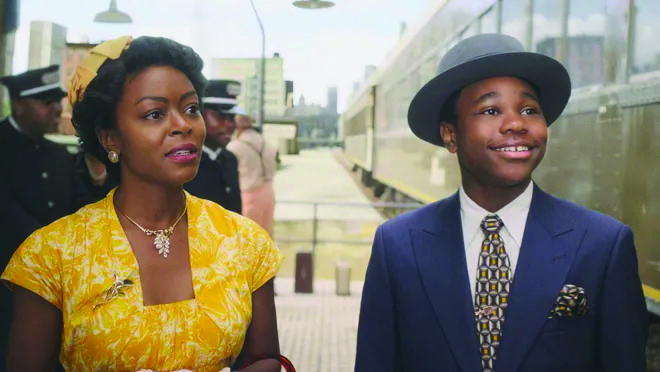
Mamie Till-Mobley, mother of the murdered child Emmett Till, is the focus of Till, a close-up portrait of a woman’s rage and grief.

Mamie Bradley (Danielle Deadwyler), as Till-Mobley (who died in 2003) is known for most of the movie, is worried from the moment she sends her only child, Emmett Till (Jalyn Hall), on a train to visit cousins in 1955 Mississippi. He has grown up in Chicago and even though the city is hardly free of racism, he doesn’t have experience with the dystopian apartheid of the South and the deadly consequences of running afoul of its hellish social conventions.

A sunny, friendly, baby-faced 14-year-old, Emmett seems to be generally enjoying himself with his cousins, even when he’s helping them pick cotton. While at a store buying sweets, he tells the clerk, who we later learn is Carolyn Bryant (Haley Bennett), that she looks like a movie star and later whistles at her. He thinks he’s being charming, we see a sweetly goofy kid, she goes for her gun. A few days go by and he and his cousins think the incident will come to nothing and don’t even tell their parents, Mamie’s uncle (John Douglas Thompson) and aunt (Keisha Tillis). But then men, including Carolyn’s husband, show up at the house and kidnap Emmett while holding his cousins at gunpoint.

When Mamie finds out Emmett is missing, she wants to hurry to Mississippi to find him, but family help her connect with the local chapter of the NAACP and Rayfield Mooty (Kevin Carroll), who tries to get political officials and the media involved in Emmett’s disappearance. When Emmett’s body is found, Mamie, nearly shattered already, insists on having him returned to Chicago and on seeing him. Emmett’s face and head are horribly disfigured and he is bloated from being in a river. Mamie decides that Emmett’s funeral will be open casket and she brings newspaper and magazine photographers in to take pictures of Emmett’s body to show the world what happened to him.

An extended trailer for this movie mentions the fact that we don’t actually see Emmett being murdered — an effective and possibly more emotionally devastating choice. While the movie shows us Emmett’s body and what seeing him does to Mamie, other family members and the larger public, it keeps the focus on Mamie, her heartbreak and her relationship with Emmett. The movie never lets us forget that he is a child and he is her child and it doesn’t waste a minute with sensationalizing his lynching or trying to get us to understand his murderers or the society that protects them. That sounds like kind of an obvious thing — that the murdered child and the effect of his murder on his mother would be the center of this story — but it feels so Hollywood-standard for a Civil Rights era movie to filter Black stories through some kind of white character that this “a movie about Mamie that puts Mamie at the center” approach makes Till feel innovative.

And Deadwyler’s performance absolutely holds us in her experience throughout the movie. She puts us in Mamie’s emotions, from the worry and dread that come with sending Emmett to Mississippi through the ocean of grief after his death and the anger that I think would completely consume most people. It’s not always easy (I think especially if you have kids and can call up worry about them with zero effort) to be with her in that headspace, but it is so well done, her feelings are so well examined and shown (not told), that when characters praise her out loud it almost feels unnecessary. Just making it through the day as a woman who has lost so much seems like an exceptional feat — and this movie makes us feel the effort this requires of her. When we see her doing so while being able to serve as an advocate for justice, Mamie displays an almost superhuman strength. A

Rated PG-13 for thematic content involving racism, strong disturbing images and racial slurs, according to the MPA on filmratings.com. Directed by Chinonye Chukwu and written by Michael Reilly & Keith Beauchamp and Chinonye Chukwu, Till is two hours and 10 minutes long and distributed in theaters by Metro-Goldwyn-Mayer Pictures.

Featured photo: Danielle Deadwyler and Jalyn Hall in Till.

Shuna’s Journey, by Hayao Miyazaki

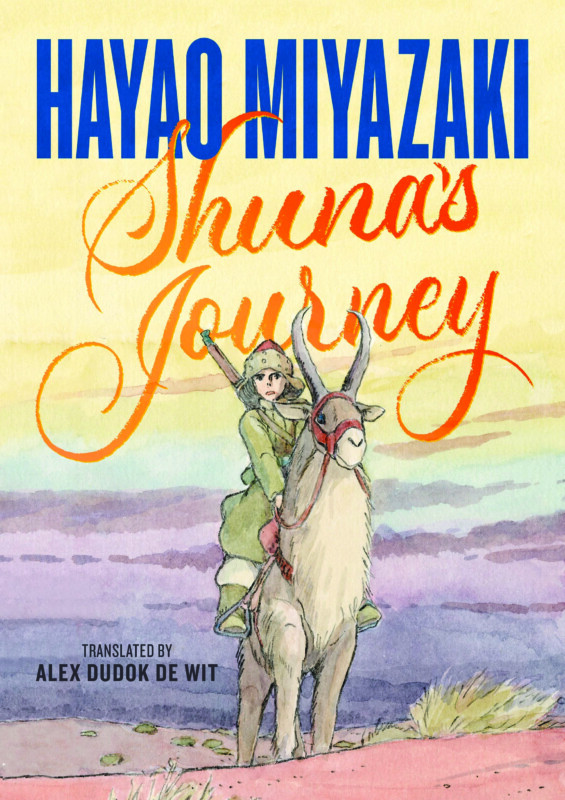
Shuna’s Journey, by Hayao Miyazaki (First Second, 160 pages)

At a glance, Shuna’s Journey feels like well-mapped territory for author and acclaimed director Hayao Miyazaki. Originally published in 1983, the story about a prince who leaves his home on an ungulate steed for parts unknown bears a striking resemblance to Miyazaki’s 1997 film Princess Mononoke. Assumingthe graphic novelis only a springboard for the acclaimed animator’s later film, it would only seem accessible to mega-fans of his work. Assumptions are often proved wrong and Shuna’s Journey is much stranger than anyone could hope to assume.

The book itself is not laid out like a traditional comic or manga, stereotypically filled with sliced and diced frames meant for frenetic page-turning. In fact, the layout of Shuna’s Journey shares more commonality with a children’s book of myths and legends. Pages primarily consist of large single-columned panels, the maximum being only three per page. They bleed over onto the corresponding pages in uneven hand-painted watercolor, bringing humanity to the larger-than-life renderings.

The book opens peacefully among the mountains that tower over Shuna’s village with the lines, “These things may have happened long ago, they may be still to come.” and it could almost serve as an excuse for an unrealized, undeveloped setting. Instead, the stage is set with background art portraying an environment triumphant over human civilization. Empty ruins look like dry bones against barren plains and the desert lands stretch endlessly into the horizon, marbled in red and blue hues. Even human creations feel alien in this land. As Shuna makes his way west he takes shelter under giant abandoned robots as well as a colossal battleship, grounded and wasting in a sea of sand. All serve as breadcrumbs of a mythic past where humans thrived, making the reader wonder what happened to make Shuna’s world this way.

There is also an anthropological element that helps flesh out Shuna’s world. In his home village, walls painted with cosmological designs hint at a culture with deep-rooted beliefs and customs. The fur hat Shuna wears marks him as someone of high status, and other characters who also wield power wear similar headgear. Some of the bigger antagonists in the story, those participating in the slave trade have their own menacing iconography differentiating themselves from the small village kingdoms. These details help cut down on exposition that could cramp the page. The narrative does not need to slow down with backstory exposition when Thea (a character whose perspective takes over for the final third of the book) is introduced. Her distinctive hair ornaments tell everything about how she treasures her past and fights for her individuality even as the slave trade tries to take it from her.

Storywise, the book follows the archetypal hero’s journey, making the narrative easy to follow. Shuna and his people are caught in a cycle of hunger and scarcity. There’s not enough food for the people and animals, so when there is a chance to break the cycle, the hero sets off on his quest for a crop that will sustain his people. Miyazaki makes sure to impress upon the reader the constant looming state of desolation in which the characters find themselves. While Shuna must overcome physical challenges to survive, he needs more than muscle to accomplish his goal. The trials during the story test his resolve to complete the journey, making him learn what it means to both help and hurt others.

The pacing is even; the climax hits when Shuna finally makes it to the land of the god-folk. This is where the graphic novel’s art and story both reach their peak. The environment, with its vibrant forests filled with animals and large cultivated fields, is completely different from the wastelands Shuna previously journeyed through. The land of the god-folk is more than paradise and it is here where Shuna’s Journey dips into the realm of cosmic horror. The creatures that make the land their home look like they come straight from the Cambrian explosion, while the mechanisms that cultivate grain are beyond human comprehension. When the truth is finally revealed the reader may find themselves so horrified and filled with existential dread that they wonder whether it was worth it for Shuna to have left his home after all.

The story does not end in the land of the god-folk, but comes to a satisfying, if not complete, conclusion. The final third of the book, with Thea at its center, feels slightly disjointed from the first two-thirds of the story, but it would be much more disappointing if Thea’s section were not included. Since the core of Shuna’s Journey focuses on the quest to cultivate grain it makes sense that part of the story should involve farming. After all, the problem of hunger in Shuna’s world will not solve itself with force, but instead with patience, understanding and kindness. A

— Bethany Fuss

Album Reviews 22/11/03

Brothertiger, Brothertiger (Satanic Panic Records)

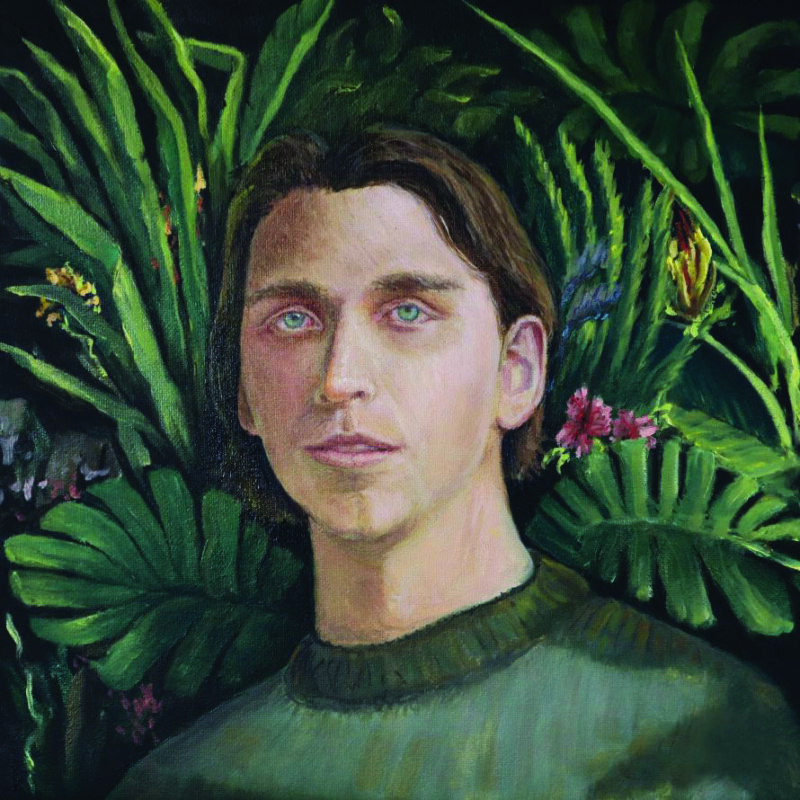
If you were around in the late ’80s, you probably heard your share of corporate metrosexual chill-techno music by Tears For Fears, Scritti Politti, Spandau Ballet and all that junk, usually at the most inopportune times, like when you were stuck someplace where it was being played loud enough for you to hear it. No, I kid this kidder, because you could do a lot worse these days than this kind of thing, Perry Como makeout tunes for the generation who thought John Waters was the greatest filmmaker of all time. This guy — the mononymed Jagos, who’s done four other LPs with this project — has really nailed the vibe; there’s pretty, slick synth-cheese all over the place, as well as the staple fake-bell sounds that signified ’80s-pop more than basically anything else if you think about it. It’s all well done, the vocal lines smooth and low-slung. There’s no reason for this kind of music to exist in current-year, but it is what it is. A

Amanda McCarthy, “Lifeline” (single) (self-released)

When last we left this New Hampshire-based country-pop singer-songwriter, she’d released her 14-song debut LP Road Trip, which, now that I’m re-listening to it for the first time in forever, actually has almost a Christian-pop feel to it, but that’s probably mostly owed to my listening to a lot of church-rock nowadays for some reason. Anyway, she’s in Nashville or thereabouts now, shooting for the bigs, and to make it in the bigs, one needs big-sounding – and, yes, I hate this word as much as anyone — production. This song does have that, let’s get that out of the way; it’s got as much a Tegan and Sara feel as it does a slight Faith Hill twang to it. It’s a very catchy rock-ballad-ish tune, one she “tried to write for years,” so she says”… my brain kept coming back to this song.” Good thing it did. There’s nothing amiss here. A

Playlist

• Like Zippy The Pinhead always says: Yow, look at all the new CDs that are coming out! Yup, it’s a huge pile of new albums due out on Friday, Nov. 4, and the worst, I mean first, one is Aughts-indie stalwarts Phoenix, with their new album, Alpha Zulu! You know, back when I first started writing this column — before the Best Of New Hampshire CD Reviews award and the other one, I forget which it was — I was really intimidated by Phoenix and their musical meatloaf of Kaiser Chiefs and whatever else, like, it was kind of heavy but also kind of awkward and badly done, which was all the rage back then, so I had to watch what I said about them because I was afraid some 98-pound hipster with skinny jeans and a flavor-saver patch under his lips would tell my editor to fire me because I just wasn’t sufficiently plugged into the zeitgeist. Of course, the happy ending came years later, when music journalists who’d suffered under the whip of utterly incompetent Brooklyn scenesters who pretended to like bands like Pavement and Air — you know, the really bad stuff — finally decided enough was enough and that it was OK for us writers with a bare modicum of taste to admit that we couldn’t stand any of those bands. It was kind of organic for me, like, I had gotten to the point where I just couldn’t take it anymore and had started dragging some of them (ha ha, remember Snow Patrol, how they couldn’t quite write a song that Gin Blossoms wouldn’t laugh at? Write those weak, unsellable B-sides, Snow Patrol! Write!). OK, and whatever, I’ll go listen to this dumb Phoenix album so that you don’t have to. I assume they’ve improved by now, seeing as how they’ve had what, 15 years to think about all the damage they’d done to rock ’n’ roll? I have no expectations at the moment, I just hope it isn’t completely unlistenable, whatever it is — ah, there it is, the title track. Oh jeez, they’ve gone the Yo La Tengo/Chk Chk Chk route but (and you’ll never believe this) less interesting. Kind of mellow, a sneaky little hook in there halfway through the song, vibe with no purpose other than ordering avocado toast or something. Anyway, there you go, Phoenix, everyone.

• For whatever reason, some of you are really big into Queens Of The Stone Age and buy all their albums, and for that, they thank you, and you’ll want to know about Tropical Gothclub, the new solo album from QOTSA multi-instrumentalist Dean Fertita, streeting this Friday! This fellow also played with Dead Weather, so he’s supposedly seen Jack White eat an entire bag of Wendy’s hamburgers in one sitting, a story he can tell his grandchildren. I expect this will be a set of stoner-rock songs, given Fertita’s liking for stoner rock, but let’s do a quick CSI just to be sure. So the first single, “Wheels Within Wheels,” is, you guessed it, basically a QOTSA song, but with a more boneheaded, King Gizzard-ish psychedelic angle. Good lord, it’s noisy and pointless, I’m unimpressed but will admit it’s better than a lot of the trash out there.

• What in tarnation is the Ezra Collective, fam? I don’t know, I have no idea, let me Google it. Ah, OK, I get it, they’re a jazz band of some sort; their 2019 instrumental single “Quest for Coin” was premiered as a “Hottest Record in The World” on BBC Radio 1’s Annie Mac show. Where I’m Meant To Be, the new album, features the single “Life Goes On,” a weird but irresistible thingamajig combining breakbeat, ska and Fela Kuti. Simply too cool.

• We’ll wrap up this nonsense with Swedish folk-rock girls First Aid Kit’s new LP, Palomino! Not much to say other than if you ever wanted to hear a slightly depressing version of ABBA, you’ll love this. Great stuff.

If you’re in a local band, now’s a great time to let me know about your EP, your single, whatever’s on your mind. Let me know how you’re holding yourself together without being able to play shows or jam with your homies. Send a recipe for keema matar. Message me on Twitter (@esaeger) or Facebook (eric.saeger.9).


Wine pairing, Italian style

What to drink with each course of a hearty Italian meal

The crisp days of autumn call for a reunion of family and friends. Italians are well-practiced at family reunions over hours-long dinners, with multiple courses, accompanied by the appropriate wines, punctuated by short rests between the plates.

The gathering may start with a traditional aperitivo, a sampling of a plant-based dip, olives, nuts, and cheeses, followed by a traditional antipasto, an arrangement of best cheeses, meats, marinated artichokes, olives, crostini, the spread before the main meal. It is a delight to both the eye and the tastebuds. The primi piatti, or first course, can be a pasta, risotto, soup or polenta; the possibilities are endless. Secondi piatti, or second course, will feature different types of meat and fish. The portions are small and will typically have a vegetable alongside the protein. Just when you think you have completed the meal, along comes the insalata, composed of leafy greens dressed with oil and vinegar, salt and pepper; and lastly, followed by the dolce, or dessert. Panna cotta or tiramisu are prime examples, served alongside a tiny cup of dark, strong coffee.

What sort of wines are served with this mélange of courses, all different from each other? The aperitivo calls for a prosecco or spritz. The antipasto calls for an unoaked white or a light dry red wine like a barbera. The primi piatti course typically calls for a wine that will match the dish, dry for a pasta laced with pesto, or a creamy chardonnay with a pasta with clam sauce. The secondi piatti course will be matched to a wine that depends on the protein, from pinot gris, which pairs well with a creamy seafood dish, to a dry Chianti, the most commonly consumed wine of Italy. The insalata and dolce are the only two courses without a pairing to wine.

Two red wines noted in the paragraphs above include barbera, from the Piedmont region of Italy, and Chianti, from Tuscany, made primarily from sangiovese grapes. What are their similarities and differences? Sangiovese is a relatively “sweet” newer wine, but its sweetness can be brought closer to barbera when blended with dry red wines. Both have strawberry as a primary flavor, but that “sweetness” may be more apparent in the sangiovese than in the barbera. We should note the term “sweet” does not imply sugar; it refers more to the level of fruit that is experienced in the nose and on the tongue.

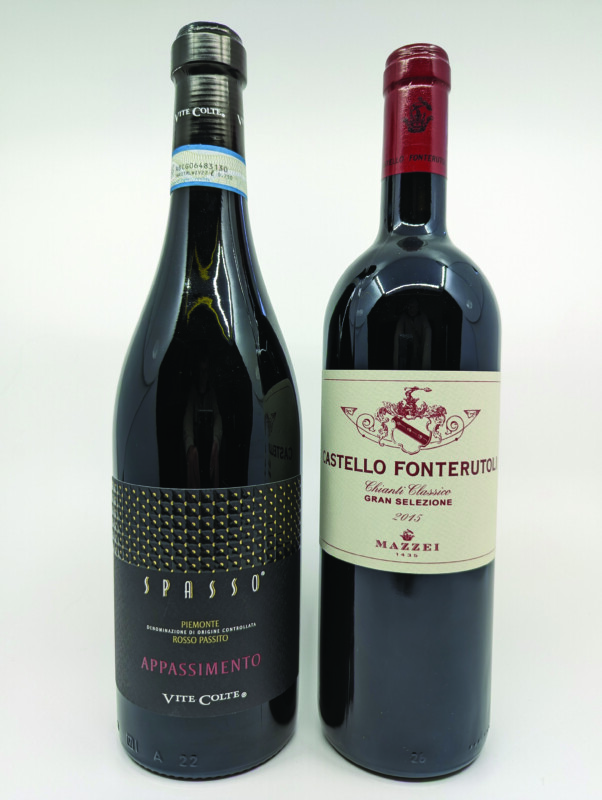
The Vite Colte Piedmonte Spasso Passito Appassimento Rosso, available at the New Hampshire Liquor & Wine Outlets, priced at $39.99 and reduced to $19.99, has a deep ruby red color. To the nose it is open and elegant, with ripe fruit of berries and plum. On the tongue, the wine is dry with light tannins; the fruit carries through with some herbaceous notes. Barbera is not grown on the best real estate of the Piedmont, but its lowly position should not be ignored. It is meant to be enjoyed young, is affordable, and is a perfect complement to the antipasto, or perhaps also enjoyed with the courses that follow.

The 2015 Castello Fonterutoli Chianti Classico Gran Selezione, from the Mazzei Vineyards, available at the New Hampshire Liquor & Wine Outlets, priced at $71.99 and reduced to $35.99, may not be the least expensive Chianti, but it is an excellent choice, coming from one of the most prestigious wineries of Tuscany, owned by the Mazzei family for 26 generations. This blend of 92 percent sangiovese, 4 percent malvasia nera and 4 percent colorino, two indigenous varietals, it hails from the vineyard’s best parcels. With a deep red color and pronounced fruit to the nose and tongue, this Chianti calls for rich, dark meats, mushrooms, herbs, herbaceous cheeses, root vegetables and braised greens. It will complement a rich, meaty secondi piatti.

Autumn is a time to settle back indoors. Plan a four-hour, multi-course Italian dinner, with family and friends. Enjoy the camaraderie of sharing a well-planned spread, paired with an excellent selection of wines. Repeat those great stories again, revisit those shared adventures, all enjoyed over great food and wine. Enjoy a meal the way Italians do!

Stay in the loop!

Get FREE weekly briefs on local food, music,

arts, and more across southern New Hampshire!