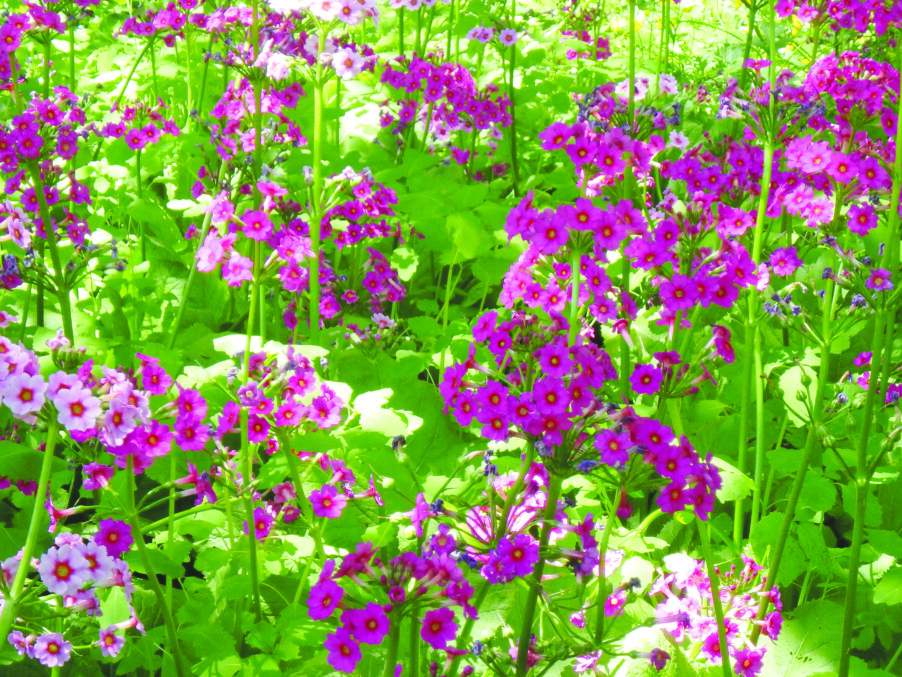
Asking me to name my favorite flower is, perhaps, like asking you to name your favorite child or dog. But late May brings one of my top picks: the candelabra primrose (Primula japonica). It sends up a flower stalk with a circle of florets, then it grows a few inches and sends out more blossoms, getting taller and blooming sequentially for nearly a month. They grow best in deep, rich, moist soil in partial shade and ideally under old apple trees.
Late May will also produce early peonies I love, including two part-shade peonies, Paeonia obovata and P. tenuifolia. The latter is also known as the fernleaf peony for its finely cut foliage; the blossoms are a deep red. Neither is common in garden centers, but keep an eye out for them.
Spring is a good time to improve your soil. Most commercial farmers grow food by adding chemical fertilizer to the soil before planting. I am an organic gardener, meaning I do not use pesticides nor do I use any chemical fertilizer.
Chemical fertilizers are safe to use but only provide three of the 17 elements needed by plants to grow and thrive. Granted, most of those elements are needed in very small quantities and may already be in the soil, but I want to provide my plants with the equivalent of a full five-course meal.
Chemical fertilizers only contain nitrogen (N), phosphorus (P), potassium (K), and lots of filler. A 5-10-5 fertilizer is 5 percent N, 10 percent P, and 5 percent K; the rest — 80 percent — is filler. Nitrogen in the form of nitrate and ammonia ions is used by plants to make proteins, fueling green growth. Phosphorus promotes growth of roots, blooming, seeds and fruits. Potassium is important for growing thick cell walls to survive cold and excess heat.
Plants also need other elements in order to thrive: calcium (for cell metabolism), magnesium (for chlorophyll needed for photosynthesis), sulfur (for making proteins and fats). Also needed are micronutrients like iron, chlorine, manganese, zinc, copper, boron, molybdenum and nickel.
All those elements are found in organic fertilizers like Pro-Gro, Gro-Tone and others. And while most chemical fertilizers provide water-soluble elements for quick absorption, organic fertilizers are mostly slow-release, providing key elements over a period of months, or even years. Most contain things like cotton seed meal, kelp meal, ground peanut shells and ground oyster shells.
So what can you do to improve your soil? Add compost. Don’t buy just a bag or two of compost and think it will improve your whole vegetable garden with some left over for new perennials. Borrow a pick-up truck and get a “scoop” from a front-end loader at your garden center. Or get it delivered. Alternatively, you can buy aged manure from your local dairy farmer. Even aged manure will have some weed seeds, but it will add good organic material that will be used by your plants.
Why is compost so good? Well-made compost is full of microorganisms that will work with your plants. Many produce organic acids that help to dissolve minerals from fine stone particles in the soil and make those minerals available to your plants. Compost is, or should be, biologically active: full of living bacteria and fungi. And it will improve soil texture making root growth easier for your plants.
Our soils were created back during the last Ice Age when glaciers a mile thick ground up bedrock, making sand and even the finer bits of stone that are in clay and loam. Fully 50 percent of all soil is made of ground up rocks. The rest? Anywhere from 1 percent to 8 percent is organic matter, and the rest, nearly 50% of soil by volume, is air. Oxygen is absorbed by root hairs from the air in the soil.
Two other key ingredients do not come from the soil. Plants get carbon, a major part of all plants, from carbon dioxide that is in our air. Nitrogen is in our air, but most nitrogen used by plants comes from decayed plant or animal material — or is made in a chemical factory and sold as a fertilizer.
I highly recommend getting your soil tested every three to five years. Each state university offers a service for gardeners and farmers. It will tell you soil pH (a measure of acidity), soil type, levels of some soil minerals and the percentage of organic matter. It will offer suggestions on what to add to your soil, though different plants have different needs. You should strive to have 4 percent or more organic matter in your soil.
You can perform a simple test to see how well your soil holds water or drains. Dig a hole 24 inches wide and 8 inches deep with sloping sides. Fill it with your hose and time how long it takes to drain. Sandy soil will drain almost immediately. Clay soil will hold water for several hours, even overnight. Good loam might take an hour or two, depending on how much rain you’ve had recently.
Adding compost to heavy clay or sandy soils will help them considerably. Soil texture and the ability to hold some water but drain well is important to most plants. Compost does both.
Improving your soil takes years, even decades. Yes, I do use some slow-release organic fertilizer at planting time, but my real success has come from years of adding compost.
You may reach Henry at henryhomeyer@comcast.net.
Featured photo: Candelabra primroses delight me each year, starting in late May. Photo by Henry Homeyer.
Folk Voices and Fantasies, an upcoming afternoon of classical music from the New Hampshire Philharmonic Orchestra conducted by The Phil’s Music Director Mark Latham, offers three works from three composers, each from a distinctly different corner of the world.
What binds together Igor Stravinsky’s Petrushka, Max Bruch’s Scottish Fantasy, and Carlos Chávez’s Sinfonía India isn’t style or era but instinct, Latham explained in a recent Zoom interview.
“The main connecting thread is composers using folk music from their native traditions,” he said.
For Petrushka, Stravinsky borrowed Russian folk songs and even a few German waltzes; most of its melodies weren’t his to begin with. Bruch did the same with Scottish reels and airs, and Chávez went even further, working not from memory or nostalgia but from within a living indigenous Mexican tradition.
To honor that, an orchestra member hand-built a traditional güiro for the performance. The notched hollowed-out gourd is usually played with tines and produces a ratchet sound. “Because the percussion element in the Chavez is very strong and uses a lot of Mexican instruments,” Latham said. “It’s trying as much as we can to use those instruments.”
It reflects a late 19th- and early 20th-century trend of composers “very interested to explore what was going on musically in their native arena,” Latham offered. “Bartok, for instance, was going out into the countryside before the advent of recorded sounds, actually notating local folk songs and that kind of thing … very early musicology.”
The concert begins with Stravinsky’s tale of a carnival puppet who turns out to feel things too deeply for his own good. It’s an exhilarating choice for an opener, and it concludes not with a bang but with a ghost: Petrushka, apparently killed, reappears hovering over the theater in the final bars, leaving the question of his humanity forever unresolved.
A superimposed C major and F-sharp major, called the Petrushka Chord, recurs throughout the work. It denotes the main character’s many dualities: puppet and person, ridiculous and suffering, knowable and unknown. The motif became a go-to for composers like John Williams, who used it for his “Theme From Jaws.”
Fifteen-year-old violin prodigy William Yeh solos on Scottish Fantasy. Yeh is a student at the Juilliard School in New York and last year’s Sempre Musick Competition winner. The Phil has collaborated with Sempre Musick for the past few years, Latham said. “These days, the Grand Winner plays their piece with the New Hampshire Philharmonic the next season.”
The piece is a back-and-forth that Latham described as a conversation. With the young soloist still developing his voice, it has its own particular texture — the orchestra takes its tempo from listening to Yeh, and shapes its phrases around his. “The soloist provides the main musical impetus, and then we answer.”
The evening ends with Chávez’s percussion finale and its offbeat sparks that, Latham said, “aren’t quite agreeing with the rhythm,” and a frenetic ending that inspires both audience and orchestra. “It’s like a rock drummer … ‘Let’s just go for it at the very end,’ right? It’s percussion going crazy.”
Latham has made the case throughout The Phil’s current season that classical music belongs to everyone. Folk traditions aren’t less powerful when they’re arranged for an orchestra, and the barriers people feel entering a concert hall are mostly imaginary.
“If people at a classical music concert would be more like a rock concert,” Latham said, “that’d be fantastic.”
Beyond that, he believes music is a salve for challenging times, remembering Romanian conductor Sergiu Celibidache’s observation in an interview with a French journalist 30 or 40 years ago. “Beauty is a stepping stone to freedom,” he recalled him saying.
Latham added that the act of creation is, more often than not, a political one.
“Some people say, ‘art for art’s sake’ — I’m not one of them,” he said, citing Leonard Bernstein’s words in the aftermath of his close friend John F. Kennedy’s assassination. “This will be our reply to violence; to make music more intensely, more beautifully, more devotedly than ever before.”
Folk Voices and Fantasies: Music Rooted in Culture and Imagination When: Saturday, May 30, and Sunday, May 31, at 2 p.m. Where: Seifert Performing Arts Center, 44 Geremonty Drive, Salem Tickets: $5-$35, nhphil.org
Featured photo: Clockwise from top left Sean Williams, Pauline Berger, Margot Lasalle, Anna Multone. Courtesy photos.
For gardening nerds and the occasional gardener alike, a trip to a top-notch “professional” garden is more fun than a week at Disney. Seeing what is really possible if you have enough experience and put in the hard work can be truly inspirational.
A really good resource for this is the reference book The Garden Tourist’s New England: A Guide to 140 Outstanding Gardens and Nurseries by Jana Milbocker, who views these visits as a good way to see gardening from somebody else’s perspective. She recommends paying close attention to the combination of plants that a master gardener has put together.
“People really give a lot of thought to how they use the forms of the garden design,” Milbocker said in a telephone interview. “I think it’s really helpful for me to go through a garden in that direction, to experience it the way that the garden owner wants you to experience it.” Thinking about the question “Why is this here?” can help reframe a home gardener’s outlook, she said.
But then, she advised, take a second look.
“You’re going to see things that you missed the first time. It’s possible also, for instance, a garden conservancy will have a garden open in the early summer and that same garden open later in the season, like late summer or early fall. It’s great to see any garden in different months because it can be vastly different. Different plants have beautiful colorful foliage in the fall. So to see a garden [over time] is really a great experience.”
A good way to find gardens to be inspired by is to take part in a sponsored garden tour.
Amy Murray is the Open Days Program Manager for the Garden Conservancy (gardenconservancy.org), an organization dedicated to garden preservation.
“We assist public gardens that are either damaged or are in need of preservation services,” Murray said. “We also give small grants to a variety of horticultural organizations that are bringing gardening to people and making significant impacts within their communities.” Murray’s particular job is working with gardens, public and private, in a given area, to help them participate in “Open Garden Days” — one or more days per season when the public can visit them.
“Unless you have a very explicit program or invitation through something like the Open Days program, there’s really not a ton of opportunities to see these spaces,” Murray said. “Open Days are absolutely wonderful because if you are interested in a garden and you want to see it, you have to go to that Open Day. There are no guarantees that a given garden will be open in a subsequent year or even ever again. We have a variety of gardens. Some love the practice of opening every single year. Some will take a few years off in between and then open once and then stay closed for several seasons. And then some will open once and never again. And so if you want to see it you have to see it on that day.”
Michael Gordon is in charge of working out the details for the Open Garden Days in New Hampshire. He said each garden in the program brings something different to each visitor.
“On one level, it’s just fun to have a nice day and you get to see pretty places. And then if you’re a more serious gardener like I am, you get ideas and see plants. It’s a good way if you live in the area to go to a garden and find out what they’re able to grow because you will be able to grow it too because it’s local to you. You can make a day of it and go from garden to garden. And people are generally really excited to share their garden,” Gordon said.
Another popular garden tour each year is put on by the Palace Theatre in Manchester. It is one of the Palace’s biggest fundraising events each year, said Box Office Manager Cherie Prior.
“The garden tour is a self-guided tour we’re running on June 20 this year,” she said. “In the morning, participants register at Demers Garden Center and they’re given a program, which lists the individual gardens. We have a combination of private and public gardens and [people on the tour] have the rest of the day to travel to the gardens and take their time at each one. Our host gardeners are there to talk about the garden and we have write-ups about each garden and its history and sort of the plants and the things that the host gardener wants to talk about.”
“We work with the Manchester Garden Club,” Prior said. “They help a lot about picking the gardens because they’re the ones out there looking at other people’s gardens and letting us know. We [the Palace Theatre] are invested in art in the community. And we consider gardens to be a part of that as well; a beautiful garden is just as valuable as a beautiful stage production. And we like to be able to promote beauty in any form within our community.”
Elinor Terrell of the Manchester Garden Club described the Palace Theatre Garden Tour as a way of giving area gardeners inspiration and a jumping-off point for their own garden projects.
“The Garden Tour is about showing the lovely hidden treasures of Manchester,” Terrell said. “We have little pocket gardens that are just tiny little things. We also have some of the nice big homes down on River Road. So it’s a wonderful way to show the treasures of the city and also to promote the love of gardening and inspiration. People will see them and go, ‘OK, I’ve got something like this. I could do this.’”
Palace Garden Tour. Courtesy photo.
The Garden Club of Deerfield will host a garden tour in June called “Heritage in Bloom” that will showcase gardens and plants tied to Deerfield’s almost 300-year history.
“One of the stops,” said Robin McKinnon, the President of the Garden Club, “is a fourth-generation property. It comes from the 1830s. And there are plantings of lilacs that were taken from the Governor Wentworth mansion in Portsmouth. And those were the original lilacs that came to the New World. We have one farm that lies within the region historically inhabited by the Algonquin-speaking peoples, including the Seneca and related groups of the Wabanaki Confederacy. And there’s a small family cemetery on site, including the grave of a young man who served and died in the Civil War. Another [stop on the tour] is a farm from 1742 that chooses plants for their beauty but also their sustainability and healing qualities — perennial herbs, fruits, trees, vegetables selected for their dependability and heirloom varieties long valued by earlier generations.”
There are a variety of garden tours throughout the growing season, but there are also public and private gardens throughout the state that welcome visitors but are not part of organized tours. Each appeals to a different type of gardener and embraces a different gardening philosophy.
For 17 years, Petals in the Pines in Canterbury has been a go-to choice for families to spend a day outdoors, hiking along trails and enjoying gardens. According to owner Donna Miller, if you haven’t ever visited, you probably should do so this summer.
“This year will be our last year of being open to the public full-time,” she said. “Four years ago, my husband Jim and I drew a line in the sand. We said, ‘Let’s do this for five more years.’ And this is Year Number 5.”
In addition to pollinator gardens and gardens where visitors can pick their own flowers, “we have 2 miles of outdoor trails,” Miller said. “We have two labyrinths that some people use to get in touch with their thoughts, almost like meditation. We have an outdoor classroom, and a Tale Trail, with laminated pages from four different nature books that parents can read to young children as they walk, and older children can read themselves. There’s something for everyone.”
For families who want to visit throughout the season, season passes are available.
The Canterbury Shaker Village (288 Shaker Road, Canterbury, 783-9511, shakers.org), on the other hand, probably not surprisingly, takes a more historical approach. The Shakers took growing plants very seriously, said Garrett Bethmann, the museum’s Manager of Communications and Engagement, and that is reflected in the gardens on the grounds today. “There are basically three main agricultural or garden spots that people can walk through and check out,” Bethmann said. “There are the granite beds, kind of that smaller plot of what people I think would traditionally see as gardens or botanical gardens. Then we have our farm fields, and those have a lasting imprint on the site. And then we have our orchards.”
“The orchard is filled with different versions of apple trees,” Bethmann said. “The Shakers used to grow apple trees in different locations throughout their close to 200 years of active living here. The orchards in the space, where they are now, first got placed there in about 1917, and a lot of those trees are from that time period.”
“The thing that I think has always been true about when people come and visit our spaces here,” Bethmann continued, “is that as best as we can, we try to use our gardens and our agricultural spaces as ways to showcase the Canterbury Shaker legacy and, as best we can, tie the things that we have going on now to elements and aspects of what they were doing in the past when the Shakers were here. So, for instance, over in our herb gardens where the granite beds are it’s a nice show of preservation in action. Typically we try to use the granite beds to kind of showcase some of the plants and herbs and perennials that were grown there in the past.”
Other gardens focus on plants that grow under very specific conditions.
The Evergreen Woodland Garden in Goffstown, for instance, features plants that thrive in the limited light found on the floor of a forest.
“It’s a one-acre woodland garden heavy on pines,” said Robert Gillmore, the garden’s creator. “There’s a total of around 400 rhododendrons. It’s probably one of the largest rhodi gardens in Northern New England. Of course, there are other ericaceous plants like mountain laurel and Lakota weed and so forth. It’s an extremely low-maintenance garden and it was designed that way. One of the problems, if you want to have a large garden, unless you’re rich with 20 gardeners on your payroll, it’s got to be low-maintenance. So with a woodland garden, one of the reasons it’s low-maintenance is that there’s no grass. There are no high-maintenance plantings, like trees and shrubs and ground covers. Another thing that makes it low-maintenance, of course, is that it’s in the shade. A woodland garden is a shade garden. And a shade garden is a slow ecosystem. Things happen slowly. Weeds happen slowly or not at all.”
“In gardening,” Gillmore said, “there is a quote by the poet Alexander Pope: ‘Consult the genius of a place,’ and by that he meant consult the special character of the site and use what’s on the site. The special character of Evergreen is a pine woods. The most expensive plants in a garden — the plants that are unavailable in any nursery at any price — were already there, planted, growing: the trees, free of charge. There are also some lovely large granite glacial erratics. It’s a wonderful topography,”
Bedrock Gardens. Courtesy photo.
Another approach to gardening is aligned with the Palace Theatre’s philosophy of gardening as an art form. This is the perspective of Bedrock Gardens in Lee. John Forti is the Executive Director there.
“Bedrock Gardens opened to the public formally as a public garden nine years ago,” Forti said, “and we just reopened for the season a week or so ago. It’s a 37-acre old farm that has been here for centuries. The founders of the garden, Jill Nooney and Bob Munger, worked for over 30 years to create a really fascinating garden infused with art and rare botanicals that has become an oasis of art and horticulture. It’s become a public garden where people can take garden tours, art tours, special educational programs and events for all age levels that really help people connect to nature and art and find just a really unique, beautiful green space. Unlike a lot of public gardens, this is really designed to just take you on journeys so that it can be a serene step away from the world, but a place where you can really find some sanctuary and some peace. Gardeners or art enthusiasts are drawn into every corner, because there are dozens of outdoor rooms, one after the next, each with its own mood and emotion and color palette and seasonal specializations and rare plants that just tell stories and pull you away from your daily life into experiences all throughout that 30 plus acres. [The art] is largely sculptural art that really is found in every nook and cranny.”
At NH Audubon’s McLane Center in Concord, the focus is immersing visitors into native species. The Center’s Diane DeLuca said that an aim has been to restore an entire ecosystem. “Four years ago or so,” she said, “we restored an old field area that was full of invasives to an acre of pollinator meadow. It hasn’t been possible to clear out all the invasives, as you might imagine, but now there is at least an acre of native pollinator plants out there. We also have native plant pollinator gardens that go all the way around the building. And also up on the hill there’s some space that we call our butterfly garden, which is meant to be more attractive to some of the species of butterflies that move through here — monarch butterflies specifically — and the pollinators that use areas late in the fall, including migrating butterflies.”
“Our gardens here,” DeLuca said, “are meant to be as diverse as possible in order to attract all kinds of wildlife. They have a lot of different structural diversity, meaning we have some attractive trees for pollinators, which would include our birds, some of which are actually nesting in and around the garden. It’s definitely an area that’s attractive for hummingbirds, because there are a lot of plants that are in here that specifically hummingbirds enjoy and will be pollinators of those particular plants as well. The structural diversity in the garden allows for different wildlife species.”
A decision was made early on when planning the Audubon’s gardens, DeLuca said, to fill it with plant species that would peak throughout the entire growing season.
“We have blooms that start in the early part of the spring … and are available for pollinators to come out early, like queen bumblebees and some of the other bees which tend to emerge pretty early in the season and need plants that they can both nectar on and get pollen from. We think about blooms across the season, into mid-summer, and then as late as possible into the fall. We also think about diversity of the flower structures for those plants, because some of the pollinators need plants where they don’t have to get their tongues deep into the plants, because they don’t have that ability. Some of them can reach far in. So you want plants that are tubular, that hummingbirds might be attracted to. You want plants that are flat-topped, that are much easier for some of the bees and butterflies to get into. We want a diversity of structure. so that we can attract many different forms of wildlife into the garden.”
Public gardens
Here are some area public gardens.
Bedrock Gardens (19 High Road, Lee, 659-2993, bedrockgardens.org) A nonprofit public garden that integrates unusual botanical specimens, unique sculptures, and interesting landscape design and features into an inspiring journey. This 30-acre site has recently transitioned from a historic farm and private garden to a self-described “public oasis of horticulture, art, and inspiration.” Adults $15. Children 12 and under free.
Brigit’s Garden in Livingston Park (156 Hooksett Road, Manchester) A public garden within Livingston Park, created by the Brigit A. Feeney Foundation for Hope and Healing, in memory of Brigit A. Feeney, a victim and witness advocate with the NH Department of Justice, who died in a motorcycle accident in 2021.
Canterbury Shaker Village (288 Shaker Road, Canterbury, 783-9511, shakers.org)Canterbury Shaker Village describes its mission as “preserving and sharing the legacy of the Canterbury Shakers, promoting learning, connection, and rejuvenation for people from down the street and around the world.” There are three main gardens on site: an herb and culinary garden, apple orchards, and farm fields. Throughout the summer the Village will be open seven days a week from 10 a.m. to 4:30 p.m. Nature trails are free to explore daily from dawn to dusk. Adult admission is $25.
Kimball Jenkins Estate (266 N. Main St., Concord, 225-3932, kimballjenkins.com) A historic mansion in Concord, now the site of the Kimball Jenkins Art School. The campus grounds have gardens that are currently under renovation.
Maple Hill Gardens at the Beaver Brook Association (117 Ridge Road, Hollis, 465-7787, beaverbrook.org/visit-us/maple-hill-gardens) “There are 13 themed gardens, a natural play area, a demonstration compost court, picnic areas and even a wildflower trail to explore,” according to the website.
New Hampshire Audubon Society NH Audubon has two visitor centers in the region with gardens: The Susan N. McLane Audubon Center (84 Silk Farm Road, Concord, 224-9909, nhaudubon.org/center-and-events/mclane-center-concord) is open Wednesdays-Saturdays from 11 a.m. to 5 p.m., with trails and pollinator gardens open from dawn to dusk daily; Massabesic Center (26 Audubon Way, Auburn, nhaudubon.org/center-and-events/massabesic-center-auburn) is open Wednesdays-Saturdays from 11 a.m. to 5 p.m., with trails and pollinator gardens open from dawn to dusk daily.
Petals in the Pines (126 Baptist Road, Canterbury, 783-0220, petalsinthepines.com) A family-friendly farm with hiking trails, pollinator gardens, PYO flower bouquets and a farm stand. The summer of 2026 will be its final year open to the public. Open Wednesday through Sunday; closed Monday and Tuesday. Season passes are available for $25.
Pickety Place (248 Nutting Hill Road, Mason, 878-1151, pickityplace.com) An 18th-century Cape surrounded by vast, well-established garden beds, mainly perennials and herbs. The herbs are served in the restaurant’s five-course lunches.
Garden tours
Here are some upcoming garden tours. Know of any tours not mentioned here? Let us know at adiaz@hippopress.com.
37th Annual Pocket Gardens of Portsmouth Tour What: The tour features 10 private gardens in the historic South End neighborhood of Portsmouth, the Goodwin Garden at Strawbery Banke Museum, and the garden at South Church. When: Friday, June 19, Saturday, June 20. Admission: Early bird tickets $25 (until June 13), general admission tickets $30 (June 14, until day of tour). More info: Visit portsmouthnhtickets.com/e/37th-pocket-gardens-of-portsmouth
7th Annual Palace Theatres Garden Tour What: A self-guided, self-paced tour of both private and public gardens throughout Manchester. When: Saturday, June 20. Admission: Tickets are $20. Registration is from 9:30 a.m. to noon at Demers Garden Center in Manchester. More info: Visit palacetheatre.org/events/2026-garden-tour.
4th Annual Lilac City Garden Tour What: Organized by Lilac City Gardeners (formerly Rochester NH Garden Club). Local gardeners will showcase their gardens, share knowledge, and inspire others in the community. When: Saturday, June 20. More info: Visit Lilac City Gardeners’ Facebook page.
Heritage in Bloom What: A tour of six historic gardens in Deerfield. When: Saturday, June 27. Admission: senior/student $8, general admission $10, carload $30. More info: Visit givebutter.com/heritage-in-bloom
Jaffrey Artist and Garden Tour What: Features local private gardens, each hosting a local artist at work. You’ll have the chance to see artists create in real time — painting, sketching, and capturing the beauty of each setting. When: Saturday, July 11. Admission: $15. More info: Visit jaffreyciviccenter.com/event/event-artist-garden-tour.
Hospice Home and Garden Tour What: A tour of four residential properties on or near Lake Winnipesaukee, benefiting Granite VNA. When: Wednesday, July 15. Admission: $55 Visit granitevna.org/ways-to-give/hospice-home-garden-tour.
Garden Conservancy’s Open Garden Day What: A self-guided tour of some of the area’s best public and private gardens in Manchester, Nashua, Milford, Pelham, Hollis, Hudson and Hooksett. When: July 18. Admission: $10, by pre-registration only. More info: Visit gardenconservancy.org/open-days/ticket-release-dates
The Second Annual Five Senses Tour at Tiffany Gardens What: Use your five senses while exploring the private gardens hidden in a quiet Londonderry neighbor. Enjoy food, drink, music, art and nature. When: Saturday, July 25, and Sunday, July 26. Admission: $20. More info: visit comcaregivers.org/garden-tour.
Manchester’s Taco Tour takes place today from 4 to 8 p.m. in downtown Manchester. See tacotourmanchester.com and our story in the May 21 issue on page 24, available in our digital library at hippopress.com.
Saturday, May 30
Sip and Sun Brew Fest will take place today from noon to 4 p.m. at Mel’s Funway Park in Litchfield, featuring tastings from local breweries, live music from The Slakas, food trucks and more, according to melsfunwaypark.com, where you can purchase tickets.
Saturday, May 30
NH Roller Derby continues its season with a doubleheader against Garden State Roller Derby today at 4 p.m. at JFK Coliseum, 303 Beech St. in Manchester, according to nhrollerderby.com.
Saturday, May 30
Synthfest 2026, an evening of live electronic music, will take place today from 5 to 8 p.m. in Rollins Park Gazebo in Concord, according to boseyjoe.com/synthfest. The line-up includes Bosey Joe, Green Leader and Hyponova, according to the website.
Saturday, May 30
Concord Community Music School’s “New England Roots & Branches” series will hold a Contra dance today, starting with an open slow jam session at 6 p.m. followed by a dance called by David Millstone at 7 p.m. at the Citywide Community Center on Canterbury Road in Concord, according to a school newsletter. Performers include Audrey Budington, Jordan Tirrell-Wysocki, and Liz Faiella on fiddles and Dan Faiella on guitar, the newsletter said. See ccmusicschool.org.
Saturday, May 30
Just Another Day, “a heartfelt and humorous theatrical production starring acclaimed actors Dan Lauria and Patty McCormack,” will be presented by The Front Door Agency at Souhegan High School in Amherst today at 7:30 p.m. and Sunday, May 31, at 2 p.m., according to a press release for the Front Door Agency, an “organization that invests in New Hampshire individuals and families as they transition from crisis to self-sufficiency.” Lauria is best-known for his role as Jack Arnold, Kevin’s dad, on the original The Wonder Years, and McCormack’s career in theater, television and film included her role in The Bad Seed as a child, the email said.
Saturday, May 30
The Nashua Chamber Orchestra wraps up its 2025-2026 season with a concert tonight at 7:30 p.m. at the Nashua Community College featuring “the next generation of award-winning musical talent,” according to a press release. “Sixteen-year-old Antonio Casarano will perform Haydn’s Cello Concerto in C major. The orchestra commissioned a new work, Celebratory Overture by Nashua High School senior, composer & oboist Anthony Umbro, which will be premiered. Other works performed will be Delius’ On Hearing the First Cuckoo in Spring and Schubert’s ‘Tragic’ Symphony,” the release said. The orchestra will also play Sunday, May 31, at 3 p.m. at Milford Town Hall. See nco-music.org for tickets.
Sunday, May 31
The Palace Theatre’s annual Kitchen Tour will take place Sunday, May 31, from 10 a.m. to 4 p.m. featuring a self-guided tour of kitchens in southern New Hampshire, according to palacetheatre.org, where you can purchase tickets (a lunch is included).
Friday, June 19 Northlands Music and Arts Festival will take place Friday, June 19, through Sunday, June 21, at the Cheshire Fairgrounds in Swanzey, according to northlandslive.com, where you can purchase passes to the festival for three days or one day and find information about camping and parking. You can also find the line-up of bands on each day (Dirty Heads, pictured, is slated to perform Friday) on the website as well as information on food, craft and art vendors, health and wellness activities and kids’ activities.
The New Hampshire Fisher Cats occasionally play under two other names during home games: the Manchester Chicken Tenders (to celebrate Manchester’s reputation as the “Chicken Tender Capital of America”) and the New Hampshire Space Potatoes (celebrating New Hampshire’s special history of UFO reports). In an open letter to the team on May 12, the Physicians Committee for Responsible Medicine asked the team “to retire your Manchester Chicken Tenders identity and stop Tender Tuesdays, both of which promote unhealthy fried chicken.” The letter went on to explain that “eating 300 grams of poultry — about six typical chicken tenders — per week has also been found to increase the risk of gastrointestinal cancer and death from all causes.”
QOL score: -1 because, we know, docs, but hands off our tendies (meanwhile, chicken tender fans can head to instagram.com/tendertownies to check out the 2026 Chicken Tender Passport challenge and contest going on until July 21 at participating Manchester restaurants)
Comment:In a May 20 email to the Hippo, Fisher Cats General Manager Taylor Fisher wrote: “We are aware of the press release from the Physicians Committee for Responsible Medicine. The Chicken Tenders is an alternate identity meant to capture the fun, quirky nature of Minor League Baseball, an experience we’re proud to create for our fans no matter what we’re playing as. We’re equally proud of the local history the identity is based on, paying homage to Manchester’s Puritan Backroom Restaurant, where the chicken tenders were invented in 1974, a legacy our community understands and celebrates.”
Spring can be hard on a person’s lungs
Last week was a rough week for air quality. In a May 19 online article, NHPR reported that the New Hampshire Department of Environmental Services had issued a Code Orange alert “in anticipation of unhealthy ground-level ozone in Rockingham County,” adding, “The air quality alert also covers parts of the state that are higher than 2,000 feet in elevation.” Additionally, a May 22 forecast on accuweather.com predicted levels of airborne tree pollen between “high” and “very high” for the following week in the Manchester area.
QOL score: -2
Comment:According to the NHPR article, “a ‘code orange’ is an alert issued when air pollution levels are considered unhealthy for children and older adults, anyone with lung disease, and people who are active outdoors. Experts recommend people take precautions by limiting outdoor exertion.” AccuWeather.com advised pollen-sensitive breathers, “During peak season for tree pollen, keep your windows and doors closed, especially on windy days. Avoid outdoor activities in the early morning, and be sure to shower and change clothes after coming indoors. Taking allergy medication can also help alleviate symptoms.”
QOL score last week: 51
Net change: -3
QOL this week: 48
What’s affecting your Quality of Life here in New Hampshire?
It’s not officially summer, but it makes it feel like summer has arrived. However, it brings an early holiday deadline that messes with my usual formula, so I’m doing something a little different today by giving my blueprint for how the C’s should reshuffle the deck.
Sports 101: Name the only three basketball players to win a HS State Championship, NCAA title, NBA title and Olympic gold.
News Item – Calendar Day: Come Monday, June 1, the Eagles can affordably make the long-rumored A.J. Brown deal to the Pats. What cost is moving him worth to you? Not more than a second-round pick for me, because at 29 he’s probably got three years left as a prime receiver.
Celtics Blueprint
The annual “we have to split up Jayson Tatum and JaylenBrown” nonsense has begun. However, while it is a dumb practice, I could live with a deal for either depending upon whether the offer was eye-opening enough. It would have to achieve at least one of the following; (1) Makes them younger and deeper. (2) Someone in the middle who can cover JoelEmbiid. (3) Spreads out years between max contracts to top players to manage the cap better. (4) A younger, cheaper on-the-way-up guy who’ll grow into what Brown or Tatum were at the same age in their careers.
Who Goes – Tatum or Brown: This year taught us they can win with either. So the one who goes is simply the one who brings the most back. That’s likely Tatum.
Rumors – GiannisAntetokounmpo: He’s one of my all-time favorites. But he’s 32, unsigned past this year, and his last two seasons have ended with injuries. All red flags. The only place he improves what’s needed most is size and scoring underneath.
A few names who’d interest me:
Nikola Jokic – Not likely, but Denver may be looking to shake it up. They’d give up quickness to fill the hole in the middle while improving ability to score better in half court and rebounding.
Deni Avdija – What’s not to like? He scores, rebounds and passes. Just nobody around here knows how good he is.
Stephon Castle – This guy’s got it — duende. A winner.
Jalen Johnson– It took him a while to get the career going with Atlanta but he’s been solid the last two years, culminating with last year’s 22.2 points, 10.7 rebounds and 7.9 assists per game.
Acceptable deals:
Scottie Barnes and R.J. Barrett –Makes them more versatile offensively by adding two 20-point-per-night scorers for Toronto last year.
Amen Thompson– His age 21, 22 and 23 with Houston were all better than Brown’s. And he’s already the best wing defender in the league. Throw in 7-footer Jabari Smith to add size in the middle and I’m in.
The Numbers:
22 – points behind with 8:19 left before the Knicks overcame the largest fourth-quarter playoff deficit in franchise history in their 115-104 Game 1 playoff win over Cleveland
60.2 – regular season shooting percent for MVP Shai Gilgeous-Alexander, which is unheard of by a guard
A Little History – The Memorial Day Massacre: It was an epic beatdown when the Celtics opened the 1985 NBA Finals with a 148-114 Game 1 slaughter of the Lakers. So bad that Celtics rookie CharlesBradley turned it into the first Celtics dunk-a-thon.
But it was also a lesson that taught all it was just one game, nothing more. Which L.A. demonstrated by winning the next two leading to a 4-2 Finals win.
Sports 101 Answer: The rare four-title champs are Jerry Lucas, Magic Johnson and Quinn Buckner.
Final Thought – Be Careful What You Wish For: The L.A. Clippers had Kawhi Leonard ready to re-sign if they could acquire another major star like Oak City’s Paul George. Which the usually wrong pundits all said would make them a true contender. But this deal reminds us trades are not won on paper, as Thunder GM SamPresti used L.A.’s desperation for a star to extract an astonishing six first-round picks and an afterthought rookie on their current roster for George.
So who won that deal? Well, the Clippers never won more than 51 games, missed the playoffs entirely once, were Round 1 losers twice, and after playing just 236 of 410 games with L.A. the constantly injured George is now in Philly.
Meanwhile one of those six picks became All-Star JalenWilliams, and that rookie thrown into the deal is now two-time MVP Shai Gilgeous-Alexander after leading them to become reigning NBA champs and getting close again. And astonishingly they still have the 12th pick this year from a deal made in 2020.
Thus desperation led L.A. to make arguably the worst NBA trade in history.