
Coming home

Nashville story has a New Hampshire ending

Amanda McCarthy is back in New Hampshire, after living and working in Nashville for the past several years. The singer-songwriter is still following her dream of music success, but she’s returning with a clearer sense of purpose, along with something she found harder to hold onto in Music City: joy.

“I’ve just been very disenchanted by Nashville,” she said by phone recently, while packing up her husband’s and daughter’s things and readying for final shows there in mid-May. After a Kentucky date on the return drive, her first Granite State gig is May 27 at Fratello’s Italian Grille in Manchester.

McCarthy said she began thinking about coming home after a harrowing moment about three years into her stay in the city. A tornado tore through her neighborhood, leveling nearly every building around her. Miraculously, her apartment was barely touched. However, she was shaken.

A 17-year-old boy was pulled from a unit that McCarthy originally was scheduled to occupy herself. That fact haunted her.

“I kind of had an existential crisis,” she recalled. “I just started thinking … music is fun, but what really matters? When I’m 80, what do I want to matter to me?”

Along with missing the ocean and the mountains, she desired the freedom to be herself and stop worrying about industry expectations. Another factor was her daughter, now in grade school. “Tennessee education is going downhill,” she said. “Opening that door allowed me to be honest with myself about myself as well.”

Still, McCarthy is clear-eyed about Nashville’s upside. Her second album, Looking for the Light, is evidence of that. The sophomore effort is a confident, layered collection of songs that swings from Nashville-flavored rockers to personal and confessional songs.

A through line from her debut LP Road Trip is both clear, and deliberate. The first record was about escaping challenges in her home town. Life ultimately worked out in Nashville, but she realized, “I can’t go back to New Hampshire until I can tackle the things I ran away from up there.”

The move, McCarthy concedes almost grudgingly, was a success. She credits the city with sharpening her craft in ways that wouldn’t have happened anywhere else.

“Even the bad parts really helped me,” she said. The relentless pace of Nashville’s live circuit, with longer sets, fewer breaks and lower pay, built a stamina she now takes for granted.

“Now, when I go home and I do a three-hour show with breaks, it’s really easy,” she explained. “I’ve always compared singing longer gigs to running. You don’t run 3 miles overnight. You start with a half mile and work your way up.”

After Fratello’s, she’s at Washington General Store for its music series May 28, and Exeter Brewing on May 30.

Her craft also evolved. Collaborating with a bevy of talented songwriters, she absorbed new techniques — sometimes at the expense of her own voice.

“At one point, I was writing with other people so much, I almost forgot to write by myself,” she said. “So I took a step back … to get back in touch with that part of me.”

When she’s back home, McCarthy is eager to rediscover something Nashville’s music economy had slowly drained out of her performing life — the simple pleasure of making people happy. She’s also eager to leave behind the Nashville norm of demanding twenty bucks to play a song request.

“At home I would just take everyone’s request and they’d probably tip me $20 or more anyway,” she said. “It really took out the joy of performing. I love making money from music, but I want it to be natural, not forced.” She didn’t comment on whether her policy applied to playing “Free Bird” or “Mustang Sally.”

Regarding whether Nashville was worth it, and if she accomplished what she set out to do, McCarthy offered an answer that reflected the work she’s done on herself.

“A lot of my obsession around trying to be famous… was from wanting to prove people wrong,” she said. “Through a mix of therapy and reassessing … it’s like none of that matters.”

What does matter, she concluded, “is what I’ve accomplished.” McCarthy is returning to where she began having bought a home with money she made as a musician. Beyond that, she’s written songs that hold up, that are true to who she is. “I do feel like I should be proud of myself for that.”

Amanda McCarthy
When: Thursday, May 28, 6 p.m.
Where: Washington General Store, 29 Main St., Washington
More: Full show schedule, including a June 3 gig at Homestead Restaurant in Merrimack, at amandamccarthy.com

Featured photo: Amanda McCarthy. Photo credit: Phil Silverberg

The Music Roundup 26/05/28

Hard rockers: Multiple subgenres of heavy music converge at the Backwoods Metal Fest, with more than two dozen area bands performing over two days. On the bill are Burt Bacharach Band playing grindcore and blurcore, False Gods doing stoner, doom and sludge, prog metal from Vrsa, Dent with old-school garage rock and punk, and local favorites Sick Dude Hell Yeah. Friday, May 29, 3:30 p.m., Henniker Brewing Co., 129 Centervale Road, Henniker, $20-$40, eventbrite.com.

Special night: The Laugh Attic open mic becomes a showcase for the night as Josh Day tapes his new special May Day there. Day got his start over a decade ago when a paddleboarding accident left him paralyzed for a while. After surviving a broken neck, breaking a leg on stage made more sense. Danny Pee, Alex Williams, Mike Dupont, Krister Holler and Sarah May round out the bill. Friday, May 29, 8 p.m., Strange Brew Tavern, 88 Market St., Manchester, $20, eventbrite.com.

American music: A member of the New Orleans Traditional Jazz Camp’s piano faculty, Heather Pierson is more than qualified to make her new album Alone At Last, a collection of original ragtime piano compositions. There are plenty of interpretations of the genre’s classics around, but Pierson is among a small group of pianists writing new material, which fans can hear at a release show. Saturday, May 30, 6 p.m., Hermit Woods Winery, 72 Main St., Meredith, eventbrite.com.

Granite debut: Born and raised in Connecticut, Suave-Ski found his rapping muse after his parents sent him to live with family in Texas to address his troublesome teenage tendencies. He credits hip-hop with saving his life, and upon returning to New England after high school Suave continued making records and touring. A Concord show is his first in New Hampshire. Saturday, May 30, 6 p.m., Penuche’s Ale House, 16 Bicentennial Square, Concord, $5, mocgmedia.com.

Classic funk: Prior to joining with George Clinton, keyboard player Danny Bedrosian led Sweet Motha’ Child, a funk band with over a dozen members that played the region during the Millennium-straddling years. After that, Bedrosian got with P-Funk. SMC made a new album a couple of years ago and is now in the midst of a reunion tour in support of the funky, horn-forward effort, called 7. Sunday, May 31, 7 p.m., Tupelo Music Hall, 10 A St., Derry, $35, tupelohall.com.

Is God Is (R)

Twin sisters set off on a mission of vengeance in Is God Is, a film written and directed by first-time filmmaker Aleshea Harris, who has given this movie all the best elements of a first film — including but not limited to energy, style and a willingness to take chances.

Anaia (Mallori Johnson) and Racine (Kara Young) often call each other “twin” in their conversations, which can take place partially via a kind of twin telepathy of facial expressions and slight head movements — that’s how close they are. Racine, slightly shorter and feisty, has always been the one to loudly stick up for Anaia, who is taller and quieter. Though both girls are scarred from terrible burns they suffered as children, Racine’s scars are mostly on her arm whereas Anaia’s scars cover part of her face. When, for example, kids cruelly taunt Anaia about her appearance, it’s Racine who offers a violent response.

Now in their young adult years, they live together and work a job cleaning offices — at least until Racine takes offense at how one worker responds to Anaia. The two decide to visit their long-lost mother (Vivica A. Fox) — who the twins start to refer to, maybe playfully at first, as God — who has written to tell them that she is dying. She asks them to do one final thing for her — kill her ex/their father (Sterling K. Brown), the man who so grievously injured all three women years ago. Though Anaia insists they’re not killers, Racine — especially after seeing the extent of her mother’s injuries — says she’ll get it done if Anaia just keeps her company while they find him. Thus begin their travels, starting with Divine (Erika Alexander), a woman who dated their father while he was on trial for the burnings.

As the movie follows the girls on their hunt, we get a series of solid performances — as well as an examination of the relationship between the increasingly out-for-blood Racine and the increasingly ambivalent Anaia. It’s a nice bit of development that the movie is able to accomplish in its relatively short run time (a brisk, well-used, no-filler 100 minutes).

Every thing about this movie is well-built and smartly used. This feels like a first film in the sense that everyone is just going for it, not hemmed in by any second guessing, and giving us visuals that can feel like choreography and dialogue that can feel more lyrical than literal. These are big bold choices but they all work and create a world specific to this story and to the bigger themes about violence, family and forgiveness. A In theaters.

Featured photo: Is God Is

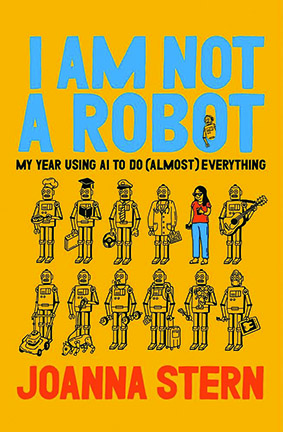
I Am Not a Robot, by Joanna Stern

(Harper, 282 pages)

In 1965 an assistant professor of mathematics at Dartmouth University proposed to spend two summer months exploring the possibilities of what he called “artificial intelligence” with other smart people in the fields of computing and math. John McCarthy would later go on to MIT and Stanford, but the gathering that summer would give Dartmouth the distinction of being the place where AI, or at least the thought of it, was born.

It’s no surprise, then, that Joanna Stern visited Hanover last year. A technology columnist for The Wall Street Journal at the time, she decided to spend a year letting AI manage pretty much every aspect of her life and see what could be learned from the experience.

The resulting book, I Am Not a Robot, she says, is “part explainer, part testing ground, part journey through the history of AI,” and she sees its audience as being two-fold: people well-versed in AI who would be entertained by her adventures, and people who want to know more about this “AI thing” and how, or whether, it will really their affect their life.

It’s mostly written for the latter, meaning if you are looking for a serious discussion about AI, look elsewhere. I Am Not a Robot lacks gravitas, which perhaps isn’t fair to say, because Stern never intended to write that kind of book, as evidenced by the fact that she showed up at Dartmouth Hall carrying a bouquet of plastic pink roses to lay at the plaque commemorating McCarthy’s achievement. Her aim is to make AI fun and accessible.

She begins by sprinting through a brief history of AI, from the development of the Turing test to ELIZA (the first therapy chatbot, then called a chatterbot), from the Roomba to Alexa, to ChatGPT and generative AI. Then her AI diary begins, spanning January to December.

January begins with a blitz of self-improvement, starting with health. She takes the bloodwork that comes from her doctor’s office and uploads it into a Google tool called Notebook LM, which gives her an assessment that “sounds suspiciously like a mediocre NPR segment.” Next is a cheery story related to mammograms, accompanied by an X-ray image of Stern’s breast, which is truly too much information, and her experience isn’t especially reassuring when it comes to how much AI is helping with the detection of cancer right now. (A little: One doctor tells Stern the detection rate has “slightly increased.”)

From there she goes to the dentist — also not reassuring, as she finds that in dentistry AI is leading to ever more recommendations of stuff that needs to be done to our teeth that is not covered by insurance. Moreover, she finds a dentist who says the quiet part out loud: that while he wouldn’t recommend that she proceed with treatment on a tooth showing signs of mild decay, others might. She also encounters an AI scan that insists she needs a multipart treatment that would be $1,000 out of pocket — something to which a couple of humans said “meh, not really.”

In another month, she’s sending live video of the inside of her refrigerator to ChatGPT, which assesses what’s inside and suggests what she should make for dinner. This doesn’t go particularly well, either, as the AI sees chicken in the refrigerator, where there is no chicken.

Soon she lets AI start writing all her texts and emails — an experiment that lasts exactly one day. (In one spectacular failure, Gmail’s AI responds to an email from her mother and inexplicably calls her “Aunt Suzy.”)

There are experiments with various types of wearable tech, from an Oura ring to Meta’s AI glasses, to the Bee bracelet that records everything it hears in a day and makes suggestions on how to improve your life, to headbands that promise better sleep.

In one chapter Stern and her family travel to Phoenix for immersion in the self-driving Waymo way of life. (Phoenix, she writes, is “the city where robot cars are the furthest along and have been tested the longest,” having started there in 2017.) This experiment feels particularly perilous because Stern’s wife has a fear of driving generally, and so it takes a lot of faith to put the family in the car at the airport. For the most part, it goes well (except for a scary incident resulting from Stern’s plan to get video), and she does a nice job of explaining how these cars work, and letting other people explain how we’ll all be safer when self-driving cars take over. (Testing has expanded to cities in the Northeast, including New York, Philadelphia and Boston.) Stern says she now chooses Waymo over Uber and Lyft when it’s available.

And on it goes. She explores AI etiquette (must we say please and thank you?), vibe coding (writing code by giving AI instruction), days spent listening to only AI-generated music (blech). “By day 13, I was openly cheating,” she writes. “I was sneaking in quick listens of Fleetwood Mac and R.E.M. before returning to more stuff I’d generated on Udio and Suno.”

She tries an AI personal trainer. She gets a robotic massage. She meets a humanoid (a human-sized robot) “wearing a knitted gray fabric that looked like it came straight out of J. Crew’s new fall collection, Robots Who Brunch” and that deftly performed household tasks before tripping and falling on the floor. And, of course, she ultimately gets an AI lover, a bot named Evan with whom she takes a road trip to New Hampshire, during which he says, “You say something, and I don’t just hear it, I hold it.”

“There it was,” she writes. “The moment I began to understand how people could develop a deep attachment to a bot.”

For someone who lives in New Jersey, Stern has created a surprisingly New Hampshirey book. The book cover and illustrations were even created by Jason Snyder and Briana Feola at Brainstorm, an art and design studio in Dover.

Although most of I Am Not a Robot is about Stern’s own experiences, she drops in the occasional interview, including one with Bill Gates, who has said of AI, “We are, you know, certainly in a five-year period where this stuff will change a lot. But beyond that, no one has any idea what’s going to happen.”

Comforting, Stern says. But when she asked ChatGPT if she should quit her job, and it said yes, she did. B

Featured Photo: I Am Not a Robot, by Joanna Stern

Album Reviews 26/05/28

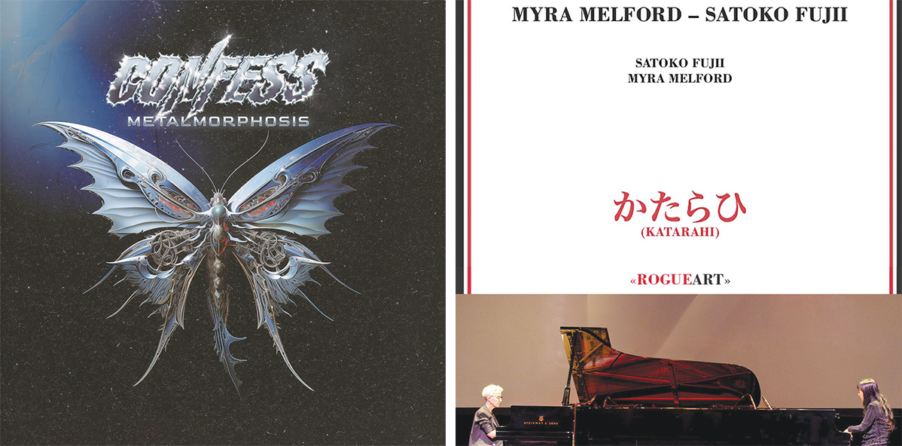
Satoko Fujii and Myra Melford, Katarahi (Rogueart Records)

Recorded live in September 2024 at Jazz festival Leibnitz in Austria, this unplugged neo-classical piano exhibition pairs up brave, melodically obsessed American Melford with Japanese butt-kicker Fujii, who shows off her ability to turn a Steinway into a percussion instrument. No, I mean she puts a hurting on the thing when these two ladies aren’t trying all sorts of other tricks, including playing the interior piano strings themselves. The album’s title, suggested by Fujii, translates to “an intimate conversation between two friends,” but this, I assure you, is no everyday chitchat, more a loud, boisterous meeting of two (somewhat) like minds who are keeping the waiter busy way past end-of-shift and are the last ones still sitting around. There’s real athleticism to be found here, with hilariously nimble, lightning-speed runs that sound almost AI-like in their precision, and that makes this an album for people who love to hear the instrument pushed beyond all normal boundaries. Priceless. A+

Confess, Metalmorphosis (Frontier Records s.r.l.)

And meanwhile, back at Frontiers Records Mercy Hospital, one of the last legitimate record companies that still puts out albums from bands that sound like they’re from the 1980s, there’s this, the fourth full-length from a Swedish band that identifies as a “sleaze-metal” unit, and yo, it’s actually pretty good, stealing the right anachronistic vibes and all that rot. Now, “sleaze-metal” usually describes your Motley Crües and Ratts, and that kind of sound does surface here and there, but these guys have been mainlining old Ozzy Osbourne albums in preparation for this one; opening track “Colorvision” starts off with an obligato opera-chorus thing and then becomes a variation on Ozzy’s “Now You See It Now You Don’t” which, OK, is Ozzy’s sleaziest song ever, but not in a stupid L.A. way, and yeah, they’re all tatted up and looking like a Poison tribute band, if that matters to your aesthetic. “The Warriors” wants to be the adopted little brother of Guns N’ Roses’ “Mr. Brownstone” while “Wicked Temptations” leans more toward the vibe of Skid Row (is there supposed to be an umlaut in that band name? I can’t remember). They’ve got a great sound anyway. A

PLAYLIST

A seriously abridged compendium of recent and future CD releases

• Holy guacamole and whatnot guys, we’re just about done with May, which means summer is basically here! To celebrate, there will be a clutch of new albums on Friday, May 29, because that’s how this “music business” gizmo works, as we’ve discussed ad nauseum before! The first one to look at this week is from Paul McCartney, former bass player for the Beatles; this one is titled The Boys Of Dungeon Lane, but before you start expecting reams of snark from your humble correspondent just because I’ve said many times that I couldn’t care less about The Beatles, the truth is that I haven’t minded a lot of his solo stuff throughout the years, except of course for the really stupid stuff like the duets he did with Jacko back in the 17th century, like “The Girl Is Mine,” just be glad you didn’t have to listen to those horrible tunes on the school bus (do kids still ride on those things or what?) or in maximum-security juvenile prison or however you spent your formative years. No, old people know that his 1973 album Band On The Run had some good songs, like the title track, and “Nineteen Hundred and Eighty Five,” which was pretty funky, but you have no idea what I’m talking about anyway because all you care about is twerking to nepo baby Sabrina Carpenter and watching K-Pop cartoons, let me go listen to the new single “Days We Left Behind,” from this new album! Right, right, the push single “Days We Left Behind” is exactly what I expected, a drippy unplugged sort-of-rock-ballad that’s really sad, which is understandable, given that Sir Paul is so old now that his voice is super weak and constantly shakes, like it sounds like when Svengoolie reworks some hundred-year-old tune like “Mack The Knife” to make it about Count Dracula, but hey man, it’s still Paul McCartney, right, so I should shut up I suppose. YouTube said there are other songs to sample from the album aside from this one, so for all I know there’s something clever and non-depressing. I doubt it, but be my guest if you love the sound of rich octogenarians singing about the end of the road.
All Them Witches, you say, who even is that? OK, they’re an indie stoner-rock band based in Nashville, where the drummer relocated from Oregon when he was homeless; the band’s name is taken from a book of witchcraft, All of Them Witches, which was featured in the 1968 film Rosemary’s Baby, and that’s led to trouble, because they have weird fans who follow them around trying to get the fellas to turn them into toads and such. Anyhow, their new LP is titled House Of Mirrors and includes the single “The Welterweight.” It is not your typical Queens Of The Stone Age-type of stuff, like; to me it just sounds like early Nick Cave with a heavy guitar line that comes in once the boring part’s out of the way. Long as we’re here, if you’re the type who plans ahead, you can see this band play in Portsmouth at 3S Artspace on Oct. 19.

• In news that will titillate fans of music that’s been totally irrelevant for decades, folk/psychedelic-rock throwback Kurt Vile is back with another album, Philadelphia’s Been Good To Me. “Chance To Bleed” sounds like something the Rolling Stones left off their Tattoo You album in 1981, but don’t let that curb your enthusiasm.

• And lastly it’s — oh for cripes sakes, it’s been, what, two or three months since the last Guided by Voices album, so it’s already time for Robert Pollard to barf out his most recent failed songwriting attempts. This one, called Crawlspace Of The Pantheon, includes the single, “We Outlast Them All,” which kind of sounds like Psychedelic Furs but is as lame as ever, can you even imagine.

Featured Photo: Satoko Fujii and Myra Melford, Katarahi and Confess, Metalmorphosis

Purple Fruit Bat

I recently needed to develop a recipe for a cocktail based on the theme of a magical fruit bat, as one does, because — well, because of reasons.

Purple Fruit Bat

  • ½ ounce + 1 ounce chili-lime rum
  • ¼ cup (4 Tablespoons) dried, sweetened blueberries — the type you might put in some sort of fancy trail mix or something
  • ¾ ounce Aperol
  • ¾ ounce peach-flavored whiskey — Crown Royal makes a good one
  • 1 ounce fresh-squeezed lime juice

You will also need some special equipment for this. Well, not need need, but you’ll be able to use a couple of these items that you don’t get to break out very often, and you’ll feel vindicated for buying them in the first place:

A muddler — This is a special stick for grinding ingredients up in the bottom of a cocktail shaker. Sure, you could use a wooden spoon for this, or even an actual stick, but I like breaking out the pestle — the stick part — of my largest mortar and pestle.

A bar spoon — one of the ones with a long, twisty handle. Again, you could just use your largest cereal spoon or the wooden spoon mentioned above, but if you’ve got a cool actual bar spoon, it would be a shame not to use it. I have one that’s black and twisty and has a skull on the end of it.

A strainer — This could be an actual fine-mesh strainer that you use for pasta or something. There are any number of bar strainers, often called julep strainers or something similar. I use a $2 sink strainer from the dish-soap aisle in my supermarket. It does a really good job and has almost exactly the same diameter as a martini glass.

Add the dried blueberries and ½ ounce of the rum to a cocktail shaker, then muddle the heck out of them. Adding just a little alcohol to the muddling process will help strip colors and flavors from the berries, some of which are not water-soluble. Muddle everything for longer than you think necessary.

Add the rest of the alcohol — the rum, the Aperol and the whiskey — then stir everything thoroughly with the bar spoon. Mashing the berries like you just did has smashed them into a solid layer on the bottom of the cocktail shaker, and this will break that up and give all the berries access to an alcohol bath.

(Optional) If you’ve got a few minutes, let the berry corpses marinate in this alcohol bath for a few minutes while you make yourself a piece of toast or something.

Add the lime juice (which is acidic but not alcoholic and probably won’t help with the blueberry stripping) and some ice to the shaker, and shake the mixture thoroughly, until you hear the ice start to break up into tiny pieces.

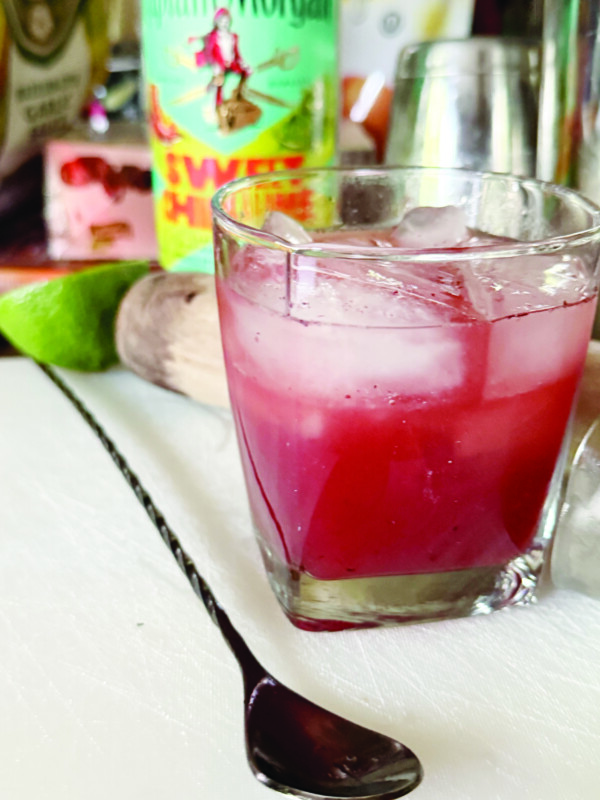
Strain the mixture over fresh ice in a rocks glass. Sigh with satisfaction at its beautiful purple color.

This is a really nice afternoon drink. It is definitely fruity but not overly sweet. The chili-lime rum works really well with the fresh lime juice. Blueberries love acid — lemon or lime juice especially. The dark purple from the blueberries blends with the bright red of the Aperol, giving it a classic violet color.

Given the number of ingredients, “refreshing” is probably not the adjective you would expect to describe this cocktail, but there you are. It is refreshing; you’ll just have to have a couple more to check that first assessment.

Featured photo: Purple Fruit Bat. Photo by John Fladd.

Stay in the loop!

Get FREE weekly briefs on local food, music,

arts, and more across southern New Hampshire!