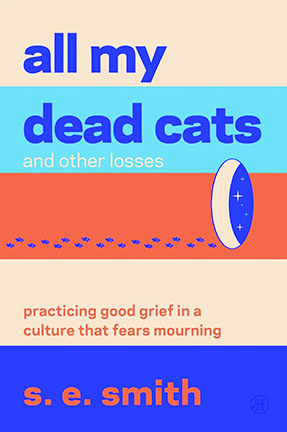
(HarperOne, 320 pages)
The business of burying a loved one is much different in Greece than in America. Because of the country’s size, there isn’t enough land to bury everyone, and so people typically rent grave sites for a few years, just long enough to allow for the decomposition of the body. Then, the bones are exhumed and interred in a building called a charnel house.
The writer s.e. smith grew up in Greece and had a father who thought a visit to a charnel house was a good way to pass time with a child.
“The ossuary was a tumble of boxes, some of which were actively breaking open or losing their plaques, decorated with moss and small plants if they were close to the entrance, green tendrils yearning for the sun,” smith writes. “It had a dark, earthy scent, thick under your tongue, an old-bone smell that I sometimes catch on the wind thousands of miles and decades away.”
Such is the promising beginning to All My Dead Cats and Other Losses, a meditation on“practicing good grief in a culture that fears mourning.” A lifelong lover of cats, the author frames the book around the instructive passing of an eclectic assortment of cats, then uses each story as a springboard to investigate some aspect of death, American style. “Each unique death told me something about myself and the culture I live in, even as it felt like the world passed me by, missing the moment,” smith writes.
There was, for example, Sofie the Sofa Cat, smith’s first cat, who became an important part of the author’s childhood after their parents separated, “becoming a constant in an inconstant life.” Sofie was hit by a car one day while smith was at school, and their father inexplicably gave the cat’s corpse to the driver who hit her for burial, which denied the chance for ceremony and closure. “Sofie was simply there in the morning and gone in the afternoon, but not gone in a definitive way that I could see and feel.”
From there, smith goes on to discuss, with reporting and interviews with various people, how children grieve and the ways in which we fail them by insulating them from death. “You do not forget your first dead body — human or animal — and the sense of absence that it projects, the spark of whatever made it alive gone, leaving something inert and somehow smaller than it was before. At any age it’s a jarring event. Does that mean it is one that should be avoided, shrouded in mystique? Or is it a moment in which children should be invited to participate — if they want — to ground their understanding of death in something present, real, and concrete?”
The quick and unexpected death of a cat named Mr. Bell allows smith to consider how sudden deaths affect us differently from drawn-out ones — “the freak event that forever changes our lives: the riptides and falls, the heart attack while mowing the lawn, the senior cat who has a seizure after a brief period of feeling unwell.”
In this chapter, smith leans into a lecture mode only hinted at previously, noting, for example, how “medical racism” is in part to blame for higher incidence of cardiac deaths among Black Americans, and how “structural inequalities” determine which people work in dangerous jobs. Both assertions may well be true, but the digression, and other similar ones that betray the author’s political leanings, detract from the overlying theme of “we’re all on a march to the grave” and need to better support each other in times of grief. It’s a small quibble, but one that some readers will note and dislike.
Beyond that, the transitions between dead-cat anecdotes and reporting are sometimes jarring, a departure from the lyrical and memorable writing that the author is clearly capable of. Smith’s story of witnessing the euthanasia of a cat named Leila can bring you to tears, and their subsequent musing on guilt associated with a death is tender and thoughtful. “We can poke and prod the dying seemingly indefinitely, if we want. We forget, sometimes, that just because you can doesn’t mean that you should, and that what is true for you, and works for you, is not universal.”
Then, we’re suddenly talking about the Affordable Care Act and spiritualism, and then encounter a sentence that looks like it was dropped into the book by an errant Walmart drone: “Even today, experimenting with Ouija boards is a classic rite of passage.”
Is it really? Who knows? Can you get back to Leila, please?
“But I digress” is a punchline, but it is all too often a stop sign in this otherwise beautiful book.
The author also digresses in a difficult-to-read chapter on volunteering at an animal shelter, discussing animals that are put down despite the prevalence of “no kill” shelters in the United States. But smith, who preserved pieces of their dead cats in urns and memorial jewelry, does a yeoman’s job in exploring the many layers of “It’s just a cat” — the central mystery of why an animal’s death affects people the way it does.
“He was just a cat. But also, he was a whole world,” the author writes while recounting a frantic trip to the animal emergency room with a cat named Loki howling in pain. “I am not alone in feeling like a bad person, or a cold one, for being more affected by the death of an animal than that of a human.”
All My Dead Cats and Other Losses is a very good book that could have been great with a bit more time and some strategic editing. As for the absence of dogs, dog lovers, do not worry; you will find community and solace here as well. B+
Featured Photo: All My Dead Cats and Other Losses, by s.e. smith