
The Tomorrow War

The Tomorrow War (PG-13)

Chris Pratt stars in the old-fashioned summer save-the-world popcorn movie The Tomorrow War, released on Amazon Prime Video.

Dan Forester (Pratt) is having difficulty getting ahead in his career (science something or other) but has all sorts of admiration from his wife, Emmy (Betty Gilpin), and young daughter, Muri (Ryan Kiera Armstrong). He’s in the middle of a consoling snuggle with the two of them while watching World Cup soccer when a wormhole opens up on midfield and soldiers come pouring through. They announce that they are from about 30 years in the future and are losing a war with an alien force. Come and fight with us to save humanity, they say, and, as news clips explain, the countries of the world eventually agree to a draft. The people drafted are both random and specific: They are men and women, fit and doughy, but most tend to be older — perhaps because, as Dan and fellow draftee Charlie (Sam Richardson) surmise, they will all be dead by 2052 and therefore won’t accidentally meet their older selves and cause a paradox.

When Dan is called up, it’s after nearly a year of the present sending soldiers to the future, with few returning and no sign that humanity’s prospects for winning the war are improving. He learns that draftees get very little training and not much in the way of uniforms; it’s just “here’s a gun, try not to get eaten.” The aliens, white insect/crustacean-y creatures, don’t have weapons (except for the sharp spikes that shoot out of their tentacles, hence their name “white spikes”) or even an organizing structure. They eat, people and whatever other animals cross their path, and once a week they go back to their nest-holes and rest (or, as we later learn, breed, which is why there are now so many of them). White spikes move fast and only lucky neck or abdomen shots take them out, so when Dan shows up in the future for his seven-day stint in the war, it’s clear that the outlook for humanity is bleak.

Dan, who once served in the military and did a tour of duty in Iraq (where he had a leadership role), is also a science teacher who has shared his love of science with his daughter. Charlie is also a former science professor who now works in tech research and development and makes up for his lack of military prowess with quips. Dan has a difficult relationship with his father, James (J.K. Simmons), who also has a military background and now has a shifty job fixing planes and skirting the law. I could list a few other Chekhov guns in the packed metaphorical armory of the first segment of this movie that go off in the final action set piece. There are a lot.

And that’s OK.

Like an Independence Day with a smaller budget and a lower wattage of stars, The Tomorrow War hits a lot of the familiar apocalypse action movie beats with a nice mix of shooting and explosions and humor and basically appealing characters played by actors who have more in them than this movie asks of them. It’s microwave popcorn fare, in the sense that it isn’t quite the fresh popcorn with real butter of summer blockbusters past and in the sense that you’ll be enjoying this one at home, which perhaps lowers the bar a little. If you need it, you can look for some deeper commentary about climate change and the ability of humans to come together (or not) when they really need to. But you also don’t need to dig that deep for a reason to basically enjoy this (long but forgivably so) lightweight summer movie. B-

Rated PG-13 for intense sequences of sci-fi violence and action, language and some suggestive references, according to the MPA on filmratings.com. Directed by Chris McKay with a screenplay by Zach Dean, The Tomorrow War is two hours and 20 minutes long and is distributed by Paramount Pictures but somehow available on Amazon Prime Video.

The Boss Baby: Family Business (PG)

The suit-and-tie baby of the 2017 The Boss Baby returns in The Boss Baby: Family Business, a cute animated movie that isn’t quite as rich as the original version but is still family-friendly.

And by that I mean not only that it is kid-appropriate (for, I don’t know, elementary schoolers and up) but also all about family. In the first movie, Boss Baby, also named Ted (voice of Alec Baldwin), is the younger brother of Tim (voiced in this movie by James Marsden). Though appearing to be a regular goo-goo-gaa-gaa baby, Boss Baby is actually a 30 Rock’s Jack Donaghy-style corporate ladder-climber sent by his company, Baby Corp., on a mission. Tim deeply resented new baby Ted at first but eventually learned to live with him, in part by helping him with his corporate ambitions at Baby Corp., the company that is bullish on babies and tries to keep their affection rankings higher than those of, say, puppies.

In the years since, Ted and Tim have grown up and grown apart. (Actually, in the years since 2017, Boss Baby and Tim have had continuing adventures in a Netflix TV series called The Boss Baby: Back in Business, which has an enjoyably oddball sense of humor. For example: Boss Baby finds himself battling an outside consultant brought in to evaluate Baby Corp. managers and makes regular cracks about why you can’t trust the marketing department. In one episode, when the boys’ grandma fights with a department store over returning a blouse, she ends up unionizing the store workers. It’s weird and I recommend it.)

But now adult Tim is living in his parents’ (voiced by Jimmy Kimmel and Lisa Kudrow) old house with his wife Carol (voice of Eva Longoria) and their two daughters, second-grader Tabitha (voice of Ariana Greenblatt) and baby Tina (voice of Amy Sedaris). Tabitha has recently started at a new school and seems stressed out by its expectation for advanced math and proficiency in Mandarin. Tim, a stay-at-home dad, is worried that she is growing up too fast and growing away from him, not unlike how he and Ted have grown apart. Though they were once best friends, Ted is now very busy with his executive businessman lifestyle and mostly interacts with Tim by turning down invitations to come and visit and sending overly elaborate gifts.

This can not stand, decides Tina, who is, like her uncle before her, a Baby Corp. executive. She needs both Ted and Tim to help fight a new threat: Dr. Armstrong (voice of a very Jeff Goldblum-y Jeff Goldblum), the head of the international chain of high-achievement-focused schools (including Tabitha’s). Tina and Baby Corp. are certain he has some sort of shifty plan and they need Boss Baby to help them. Thus does Tina lure Ted to the family home and then dose both Ted and Tim with special de-aging formula that temporarily turns them back to roughly Tabitha-aged Tim and Boss Baby.

The first movie used the Boss Baby conceit as a way to play out Tim’s feelings about going from only child to oldest child with a pushy infant sibling. Likewise, this movie uses it to work through various family relationships — Tim and Ted, Tim and Tabitha and maybe Tim and his own sense of self if his oldest daughter doesn’t need him as much. And it works about as well as the first movie did, but this feels less kid-focused. Though he appears in a kid’s body, Tim is really an adult person with his adult person worries and the movie is more centered on those than on executive baby humor or kid antics.

That said, the movie did seem to have enough wackiness to entertain kids — there’s a lot of silliness with a horse, we do still get some “the horror of other babies” moments with Boss Baby. Goldblum brings a nice element of weirdness to his character who is a villain but not violent or particularly mean.

I think I liked the original The Boss Baby (which doesn’t appear to be streaming anywhere but is available for rent or purchase) more than a lot of reviewers. I still like the overall universe, as presented here, even if the sequel doesn’t quite match up. B

Rated PG for rude humor, mild language and some action, according to the MPA on filmratings.com. Directed by Tom McGrath with a screenplay by Michael McCullers (based on the books by Marla Frazee), The Boss Baby: Family Business is an hour and 47 minutes long and is distributed by Universal Studios in theaters and on Peacock.

The Forever Purge (R)

The Purge-supporting totalitarian government of the U.S. is threatened by an even more violent social-media-organized group in The Forever Purge.

Don’t worry if you haven’t seen or have forgotten previous Purge entries (this is No. 5 in the series). This movie sort of catches you up/reorients you in the Purge universe: The Purge is the annual 12-hour period when people can commit any crimes they want and apparently what they want is to wear menacing animal masks and go on spree killings. It went away for a while but is back now, thanks to the recent elections favoring the Purge-supporting New Founding Fathers. They were reelected because of increased crime and anti-immigration sentiment and something something The Purge will fix it.

This movie, though, isn’t really about the Purge. While we see two main sets of characters prepare for and weather the Purge, most of the story takes place in the hours after it’s over.

The wealthy cattle ranching family in rural Texas the Tuckers gathers at their large, secure home for the Purge: there’s the paterfamilias Caleb (Will Patton), his adult daughter Harper (Leven Rambin), his sullen adult son Dylan (Josh Lucas) and Dylan’s pregnant wife, Emma Kate (Cassidy Freeman). None of them seem to be on Team Purge or Team Current Administration, though Dylan has some general resentment because his father and everybody else at the ranch knows that he’s not such a great cowboy. Certainly, he’s not a great cowboy compared to Juan (Tenoch Huerta), one of the ranch workers, and this makes Dylan all jealous, which he expresses via racism.

Juan and his wife Adela (Ana de la Reguera) are recent immigrants from Mexico and are aware of the weird annual festival of violence of their new home but they are determined to make it work, especially Adela. They spend Purge night hunkered down with other families in a fortified and guarded warehouse. And yet she remains optimistic about America and their future as the Purge ends and she heads back to her life. Optimistic right up to the moment when she is trapped and nearly killed by some mask-wearing loons telling her that it’s “purge ever after.” The Forever Purgers have decided one day of violence is not enough and want to continue the killing until everyone who doesn’t agree with their brand of white supremacist fascism is dead.

She and Juan and their friend (Alejandro Edda) and the Tuckers trying to find their way to safety — which is eventually identified as refuge in Mexico — makes up the bulk of this movie’s action, making it not really about some “organized chaos” day but about actual anarchy and the collapse of society.

I’ll try to separate what has always annoyed me about the Purge movies and the overall “watching a reenactment of your root canal” feel of this movie with what worked about it — and there are small elements that work.

I have always found the Purge as a concept maddening, both as public policy (how does it reduce crime and stimulate the economy? Even in a bread-and-circus sense it seems stupid) and as a story-telling device. The movies use the Purge as a sort of dippy murder fest — either thrill killing or petty revenge — without going much beyond that. There is a general “saying something about wealth inequality” sheen on these movies but they don’t really say that much; “rich people are jerks” is maybe as far as it goes.

So what works here? The movie gets its pacing right. It takes us from Juan and Adela’s backstory to Purge night to post-Purge pretty quickly. And it keeps up the energy without lingering too much on grisly violence for grisly violence’s sake.

Ana de la Reguera is a fun action heroine. We are probably with her more frequently than with any other one character and she definitely has that believable, can-do butt-kicking energy.

The movie also has some visual cleverness about juxtaposing Mexico and the chaotic U.S.; one of the final shots in particular made me think “huh, neat” for the way it referenced so many other movies.

Overall, though, The Forever Purge was a bummer, but I guess if Purge movies are your thing, this is maybe one of the better ones. C

Rated R for strong/bloody violence and language throughout, according to the MPA on filmlistings.com. Directed by Everado Gout with a screenplay by James DeMonaco, The Forever Purge is an hour and 43 minutes long and is distributed by Universal Studios, in theaters.

Featured photo: The Tomorrow War

Crying in H Mart, by Michelle Zauner

Crying in H Mart, by Michelle Zauner (Alfred A. Knopf, 239 pages)

The first time that I, a southerner raised on white bread, meat loaf and McDonald’s, went to an H Mart, the traffic shocked me as much as the food offerings. In Burlington, Massachusetts, the closest H Mart to Manchester, you can hardly find a parking place any time of day.

For the uninitiated, H Mart is a supermarket that specializes in Korean food and products. Its name derives from a Korean phrase, han ah reum, which means an armload of groceries. And the store is stocked with things you don’t often come across at the Hannaford, such as frozen sliced octopus.

But I didn’t understand until reading Michelle Zauner’s powerful memoir why H Mart is always packed and rapidly expanding across the U.S., and it has little to do with the groceries and Korea’s famed beauty products. H Mart sells food, of course, but it taps into something deeper for Americans of Korean descent. As much as meat, produce and authentic ramen, H Mart sells a sense of home. Zauner reflects on this in her opening, as she describes people-watching at the H Mart food court, which typically offers sushi and Chinese and Korean food, fast-food style.

“It’s a beautiful, holy place. A cafeteria full of people from all over the world who have been displaced in a foreign country, each with a different history,” she writes. “Where did they come from and how far did they travel? Why are they all here?” They’re there to buy products that Trader Joe’s doesn’t carry, but ultimately for more. “I’m not just on the hunt for cuttlefish and three bunches of scallions for a buck; I’m searching for memories,” she says.

Zauner doesn’t travel far to the H Mart where she shops, near Philadelphia, and she grew up in Eugene, Oregon. But she cries at the H Mart because it reminds her of her mother, a Korean woman who married an American man, but took her daughter to visit relatives in Seoul every other year. Food, Zauner writes, was how her mother conveyed love; “I could always feel her affection radiating from the lunches she packed and the meals she prepared for me just the way I liked them.”

She was often harsh, yelling at her daughter if she got injured while playing, and once reacted to Zauner’s getting fired at a waitressing job by saying, “Well, Michelle, anyone can carry a tray.” By her teens Zauner had developed the adolescent revulsion to her mother’s touch, and the relationship further soured as her mother’s behavior bordered on full-blown abuse.

But when her mother developed Stage IV pancreatic cancer when Zauner was 25, she was devastated. The memoir is her account of a painful reckoning that they both endured during the mother’s treatment and final months of life, a cold and gritty look at the realities of hospital (“The house was quiet aside from her breathing, a horrible sucking like the last sputtering of a coffee pot”) and also the small moments of grace.

The memoir continues after the mother’s passing, as Zauner comes to fully understand her mother in ways she couldn’t while she was alive. It is taut and elegant, with no descent into melodrama: just a matter-of-fact but beautifully written elegy that explores the challenges of loving difficult people. But it is a deeply hopeful book, despite being centered around death. And don’t let the title fool you — while H Mart may appeal most to Koreans and other Americans of Asian descent, Zauner’s story is universal, as is the connection that she forges with her mother, both in life and in death, through food. To cope with her mother’s death, she starts seeing a therapist, but it wasn’t helping, so she starts cooking her mother’s Korean recipes, ultimately making so much that she had to start giving it to friends.

“The smell of vegetables fermenting in a fragrant bouquet of fish sauce, garlic, ginger and gochugaru radiated through my small Greenpoint kitchen, and I would think of how my mother always used to tell me never to fall in love with someone who doesn’t like kimchi. They’ll always smell it on you, seeping through your pores.”

Zauner did fall in love with someone who liked kimchi, a Korean side dish, and who married her during her mother’s treatment, so it wasn’t just cooking that helped her heal. There are other memoirs that make that claim; Zauner’s isn’t that simplistic. But hers is a surprisingly engrossing account of a mother and daughter’s struggle to love each other, and a crash course in a culture with which you might not be familiar. Familiarity with H Mart is not a prerequisite, but you’ll likely want to visit after reading this book. B+

Book Notes

Last week’s review of The Anthropocene Reviewed noted that the book’s genesis was the podcast of novelist John Green and his younger brother, Hank Green. This was interesting because podcasts are now a common form of book promotion, and so it’s becoming increasingly common for authors to start their own, after getting familiar with the medium.

I subscribe to two podcasts because I previously read books by the hosts: Rich Roll, the ultra-athlete who wrote Finding Ultra (Crown, 288 pages), and Tim Ferris, who wrote Tools of Titans (Houghton Mifflin Harcourt, 736 pages) and the four-hour-everything series.

Podcasts are a weirdly intimate form of conversation, even more than radio, since they’re not on public airwaves. They feel like it’s just you, the host and a guest, sitting around the kitchen table. As such, they can give you a connection with authors beyond what you get on the printed page. Here’s a look at podcasts by well-known authors.

“Dear Sugars” is an advice podcast by Cheryl Strayed, author of Wild (Vintage, 336 pages), and Steve Almond.

Stephen Dubner and Steve Levitt obtained literary fame with their 2005 book Freakonomics (William Morrow, 256 pages); their podcast is “Freakonomics Radio.”

Elizabeth Gilbert, most famous for Eat, Pray, Love (Riverhead, 352 pages), also wrote a book called Big Magic (Riverhead, 288 pages), which she’s parlayed into a podcast called “Magic Lessons.”

Roxane Gay, author of Hunger (Harper, 320 pages), Bad Feminist (Harper Perennial, 336 pages) and other books, has a podcast with Tressie McMillan Cottom, author of Thick, and Other Essays (The New Press, 224 pages). It’s called “Hear to Slay.”

Malcolm Gladwell, who wrote Outliers (Little, Brown & Co., 309 pages), Blink (Little, Brown & Co., 288 pages) and other bestselling nonfiction books, has a podcast called “Revisionist History.”

And don’t forget, there are plenty of podcasts about books, most notably NPR’s “The Book Show” with Joe Donahue and “The Great Books Podcast” from John J. Miller and National Review. Locally, Concord’s Gibson’s Bookstore produces “The Laydown” podcast, with new episodes released monthly.


Books

Author events

TERRY FARISH Meet-and-greet with picture book and young adult author. Kingston Community Library, 2 Library Lane, Kingston. Thurs., July 8, 3:30 p.m. Registration required. Visit kingston-library.org.

CHRISTINA BAKER KLINE Author presents The Exiles. Hosted by The Music Hall in Portsmouth. Tues., July 13, 7 p.m. Virtual. Tickets cost $5. Visit themusichall.org or call 436-2400.

MEGAN MIRANDA Author presents Such a Quiet Place. Hosted by The Music Hall in Portsmouth. Tues., July 20, 7 p.m. Virtual. Tickets cost $5. Visit themusichall.org or call 436-2400.

JOYCE MAYNARD Author presents Count the Ways. Toadstool Bookstore, 12 Depot Square, Peterborough. Sat., July 24, 11 a.m. Visit toadbooks.com or call 924-3543.

GIGI GEORGES Author presents Downeast: Five Maine Girls and the Unseen Story of Rural America. Toadstool Bookstore, Somerset Plaza, 375 Amherst St., Route 101A, Nashua. Sat., July 24, 2 to 4 p.m. Visit toadbooks.com or call 673-1734.

JESS KIMBALL Author presents My Pseudo-College Experience. Virtual event, hosted by Toadstool Bookstores, located in Nashua, Peterborough and Keene. Tues., July 27, 6 to 7 p.m. Visit toadbooks.com or call 673-1734.

CATHLEEN ELLE Author presents Shattered Together. Virtual event, hosted by Toadstool Bookstores, located in Nashua, Peterborough and Keene. Thurs., July 29, 6 p.m. Visit toadbooks.com or call 673-1734.

Poetry

DOWN CELLAR POETRY SALON Poetry event series presented by the Poetry Society of New Hampshire. Monthly. First Sunday. Visit poetrysocietynh.wordpress.com.

SLAM FREE OR DIE Series of open mic nights for poets and spoken-word artists. Stark Tavern, 500 N. Commercial St., Manchester. Weekly. Thursday, doors open and sign-ups beginning at 7 p.m., open mic at 8 p.m. The series also features several poetry slams every month. Events are open to all ages. Cover charge of $3 to $5 at the door, which can be paid with cash or by Venmo. Visit facebook.com/slamfreeordie, e-mail slamfreeordie@gmail.com or call 858-3286.

Book Clubs

BOOKERY Online. Monthly. Third Thursday, 6 p.m. Bookstore based in Manchester. Visit bookerymht.com/online-book-club or call 836-6600.

GIBSON’S BOOKSTORE Online, via Zoom. Monthly. First Monday, 5:30 p.m. Bookstore based in Concord. Visit gibsonsbookstore.com/gibsons-book-club-2020-2021 or call 224-0562.

TO SHARE BREWING CO. 720 Union St., Manchester. Monthly. Second Thursday, 6 p.m. RSVP required. Visit tosharebrewing.com or call 836-6947.

GOFFSTOWN PUBLIC LIBRARY 2 High St., Goffstown. Monthly. Third Wednesday, 1:30 p.m. Call 497-2102, email elizabethw@goffstownlibrary.com or visit goffstownlibrary.com

BELKNAP MILL Online. Monthly. Last Wednesday, 6 p.m. Based in Laconia. Email bookclub@belknapmill.org.

NASHUA PUBLIC LIBRARY Online. Monthly. Second Friday, 3 p.m. Call 589-4611, email information@nashualibrary.org or visit nashualibrary.org.

Featured photo: Crying in H Mart.

Zin for your barbecue

Three variations on the versatile zinfandel

Zinfandel wine has a long and storied past.

Those of a certain age may remember it as a jug wine, bottled in huge tear-shaped bottles, or as a rosé, known as white zinfandel. But zinfandel has been around a lot longer than Gallo. The roots of this grape varietal can be traced to the southern “heel” of Italy, where it is known as primitivo, and well before that to Croatia, where it is indigenous, and was likely cultivated by ancient Greek colonists. Arriving in the United States in 1829, and cultivated in greenhouses on the East Coast as a table grape, it made its way west in the Gold Rush of 1849, where it became known as zinfandel by the 1870’s. In fact, some of these original vines still exist, known as “old vine” zinfandel — though the whole topic of what can be called or classified as “old vine” can be taken up in a separate column. Zinfandel grapes survived Prohibition in large numbers because they could be used in the production of homemade wine, which remained legal.

While it is grown across the United States, California takes the lead, by far. It can be made into late harvest dessert wines, rosés and Beaujolais-style light reds, all the way to big hearty reds and fortified wine in the style of port. As in all wine, the quality and character of the wine depends on the climate, location and age of the vineyard (terroir) as well as the technology and skill employed by the winemaker. Because of this wide spectrum of color, nose, taste, body and, yes, alcoholic content, zinfandel can accompany perhaps the widest of culinary offerings. It is especially good with barbecued meat: chicken and pork with sweet sauces, grilled beef, braised meats and casseroles, strong and bold cheeses from a dry Jack to aged goat cheese to Parmesan. It can be paired with spicy Mexican food and pasta dishes with robust red sauces, pizza, and root or grilled vegetables. The possibilities are virtually endless, surpassing most other wine types when paired with food.

Our first wine, Hierogram 2016 Vineyard Block 8 Old Vine Zinfandel (originally priced at the New Hampshire Liquor & Wine Outlets at $45.99, reduced to $22.99), is from Lodi, San Joaquin County, in the Central Valley of California, where some of the oldest zinfandel vines in California are planted. This wine results from them. It is dark maroon in color, and to the nose it has cherry and dark berry notes. These notes carry through to the tongue, with a full mouth feel and a bit of tangy spiciness and chocolate. Mild tannins from aging 15 months in 60 percent new American oak accompany the fruit to impart a rich, full sensation.

Our second wine, Neal Family Vineyards 2018 Rutherford Dust Vineyard Zinfandel (originally priced at the New Hampshire Liquor & Wine Outlets at $32.99, reduced to $29.99), hails from the floor of Napa Valley. This is a fully organically grown and produced wine with a low production of 613 cases coming from the Rutherford AVA. A blend of 91 percent zinfandel and 9 percent petite syrah, it is co-fermented and aged for 15 months in 40 percent new Hungarian oak puncheons. The adjacently planted two grape varietals complement one another. The color is a deep maroon, the nose is full of fruit — plum, with touches of vanilla. This carries through to the mouth, with a touch of tobacco from the oak along with an elusive herbal quality. A perfect wine for a weekend barbecue.

Our third wine, Shannon Reserve 2015 Two Bud Block Zinfandel (originally priced at the New Hampshire Liquor & Wine Outlets at $37.99, reduced to $17.99), is from Lake County, California. It is also a blend of 95 percent zinfandel and 5 percent petite syrah. It is aged for 20 months in 35 percent new French and American oak. The vineyards are sustainably farmed with sheep controlling the weeds and fertilizing the vines. The color is of a deep maroon, the nose of rich blackberries and vanilla, which carries through to the mouth enriched by a hint of chocolate. The oak imparts subtle tannins, all made for pairing to great barbecued fare.

So explore the subtle differences not only of these three zinfandels but of the other seemingly countless approachable “zins” to be enjoyed with a vast array of foods and cuisines.

Featured photo: Courtesy photo.

The Weekly Dish 21/07/08

News from the local food scene

New spot for Granite State Naturals: After temporarily closing over the holiday weekend, longtime health store Granite State Naturals opened a new location on July 6, in the adjacent property on the corner of Granite Avenue and North State Street in Concord. Executive Chef Rob Cone has worked with owner Matt Jeannotte to expand the business into more of a superette — new items include grab-and-go sandwiches made with meats from North Country Smokehouse, as well as a variety of house side dishes, grain salads, house marinated meats, and dairy products sourced from both Brookford Farm in Canterbury and Huckins Farm in New Hampton. There is also now a selection of about 40 beers, ciders, seltzers, ready-to-drink cocktails and hard kombuchas, plus various wines from organic and biodynamic vineyards. The new location is open Monday through Saturday, from 10 a.m. to 6 p.m., and Sunday, from 10 a.m. to 5 p.m. Visit granitestatenaturals.com.

Canning and pickling: Join the Rodgers Memorial Library (194 Derry Road, Hudson) for Preserving the Harvest, a virtual program in pickling, canning, freezing and drying your own food that’s scheduled for Monday, July 12, from 7 to 8 p.m. Mark Gostkiewicz of Tri Gable Lea Farm in eastern Connecticut will discuss the pros and cons of each of these methods, as well as what details to pay attention to in order to avoid spoilage or food poisoning. Simple at-home projects using basic kitchen equipment will also be introduced during this live Zoom presentation. Participants can register at events.rodgerslibrary.org. If you can’t make the live class but still want to learn the information, a recording will be emailed to you, in addition to handouts and references that will be covered during the talk.

Wine and barbecue: Get your tickets now for the next monthly wine dinners at the Colby Hill Inn (33 The Oaks, Henniker), set for Friday, July 16, and Saturday, July 17, in The Grazing Room. The event will feature a three-course dinner with wine on Friday evening, followed by an a la carte barbecue lunch beginning at noon on Saturday, then a three-course dinner that evening at 6 p.m. with pairings of McPrice Myers wines. The Colby Hill is also continuing its Sunday night out events with seatings on Sunday, July 11, from 4 to 7 p.m., where you can enjoy local seafood, barbecue items, and flight trios of wine, beer and sake. Visit colbyhillinn.com.

Eating local: Half of Granite Staters report buying food from local farms at least twice a month, according to a University of New Hampshire news release. The research, which was conducted by UNH’s Carsey School of Public Policy, found that the frequency of local farm food purchases varies across the state, with the highest rates along the Vermont border. Between one-third and one-half of adults buy local at least occasionally across Hillsborough, Rockingham and Strafford counties. The study also noted that 88 percent of Granite Staters reported that in-person sales models like farm stands and farmers markets were easily accessible, while, despite a rise in online shopping during the pandemic, only 23 percent of people said the same about online market platforms for local food.

Cucumber gimlet

My grandparents were civilized people. One of my favorite memories of them is their rigorous observance of Cocktail Hour.

Every evening, when Opa got home from work, he would change clothes, then he and my Oma would sit down for a cocktail. This was not precisely a formal ritual, but it was one thoroughly saturated with respect. For an hour or so, they would sit together without distractions and focus on each other. Opa would slip in some form of compliment for my grandmother — her name was Grace, but he called her “Dolly” — and at some point, he would usually lean back, sigh with contentment and wonder out loud, “what the poor people” were up to that night.

For me, the classiest part of the whole ceremony — because, really, that’s what this was — was that they always had a small bowl of Pepperidge Farm Goldfish with their cocktails.

I remember once asking my grandmother if I could have a sip of her cocktail. Amused, she let me have one. It was the worst thing I had ever tasted up to that point in my life (I was about 8).

“What IS that?!” I asked, overcome with feelings of betrayal and disgust.

“It’s a gimlet,” she told me serenely, and it was seared into my memory. She let me have a handful of goldfish to clear my palate, and those are there, too.

I wish I had a profound lesson to tie this story to — other than the fact that Oma and Opa have both been gone for about 40 years, and I still miss them achingly.

Anyway, here is a recipe for a take on a classic summer gimlet, with cucumber.

Cucumber Gimlet

45 grams (3 thick slices) cucumber

1/2 ounce cucumber syrup (see below)

2 ounces gin (I’m using Wiggly Bridge this week, given to me by a friend who distributes it in New Hampshire.)

3/4 ounce lime juice, freshly squeezed (see below)

1. Muddle the cucumber and cucumber syrup aggressively in the bottom of a cocktail shaker. Be careful not to splash yourself.

2. Add the ice, gin and lime juice. If you have a choice, go with the lime that has been sitting around your kitchen for a week or so and is looking a little tired. If you think you can see his ribs showing, he’s the one you want. His juice will taste extra-limey.

3. Shake until the condensation on the side of the shaker starts to freeze.

4. Strain into a coupé glass.

5. Drink this while giving someone your undivided attention.

Gin and lime are a classic combination. The cucumber makes this drink more summery and refreshing. It provides a framework to hang the crispness of the gin and the fruitiness of the lime.

Is there a way to make this even more cucumbery?

Yes — I would shred half of an unpeeled cucumber with a box grater, and use it to infuse an equal amount of gin for a week or so. (I say I “would”; in point of fact, I am infusing a batch of it right now, but it’s hot out and I’m feeling nostalgic. I’d like a gimlet right now, please.)

Cucumber simple syrup

I tried and compared several different methods for making this syrup. I’ll spare you the details of my testing protocols, but here is the least fiddly method that gave me the sharpest cucumber flavor:

1. Wash an English cucumber, then roughly dice it, with the skin still on. Freeze it for an hour or two; ice crystals will help break down the cell walls and persuade the cucumber to give up its juice more generously.

2. Combine the frozen cucumber and an equal amount (by weight) of sugar in a small saucepan and bring to a boil, stirring regularly.

3. Remove from heat, then mash the cucumber pieces with a potato masher. Don’t be gentle.

4. Cover the pot and let the cucumber steep for half an hour.

5. Strain with a fine-meshed strainer, and use a funnel to bottle it.

Featured photo: Cucumber gimlet (with accompaniments). Photo by John Fladd.

Abbey Morrison

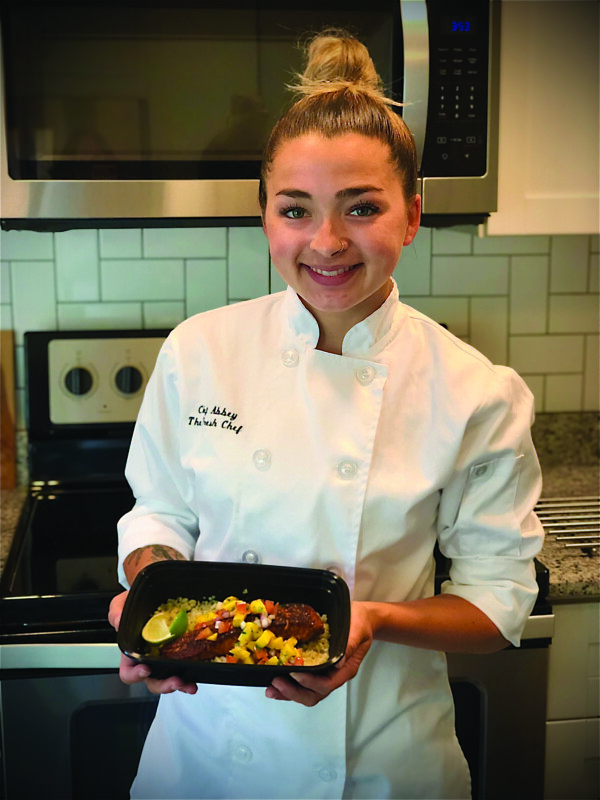
Abbey Morrison of Manchester is the owner and founder of The Fresh Chef Meal Prep (freshchefmp.com, and on Facebook @thefreshchefmealprepllc and Instagram @the_fresh_chef), a business she started last year specializing in lunch and dinner items with fresh ingredients delivered to your door. A graduate of Johnson & Wales University in Rhode Island, Morrison first got an associate’s degree in culinary science, followed by a bachelor’s degree in nutrition and product development. She also completed an internship with Great New Hampshire Restaurants, working at the Copper Door’s new location in Salem in 2018. Each of her meals features ingredients that are in season, always containing a protein like chicken or steak, as well as at least one vegetarian option for both lunch and dinner. Everything is cooked the same day it’s delivered. Recent popular items have included salmon burgers, Mediterranean pizzas and fresh guacamole, while during the wintertime she’ll cook beef stroganoff, stuffed sweet potatoes and other heartier dishes. New menus are dropped each Monday, with ordering open until Friday afternoon for the next week and delivery times from either 3 to 5 p.m. or 5 to 7 p.m.

What is your must-have kitchen item?

It would be a French knife, hands down. If that was all I had, then I’d still be able to get the job done. It’s like an extension of my arm.

What would you have for your last meal?

My favorite dish, which is a treat to myself, is fresh sea scallops in a cast iron skillet with homemade pesto and gnocchi from scratch.

What is your favorite local restaurant?

Republic [Cafe in Manchester]. … Their curried cauliflower is my go-to every time.

What celebrity would you like to see ordering one of your meals?

I’m a die-hard basketball fan. It would be an absolute honor if I could cook for Skylar Diggins. She’s a WNBA star who currently plays for the Phoenix Mercury. I’ve followed her journey since she played at the University of Notre Dame. She’s a role model.

What is your personal favorite thing on any of your menus?

Since we’re in the summer, I would choose between either the salmon burger or the prosciutto pizza. The salmon burger is also a customer favorite.

What is the biggest food trend in New Hampshire right now?

Keto is a big one, and also fasting. I feel like those are the two biggest trends, not only in New Hampshire but all around the world.

What is your favorite thing to cook at home?

I love grilled pizza in the summer. I’ll throw a pizza dough on the grill, let it char right up within five minutes on each side, then put mozzarella cheese on top, with vegetables and a balsamic glaze. It’s super quick, easy and healthy.

Blackened salmon with mango salsa
From the kitchen of Abbey Morrison of The Fresh Chef Meal Prep in Manchester

1 8-ounce fillet fresh Atlantic salmon
3 tablespoons blackened seasoning
¼ cup mango salsa
1 cup cauliflower rice
Salt
Pepper
Garlic powder
2 lime wedges

Remove skin from the salmon with a knife, then use tweezers to pull the fin bones out. Wash the salmon and pat it down dry. Place the salmon in a bowl and add the blackened seasoning, making sure all corners of the fillet are covered. On a medium-sized flat top over medium to high heat, add salmon with one tablespoon of oil. Cook for five minutes on each side, or until the desired temperature is reached. Measure cauliflower rice and place in a small saute pan over medium heat. Cook for 5 minutes or until translucent. Sprinkle with salt, pepper and garlic powder and set aside. Cut lime wedge, then take cauliflower rice and place at the bottom of a disposable meal prep container. Place cooked blackened salmon on top of the rice and finish with mango salsa and a lime wedge.

Featured photo: Abbey Morrison

Stay in the loop!

Get FREE weekly briefs on local food, music,

arts, and more across southern New Hampshire!