Collective effervescence

Sunny Jain’s Love Force hits New Hampshire

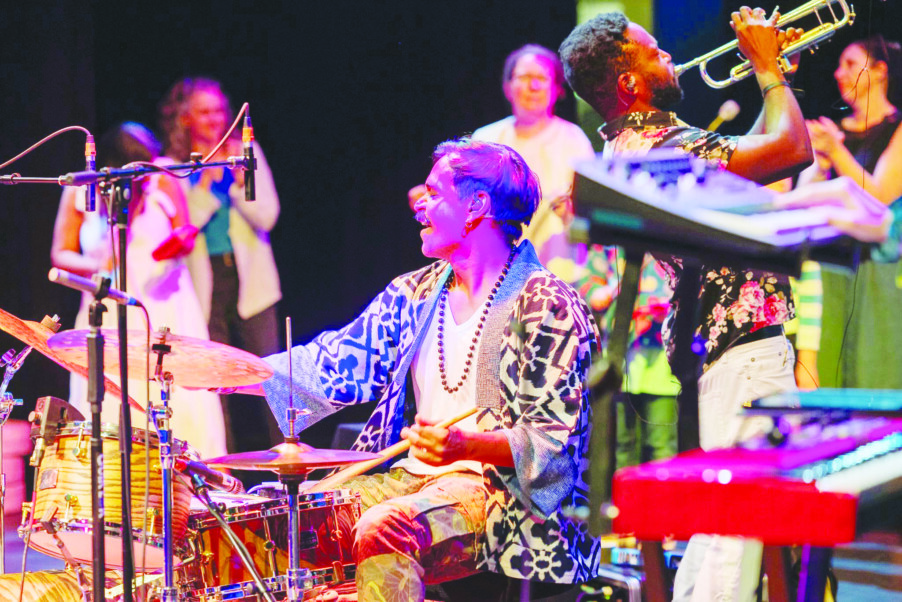
For his debut theatrical project, Love Force, Sunny Jain is performing his hypnotic, percussive brand of Bhangra-inspired jazz for a congregation. He’s on a mission to blur the lines between band and crowd, to make them one with the music and capture the energy of the shows he does in sweaty clubs with his band Red Baraat.

“What I’ve always enjoyed about music is that kind of communal experience … where you really rely on the energy in the room as a performer,” Jain said by phone recently. “I wanted to bring that element to a theatrical space … storytelling and narrative just through sound; how that impacts people, and how we vibe off of it.”

The message of Love Force comes from the concept of satyāgraha — the existence of truth. In the early 20th century, it underscored Gandhi’s nonviolent protests against British colonialism in India. It was later adapted by B.R. Ambedkar and, during the U.S. civil rights movement, employed by Martin Luther King Jr.

Jain, who plays drums and the dhol, combines it with music and personal stories of the immigrant experience, using Love Force to confront social oppression.

“You can’t fight back with more tyranny,” he said. “You have to lead with love and just melt away any kind of evil doing.”

The stage is a pulpit, he continued, and music a sermon delivered in a common language.

“I’m trying to really tap into that energy of music really unifying people, putting aside these differences we have,” he said. “Recognizing places of worship, the thing that really unifies people in there is the chants, the mantras, the songs, the hymns, everything that we sing.”

Jain’s Love Force ensemble consists of longtime accompanists Alison Shearer on sax and bassist Almog Sharvie, along with horn players David Adewumi (trumpet) and Jasim Perales (trombone) and with Julia Chen on keyboards. As they play, images flash behind them, as well as word collages — one a phrase that provides a lot of the evening’s energy.

Jain discovered “collective effervescence” after a conversation with Ash Fure, a Dartmouth associate professor of sonic arts, a few years back. The two were discussing Jain’s developing project and his interest in music’s coalescing power. Fure pointed him to Barbara Ehrenreich’s 2006 book Dancing in the Streets: A History of Collective Joy.

“Ehrenreich talks about this shared activity, almost akin to religion, that you find nowadays in the rave scene,” Jain said. “Then she points back to Emile Durkheim, the French sociologist, [who] coined the term collective effervescence.” His research found that it was key to the early beginnings of organized religion.

“People came together around a totem … reflective of their group or clan, and stomped in unison to give reverence to one another or to the human being,” Jain said. “Something just stuck to me about that — being engaged with and a lover of Sufi music, especially Sufi dhol drumming. Where the essence is of music and sound enabling you to reach the omnipotent.”

One fun fact learned in the interview was that a different twist of fate might have led Sunny Jain to join a rock ’n’ roll band. When he was 12 his brother took him to see Mötley Crüe and Whitesnake, his first concert. It inspired an interest in percussion, and he enrolled in drum class to learn Tommy Lee and Neil Peart. “Because I loved Rush as well,” Jain said. But his first teacher was a bebop jazz drummer and taught him that instead. “That’s how I fell in love with jazz.”

Does performing Love Force differ from working with his best-known band? “Yes,” Jain said. “There’s a lot more expression. Red Baraat is very much a musical force of the club and festival circuit of like just really amped up party music [and] this has a much more dynamic expression of emotion, just with the fact of the storytelling.”

Sunny Jain’s Love Force
When: Saturday, April 18, 7 p.m.
Where: 5 Pinkerton St., Derry
Tickets: $28 and $33 at pinkertonacademy.org
Also Thursday, April 16, 7:30 p.m., Hopkins Center, 12 Lebanon St., Hanover, $30+ at dartmouth.org

Featured photo: Courtesy photo.

The Music Roundup 26/04/16

Mom rock: Adopted as their own by New England music fans in her Berklee days, Liz Longley has remained a favorite here. She returns to an intimate room for a solo show. On the title track of Longley’s latest album, New Life, she describes motherhood as “clarity in all this static” of uncertain times. “I brought new life to a dying planet,” she sings, “a shoreline to a sea of panic.” Thursday, April 16, 7:30 p.m., Flying Goose, 40 Andover Road, New London, $25, 526-6899.

Last pass: With alumni including Jackson Browne and Steve Martin, the Nitty Gritty Dirt Band was a driving force in the melting pot of folk, rock and roots music that came to be called Americana. After six decades together they’re in the midst of a farewell tour, offering a final chance to hear classics like “Long Hard Road (The Sharecropper’s Dream)” and “Mr. Bojangles.” Friday, April 17, 7:30 p.m., Nashua Center for the Arts, 201 Main St., Nashua, $68 and up, etix.com.

Night moves: Return to the days of holding up a Bic lighter at a concert instead of an iPhone video with Live Bullet, a Bob Seger tribute band that sticks to his two live albums. Hopefully the extended versions, as the Nine Tonight version of “Brave Strangers,” originally a B-side, is among Seger’s best. Since 2010 the New England-based band has built a steady audience. Friday, April 17, 8:30 p.m., Murphy’s Taproom & Carriage House, 393 Route 101, Bedford, $42, eventbrite.com.

Green night: At the third annual Earth Day concert, The Mighty Colors and Jamdemic return to raise environmental awareness and funds for Beaver Brook Association and show host Andres Institute of Art. Nashua-based Mighty Colors cover everyone from the Stones to Goose, while Jamdemic aims to “revive the public soul” with interpretations of Phish, Pink Floyd and more. Saturday, April 18, 7 p.m., Andres Institute of Art, 106 Route 13, Brookline, $25, andresinstitute.org.

Song man: Inspired by Nashville music clubs like the Bluebird Café, Charlie Chronopoulos launched the White Horse Round series last month, inviting fellow singer-songwriters to come by and swap tunes. Check Chronopoulos’s Facebook page for this week’s guest, and head to Apple Music or YouTube to hear his music, including his most recent single, the dark, mournful “Shot.” Sunday, April 19, 5 p.m., Riley’s Place, 29 B Mont Vernon St., Milford, charliechronopoulos.com.

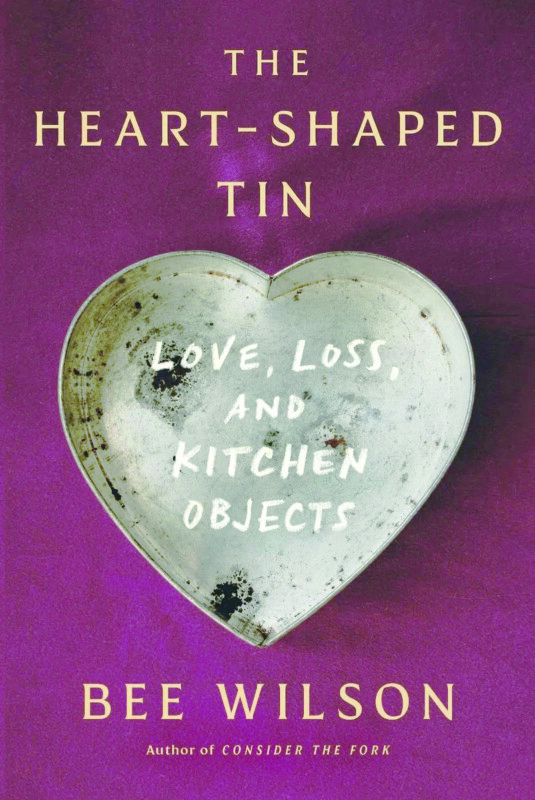
The Heart-Shaped Tin: Love, Loss, and Kitchen Objects, by Bee Wilson

(W.W. Norton, 291 pages)

Not long after Bee Wilson’s marriage of 23 years dissolved, a heart-shaped cake tin clattered to the floor at her feet. It was the tin she had used to bake her wedding cake, and later to bake birthday cakes for her children. Now she was unsure what to do with the tin and all the complicated feelings it evoked.

Wilson started to think about all the other items that filled her kitchen cabinets and cupboards, and the sentimental attachment that so many held. Many had been passed down to her from family members or arrived as gifts. It is notable, she writes in The Heart-Shaped Tin, that “kitchenware seems to be one of the main forms of currency between grown-up family members, whether given by a child to a parent or the other way around. What is really being exchanged is an idealised memory of the family dinner table.”

We all have the equivalent of Wilson’s heart-shaped tin, some item that, whether used or not, is absurdly precious. Mine is an antique Coca-Cola-branded bottle opener that was attached to the wall of my late grandmother’s home and now hangs in my kitchen. It is rarely used since I hardly ever buy bottled drinks, but I would fight to the death anyone who tried to take it from me.

In her book — part memoir, part history — Wilson delves into the reasons for these attachments, looking at her own family’s treasures as well as the treasures of other people around the world. She explores the psychological and societal factors that influence what we consider priceless or worthless, from a relatively cheap melon baller that her sons fight over, to an iron pan that a South American woman is so attached to that she sometimes takes it with her on vacation.

“We like to think that love is a natural phenomenon that happens all by itself, springing directly from our hearts. But to live in the modern commercial world is to have thousands of desires and longings inside us without our say-so. You wake up with an urge to buy a giant coffee in a paper cup decorated with a green mermaid and you have no idea why,” Wilson writes.

Wilson is an English writer whose previous nonfiction books have also involved kitchenware and food (see 2012’s Consider the Fork and 2010’s Sandwich: A Global History). Her latest is a surprisingly engaging tour de kitchenware that takes us from an ancient ceramic container found in Ecuador that challenged what we thought we knew about the history of chocolate consumption to the mysterious kitchen sieve that Queen Elizabeth I is holding in a 1583 portrait of her. The vast range of items discussed goes from vegetable corers to canisters, from glory boxes (a kind of hope chest or dowry) to burial plates, the blue and white ceramic plates sometimes buried with corpses in England in the 18th and 19th centuries. All together, it is a cornucopia of fascinating historical anecdotes.

Wilson also helps to explain why fine china has been so important throughout human history, to the point where even people of modest means would work to obtain a full setting, one piece at a time, in order to honor their guests. She writes of the legacy of guilt that such household items like this leave when you realize the china either never appealed to you or has outlived its purpose.

“Every time I opened the cupboard that contained the Kutani Crane vegetable tureens they made me feel faintly strangled,” she writes. “These dishes had been handed down to me not just by my own father but by his father. When I looked at them, I felt weighed down by two generations of filial obligation.”

Wilson is a master of the interesting aside, as when she explores the control that the philosopher Jean-Paul Sartre believed is at the center of gift-giving. Nowhere is this a greater problem than in Japan, she writes, “which has a culture of gift-giving more extensive than any other advanced capitalist society.” The Japanese not only give lavishly to each other but are expected to give a gift after being presented with a gift. Moreover, next time you complain about the preponderance of “Hallmark holidays” in America, remember that Japan also celebrates Girl’s Day, Boy’s Day and Old People’s Day — all of which come with gifts.

Wilson also writes poignantly about the difficulty of getting rid of sentimental objects, even when you are psychologically ready to do so, and sometimes even when they are broken. She had finally packed up an expensive set of china, having decided to donate it to a thrift shop, when one of her sons protested her giving away those pieces of his childhood. She had better luck when she finally decided to give away the “Elmer the Elephant” plate her sons had eaten on as toddlers, but it wasn’t without pain.

It is possible “to hanker deeply after something which is neither pretty nor useful, just because of the person who once used it,” she writes. “The fact that no one needs it anymore is exactly what makes the wanting so fierce, because it reminds you of a time when you were needed too.”

I approached The Heart-Shaped Tin with some skepticism about whether Wilson’s premise could hold my attention for nearly 300 pages, but it did. Readers will continue to think about not only the stories the author tells but the stories contained in their own kitchens. B+

Featured Photo: The Heart-Shaped Tin: Love, Loss, and Kitchen Objects by Bee Wilson

Album Reviews 26/04/16

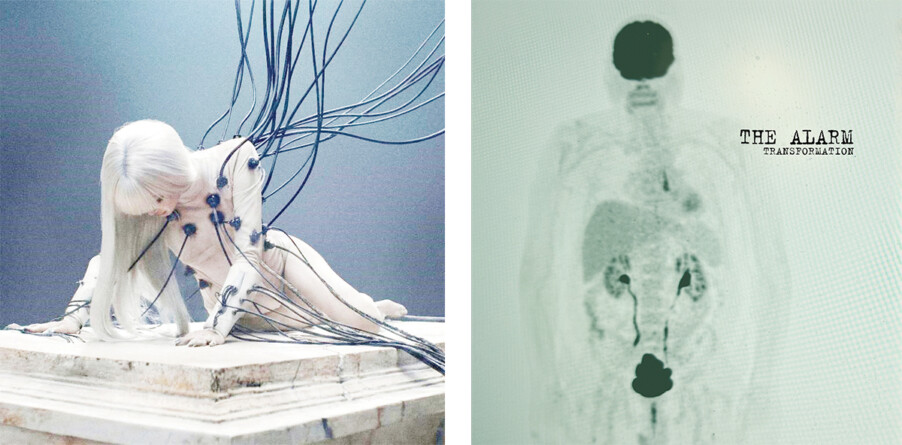
The Alarm, Transformation (Twenty First Century/Virgin Records)

This may or may not be the final album from this Welsh new-wave band under its original name, whose tuneage I’ve previously described as a kinder, gentler Clash or a more aggressive U2. Last year, bandleader Mike Peters finally lost his battle with the cancer that had been attacking him for 30 years; Peters’ son Evan is now fronting the band as “The Alarm Presented by Evan Peters,” while original bassist Eddie McDonald is leading “The Alarm 2.0,” but whatever, this may be it for The Alarm proper, a band that was maligned since birth in the British press for being derivative and pretentious and only scored one hit in the U.S. (“Sold Me Down the River,” which ripped off “Bang A Gong,” for the Gen Xers who can remember all that stuff). This one leads off with “New Life,” which, um, derivatively enough, is basically a jam-out version of Gary Glitter’s “Rock n Roll Part 2.” But most of the other songs are fine, like “Chimera,” a stadium-ready protest-stomper that’s a lot better than that U2 EP I reviewed here the other week, if you’re a fan who needs to read some faint praise. B

Anyma and Lisa, “Bad Angel” (Interscope Records)

You know, if there’s anything that gets on my nerves about the current timeline with regard to the music-tastemaking space, it’s the blinding array of collaborations between (mostly disparate) artists. I mean, I get that we’re in a post-band/post-album world, but every other day it seems like there’s a new pair of strange bedfellows barfing out a single that wants to squeeze money out of today’s youth, a cohort that’s of course more concerned with preserving what’s left of their mental health than maintaining their hipness level. Records like this one remind me of the one-off Marvel Team-Up comic books of my youth, which were cynically intended to, among other things, expose regular Iron Man readers to the improbable world of the Silver Surfer, that sort of thing. This tune, with its dark, melodic techno, could have just as easily been promoted as an “Anyma feat Lisa” joint and added to his next ÆDEN album or whatnot; Lisa’s just got more ethereal reverb/next-gen-Autotune effectage on her vanilla-diva voice here than usual. It’s not any more interesting than Chris Avantgarde’s stuff, let’s say, and furthermore — oh, wait, I get it, she’s headlining Coachella this year, that’s what this is about. Well played, Interscope, well played (eyeroll emoji). D+

PLAYLIST

A seriously abridged compendium of recent and future CD releases

• Friday, April 17, is almost here, my dudes, so what will you do to advance the cause of rock ’n’ roll in our republic on that album release day? Just look at all the new albums that are coming out that day, the bigly-est albums ever in the history of the universe, until next Friday! Look at all these new albums, and never even mind that it’s already too late to talk about The World Is To Dig, the new one from famous Weezer-for-dummies children’s band They Might Be Giants, who did the Malcolm in the Middle song at the dawn of the Aughts, before the last flickers of hope for humanity began to falter, remember those days, and all the faltering? Yup, it’s too late to talk about this new They Might Be Giants album, because that one actually came out on Tuesday, even though Tuesdays stopped serving as the traditional album release weekday in 2015, according to this pesky spamming Google AI bot, who says “Tuesdays officially stopped being the traditional day for album releases in the United States on July 10, 2015, when the industry shifted to ‘Global Release Day’ (or New Music Fridays) to align releases with Fridays in more than 45 countries, reducing music piracy and syncing with streaming culture.” Of course, that tradition has been obsolete for years now, now that everyone simply uses YouTube-to-MP3 sites to rip music for their mixtapes, naïvely expecting their virus protection software to — you know, protect them from viruses, which it can’t when people are practically begging to get hacked, but can’t we just stick to Global Release Day Fridays anyway? Is nothing sacred anymore, but belay that patently naïve question, nothing has been sacred since Walmart started making their people work on Thanksgiving starting in the 1980s (that is until 2020, when even Walmart realized how stupid that was). But let’s just pretend They Might Whatever weren’t the Walmart of children’s emo bands and were putting out their new album this Friday, what would I say about their new single, “Wu-Tang?” Well, I’d probably say that it was an uninteresting, strummy, mid-tempo children’s singalong that has no Wu Tang guest-feats on it, but it’s too late to talk about it, so let’s just move along.

• Canadian DJ/producer Tiga releases “Hotlife” this week. As always, “Hot Wife” is a fun and silly track, but this time it is slow and stompy and makes use of the “Bugatti snare” drum sound, which impressed one YouTube commenter enough to make a fuss about it, which was kind of stupid to see. The tune is a collaboration with German producer Boys Noize, who’s usually pretty selective about whom he collaborates with (which is neat and everything, but I’m sure if the Muppets called he’d be on the next flight. See how the Matrix works?).

Honey Dijon (Honey Redmond) is a renowned Black American DJ, producer and fashion icon with an energetic DJ style that leans heavily on “golden-era disco, techno and house,” so maybe her new single “The Nightlife” from her new album Nightlife will be fun to listen to and have nothing to do with the old 1978 Alicia Bridges song, because my nerves can only handle so much today. Nope, this song is a torchy sexytime thing in the vein of Kylie Minogue, I don’t mind it.

• And finally it’s Canadian alt-rock band Arkells with a new LP titled Between Us. “Next Summer” is a pretty neat tune, catchy, the singer is really good in an old-school way, like a cross between Michael Bolton and the dude from The Outfield (just Google them, guys).

NOTE: Local (NH) bands seeking album or EP reviews can message me on Twitter/Bluesky (@esaeger) or Facebook (eric.saeger.9).

Featured Photo: Anyma and Lisa, “Bad Angel” and The Alarm, Transformation

Blackberry Holstein

Let’s do a deep dive to the back of your kitchen cabinets.

Behind five or six half-full boxes of pasta, three different brands of canned diced tomatoes, and that bottle of Champagne vinegar you’ve always meant to use but never have, you will find a couple of truly surprising items that you have hazy memories at best of ever buying:

Three packets of fried chicken-flavored ramen noodles

A tin of smoked oysters

A vintage (but still unopened) jar of grapefruit marmalade

Some of us have a similar situation going with our liquor cabinets. A quick look will show pretty much exactly what we expect to see — a couple bottles of whiskey, maybe some tequila, and in my case about a dozen bottles of rum, because where there’s rum there’s citrus juice, and you have enough problems in your life without risking scurvy.

But in the back, behind the mainstream bottles of expected and respectable spirits, there is at least one bottle — and let’s face it, probably more — of some sort of purple-ish, fruit-flavored alcohol. It might be sloe gin. It might be plum brandy. There is almost certainly a bottle of blackberry brandy you have no memory of buying, using, drinking or even seeing before. It’s like the cocktail elves have paid a visit.

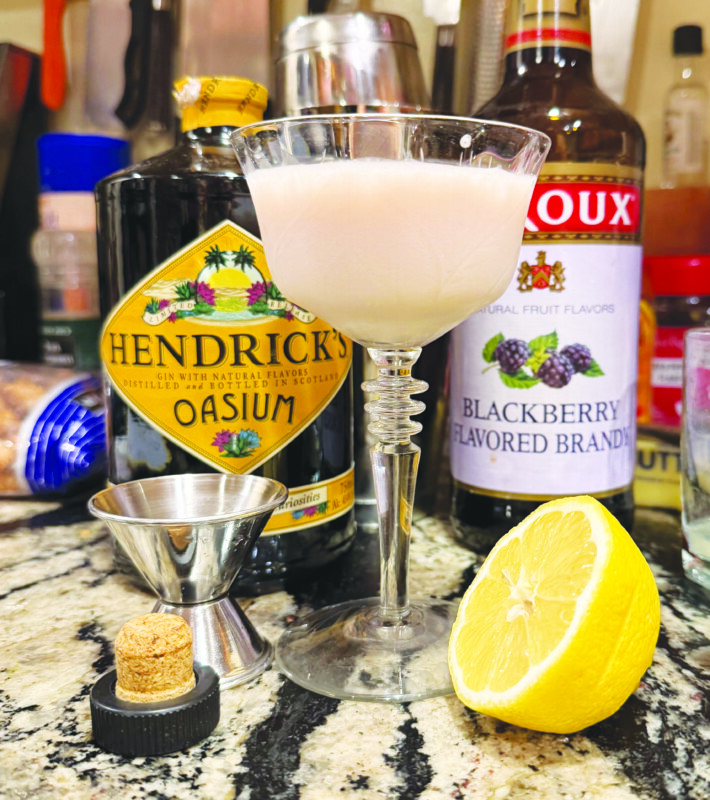
Let’s use a little of that blackberry brandy:

  • ½ ounce blackberry brandy
  • ½ ounce fresh squeezed lemon juice
  • ½ ounce half and half
  • 1½ ounces botanical gin – I very much like Hendrick’s Oasium
  • ¼ ounce simple syrup

Chill a coupe glass with several ice cubes. Set it aside, telling it, “Go think about what you’ve done.” In point of fact, this more or less innocent piece of glassware hasn’t actually done anything, but it’s good to keep it on its toes.

In a cocktail shaker, add ice, the blackberry brandy, lemon juice, half and half, gin, and simple syrup. Shake enthusiastically for 30 seconds or so, until you hear the ice start to break up. Ideally, you’re going to want a few tiny ice chips floating on the surface of your cocktail, so shake until you hear them make an appearance.

Retrieve your coupe glass and discard the ice. Strain the cocktail into the glass. Because it has a stem, this glass will keep your drink colder for longer.

Ask your digital assistant to play a classic banger of a rock song from your youth. I recommend “Hold the Line” by Toto.

Sip your cocktail, and play a little game with yourself. Try to get an overall impression of the flavor. What does it taste like in the aggregate? Pretty good, right?

Now, try to identify each ingredient. Look for the flavor of blackberries. You’ll find it. Ditto with the lemon juice. And the creaminess of the half and half.

There are some cocktails I like to think of as an ensemble cast — together, they create something greater than the sum of their parts. I think of the Blackberry Holstein as a top-notch variety show. Each performer gets a solo.

Featured photo: Frozen Peanut Butter Salad. Photo by John Fladd.

Good eats for a cause

Taste of the Towns raises money for the Nashua Center

The Nashua Center spends the vast majority of its time and energy helping children and adults in the greater Nashua area with disabilities or traumatic brain injuries, but for a brief time each spring some of that energy is focused on Taste of the Towns, an event that brings together the area’s food and beverage businesses and the people of Nashua to raise money and awareness for the Center.

“It’s our signature event,” said Marianne Gordineer, the Nashua Center’s Director of Development. “It brings together local restaurants, breweries, vineyards, etc. — local businesses — and of course, our supporters, who all enjoy great food while supporting the work happening at Nashua Center. I call it dinner by the bite because all of our vendors create amazing [food] for the event and it’s all in tasting portions, so our guests can go from table to table and just enjoy themselves.”

Gordineer said Taste of the Towns is the Nashua Center’s biggest fundraiser of the year. Between fundraising and help from corporate sponsors like Milliard Bank, the Center was able to purchase its building last spring.

“[That] has been so incredibly important for our programming,” she said, “and it gives us a permanent home to continue and grow our services. We’ve been leasing our location for practically 30 years, so we’re happy to say we’re home at last. It’s permanent.”

The restaurants and businesses that participate in Taste of the Towns range from small family-owned businesses to national chains and will include Bellavance Beverage Co., Brickhouse Restaurant and Brewery, The Good Place Cafe, The Imported Grape, In the Mix Bartending, K’sone’s Thai Restaurant & Lounge, Le Gris Charcuterie, Maggie’s Munchies, Nothing Bundt Cakes, Not Your Average Joe’s, Shorty’s Mexican Roadhouse, Soel Sistas, Spyglass Brewing, Tara House Grill, Thon Khao, Tito’s Vodka, Woodman’s Artisan Bakery, YouYou Japanese Bistro and Zorvino Vineyards.

“Tito’s Vodka has been a great partner of ours,” Gordineer said. “They’re also a sponsor of the event, and they’re coming back again with some great drinks…. And another great partner has been K’Sone’s [K’Sone’s Thai Dining and Lounge]. The owner has been participating for many years and just the energy that he brings and his display is spectacular. The Tala House Grill, the in-house restaurant from the Sheraton, makes a really dramatic presentation, too.”

Gordineer said 17 area food and beverage businesses will serve more than 300 attendees this year.

“It’s a really great event,” she said.

Taste of the Towns
When: Thursday, May 7, from 6 to 9:30 p.m.
Where: Sheraton Nashua, 11 Tara Blvd., Nashua, 888-9970, marriott.com
Festive attire is requested. Tickets start at $85 at nashuacenter.ejoinme.org/tasteofthetowns2026.

Featured photo: Courtesy photo.

Stay in the loop!

Get FREE weekly briefs on local food, music,

arts, and more across southern New Hampshire!