
Thelma (PG-13)

Three generations of a family undergo gradations of life crises whilst grandma seeks to take down some scammers in Thelma.

I believe the generations work out like this: Zoomer Daniel (Fred Hechinger) spends time with Silent Generation grandma Thelma (June Squibb) while her Gen X daughter Gail (Parker Posey) and son-in-law Alan (Clark Gregg) worry over both their life trajectories. The movie centers Thelma, of course, but it helps that we’re seeing people in different life stages feeling different kinds of lost. We avoid the cute-ification of Thelma, what Tara Ariano on the Extra Hot Great podcast refers to as the “rapping granny” effect.

Thelma lives alone after the death of her husband. Daniel is kind of adrift both in his career (we see his mother encourage him to apply to work in a friend’s dental office) and in his personal life, where he is “still on a break” with a girlfriend who we get a sense was the together one in the relationship. Gail is worried that her mother, who has suffered from a variety of health ailments and no longer drives, might not be up to living alone anymore (just as she is also worried that Daniel isn’t getting with the program, adulting-wise).

Gail expresses this worry after Thelma is taken in by a phone scam in which “Danny” calls to tell her he’s been arrested and to give money to a defense attorney who asks for $10,000 in cash. Thelma rushes to mail the envelope of cash but Daniel turns out to have been at home asleep all day. After the police tell Thelma there’s nothing they can do, her family takes her home, with Daniel promising to look in on her more and pushing her to wear her life alert watch.

Despite her family’s urging that she let it go, Thelma decides she wants her money back. But she doesn’t want to involve Gail or Daniel in her plans. Transportation-less, Thelma turns to Ben (Richard Roundtree), a not-super-close friend who lives at a senior facility. Much like how friendships among teens are often forged based on who has a car, Ben’s appeal to Thelma is largely that he has a sweet electric scooter.

Thelma first tries to “borrow” Ben’s scooter but when he stops her he agrees to go with her to the location of the post office box she sent the money to so she can scope it out and find the scammers. The trip across the San Fernando Valley takes time but Thelma is determined to get her money back — and probably to prove that she can still take care of herself.

Meanwhile Gail, Alan and Danny are desperate to find the missing Thelma, especially Danny, who feels responsible for having “lost” Thelma and that it’s yet another example of his general life failure.

The June Squibb/Richard Roundtree of it all perhaps had me expecting some level of action cleverness, humor and overall smartness that this movie doesn’t quite achieve. But, stepping back from my expectations, the movie has nice moments between the different characters and a general sweetness. We get to see their relationships to each other and their own difficulties. Thelma, for the most part, gets to feel like a real person, someone who is enjoying her independence for the first time ever (we learn that she lived with her parents until marriage and then with her husband until just a few years ago) but also is at times lonely and feels the vulnerability of her age for all that she tries to fight against it. Squibb gives a solid performance that has heart even as it has fun with its heist movie-like elements. B

Rated PG-13 for strong language, according to the MPA on filmratings.com. Written and directed by Josh Margolin, Thelma is an hour and 37 minutes long and distributed in theaters by Magnolia Pictures.

Featured photo: Thelma.

The Demon of Unrest, by Erik Larson

The Demon of Unrest, by Erik Larson (Crown, 497 pages)

It may be an egregious conflict of interest for a native South Carolinian to review any book about the onset of the Civil War, given the Palmetto state’s outsized role in that conflict. So take everything I say here with a grain of grits.

But Erik Larson has produced a masterful work in The Demon of Unrest, his narrative history of one of the most consequential five months this country has seen: the time period bookended by the election of Abraham Lincoln on Nov. 7, 1860, and the shots fired on Fort Sumter on April 12, 1861. We all know generally how the story began and ended. Larson fills in the details, by presenting the stories behind the stories, in rich detail. Incredibly, he manages to make the story suspenseful.

Not that this hasn’t been done before — the Titanic movie was suspenseful, and we knew how that ended, too. But Jack and Rose were fictional characters, their travails invented by James Cameron. For The Demon of Unrest, Larsen combed through realms of historical documents and journals and reconstructed the minutiae of the lives of leading figures in the Civil War, some of whom, like Abraham Lincoln and Mary Boykin Chestnut, are well-known; and others, who may not be quite as familiar.

He then artfully assembled the information and, instead of trying to write history, he just told stories — stories that explain the onset of the Civil War better than any AP history course ever could.

Thousands of books have been written about Lincoln; NPR once reported that Lincoln is only second to Jesus of Nazareth in the number of books written about him. So for serious Lincoln fans, The Demon of Unrest may not bring much new information to their table in this deeply sympathetic portrait of the 16th president. And I would be remiss to not point out that this book is not kind to the South, focusing as it does on letters and speeches that make clear that the conflict hung on slavery, not states’ rights. (Although there was a Confederate officer in South Carolina who was literally named States Rights Gist — mercifully, the man only went by “States” and the name seems to have died on the battlefield with him.)

Even Mary Boykin Chesnut, the Civil War diarist who was the wife of a wealthy planter, does not come off looking great, though her writing is generally acclaimed and was the basis of a book that won a Pulitzer Prize for history. We may not cheer when her Mulberry plantation is desecrated by Union soldiers, but neither do we weep.

That said, Chesnut is not presented as abjectly villainous, as are Edmund Ruffin and James Hammond, two pro-slavery and pro-secession Confederates whose beliefs did not age well and whose deeds were abhorrent even for their time.

Hammond, for example, sexually abused people he enslaved and also four under-aged nieces; he wrote unashamedly about his exploits in his journals. There was a great scandal when the relationship with the nieces came to light and Hammond retreated from public life for a while but later, incredibly, was returned to public office in South Carolina. Ruffin, a Virginian, was famously assigned to fire the first shot on Fort Sumter. He did so after dining the night before on cheese and crackers, and sleeping on “a pallet under two thick blankets,” still dressed in his clothes, because he was so excited for the war to start.

There are heroes in The Demon of Unrest, however, apart from Abraham Lincoln; most notable is Major Robert Anderson, the commander of Fort Sumter, the small island in Charleston Harbor where the first shots of the war were fired. Anderson is heroic, despite having once been a slaveholder, not only because he was on the right side of history, but also because he remained loyal to the Union despite his deeply conflicted feelings about the impending war.

He was, for example, sympathetic to various complaints of the South, and he was friends with General P.G.T. Beauregard, South Carolina’s military commander. The two men had to navigate the increasing military hostilities amid a friendship that began at West Point. They were unfailingly solicitous to each other in their correspondence, even as they were making preparations for their respective forces to do battle.

One of the starkest takeaways of the book is how vitriolic the South had become not only to the union but to everyone in the North. And they especially hated people who lived in New England. William Russell, a war correspondent for the London Times, was reporting in the colonies and wrote, “Whether it be in consequence of some secret influence which slavery has upon the minds of men or that the aggression of the North upon their institutions … certain it is there is a degree of something like ferocity in the Southern mind toward New England which exceeds belief.”

One might say a vestige of that remains in the South’s animosity toward certain New England sports teams.

Larson ends his story on April 18, 1861, but includes an epilogue that gives the post-war outcomes of all his major players. The Demon of Unrest adds to his compendium of lengthy narrative histories that include his treatment of Winston Churchill and the London Blitz, the Galveston hurricane of 1900, and the build-up to World War II under Hitler’s Germany.

His books are exhaustive, and as such, some consider them exhausting, but he performs a kindness for the reader by formatting the stories in short chapters, some only four or five pages. They are the sort of books best read over the course of a year, not over the course of a vacation, and require a high degree of interest in the subject matter. But nobody does it better when it comes to putting readers in the trenches of history, in this case with cannonballs whizzing over our heads. A —Jennifer Graham

Album Reviews 24/06/27

Potion Seller, When They Get Old (PNWK Records)

This was proffered to me as an EP from a Grand Rapids, Michigan,-based “alt-rock/post-emo/pop-punk band,” so I immediately went into snark mode in preparation for listening to this stuff, expecting it to evoke Good Charlotte and all those way-overdone sounds. But wait a minute, this isn’t your typical nerd-rock band, there’s actual old-school emo here, not just wishy-washy Dashboard Confessional obeisance and over-processed guitars. No, there are some organics here, not to mention some subtlety and even silence; there are spots during “Faster” when I almost expected to hear someone drop a coffee cup in the background. Yeah, the louder moments are cookie-cutter for the genre, but even those aren’t simply wall-of-sound bleatings; in fact — and I know these guys are too young to even know who they are — it’s actually reminiscent of Gin Blossoms or Skynyrd in spots. All told, the band’s first release for this imprint offers a very workable blend of Aughts-era pop-punk and modern emo. A+

Inter Arma, New Heaven (Relapse Records)

OK, cool story time, bros and gals, this was originally going to be a quick review of a different LP from my old friends at Relapse, but the link to the “advance album” was hopelessly mixed in with a bunch of different links, none of which pointed to the actual album in question, and so I’m doing this one instead, which is now two months old. The moral: overeducated PR reps, please make your emails make sense if you’re trying to push a new album to us lowly music journos, that’d be great. Anyhow (grrrrr), this Richmond, Virginia,-based metal act is known for eschewing structure in their rabid noise-scapes, but this is a departure in that the songs are more, well, song-like than what you may be accustomed to from these guys, if you are at all. The tldr is that the tunes are loud and aggressive in an unusual vein, combining sounds and hamster-wheel speeds native to both Cannibal Corpse and Bathory, i.e., the vocals fluctuate between Quorthon and Cookie Monster, but there’s a lot of clangy discordance. Not my cup of tea, but have at it. B-

PLAYLIST

A seriously abridged compendium of recent and future CD releases

• June 28 is a Friday and, thus spake the record companies, there will be many new albums presented for your entertainment and ridicule, on that day! We’ll start out with wildly popular children’s bouncy house party band Imagine Dragons, whose new album, Loom, is, you know, looming over my head (see what I did there?), demanding that I talk about it, because all the young children love this arena-pop band of balloon-animal-crafting circus clowns. Wow, this is so nice of Imagine Dragons, the entire album is on YouTube, and I’m listening to the new single, “Nice to Meet You,” this will definitely rule! Ack, this is Justin Timberlake-level cultural appropriation, the singer is trying to pick up a girl at a bar where everyone is gorgeous (except the band, of course, as always) and the tune is sort of like 1970s-soul mixed with LMFAO. I don’t know any child that would like this at all, although I imagine a fourth-grader who loves everything about (the great) Imagine Dragons would force themself to like it. Anyway, Imagine Dragons, everyone.

• Renowned for twerking so vigorously that she occasionally takes flight and soars up to 20,000 feet above sea level, Megan Thee Stallion proves that she hasn’t reached her Vegas-has-been stage yet by releasing her third album, Megan, on June 28! There is music on this album, but don’t be silly, you just want to know about the beefs that are explored in its grooves, because what else is music about, if not beefs? In the single, “Hiss,” she disses Drake, who expressed public support for Tory Lanez, who was found guilty of shooting Megan in 2020. Her boss Kendrick Lamar has also besmirched Drake, so there’s trouble ahead in hip-hop land, get your popcorn. We’ll have more wrestling news after these messages!

• Oh come on already, another Guided by Voices album, so soon, how is this even news; they (meaning songwriting addict Robert Pollard) released one in November, already! Whatever, let’s get it over with, Strut Of Kings is the title, and the single is “Serene King,” a Neil Young-type mid-tempo rawker (again). Pollard sounds like Ozzy in “sinister serpent god” mode (again) in this instantly recyclable classic!

• We’ll wrap up the week with St. Louis-based folkie-whatever Nathaniel Rateliff & the Night Sweats andhis new LP, South Of Here! The album includes “David and Goliath,” a Nilsson-meets-Ben Folds quirk-a-thon that’s actually well-written.

Gazpacho

Here is a cold Spanish soup for days when it’s so hot that you can’t finish typing a coherent…

  • 2 pounds (900 g) fresh tomatoes
  • ¼ cup (50 g) pickled jalapeños 
  • 1 medium-sized cucumber, peeled
  • 1 small white onion, peeled
  • 1 clove of garlic
  • 2 teaspoons kosher salt, or coarse sea salt
  • ½ cup (100 gr) extra virgin olive oil
  • 3 slices of stale, crusty bread — Italian or French
  • 2 teaspoons sherry vinegar

Roughly chop the tomatoes, cucumber, onion and garlic, then transfer them to your blender. Mine is a heavy-duty job, named Steve, but a regular blender, an immersion (stick) blender, or food processor will do the trick, too.

Add the salt and pickled jalapeños, then blend everything, slowly at first, then more briskly. Your blender has been impatiently waiting for a chance to really go to town on something, so give him a treat and work your way through the dial or buttons, and let him really exert himself. You’ll be able to feel his smile as he sucks chunks to the bottom of the jar and powers through them.

Let your blender play with the puree for a couple of minutes, until everything has been broken down about as much as it’s going to be, then bring the speed back down to whatever equates to “medium” on your device.

You know that detachable plug in the center of your blender lid that you’ve always wondered vaguely about? Now is your chance to put it to use. While your proto-gazpacho is still blending, remove the plug and drizzle the olive oil through the hole and into your pinkish mixture. Blend everything for another 30 seconds or so, to make certain the olive oil is completely incorporated.

Strain the mixture through a fine-mesh strainer. This is to remove any remaining bits of seeds or tomato skins. Depending on how fine your strainer is, this will probably take about 20 minutes. You can help the process along by scraping the walls of the strainer with a spoon from time to time.

Meanwhile, soak your bread slices in water, then squeeze them dry.

Check on the gazpacho in your strainer. If it still looks fairly liquid, stir it around to encourage more straining, then go find something to do for a few minutes. How long has it been since you went through the top shelf in your refrigerator and got rid of all the food that has turned into science experiments?

When your gazpacho has thoroughly drained, discard the solids, thanking them for giving so deeply of themselves, then pour the liquid back into your blender.

Add your soggy bread, then blend everything for another minute or so.

Gazpacho is at its best ice-cold, so it needs to be chilled in your refrigerator for at least six hours. If you don’t have immediate plans for hummus or piña coladas, find some room on the bottom shelf, and just store it in the blender jar.

Right before serving, remove the blender jar from the refrigerator. Add two teaspoons of the best vinegar you have — sherry or Champagne vinegar is good, but it doesn’t have to be that fancy — and give it one last whirl in the blender.

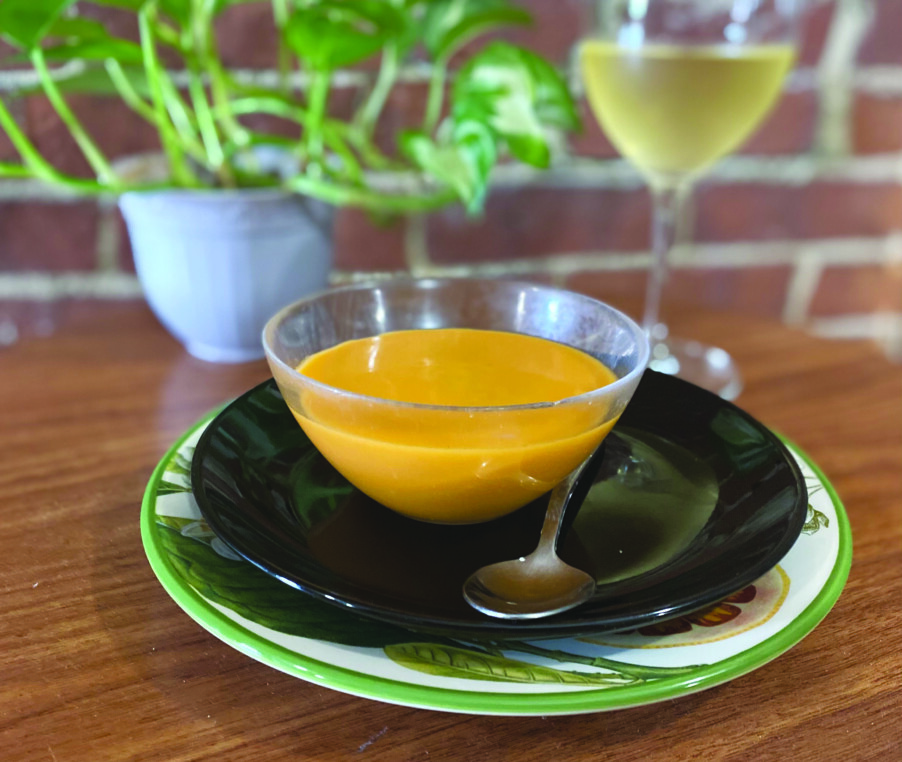
This is delicious, but very, very smooth. If you feel like you’re missing some texture, add chunks of torn bread for garnish.

This is a festive-looking soup. Depending on your tomatoes, it might be anywhere from a pastel pink color to something like a terracotta orange. You might find yourself facing a bowl of it and saying to yourself, “I don’t know; it’s really hot. I’m not sure I’m up for soup….”

But you went to all this trouble, so you figure you owe it to yourself to at least try it, so you taste a spoonful.

And your mouth explodes in Technicolor.

This is vibrant and cold, and fresh and acidic and cold, and one spoonful just isn’t enough. It’s really good. Why don’t you make this every week during the summer?

That’s a good question.

Featured Photo: Photo by John Fladd.

Pastrami to go

Jewish food fest serves deli staples, baked goods & more

Temple B’nai Israel in Laconia is taking orders now for its 2024 Jewish Food Festival.

For 27 years the Reformed Jewish Congregation has held a food festival, and for 23 of those years it was very much like many food festivals held by religious communities. Until the Covid-19 lockdown in 2020.

“It used to be a very different format,” said spokesperson Barbara Katz. “We used to have an on-site food festival at the Temple. One day a year, people came by the droves. They lined up down the street. They bought food to eat there. They bought food to take home. And then Covid hit.”

When the lockdown was announced in the spring of 2020, it put the Temple in a bit of a bind. A lot of the food for the summer Festival had already been prepared and frozen.

“It was like, ‘OK, what are we going to do with this? Are we giving it away?’” Katz remembered. Fortunately, there was already an online ordering system, so fans of Jewish food could ensure they were able to get what they wanted. “It was a simple way for people to pre-order foods,” Katz said. “They would complain that they couldn’t get what they wanted because it was sold out. So we had started this pre-order system, which went really well.”

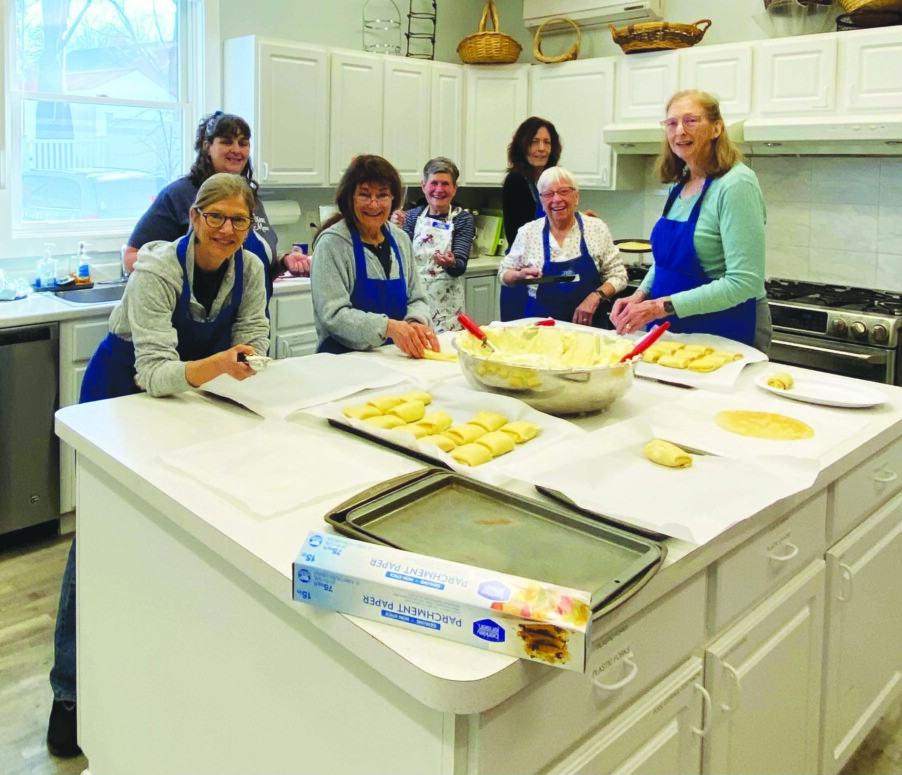
The members of the congregation were able to adapt that ordering system to take all the orders for food online, then arrange for people to contactlessly pick up their food on a particular date. “We put that into play that summer and we had a fabulous response,” Katz said. “And so now we find that it’s been a lot easier for us to host an online event than an in-person event.”

The Jewish Food Festival has a pretty consistent menu of items available for order.

“Every now and again, we throw something different in,” said Katz, “but not that often.”

The food on offer is traditional Jewish and American-Jewish dishes that customers look forward to each year. Baked goods like challah, blintzes and kugel are made by members of the Temple, as well as homemade Jewish dishes like matzah balls, knishes and slow-cooked brisket. Deli staples such as sliced pastrami, corned beef, and tongue meats, rye bread, and pickles, are ordered from Evan’s Deli in Marblehead, Mass., then brought back to Laconia just before the pick-up date.

“We buy big chunks of meat. We slice it, we package it,” Katz said. “It is fresh to go because we get it a day ahead. Anybody who orders fresh deli meats gets really fresh deli meat. We get great deli pickles that everyone just absolutely loves. We can never buy enough pickles to meet all the requests.”

“The other things we do fresh,” Katz added, “are chopped liver and the chopped herring. That is done right then and there.”

Katz stressed that although all the food at the Festival is authentically Jewish, it is not kosher. “We are a Reformed congregation,” she emphasized. “It is kosher-style in the sense that everything we do is in line with meats and dairy being separate, but we don’t want to lead anybody down a path. The other thing that is really very interesting is the majority of our customers from year to year to year are not Jewish. They love what we have to offer and keep coming back.”

The most high-demand items, Katz said, are the blintzes and the rugelach.

“Ours [the rugelach] is a very different recipe. They are coated with a turbinado sugar and the filling we use is not overly sweet. But that turbinado sugar on the top gives this unbelievable, lovely, little crusty thing going on with the sugary [crunch]. They are so good!”

Katz emphasized the importance of customers’ placing their orders in time.

“We give people four weeks to order,” she said, “but we don’t cook to order; we cook what we think will sell and that’s what’s on the inventory on the menu. Once it’s gone, it’s gone.”

New Hampshire Jewish Food Festival
Will accept orders until Sunday, July 7.
Order online at tbinh.org. Orders will be available for curbside drive-thru pickup, by appointment, on July 19 or July 20. Select your appointment time at checkout when you place your order.

Featured photo: Courtesy photo.

Strawberries and cows

Farm-to-table brunch at Brookford’s Jamboree

You could be forgiven for assuming that the big draw at a Strawberry Jamboree would be strawberries.

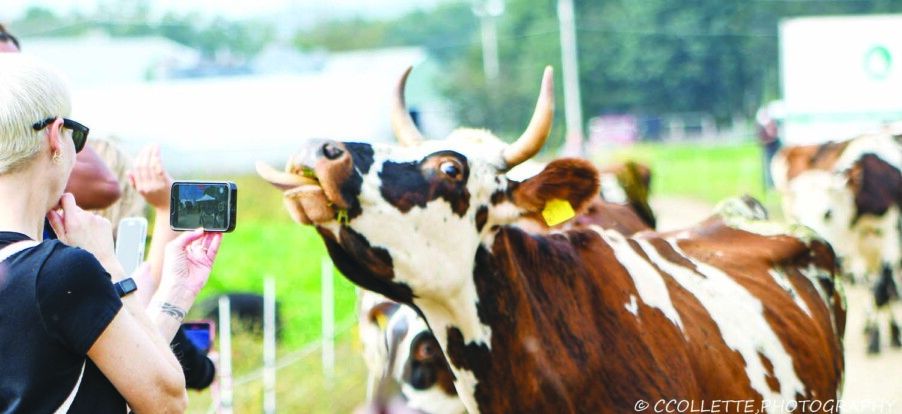
According to Megan Archundia of Brookford Farm (250 West Road, Canterbury, 742-4084, brookfordfarm.com), the crowd favorite is the Cow Parade.

“The kids love it so much!” Archundia said. “It’s always so cute, and the cows are such characters!”

Admittedly, the ideal of a Cow Parade is enormously appealing, but isn’t it just taking the cows to the barn for milking?

“Essentially, yes,” Archundia admitted. “We’re not diverting the cows or making them do anything they wouldn’t normally be doing. We’re just inviting people to line up and watch.” Which does nothing to lessen the thrill of parading cows for young children.

Parading cows aside, this is a strawberry celebration.

“[The Farm] is doing pick-your-own strawberries for the first time,” Archundia said, “so it makes sense to let people come onto the farm and experience it for themselves. We’re letting people know who’s growing their food and giving them a front-row seat to it.”

In addition to picking berries, Jamboree-goers will be able to feed pigs, take hay-rides, listen to live music and enjoy a seasonal farm-to-table brunch.

“We always have a Farm-to-Table tent at all our events,” Archundia said. “It’s all food that’s grown on the Farm or that we sell in our farm store. It’s always really fun, with a curated menu. This time, of course, we’re going to have strawberry shortcake and our 100-percent grass-fed ice cream available. One of the owners, Katarina, has a German background, so the farm has a lot of cool fermented stuff. We’re going to do a sausage plate with farm sausage, sourdough bread from Orchard Hill Breadworks [in Alstead] and some sauerkraut. I think we’re going to have a German-style potato salad on the menu. Stuff like that.”

Brookford Farm holds several open-house events each year, and according to Archundia they all have a similar format.

“There will be some live music, some sort of farm-to-table food, hay-rides and cow parades,” she said. Yes, please don’t forget the cow parades. Later in the year, the Farm will hold a Sunflower Soiree, a Pumpkins and Puppets event, and Christmas With the Cows.

The farm staff enjoys these events, which bring income that a small farm welcomes, but Archundia said they are also part of a larger mission.

“Sometimes we feel so disconnected from [where we get our food from]. In the grocery store, it’s just a product on a shelf. Everyone who works here is just so passionate. We’re excited to invite whoever wants to come to these events and see it in action. We hope they get that little bit of a spark, too, and a little bit of excitement, feeling that connection to the Earth.”

Brookford Farm is very diversified. In addition to growing strawberries, it raises dairy and beef cattle, pork, pasture-raised chickens and eggs, and grows produce that it delivers to customers and sells in its on-site farm store. The Farm’s products are also sold at the Concord Food Co-op and farmers markets. In addition, there is a CSA (Community Supported Agriculture) program. Archundia is excited about the window the Farm’s events gives community members into what is being grown pretty much in their neighborhood.

“[The visitors] bring so much excitement1” she said. “Every time they come, they’re like, ‘Oh, my gosh, I had no idea! or ‘I live right up the road!’ or ‘This is so exciting; now that I know you exist, I want to buy your products!’”

And, of course, there’s the Cow Parade.

Strawberry Jamboree
When: Saturday, June 29, and Sunday, June 30, 9 a.m. to 6 p.m.
Where: Brookford Farm, 250 West Road, Canterbury
Info and tickets: 742-4084, brookfordfarm.com
Tickets: General admission $10 online, $15 at the door; children 3 to 12 $7 online, $10 at the door; kids 2 and under free
No pets, please.

Featured photo: Cow parade. Photo by CCollette, Photography.

Stay in the loop!

Get FREE weekly briefs on local food, music,

arts, and more across southern New Hampshire!