
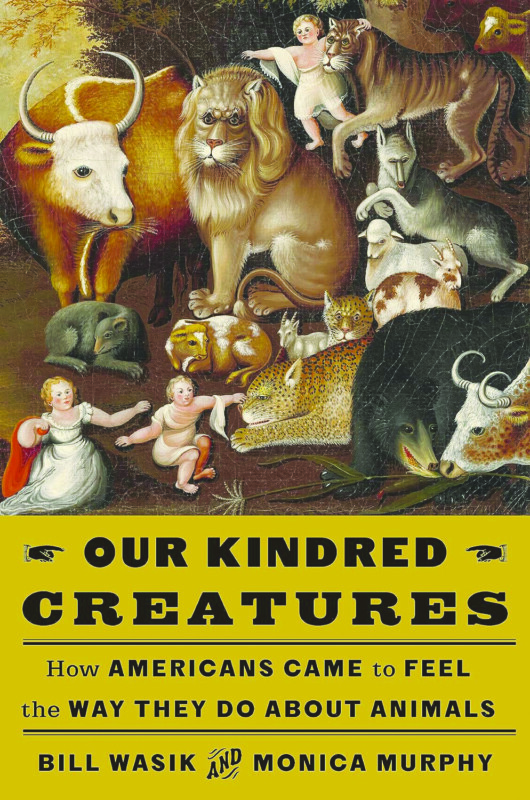
Our Kindred Creatures, by Bill Wasik and Monica Murphy

Our Kindred Creatures, by Bill Wasik and Monica Murphy (Knopf, 374 pages)

With the notable exception of factory farms, cruelty to animals is generally not tolerated in the U.S. today. Criminal penalties exist for everything from neglect to the hoarding of pets; New Hampshire’s definition of animal abuse even includes taking a colt from its mother in the first three months of life.

It’s hard to imagine, then, that just 175 years ago animal cruelty was rampant and for the most part rarely noticed or remarked upon. The change to where we are now didn’t occur gradually but was the result of a moral crusade that began in the 1860s with three New Englanders at the helm.

In Our Kindred Creatures, husband-and-wife team Bill Wasik and Monica Murphy weave together the stories of George Thorndike Angell of Massachusetts, Caroline Earle White of Philadelphia and Henry Bergh of New York, the latter of whom was said to have founded “a new type of goodness.” While many other people have argued for compassion to animals over the course of human history, these three were especially effective and their stories are remarkable.

But let the reader beware: The book is tough reading for the tender-hearted and anyone who loved the movie The Greatest Showman. Hugh Jackman’s portrayal of P.T. Barnum, it turns out, left quite a bit out.

Angell is perhaps the best-known of the three crusaders, as his name is attached to a Boston animal hospital and an animal shelter near the Massachusetts-New Hampshire state line. But it’s Bergh whose story is the most compelling. He was left a fortune by his father, which enabled him to travel as a young man. During those travels he had a moral epiphany when he watched a brutal bullfight in Spain and was horrified not just by the suffering of the animals but by the glee he witnessed in the audience by a family with young girls. Bergh came to believe that “cruelism” arises when people are entertained by animal suffering of any kind, and that human beings themselves are made morally worse by even witnessing it.

Inspired by animal-rights efforts in Europe, he came back to the U.S. and founded the American Society for the Prevention of Cruelty to Animals in 1866. Shortly afterward, thanks to Bergh’s efforts, New York passed its first anti-animal-cruelty law and ASPCA officers were given power to issue citations and make arrests. Bergh himself took to the streets, at first going after people abusing horses, and cattle en route to slaughter. He also boarded a ship carrying sea turtles from Florida to New York and tried to bring its captain to justice. (The effort failed when the judge ruled that turtles were fish and were not subject to animal cruelty laws.)

But Bergh most famously sparred with P.T. Barnum, whose story in The Greatest Showman was shockingly whitewashed. As Barnum bought and displayed an enslaved person in his exhibits, he also had elephants and whales captured and brought to New York for display. The whales all died in short order, but none in such a grisly fashion as the two that were burned in the fire that consumed Barnum’s “museum” in 1865.

Bergh and his compatriots were operating in a time in which animals were as numerous as humans on city streets, and they were not romanticized as they are today. Their excrement and, often, carcasses, were everywhere, and stray dogs were rounded up and drowned en masse in New York and beaten to death in Philadelphia. Dogfighting and rat baiting (betting on how fast dogs could kill a collection of rats) were common and cheap forms of entertainment.

Animals were also suffering behind closed doors in more sterile environs — laboratories and classrooms where vivisection was common — and at one point Bergh sent his ASPCA agents undercover into hospitals to see first-hand what was being done, similar to the undercover operations still done by PETA today.

Word spread throughout New England about what Bergh was doing, and the ASPCA offices were visited by people hoping to launch similar efforts in their own communities. One such person was Caroline Earle White, who visited Bergh on her way home to Philadelphia after spending the summer in the Adirondacks. White, like many people drawn to the animal-abuse cause, was an abolitionist, and she went on to found the Women’s SPCA of Pennsylvania and the American Anti-Vivisection Society.

She was also instrumental in the change to a more merciful manner of killing shelter dogs — using carbon dioxide, which of course is seen as cruel today, but at the time was seen as a step up from bludgeoning a dog to death with an ax. Also, in a revolutionary shelter that White and her colleagues created, dogs were given shelter and water, “and all were fed a healthy diet of horsemeat, cornmeal, and crisped pork skin, even those destined for culling.”

A Quaker-turned-Catholic, White had been troubled seeing mules and horses struggling to pull streetcars heavy with coal. She had started changing her routes around town so that she didn’t have to endure the sight. But one of the more horrific examples of horses being literally worked to death happened in Boston in 1868, when a “sleighing horse race” took place that resulted in the deaths of both animals after they were compelled to pull 400-pound sledges from Boston to Worcester, a distance of 38 miles.

The winner died the night of the race; the other horse a few weeks later. Reading about the event compelled Angell to renew efforts on behalf of animals, pushing for a law that would prevent such abuses and starting a newspaper that would go to every town in Massachusetts with the name “Our Dumb Animals” (“Dumb” here meant mute, not stupid). The publication would endure until 1970.

Wasik and Murphy are excellent storytellers, which is no surprise — he is the longtime editorial director of The New York Times Magazine, she is a veterinarian, and their first book, 2012’s Rabid, a history of rabies, was well-received. What was surprising to me was how much of this story I knew nothing about, even as an animal lover living in New England — from the Barnum whales to a horse plague that swept the country in the 1870s to how a novel published more than a decade earlier in England, Black Beauty, came to be harnessed by Angell to galvanize compassion for horses.

The authors say they researched Our Kindred Creatures for three years; 30 would have been equally believable. They have crafted an extraordinary, though heartbreaking, story. A+ —Jennifer Graham
Album Reviews 24/20/06

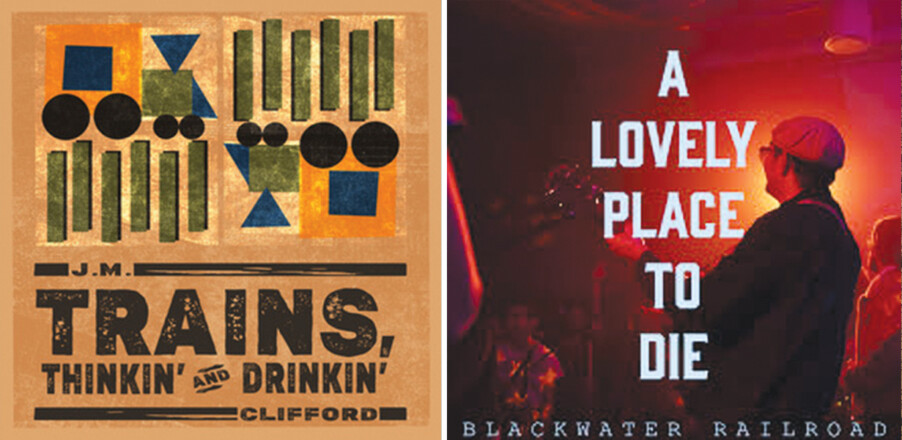
J.M. Clifford, Trains, Thinkin’ and Drinkin’ (Brooklyn Basement Records)

You know, a lot of people think they don’t like any country music, but they’re usually thinking of a specific subgenre. If you’re like me and hate WWE wrestling-intro country-metal but like Appalachia-tinged bluegrass purism, you’ll like this one, which is from a Brooklyn-based artist and educator, who hatted out to Nashville so he could recruit such renowned session players as Seth Taylor, Jeff Partin, Jeff Picker and Bronwyn Keith-Hynes into this fold. By day, Clifford is a New York City elementary school music teacher, so there’s no NSFW element to it, but innovation does abound (he won a spot as a showcase artist at the 2023 IBMA Business Conference in Raleigh, North Carolina). With titles like “Old Brown Shoes” and “Billy Goose,” you can smell the unplugged, organic moonshine from the get-go. It’s assuredly a curveball, influenced by Norman Blake, Gillian Welch, Leonard Cohen, Tom Waits and Tony Rice, which doesn’t mean it’s not instantly accessible and addictive. It’s simply good, honest stuff that instantly sticks. A+

Blackwater Railroad Company, A Lovely Place to Die (self-released)

Love it when this space can stick to one subject. In this case it’s deeply rootsy stuff; whereas J.M. Clifford’s new record (elsewhere here) is reliant on a sparser sound, this irresistibly folky LP tends to teeter between country, rock, soul and balladic folk, but with real purpose. Reportedly that’s a new development for this band, which recently added drums and saxophone to extend their lineup to five (I wasn’t crazy about the sax sound, which is a bit raw, but some people like it that way, you know, more like a Clarence Clemons type of vibe). Singer Tyson T. Davis has a picket-fence-toothed flavor to him that’s remindful of the dude from Primus; matter of fact, that’s the source of much of the charm here, but oh, did I tell you these guys are from Alaska? Aside: It’d be super cool if our local New Hampshire bands would be less fedora-hat and more like this (my OG readers have seen all the complaints I’ve lodged against bands like Truffle; give me a bunch of crazy rednecks from wayyy up north any day over those guys). A-

•

PLAYLIST

A seriously abridged compendium of recent and future CD releases

• Friday, June 21, will bring to us many new albums, try to calm yourselves, frantic fam, but first, a retraction, because for the first time in the 20 years I’ve been your favorite Best Of NH award-winning local music journalist, accept no substitutes, I have made an actual mistake! OK, I’m kidding; misremembering or carelessly bungling something is mother’s milk to me as you well know, but this time someone felt besmirched and expressed hesitance to buy my new book (order it from your local bookseller right away if you haven’t) if I didn’t fix the situation pronto please! Yes yes, in the June 6 issue I talked about The Concrete Jangle, the new album from Steve Conte, and in my abject stupidity I said that he’d only been with the New York Dolls for a very short time. That, I must confess, was FAKE NEWS, because I’d read Wikipedia’s totally incorrect timeline entry for the Dolls instead of digging further into the matter. Anywhatever, Steve messaged me on my cursed Facebook and told me “My actual timeline in the Dolls was this: In 2004 I joined the Dolls with [David] Johansen, Sylvain, Kane & made the live album & DVD, Morrissey Presents The Return Of The New York Dolls: Live From Royal Festival Hall. Then Kane died, was replaced by Sami Yaffa, and in 2005 we began the world tour (which lasted until 2010). In 2006 we made the studio album, One Day It Will Please Us To Remember Even This produced by Jack Douglas, in 2008 we made Live At The Fillmore East and in 2009, we made the Todd Rundren-produced studio album, Cause I Sez So. In 2010 I left the band after 6 years to join up with Michael Monroe (Sami, who was in Hanoi Rocks with Monroe, pulled me in) and that was the end.” Anyway, that’s important, and you should buy this new music album from Steve Conte, because he is awesome and writes great songs; you can buy it from that obscure little boutique online shop, Amazon-dot-something, same as my book, that’d be great.

• Holy black holes, Batman, I have no idea who any of these artists are, this week, so I will learn about them now, just like you! Let’s see, blah blah blah, first we have indie pop songstress Gracie Abrams, a new nepo baby whose dad is Hollywood super-producer J.J. Abrams; it must have been such a struggle for the poor thing to get a rock ’n’ roll recording contract (sad emoji)! The Secret Of Us is the album, and now I shall sally forth to listen to the single, “Close To You.” Oh boy, now we’re cooking with some serious contrivance, it’s a bloopy, foggy slow tune and she’s trying to sound like Billie Eilish, why didn’t she just buy the T-shirt instead of forcing me and whoever else gets stuck reviewing this stupid thing (someone from Nylon or whatever) to listen to this for content? Can you even stand these nepo babies (eyeroll emoji), #JustBuyTheTeeShirt, let’s make that hashtag happen on the double, eh?

• British singer-songwriter Lola Young cites Joni Mitchell and Prince as influences, so maybe her new album, This Wasn’t Meant For You Anyway, will be good, I don’t know at this juncture! Right, so in the video for the single “Messy” she’s dressed like a unicorn/elf cheerleader and she sounds vaguely like Tina Turner in chill-down mode. There are annoying samples in the beat, but this is actually a good song, go figure.

• Lastly it’s another English indie lady singer, Kate Nash, with her fifth studio album, 9 Sad Symphonies. The LP opens with “Change,” a glitch-pop thingamajig that strikes me as a joke song, what with her dunderheaded, vaguely Bjork-ish vocal approach. It’s weird, if you like that sort of thing in your disposable pop songs.

Stolen Kiss

I don’t have to tell you that this Saturday, June 22, is National Kissing Day. You’ve been stocking up on breath mints and lip balm for weeks.

There are quite a few kissing-themed cocktails. One popular one is called the Kiss Me. It’s one of those drinks that’s fairly simple in execution but calls for ingredients most of us are unlikely to have on hand. It will almost certainly require a trip to the liquor store. Because of this, you might want to save this recipe for a special occasion, like National Kissing Day.

Surprisingly, the most difficult ingredient to track down for this drink is strawberry schnapps. In the end, it required a work-around to replicate, which, in turn, required changing up the recipe’s traditional ratios. It’s easy enough to make strawberry syrup and mix it with vodka and end up with something very like schnapps.

In spite of using (almost) the same ingredients, this cocktail is different enough from a classic Kiss Me that it deserves a name of its own.

Stolen Kiss

  • 1 part rye whiskey
  • 1 part “strawberry schnapps” – see below
  • 1 part passionfruit cocktail — I like Goya’s; it’s delicious and easily available in the apple juice aisle at your favorite supermarket
  • 3 parts prosecco

Making Strawberry “Schnapps”

Combine equal amounts of frozen strawberries and granulated sugar, by weight, in a small saucepan.

Cook over medium heat, until the strawberries give up all their juice — encourage this with a potato masher — and the mixture comes to a boil.

Remove from heat, add the juice of half a lemon, and allow to cool.

Strain using a fine-mesh strainer. Eat the solids that are left behind on an English muffin or a crumpet; you won’t be sorry.

Bottle and save in the refrigerator for several weeks, although you’ll be lucky if it lasts through the weekend.

To make a decent substitute for strawberry schnapps, combine one part strawberry syrup with two parts medium-shelf vodka. I like Tito’s for this.

The Actual Cocktail

Combine the rye, “schnapps” and passionfruit with ice in a cocktail shaker. Shake enthusiastically.

Measure out and gently pour the prosecco into the cocktail shaker and stir gently. If you have an actual cocktail spoon, one with a long twisty handle, it will do a good job at mixing the drink thoroughly without de-fizzing the prosecco. If you don’t have one, a wooden spoon or even a fork will work well enough; just remember that you are mixing this gently, as if it might explode.

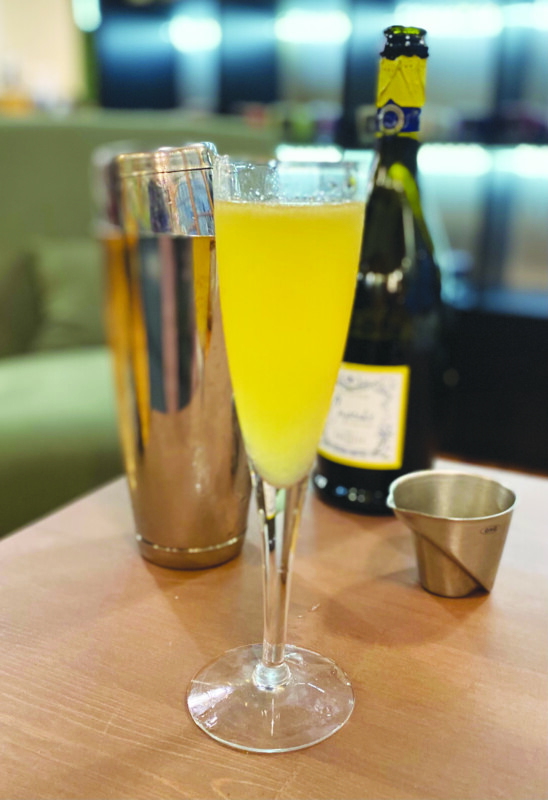
Strain the cocktail — again, gently — into a Champagne flute.

Drink — hopefully with company — to a kissing-themed song. There are any number of kissing songs, but my personal recommendation would be for Louis Armstrong’s version of “A Kiss to Build a Dream On.” Given agreeable company, it might make your heart feel as fizzy as the cocktail.

There’s a lot going on with this cocktail. The fact that it’s in a Champagne flute means that the fruity notes won’t hit your nose right away. Something like 70 percent of what we “taste” is actually dependent on what we smell. Because of the shape of the flute, you’ll catch this drink’s fruitiness on the back end, but with your first sip the rye will take a guitar solo. It’s on the second, third, or 17th sip that everything will fall into place. Appropriately enough, it tastes like a flirtation.

Featured Photo: Stolen Kiss. Photo by John Fladd.

A long road to shortcake

Strawberry Sunday in Hollis

By John Fladd
jfladd@hippopress.com

If you had to feed more than 1,000 guests, what would it take?

If you were part of the Hollis Woman’s Club (holliswomansclub.org), you’d start with 65 sheet pans of shortcake biscuits, 58 quarts of cream and 360 quarts of strawberries, then go from there.

For the past 80 years or so, the Town of Hollis has held a strawberry festival each June.

“The Town Band was founded in 1943,” said Ardie Henry, the Festival’s Director of Communications. “The first record we have of a strawberry festival is in 1946.” The Festival was a Town Band project until the 1970s. By that time, Henry said, “it had gotten too large to be handled by just one organization, so the Hollis Woman’s Club stepped in to help. Since 1978, it has been a combined effort of the Town Band, who play the music, and the Woman’s Club, [who] does the strawberry dessert part.”

For a small town event, the annual Strawberry Festival pulls in a lot of visitors.

“The most we’ve ever had is 1,300,” said Henry, “and last year we had 1,100, so we make a lot of shortcake, hull and cut a lot of strawberries, and whip a lot of cream. It’s a very large effort.” The Woman’s Club members make almost everything themselves.

“We don’t make the strawberries,” Henry said. “We get them locally from Brookdale Farm, right in Hollis. But we make everything else by hand. We have available strawberry shortcake, strawberry ice cream and strawberry sundaes.” The ice cream comes from Dr. Davis Ice Cream in Pepperell, Mass.

Although the festival, the band and the Woman’s Club are all centered in Hollis, the festival is a team effort spread out across many towns.

“This is one of the major fundraisers for the organizations [the Woman’s Club and the Town Band],” the Woman’s Club wrote in a recent press release, “each of which offers scholarships and supports other community endeavors. The Hollis Town Band currently has seventy members on its roster coming from eighteen different communities.” The Women’s Club is just as wide-ranging, said Ardie Henry. “It has approximately 80 members. There are women from Hollis, Brookline, Nashua, Milford, Amherst, Northwood, Merrimack and other surrounding towns, including northern Mass.” According to the press release, all members of the Women’s Club are requested to participate in some capacity. “We have several women who volunteer to bake,” Henry said, adding that other jobs include hulling, washing, slicing and sugaring more than 500 pounds of strawberries.

Henry said she personally is looking forward to good weather. Ideally, she said, “people bring their chairs and blankets, and if they want to have a late lunch and then have their strawberry shortcake, they can do that.”

The Hollis Strawberry Festival
When: Sunday, June 23, 2 to 4 p.m.
Where: Hollis Town Common, 7 Monument Square, Hollis (in the event of inclement weather, the Strawberry Festival will be moved to the Hollis Brookline Middle School, 25 Main St., Hollis)

The Weekly Dish 24/06/20

News from the local food scene

• On the grill: The Concord Food Co-Op (24 S. Main St. in Concord, 225-6840, concordfoodcoop.coop) holds a Grillin’ and Chillin’ event on Thursday, June 20, Friday, June 21, and Saturday, June 22, in its parking lot. From 11 a.m. to 2 p.m the event will feature grillin’ and chillin’. From 11 a.m. to 5 p.m. visitors will be able to shop with local vendors. And from 2 to 5 p.m., there will be snacks and beverages.

• Lavender: There are still tickets available for lavender-inspired Farm to Table Dinners in the Barn on Saturday, June 22, and Sunday, June 23, at 5 p.m. at Lavender Fields at Pumpkin Blossom Farm (393 Pumpkin Hill Road, Warner, 456-2443, pumpkinblossomfarm.com). These will be five-course dinners with lavender-infused cuisine prepared by Chef Bryan Leary, founder of Perspective Catering, and Michael Prete, founder of Portsmouth Catering. Tickets are $150 each and available through the Farm’s website.

• Appreciating heritage foods: A family-friendly event featuring local food, drinks and entertainment, Farm-a-Q returns to Tuckaway Farm (36 Captain Smith Emerson Road, Lee) on Sunday, June 23, from noon to 5 p.m. Tickets begin at $25. Proceeds support the Heritage Harvest Project, whose mission is to promote regional heritage foods and agricultural diversity among farmers, chefs and local communities. See “Farm-a-Q” on Eventbrite to purchase tickets, which start at $25.

Treasure Hunt 24/06/20

Hi, Donna!

I read your column each week in the Hippo!! I am hoping you can help us out. We have an antique fire extinguisher. Do you know if this is worth anything? I was going to donate it to a historical society. Any help would be greatly appreciated!

Thank you!

Donna Lee

Dear Donna Lee,

Your extinguisher makes me smile. Back in my days of owning an antique center they were very collectible and were all cleaned and polished, then either stood in a room or were made into lamps.

Not sure if they are collectible for the same reasons today. But they do have a value in the range of $100 and higher in some cases. I do think donating items to a local historical society is a great thing. Some things such as antique fire extinguishers were made en masse and there are still too many around today. You could still check to see if it is something they might want.

No matter what you decide, Donna Lee, you have an interesting piece of history. Thanks for sharing.

Stay in the loop!

Get FREE weekly briefs on local food, music,

arts, and more across southern New Hampshire!