Victory lap

Feat’s Last Farewell hits New Hampshire

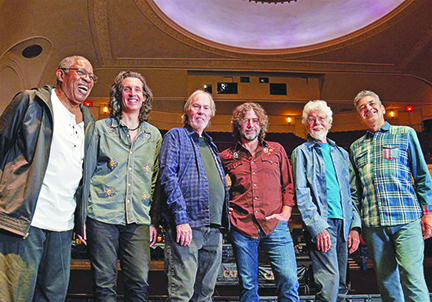
Though they’re still at the top of their game musically, Little Feat’s Oct. 2 appearance at Portsmouth’s Music Hall is likely their final one in the region. Their Last Farewell tour isn’t a hard stop, but cruises and residencies in hubs like Los Angeles, New York City and Nashville will be the only way to see the legendary band after this run ends.

“There’s an end point to jumping on the bus,” founding member Bill Payne said by phone recently.

As to why now, close to six decades after Lowell George and fellow Mothers of Invention member Roy Estrada recruited Payne and drummer Richie Hayward as the nucleus of a rootsy band that would produce timeless songs like “Willin’” and “Dixie Chicken,” Payne offered a cryptic, albeit practical, reply.

“Groucho Marx used to say, ‘I love my cigar, but I take it out every now and then,’” he explained. “I was resistant to the idea, to be honest with you, and then I began to say, ‘Travel’s travel.’ I just want to be able to play at a certain proficiency.”

That’s not a problem, based on accolades the tour is getting in places like Nashville. On Sept. 8 they made their Grand Ole Opry debut, then returned to the Ryman Auditorium the following night, where young acolytes Marcus King and Maggie Rose joined them, along with veteran guitarist Tommy Emmanuel, for a fiery second set.

It’s a victory lap, both for the band and Payne. The singer, songwriter and keyboard player has a lot going on.

He’ll begin work on a solo album in December.

“It looks like in Nashville,” he said. With a batch of songs from late Grateful Dead lyricist Robert Hunter, Paul Muldoon and Richard Wheeler, he’ll be joined by Emmanuel and Trey Hensley in the studio. Hopefully, Daniel Donato and Molly Tuttle will also pitch in.

Next year, Payne’s memoir, Carnival Ghosts, will be published. He promises an honest appraisal of his band, while noting, “it’s a fine line to watch … being truthful, but not harming people.” This applies especially to his old band mate, whose tragic end is more than well known.

“Lowell was a storyteller, and even at his most compromised, he was still writing songs like ‘Mercenary Territory’ and ‘Long Distance Love,’” Payne said. “He had this incredible gift. The sadness of course was he and others like him rolled off the edge, but he had so much to share with people. That beauty, it’s not going to be tarnished.”

A few in George’s orbit are treated less kindly, he added. “I am hurting some other people that I felt deserved it.”

Similarly balanced is Little Feat – The Documentary, released earlier this year and now on the film festival circuit. Directed by Jesse Lauter, who also helmed Learning To Live Together: The Return of Mad Dogs & Englishmen, it’s narrated by Jeff Bridges.

“I was thrilled with what Jesse Lauder came up with,” Payne said.

With the recent death of Estrada, Payne is the last surviving founding member of Little Feat. The group disbanded after George’s overdose death in 1979, reforming eight years later and making their comeback album Let It Roll in 1988. They’ve made multiple records since, though losing Hayward and guitarist Paul Barrere along the way.

Guitarist Scott Sharrard and drummer Tony Leone have stepped in for Barrere and Hayward, with results rivaling any version of the band; both possess unique talents in Payne’s view. “Somebody said it better than me: Tony’s not Richie Hayward, but Richie Hayward isn’t Tony Leone either.”

Payne is past seeing the two as new members.

“These guys are just wonderful musicians,” he said. “Tony studied Richie growing up, and Scott always wanted to be in Little Feat, even as a kid. Quite a few years ago I said to the guys, ‘You’re not auditioning for the band anymore, you’re in it. What do you want to do?’”

Featured Photo: Courtesy photo.

The Music Roundup 26/10/01

By Michael Witthaus
mwitthaus@hippopress.com

• Red Band: Two very different interpretations of Americana are on display as Matt Litzinger performs three songs each from The Band’s eponymous second album and Taylor Swift’s Red, followed by a few of his own original tunes. It’s part of an ongoing series called Live From The Countertop, where a local musician picks a pair of albums from the Billboard 100 to showcase. Thursday, Oct. 1, at 7 p.m., The Moka Pot, 8 Hanover St., Manchester, $5 at the door, mattlitzingermusic.com.

• Fugee flight: A group of self-confessed “music obsessed weirdos,” Diaspora Radio takes its Press Room covers show on the road, performing The Miseducation of Lauryn Hill in Manchester. The evening begins with music historian Zach Foote providing a backgrounder, followed by a “respectful but not reverent” recreation of the Fugees singer’s first solo flight by an all-star band. Friday, Oct. 2, 7:30 p.m., Rex Theatre, 23 Amherst St., Manchester, $34, palacetheatre.org.

• By request: Few tribute acts are like Yesterday and Today: An Interactive Beatles Experience, which builds a setlist from request cards filled out by the audience right before the show begins. Created by brothers Billy, Matthew and Ryan McGuigan to honor their late father, an Air Force veteran and Fab Four fan, it mixes memories with timeless music for a unique evening. Saturday, Oct. 3, at 7 p.m., Stockbridge Theatre, 44 N. Main St., Derry, $33 and up, pinkertonacademy.org.

• Book party: A comedian who can read the room for both laughs and emotional health, Jody Sloane performs a set and officially launches her first book. Hold The Field lays out a framework for understanding social situations without taking on other people’s problems in the process, with writing both relatable and helpful. Fellow comics Matt Barry and Jolanda Logan also appear. Saturday, Oct. 3, at 7 p.m., Headliners Comedy Club, 700 Elm St., Manchester, $20, ovationtix.com.

• Strange music: A New Hampshire sister act that’s one of rock’s weirdest stories is the subject of We Are The Shaggs, a documentary being screened in Epping. Forced to play by their father, the three daughters made a truly offbeat 1969 album that even tolerant denizens of Woodstock Nation couldn’t comprehend. In the ensuing years, Kurt Cobain and other artists cited the record as influential. Saturday, Oct. 3, at 2 p.m., Epping Playhouse, 38 Ladds Lane, Epping, free, reserve at tix.com.

Twilight alums

A look at the latest from Robert Pattinson and Kristen Stewart plus more recent releases

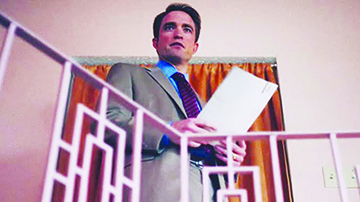
Primetime, a recently-released-in-theaters look at NBC’s Chris Hansen at the height of his To Catch a Predator fame, does a good job at highlighting its best asset: Robert Pattinson throwing his whole body into playing a weird character with a weird voice.

Pattinson plays Hansen as a man singlemindedly obsessed with fulfilling NBC head Jeff Zucker’s (playing himself) command that he beat Lost, his time-slot competitor, in the new season’s ratings. This Hansen, who gives off the sense of spiritually being at the edge of a psychotic break despite looking like a standard, well-coiffed newsman, harbors deep insecurities, best demonstrated by his hilarious jealous rage at fellow Dateline reporter Stone Phillips (Bill Heck). Beneath the TV exterior of his personality, there seems to be a boiling cauldron of crazy — Hansen doesn’t know how to be a normal person with his wife (Anna Faris) and kids, with the woman (Caroline Hebert) he’s cheating with or with Dan Plumb (Skyler Gisondo), the 20something actor who Hansen calls “Decoy Dan” for his work playing a young teen when the predators show up to meet in person. Perhaps the only person who can break through his delusion and paranoia is Andie (Merritt Wever), his producer, who is fully aware that they are working in a sleaze-based medium but is also pretty desperate to keep her position as this sleazy endeavor’s captain.

IMDb calls this movie a “psychological drama” and “thriller” and Wikipedia goes with “psychological crime thriller” but throughout I was mostly reading this as bleak, dark comedy about a specific era in media. Dan, just hoping to get his union membership from this role, is maybe the closest the movie gets to a sympathetic character. Pattinson’s Hansen is more of a fascinating trainwreck happening in front of you. I have no idea if the real guy is anything like this; “he thinks he’s Mike Wallace” some sound engineers say at one point. Pattison plays Hansen like a guy who is straining to believe he’s Mike Wallace and maybe cracking because he can’t “believe” away his personal and professional sordidness. I don’t feel that Oscar heft that this movie’s marketing had me expecting, but I do think this is a solid watch if you enjoy tense satire.

The Robert Pattinson-ness of Primetime led me to check out The Wrong Girls (an August theatrical release available for rent or purchase), whichstars fellow “Twilight movies take up ¾ of my IMDb known-fors” actor Kristen Stewart. Written and directed by Stewart’s wife, Dylan Meyer, The Wrong Girls is a showcase for my favorite kind of Stewart performance: Stewart as total goofball. See also 2019’s Charlie’s Angels and her Saturday Night Live appearances. Here, she’s Frankie, a Stanford dropout treading water in life, giving up immediately on anything that seems to be hard and putting all of her brainpower into inventing, for example, a giant bong. Frankie and roommate Molly (Alia Shawkat), who works a job she hates and dreams of becoming an avant garde chef for dishes (e.g. brownies with blue cheese) that are apparently excellent when high. Which this duo is most of the time. Behind on rent and accidentally handed a briefcase full of bottles of a strange glowy substance, Frankie and Molly decide to attempt to sell what they presume are drugs to make up their cash shortfall. They of course try out their product first, which gives them the ability to read each other’s minds and, when mixed with THC, possibly makes them telekinetic. Because, of course, other people want this substance, Frankie and Molly soon find themselves on the run with their cats (voiced by Kumail Nanjiani and Seth Rogen), whose very judgy minds they can also hear.

Zack Fox, LaKeith Stanfield, Tony Hale and Kate McKinnon also appear in this movie, which I would consider a very relaxed comedy; the jokes are loosely constructed and float by at a non-urgent pace. And it’s fine — enjoyable and funny in a comfy sort of way. I could take or leave the stoner-ness of the movie but I was charmed by the friendship, both the chemistry between Shawkat and Stewart and the “desperate love with minor quibbles about each other” quality of their relationship.

Here are some more recent releases I caught up on:

• Best of the Best (Netflix) is every great thing about a dance movie, a Pitch Perfect-style college extracurricular movie and a best friend movie. Maya (Maitreyi Ramakrishnan) and Anjali (Priyanka Kedia) are lifelong besties who have become roommates in their freshman year at UCLA. They also both love dance — though Maya doesn’t love that people know her as “Drone Strike” from a viral video shot at her high school talent show where a complex dance routine with drones lighting the stage went wrong and she took a drone to the head. When she learns about UCLA’s competitive Bollywood dance team, Maya encourage-pressures Anjali to join it with her, even though Anjali’s mother (Janina Gavankar) is extremely adamant that Anjali focus solely on her studies.

There are some boys (Ankur Rathee, Chaneil Kular) and some dance team politics but the true friction for this friendship is long-simmering resentments and fears — Maya says Anjali has always been the friendly, pretty one; Anjali fears Maya thinks she’s smarter and more talented. But we’re not friends, one says to the other at one point, we’ve always been sisters — hurray for best-friendship! In addition to this winning pair, the movie has some nice specificity about the experiences of Southeast Asian kids and their families and comedy that’s based on relationships and down-to-Earth (rather than, like, National Lampoon-style) aspects of college life. And we get some very fun dance numbers.

• The Rivals of Amziah King(an August theatrical release, now available for rent or purchase) is giving The Sticky vibes, if you recall that late-2024 series about maple syrup starring Margo Martindale on Prime Video (where it is still available and worth a watch), as well as some hints of The Lowdown (the latest very good Sterlin Harjo TV show on Hulu, slated to come back for its second season in October). Here (here being Oklahoma), Amziah King (Matthew McConaughey) is an expert in honey, which he produces (or rather, as he explains, his bees produce the honey — he is a man who deeply loves and respects his bees). The movie opens with law enforcement asking him to consult on some stolen honey, trying to help them track down who it might have originally belonged to. This leads to a strange series of events involving a dramatic farm injury that takes him to a hospital and then to a nearby diner several towns away from where he lives, which is where he runs into Kateri (Angelina LookingGlass), a young adult woman who was once a foster child Amziah and his wife raised for a few years before his wife died. Amziah brings Kateri back into his orbit and she seems delighted to be working with him on his bees and hanging out with his circle of musician friends who perform at church socials and the like. Their peace is broken when Kateri discovers that all of Amziah’s hives have been stolen. The police understand how devastating the loss is for the farm but they can’t really do much about it. Kateri decides to take it on herself to find the bees, retrieve the honey and maybe get some vengeance against the person who wronged them.

The movie starts with McConaughey and his buddies playing upbeat Americana at a drive-in restaurant, and throughout we get to know Amziah’s open-hearted personality in part through the music he plays. This feels like it should clash with the crime (some of it quite violent) and heist elements of the movie that come later, but somehow it all works together. The movie is kind and good-hearted and joyous and features murders and chosen-familial loyalty. It’s a weird mix but McConaughey plays it well and LookingGlass shows herself to be one to watch.

• Tony (an August theatrical release available for rent or purchase) gives us the “portrait of the artist as a highly slappable young man” tale of college student Anthony Bourdain. When we meet him, Tony (Dominic Sessa) is fairly confident that he’s got a writing fellowship in the bag, even though it would take saintly patience not to make barfing gestures when he describes the plot of the pretentious novel he plans to write. He is a world-class talent at being a massive jerk, a fact the real-life Bourdain was later aware of, based on the quote from his memoir Kitchen Confidential that starts the movie. When he doesn’t get the fellowship and can’t bear the thought of a summer spent with his parents, Tony basically runs away to Provincetown, chasing a girl from high school who he ran into at a bar. His attempts to pursue her are so bad I actually turned the volume down while watching it because Sessa is excellent at crafting a character who is an absolute wienball while thinking he’s being clever and charming, which makes his wienballness so much worse. Tony’s despair leads him to get so drunk at a local restaurant that he winds up sleeping it off first on the sidewalk outside the restaurant and then on the chef’s hammock. When Tony asks to stay another night or two, the Chef (Antonio Banderas, whose character Wikipedia calls José Vatel, though I don’t know if we ever hear his name) agrees in exchange for Tony’s services as a dishwasher in the restaurant. Five days a week, show up at 10:45 a.m. — a task that José makes easier by waking Tony up every morning with a pot full of sea water to the face. Tony continues to insist that he is a writer but we see him finding his place in the hyper-masculine camaraderie/abuse (and substance abuse) and discipline of the restaurant kitchen.

I remember some of this story — the vibes, really, more than specific incidents — from Kitchen Confidential. What we’re seeing here is more a slice of one young person’s growth — a completely insufferable adolescent becoming a slightly more mature, slightly more outward-looking person. And, especially once life humbles Tony a little, it’s a compelling watch, with Sessa playing against Banderas and Leo Woodall (playing, basically, kitchen worker cautionary tale), who are pulling Tony in occasionally opposing directions of order and chaos, respectively.

• Teenage Sex and Death at Camp Miasma (an August release available for rent or purchase) is the most recent movie written and directed by Jane Schoenbrun, who also wrote and directed I Saw The TV Glow. This movie feels like continuation of the thoughts in that movie — what it means to watch a TV show or movie and your reaction to it and how your reaction is and isn’t a part of the overall package of what the movie is doing and how your reaction at a young age can be completely different from what you feel rewatching it decades later. This movie adds another twist of ouroboros-like meta commentary by being about a director, Kris (Hannah Einbinder), trying to do a reboot on the Camp Miasma horror series, which the movie explains as sort of a Friday the 13th/Sleepaway Camp multi-entry franchise of decades prior. Kris travels to the abandoned camp from the first movie to seek out Billy Presley (Gillian Anderson), that movie’s “final girl” actor who bought the camp to serve as her retreat from the world. As an LGBTQ filmmaker, Kris explains to Billy, she knows she’s been brought in to smooth out some of the transphobic elements of the original film and to bring a “woke” twist to the movie while still being recognizable IP, the only thing movie studios are willing to spend money on. Billy approaches all of this explanation with an eyeroll to all the over-intellectualizing — and she isn’t fully sold on having any part of the project, which Kris feels is important.

Anderson seems like she’s having a blast here, playing Billy as a self-aware Norma Desmond (she claims she’s not and then wears the turban) in Dolly Parton hair who always seems like she might be floating away to woo-woo land or might just be messing with Kris to amuse herself. Or maybe both. She’s great, is what I’m saying, and she pairs nicely with the very serious, very “I’m here to do the work” of Einbinder’s Kris. The movie has fun with the horror movie tropes while also having fun with Billy and Kris having fun with horror movie tropes, including how horror movies approach sex and what that all means. And it all works? Or works enough for me, mixing Hollywood movie-making humor with strange little story elements.

• Fuze (an April Prime Video release), a movie that starts with the discovery of a World War II bomb in present-day downtown London, will not pain you to watch but it also will not, sorry, blow you away with its energy or innovation. Major Will Tranter (Aaron Taylor-Johnson) is called in when a construction crew digs up what appears to be a large unexploded bomb in a building site. The surrounding area is quickly evacuated — though in one building, a group of men (including one played by Sam Worthington) sit quietly in an apartment, not moving at the knock by police. As the Army works to secure and disarm the bomb, the men and their brains-of-the-operation George (Theo James) scurry around the neighborhood, sneaking into a basement and jackhammering through a wall to get to the bank vault next door. Because the police (as personified by Gugu Mbatha-Raw) have drones and heat sensors, they eventually catch on that the bomb-endangered area might not be completely empty.

This setup is fine — fun even. Who doesn’t like an overly complicated heist? But there is some tonal weirdness — is this a bouncy fun bad guys versus badder guys versus lady cop situation? Or a tense and serious affair? Or did the movie want to somehow do both things? And the movie builds itself up only to sort of balloon-slow-leak to the end.

Featured photo: Robert Pattinson in Primetime.

Cloudthief, by Nathaniel Rich

(MCD/Farrar, Straus and Giroux, 281 pages)

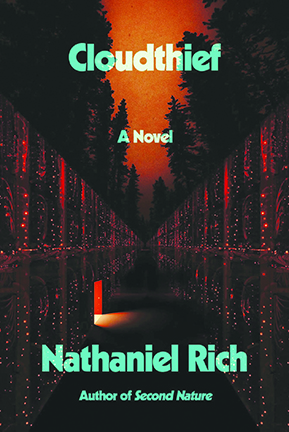
Some books take a while to grow on you; some endear themselves right from the start. The latter was my experience with Nathaniel Rich’s Cloudthief, a witty and smart crime novel with a deceivingly dull cover that does it no favors.

The protagonist is Tim, a freelance climate journalist in New York City, struggling to make ends meet by writing articles for magazines that pay by the word. He is “pathologically nonthreatening: not too tall, not too strong, not too quick, not too surprising, and not at all noticeable. Strangers were deeply unintimidated by me.”

After student-loan payments, health insurance and rent, he clears about $20,000, “enough for a weekly burrito, a monthly bender, a quarterly taxi.” When things are especially tough, as they are when we meet him, he rents out his tiny apartment for the night while he crashes on a friend’s couch.

But the night Tim is about to bunk with his friend Ces, Ces has other ideas. A brilliant eccentric whose main job is designing web pages, he’s hatched a plan to break into mini-storage units in Manhattan and steal anything of value in order to sell it. Tim is dubious but Ces has rented one of the storage units, so it’s not technically breaking and entering to enter the facility. So Tim follows along, guiltily aware that he is now, “according to the letter of the New York City Administrative Code, a misdemeanant.”

But things will get worse. And, as Tim muses, “The guilt, as with any sin, felt most acute at first occurrence. Each subsequent commission, no matter how severe, did not intensify the original guilt. Each crime alleviated it.”

Tim and Ces will part ways when they encounter a woman living in one of the storage units. Virginia has arranged her unit to lock from the inside, and she only goes outside for a few hours each night, when no one will notice her odd comings and goings.

Tim, still more journalist than thief, is intrigued and convinces Virginia to let him come in and interview her about her life, why she chose it and how she pulls it off, telling her (and himself) that it would be a great magazine story. But they become more than interviewer and subject, and together hatch a plan to pull off a much greater heist than breaking into mini-storage units. They decide to break into a data center near Tulsa, Oklahoma, and steal its most valuable data, an act they justify because of (a) the evil that technology companies perpetuate by collecting and selling our data and tracking us and (b) they are so desperate and broke.

Virginia is broke because she has chosen to take herself completely offline in order to escape from Big Tech’s all-knowing eye. She’s mastered the art of hiding not only from people but from Google, having realized that the best way to assure anonymity is to create lots of you’s. She also has acquired a lot of skills that will come in handy as she and Tim enact their plan.

Tim’s situation is more sympathetic. His financial struggles, aside from having low income in a high-cost city, are exacerbated by the fact that he is financially responsible for his sister, named Zoe, who has a genetic disease causing her to progressively lose her hearing and sight. Their parents are out of the picture, and Zoe is still able to live on her own, but both brother and sister know that at some point she is going to need full-time care.

All of this is happening in an America that is increasingly feeling the effects of a warming planet, which both Tim and Virginia refer to as “the Collapse.” Both are increasingly nihilistic, which enables them to easily make decisions that would have given others pause. They are also convinced that they can pull off the heist because of poor security in rural states. As Tim explains to Zoe, “This treasure trove is just sitting there. In giant empty warehouses surrounded by cornfields.”

Several perspective-shifting twists propel the story forward, as if a data-center heist isn’t enough to hold our attention. But the most compelling part about Cloudthief is how intelligent it is. Rich doesn’t assume that we know anything about data centers or how technology tracks us, but he explains everything in a way that is not insulting to readers. (One exception: how he uses initials to ostensibly disguise actual companies — as if we don’t know what G. and M. mean — although to be fair, the publisher’s legal team might have made that decision.) The dialogue between characters, even minor ones, is snappy and smart, and everything about the story seems thoughtful, from the contrast between mini-storage units and vast data centers, to the rich symbolism offered in a book that both Virginia and Tim treasure, a memoir by a French woman who spent 111 days in an underground cave.

And the data-center break-in, as it turns out, is but a prelude to another crime, which takes place in Boston and again, pivots the story in an unforeseen way.

Cloudthief is a story of descent, both societal and individual, and although it tries to leave us with a sense of hope, not everyone will experience it that way. Still, it’s the rare novel that will equally appeal to both women and men, and even rarer, teach you how to live in a storage unit, if that’s on your bucket list. B+

Featured Photo: Cloudthief, by Nathaniel Rich

Album Reviews 26/10/01

Satoko Fujii Orchestra Berlin, Second Attempt (Libra Records)

Jazz artist Fujii is known for her world-class improvisational piano work and finding the best collaborators available, talents that combine here in an oft-unsettling but undeniably musical form of ad hoc aural dada. On paper, a near-full horn section comprises the “orchestral” part of this experiment, but many other sounds come into play as well, including nontraditional ones (reflecting on all the turmoil that’s engulfed the world of late, one of the Lego-like sound-blocks inserted here has newspapers as its “instrument,” that is to say the musicians were tasked with extracting sounds out of them through tearing, crumpling or reading them. Other bizarre things are aboard, of course; in “Part 1” we hear Liz Kosak’s synth emulate humpback whale-song; “Part 2” features the drummer tandem of Michael Griener and Peter Orins futzing around with glitch sounds under a classic-sounding brutalist Japanese cinematic theme reminiscent of Akira Ifukube (of the earliest Godzilla films), all of which eventually starts spiraling into some noisy ad hoc jamming. “Part 3” reaches for a woozy, ethereal, unsettling vibe. As always, “good” improv is in the eye of the beholder; I had no problem dealing with the majority of this. A-

Desolat, People As Idiots & Idiots As Leaders (Reptilian Records/Exotic Fever Records)

To be honest, the things that got me interested enough in this Vienna, Austria “hardcore punk” band’s new LP to put this on the docket were (1) the album title, because come on, and (2) the fact that there are count ’em nine record labels helping to distribute the record worldwide, a factoid I wanted to bring to the attention of local bands who are putting out their own records. The band’s contracted with nine different labels to release this one, you see, including ones in France, Germany, Austria, U.K., Netherlands and two in the U.S., a pretty smart strategy that just wasn’t ever done in the past by DIY bands. Regarding the snarky quotation marks around “hardcore punk,” I wouldn’t say they’re that, more of a raw, stripped-down indie metal band similar to the ones Earache Records was hawking in the Aughts, the shorthand of which would go something like “Boris with no budget whatsoever,” a sound that actually works in our end-times. Put it this way: This was what I’d envisioned “punk metal” evolving into when the term first surfaced in the ’80s; it’s part Black Flag and part Black Sabbath, what one might call “awkward doom.” It’s quite cool. A+

PLAYLIST

A seriously abridged compendium of recent and future CD releases

• No brakes, baby, we’re suddenly into the first CD release Friday of October, on the 2nd! Now, in case you don’t know — and why would you? — Cancel Me (I’m Tired) is the second album by South London seven-piece electro-punk band Fat Dog, a group that could be considered England’s techie answer to The Hives, which means they act crazy and insane on stage, but since they’re from England and play expensive synthesizers that would fritz out if someone barfed on them, they’re more polite, as opposed to The Hives, who are Swedish and therefore don’t care about what Americans think of them, and besides, they have slightly better universal health care than Britain, so they’re just like “Neener America, come beat our heads in, at least we don’t have to sell our houses to pay for a poorly timed chipmunk bite.” So there’s that, and just to clue into what Fat Dog is about, not that it’d ever be on the test in any sane world, I watched one of their live videos, taken at the Pinkpop festival in the Netherlands earlier this year. The band’s two drummers are pretty lively, but the rest of the guys were even more tame than I’d expected, more like Daft Punk or LMFAO, like, you can’t get too wild when you’re plugged into all sorts of electronic gear, you know how it goes (let’s admit it, most soundsystem shows are about as exciting as watching someone try to correct a formula in an Excel spreadsheet). But whatever, the album’s title track is the first single; it’s fun and kind of funky and the vocals have a sort of Gravity Kills bullhorned effect on them, which I’ve never minded.

• That brings us to Walt Disco, a glam-rock/art-pop crew from Scotland that’s been making albums since 2022 and yet almost no one in the U.S. has ever heard of them, let’s change that now shall we, especially since they’re going for broke by making their third album self-titled. Well, will you listen to that, the newest single “Don’t Do This Alone” isn’t bad at all, kind of like a 2020s version of Bowie mixed with The Cure. There’s really nothing wrong with it at all; it definitely has a sleepy-chilly autumnal feel to it, and no, that doesn’t mean that I’ve suddenly stopped hating pumpkin spice, that’s something that’ll never happen, I assure you.

• Much to the disappointment of my first-ever editor from back in the days, I’ve never been big on The Smiths, mostly because I’ve wholeheartedly disliked every song of theirs I’ve ever heard, but that doesn’t mean there might not be something to like about this next one, The Age Of Everything, the fifth solo album from original Smiths guitarist Johnny Marr, so I’ll try it. Morrissey isn’t on this record, which bodes well, Yup, the kickoff single, “It’s Time,” is appropriately ’80s and jangly and harmless in the vein of The Alarm or whatnot. It’s got a little energy to it, it’s not bad.

• Alt-country musician Greg Freeman is based in Burlington, Vermont, but is nevertheless on the rise, sort of. If you’re a confirmed hipster you may know him from his 2025 single “Curtain,” in which his voice sounds like a cross between David Byrne and the dude from Clinic, which I don’t mind at all. His new LP All Set The Bone includes the tune “Cahokia,” a high-energy jangle-pop joint that sounds a lot more put together than his previous stuff but his voice is still delightfully off-key here and there.

• And finally it’s Miranda Lambert, who placed third in 2003’s Nashville Star talent competition but probably should have won, not that I’d know. Crisco, her newest album, spotlights the title track, a syrupy Dolly Parton-flavored trifle that combines cowboy-hat slide guitar with ’70s disco just to annoy me.

Featured Photo: The Church, Lacuna & Ibibio Sound Machine, Chopping.

Clever pear mocktail

  • 1 ounce pear syrup (see below)
  • Juice of 1 lime (about 1 ounce) + the carcass of half the lime
  • 3 ounces pineapple juice
  • 3 ounces club soda

Add the pear syrup, lime and pineapple juices, and half of the squeezed lime over ice in a cocktail shaker. Shake thoroughly.

Pour everything, including the ice, into a Collins glass. Top with club soda, then stir gently. Garnish with a paper umbrella or a plastic dinosaur. Drink with a straw. Because, reasons.

Pear syrup

  • 2 pears, or five or six little ones (300 g)
  • ½ cup (99 g) granulated sugar
  • 1 cup (225 g) water

Wash several pears, but don’t worry about peeling or coring them. Chop them into medium dice, then put them in the freezer for a few hours or overnight, until they are completely frozen.

Imagine that you are very tiny and have just moved into a new home — the inside of a pear cell. You have just finished getting your tiny apartment set up — the cookbooks are shelved, you’ve placed your lamps and tiny houseplants arranged just so. You put some jazz on your tiny sound system — maybe “Autumn Leaves” by the Bill Evans Trio — and have put your feet up and are relaxing. Unknown to you, the big lummox who lives outside the pear chops it into pieces. It’s like an earthquake and shocks you off your recliner, onto your tiny floor. You shout and shake your fist at the cell walls, but suddenly, the temperature starts to plummet. To your horror, the cell rumbles, and giant ice crystals start bursting through the walls, tearing brutal holes in them.

It only gets worse from there.

The point of this is that by freezing fruit, you poke holes through all its cell walls, which makes it collapse and release juice better when you make your syrup.

Combine the frozen pear pieces, the sugar and the water in a saucepan and cook over medium-low heat, until it comes to a boil. Simmer the mixture for 20 minutes. About 10 minutes in, hit the pear pieces with a potato masher to encourage them to submit to the syrup process.

Remove the pear pan from the stove and let it cool for an hour or so. Strain into a jar or a small bottle, and store in the refrigerator for up to a month.

Featured photo. Photo by John Fladd.

Stay in the loop!

Get FREE weekly briefs on local food, music,

arts, and more across southern New Hampshire!