Stories around the table

Rambling House and TaleSpinner Brewery open in Nashua

Since Debbie and Denis Gleeson founded The Nature of Things (now known as 2nd Nature Academy) in 1997, the South Nashua school has evolved to have a multi-faceted curriculum focused on sustainability — the Gleesons also operate a sister farm where they raise their own eggs, lamb and cattle. Twenty-five years later, the couple has a new locally sourced restaurant with a seasonally rotating menu, along with an accompanying craft brewery onsite.

Rambling House Food & Gathering opened March 4 on Factory Street and it’s a true family affair — all three of the Gleesons’ daughters, Erin, Kerry and Meghan Ayer, are co-founders, while TaleSpinner Brewery is spearheaded by their uncle Dave, a longtime avid homebrewer.

Multiple connections to the family’s farm or school are present, from spent beer grains going back to feed the cows, to baked goods sourced directly from the campus’s commercial kitchen. It’s a concept that’s been several years in the making, said Erin Gleeson, who serves as president.

“When I was graduating college, I had it in my mind that I wanted to run my own business [and] I was interested in food, craft cocktails and farming,” she said. “I think what we were finding was that there were places around to eat and drink, but they felt like just that, places to just eat or just drink. … What we’re trying to be … is more of a community gathering space. That was our goal, and I think luckily since the time we started thinking about this, a lot of that has been popping up in Nashua. It’s growing in that way, which I definitely think is the right direction.”

In addition to the Gleesons’ own farm, the eatery’s dinner and bar menus feature ingredients sourced from purveyors all over New England, and an in-house cafe with locally roasted coffee and grab-and-go items is expected soon. Here’s a closer look at each core part of the business.

Rambling House

Erin and Kerry’s paternal grandfather, Maurice Gleeson, immigrated to the United States from Ireland as a teenager. Growing up on a farm in the small village of Glenflesk in County Kerry, Maurice would visit a traditional “rambling house,” an informal inn of sorts that was known by all the locals as the family home to come gather and share stories, play games or listen to music.
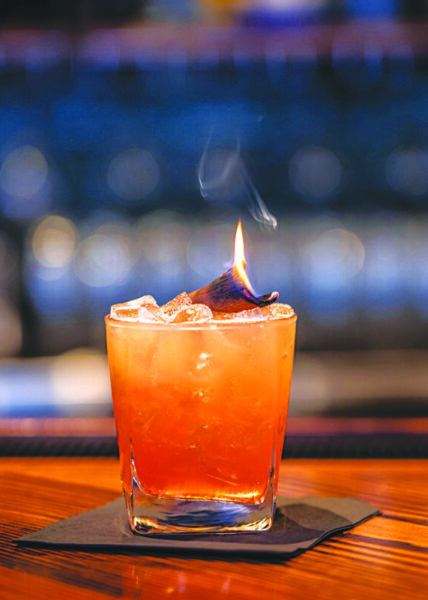
cocktail in glass with ice, set on fire
Crohan craft cocktail. Photo by Donna Desimone Photography.

“It was just the spot where everyone knew in the community to be almost like that safe harbor, and it was also the place where a weary traveler was always welcomed in by the fire to lay their head for the night,” Kerry Gleeson said. “He’d tell us all the time about how when he was young he would go visit the rambling house that was up the street from him. … He had such fond memories of it, and we just loved that sentiment, so that was a no-brainer for us for the name.”

Today, the Gleesons remain very much connected to their Irish heritage. Framed photographs taken by Maurice throughout the 1950s and early ’60s adorn the walls, and a small plaque by the door heading out to the upstairs balcony proclaims the “Margaret Mary Martha Murphy Mezzanine,” an inside joke and reference to their cousin overseas, with whom they are close.

But despite the strong family influences, Rambling House is not an Irish pub — rather, what you’ll find here is a diverse offering of meat, seafood and vegetarian options that will change every few months based on product availability and seasonality.

“We’re going to start with four menus a year, but that will probably grow to six menus a year, because our seasons are a little quick,” Erin Gleeson said. “We’ll keep a lot of the skeleton of the menu, so for example we’ll always have a burger on it, but the toppings will be different. We’ll always have a chicken [dish] on it but it might not be the lemon roast chicken we have now.”

The Gleesons have brought on Jeremy Guyotte to serve as the eatery’s head chef. A native of Gloucester, Mass., Guyotte has extensive experience working with seafood, notably during culinary stints he spent at Captain Carlo’s Oceanfront and at Passports Restaurant in Cape Ann.

Out of the gate, seafoods at Rambling House include a pancetta-wrapped Atlantic monkfish loin; pub mussels sourced from Blue Hill Bay in Maine with tasso ham, onion and herbs; and a bouillabaisse, featuring shrimp, scallops, mussels, littleneck clams and whitefish.

“When Jeremy first started making us seafood samples, we were like, ‘Oh, my gosh, who have we brought on?’” Kerry Gleeson said. “He is an artist, and our sous chef, Karyn [Polley], is fantastic too. She has been with us even longer, working at the school.”

Other menu items, like the porchetta and the shepherd’s pie, have so far received rave reviews. The latter is a traditional version made with lamb, veggies and house herbed gravy.

Baker Angel Lopez is an ardent bread maker and Erin Gleeson herself even makes her own small-batch ice cream, passion projects that are now part of Rambling House’s menu respectively in the form of desserts like brioche bread pudding and house brownie sundaes.

The restaurant’s main dining area features a unique post and beam layout with a bartop and shelves all designed by Erin and Kerry’s brother-in-law, Kyle Ayer of Green Building & Consulting Group. Once it gets a little warmer, an outdoor rooftop deck with additional seating areas will open, offering panoramic overhead views of the Nashua River.

“Our favorite thing so far is that when you’re up on that top deck, that skyline is where you can see the fireworks on the Fourth of July,” Erin Gleeson said.

A full bar features TaleSpinner brews on tap, in addition to a menu of craft cocktails, hard ciders, wines, non-alcoholic beer and hard kombucha. The cafe, meanwhile, is at the front of the restaurant and will soon be offering coffee from Bedford’s Flight Coffee Co., as well as various takeaway items like baked goods and breakfast sandwiches.

TaleSpinner Brewery

On the first level below Rambling House, TaleSpinner Brewery can be accessed through the opposite end of the building, on the Water Street side. The tasting room is at the top of a short flight of stairs from the entrance, and overlooks its full production area.

The brewery, which opened a few weeks earlier than its restaurant counterpart, was similarly named with Erin and Kerry Gleeson’s grandfather — described by Kerry as “a consummate tale spinner,” or storyteller — in mind. Their uncle Dave works closely with head brewer Scott Karlen to create TaleSpinner’s lineup of brews, which currently include a few New England-style IPAs, in addition to a Belgian blonde ale, a raspberry sour, a German-New Zealand Pilsner lager, and a Belgian strong ale. They’re also working on a peach apricot sour and an Imperial brunch stout with maple syrup, cacao nibs, vanilla bean and coffee from Flight Coffee Co. There are a total of 24 taplines: a dozen each in the restaurant and brewery.

“My uncle … made great stuff as a homebrewer and had a passion for it, and it became part of a conversation that it would be really fun to open a brewery,” Kerry Gleeson said. “So it was a natural sort of thing where the two concepts just fit into each other like puzzle pieces.”

A small bar menu is available out of the tasting room, featuring some items you’ll find upstairs at Rambling House, as well as others mostly exclusive to that space, like the fish and chips, the poutine and the duck confit flatbread. Those items, while not on the regular dinner menu at the restaurant, do become available upstairs as well after 9 p.m., Kerry Gleeson said.

Guyotte will sometimes cross-utilize TaleSpinner’s products with his food, notably a beer gravy for the poutine and spent grain waffles for the chicken and waffle sliders.

“There’s definitely a cycle with everything, and we want to build on that and make it as close to coming full circle as we can,” Kerry Gleeson said.

Rambling House Food & Gathering and TaleSpinner Brewery
Where: 57 Factory St., Nashua, Suites A and B
Current hours: Wednesday and Thursday, 4 to 10 p.m.; Friday and Saturday, 5 to 11 p.m., and Sunday, noon to 5 p.m. (extended hours likely coming soon)
More info: Visit ramblingtale.com or follow them on social media (@ourramblinghouse and @talespinnerbrew on Facebook, and @ramblinghouse and @talespinnerbrew on Instagram)
TaleSpinner Brewery’s entrance is accessed at the opposite end of the building on Water Street.

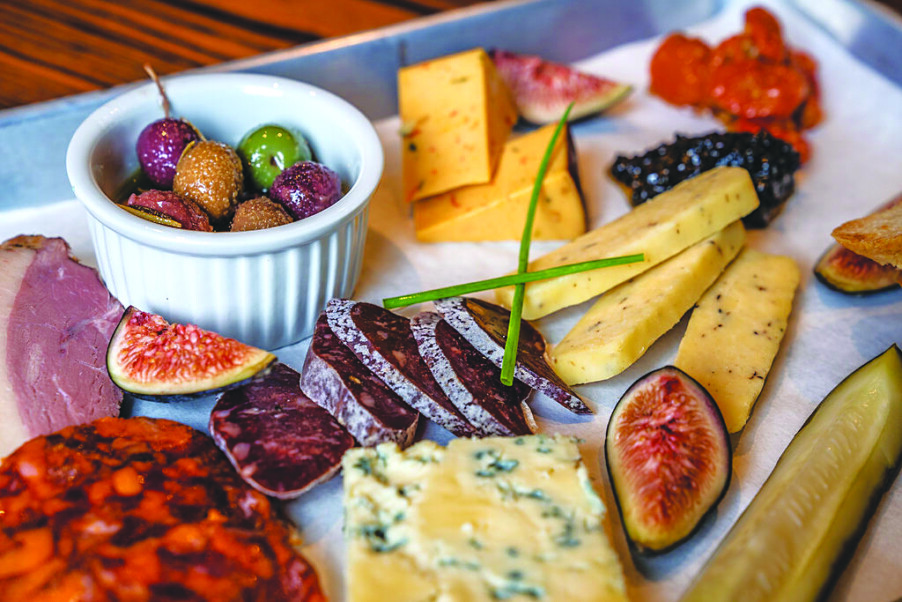
Featured photo: Winter charcuterie. Photo by Donna Desimone Photography.

The Weekly Dish 22/03/17

News from the local food scene

Franco Foods challenge: Join the Franco-American Centre for its inaugural Fleur Délices Challenge, an amateur baking competition happening on Saturday, April 9, at 6 p.m., at Anheuser-Busch Tour Center & Biergarten (221 Daniel Webster Hwy., Merrimack). Contestants are welcome to bring a cake of their own representing a country that’s part of the International Francophonie (or where French is among the most commonly spoken of languages). Winners will be chosen by a panel of local judges who will follow a grading criteria – they include pastry chef Alexandre Waddell of Cremeux French Patisserie in Merrimack and chef Matt Provencher of Red Beard’s Kitchen, a two-time winner of the New Hampshire PoutineFest. The cost is $20 and registration forms are due by March 18. See facnh.com for details.

Bunny campaign: The Salvation Army Women’s Auxiliary is selling chocolate Easter bunnies made by Granite State Candy Shoppe now through April 1 as part of its Bite Out of Hunger Campaign. The cost is $8.50 for an eight-ounce solid milk, white or dark chocolate bunny. Proceeds benefit The Salvation Army’s Kids’ Café program, which offers evening meals and recreation activities to local children and teens multiple days a week. Call Sylvia Crete at 490-4107 to order a bunny, or visit nne.salvationarmy.org/manchester to download the bunny order form. Bunnies may be picked up at The Salvation Army’s Manchester Corps (121 Cedar St.) any Monday through Friday, between 9 a.m. and 3 p.m.

Between the vines: LaBelle Winery owner Amy LaBelle has partnered with Kerri Zane of KZ Enterprises to produce a lifestyle show based on her life. According to a press release, The Winemaker’s Kitchen Show will feature both of LaBelle’s restaurants in Amherst and Derry, as well as their vineyards, event centers and other amenities that were unveiled last year, like the Derry property’s onsite golf course and artisan food market. The show will also provide various culinary tips, tricks and recipes commonly covered in her regular cooking classes and seminars. LaBelle has hosted televised cooking shows previously, when she partnered with New Hampshire PBS last year to produce a series of interactive classes geared toward kids. In a statement, Zane, an Emmy Award-winning television executive producer, said LaBelle is “poised to unseat Martha Stewart as the reigning queen of all things kitchen.” Visit labellewinery.com.

New spots for beer and barbecue: Concord’s newest craft brewery has landed — after more than a year of planning, Feathered Friend Brewing Co. (231 S. Main St.) officially opened last week in the former Taylor Rental space in the city’s South End. Owner Tucker Jadczak told the Hippo in February that the brewery’s name stems from his love and appreciation of birds. He has worked with head brewer Ryan Connor to create a lineup of craft beers that includes a red ale, a stout, a sour and a double dry-hopped IPA with Galaxy and Citra hops called Second Sun. Barrel-aged beers are also in their planning stages. An adjoining space next door to Feathered Friend Brewing Co. is the new home of Smokeshow Barbeque Co., which also recently opened its doors. Smokeshow owner Matt Gfroerer said the space triples the seating capacity of what he had before and allows him to build on his menu of Texas-style barbecue favorites. Visit featheredfriendbrewing.com or smokeshowbbq.com for more details on each.

On The Job – Melissa Gove

Melissa Gove

Weatherization specialist

Melissa Gove is the owner of Chase Hill Insulation, a weatherization business based in Weare that serves families in residential homes throughout the state.

Explain your job and what it entails.

My workday starts at 6:30 a.m., when my crew arrives at my shop. The job … is for a customer of the weatherization program, and the work … is based on an energy audit of the home. I have a work order that I follow that gives me specific details about the home and the measures my crew is supposed to install. My crew chief and I go over the work that needs to be done for that particular job and talk about any issues of concern for the job that either of us might have. The work truck is loaded with material, and my crew heads out. … Once they arrive at the job, they start the process of weatherizing the home, [which] may include insulating the basement, the walls and the attic.

How long have you had this job?

I’ve been weatherizing homes in New Hampshire for 16 years.

What led you to this career field and your current job?

Before starting my business, I lived in Rhode Island, but I would spend all my free time at my family’s camp in Deering. It was always so sad to leave the camp, and I desperately wanted to move to New Hampshire, but I needed a career to support that dream. I did hours of research online and found that there was a need in New Hampshire for insulation contractors for weatherization assistance programs. I built my business plan around that need with the help of my ex-husband, who was an experienced insulator.

What kind of education or training did you need?

I worked as a bookkeeper at a wire mill in Rhode Island for seven years, but in 2003 the mill burned to the ground. I was given an opportunity to go back to school, and in 2005 I received my degree in business management. I also have a good friend that’s an expert in the weatherization field that’s been a mentor to me over the years of building my business.

What is your typical at-work uniform or attire?

Chase Hill Insulation long-sleeve shirts, sweatshirts, hats, jeans and work boots are our everyday work gear.

How has your job changed over the course of the pandemic?

It’s really hard to ask people to let you come into their homes when they’re afraid of getting sick. I have had to reassure all of my customers that my crew and I will take every precaution to work safely while working at their home, and we will wear all necessary PPE.

What do you wish you’d known at the beginning of your career?

I wish I had known that business doesn’t always work out according to your plan. I had to learn to problem-solve, and I had to surround myself with good people. That’s how I continue to stay in business.

What do you wish other people knew about your job?

People aren’t always aware that their home is lacking insulation. Adding insulation to your home is something you can do right now to lower your heating bills for the rest of this winter and cooling costs for this upcoming summer. There are utility-funded programs available to help with these costs. People can reach out to their local utility company to see if they qualify.

What was the first job you ever had?

My first job was at my favorite pizza and sandwich shop in my hometown.

What’s the best piece of work-related advice you’ve ever received?

Take the time to listen to your customer’s needs and give them the attention they deserve.

Five favorites

Favorite book:
Dracula
Favorite movie: The Shawshank Redemption
Favorite music: Classic rock
Favorite food: Italian
Favorite thing about NH: That I never have to leave, because I’m finally home.

Featured photo: Melissa Gove. Courtesy photo.

Kiddie Pool 22/03/17

Family fun for the weekend

Art of the video game

SEE Science Center (200 Bedford St. in Manchester; 669-0400, see-sciencecenter.org) is now displaying “Video Game Art,” an exhibit celebrating the 100th anniversary of Ralph Baer’s birthday. Baer is the Manchester inventor who crafted the prototype for the first video game (find a statue commemorating him in Arms Park). The exhibit features pieces from 14 artists, according to the website, and is on display during SEE’s regular hours, Tuesdays through Sunday (10 a.m. to 4 p.m. on weekdays and until 5 p.m. on weekends). Admission costs $10 for guests ages 3 and up; advance registration is recommended.

SEE is offering a workshop for kids 12 and up next Saturday, March 26, wherein the kids make their own “Simon Says”-style game. The cost of the workshop is $5 extra and the workshop runs from 2 to 4 p.m. See the website to register and for materials requirements.

For more about Ralph Baer Projects Club, see ralphbaerday.com.

First veggies, then baked goods

Get kids excited about picking up some veggies, then grab a baked good or two at area winter farmers markets.

The Downtown Concord Winter Farmers Market runs Saturdays from 9 a.m. to noon at 7 Eagle Square. This coming Saturday, March 19, musicians Eyes of Age will perform. Find a list of vendors at dcwfm.squarespace.com.

Also on Saturdays is the Contoocook Farmers Market, which runs from 9 a.m. to noon at the Maple Street School (194 Maple St. in Contoocook).

On Sundays, head to LaBelle Winery (14 Route 111 in Derry) for the Salem NH Farmers Market, which operates from 10 a.m. to 1 p.m. Find their list of vendors at salemnhfarmersmarket.org.

More maple

Like the cover story says, we are in maple season. In Warner, the maple producers are holding a town-wide maple celebration this Saturday, March 19, and Sunday, March 20, according to a press release. Seven sap houses will be offering syrup demonstrations; find maps for the houses in Warner area businesses, the release said.

On Saturday, from 9 a.m. to 2 p.m. the Pillsbury Free Library (18 E. Main St. ) will offer a children’s craft. The Mt. Kearsarge Indian Museum (18 Highlawn Road in Warner; indianmuseum.org, 456-2600) will be open from 10 a.m. to 4 p.m. with maple sugaring demonstrations, acorn pancake samples, fry bread and maple treats for sale, a book sale, walking tours and more, according to the museum’s website. Admission to the museum costs $9 for adults, $8 for seniors, $7 for children (ages 6 to 12) and $26 for a family, the website said.

On Sunday, head to the Warner Town Hall from noon to 3 p.m. for a maple syrup tasting contest, where you can vote for your favorite.

Find more details on the event at warnerhistorical.org and if you haven’t already, check out the cover story for a listing of more area sugarhouses and their plans for this weekend and the rest of Maple Month.

On stage

The Palace Teen Apprentice Company will present Wizard of Oz: Young Performers Edition at the Rex Theatre (23 Amherst St. in Manchester; palacetheatre.org, 668-5588) on Tuesday, March 22, and Wednesday, March 23, at 7:30 p.m. Tickets cost $15 for adults, $12 for kids (ages 6 to 12).

Older theater lovers, teens in particular, may want to check out teen drama 1950s-style at Bye Bye Birdie, the Palace Theatre’s current production, which runs this weekend at 7:30 p.m. on Friday, March 18, and Saturday, March 19; at 2 p.m. on Saturday and at noon on Sunday, March 20. Tickets cost $25 through $46. The show runs through Sunday, April 3.

Outdoors after school

Beaver Brook Association (117 Ridge Road in Hollis; beaverbrook.org, 465-7787) will hold a “Hike and Sketch” program Mondays from 3:30 to 5 p.m. for kids in grades 4 through 6. Kids will walk Maple Hill Farm with their sketchbooks and draw in different locations (or in the Spear Room, if necessary due to weather), according to the website. The season, which runs March 28 through May 23, costs $120.

Treasure Hunt 22/03/17

I am hoping you can guide me. I have this wedding band that belonged to my sister. I have no use for it and am wondering what I should do with it. It’s marked 14KT with no other markings. If I had to guess, I’d say it was from the 1970s.

Can you help by telling me what would be the best way to find it a new home, maybe with a jeweler or a gold buyer?

Karen

Dear Karen,

I think the first thing you need to do is confirm it is gold. It’s tough to really tell these days when there are so many fake marks out there.

Step 2 is find someone you can trust to do business with. The markup on jewelry is so high, returning it for a wedding band to sell again might not give you the best value.

I would see what the secondary buyback value is and then what the gold value is, assuming it is gold. That’s why dealing with someone you can trust is important. I can give you a couple names of who I always dealt with for gold and silver if needed. They can determine gold, weight and best value.

Early harbingers of spring

Skunk cabbage, witch hazel and more

Here in Cornish Flat, New Hampshire, we recently had our first day that shouted, “Spring is here!” After a night of cool rain, the sun came out and temperatures climbed into the 50s. Now all we need are spring flowers. Me? I solved that problem by potting up bulbs last November and storing them in my cool basement. They rested, grew roots, and now my windowsills are crammed with pots of daffodils and crocus, some blooming, others on the way. They will help to keep my spirits up when we get, as I know we will, day after day of gray drizzle before summer gets here.

Of the outdoor bulbs, the first to bloom are snowdrops. They push up through frozen earth on south-facing hillsides starting in late February. I imagine they can do this by the process of “thermogenesis.” That’s a process whereby a plant can produce a chemical reaction that produces heat. Few can do it, but those that do can get pollinated before anything else.

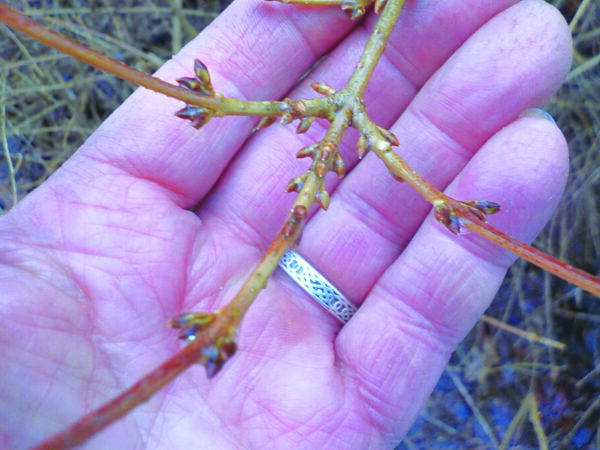
hand holding forsythia flower buds
Forsythia flower buds are pointy. Courtesy photo.

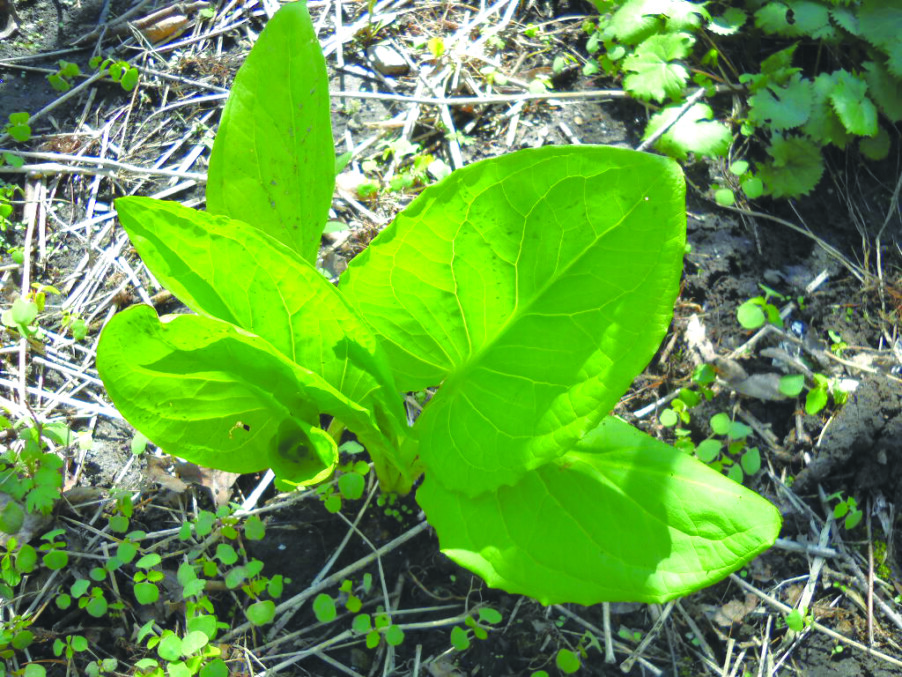
The poster child for thermogenesis is skunk cabbage. This is a plant I remember well from my boyhood home in Woodbridge, Connecticut. We had a small brook behind the house, and some wet areas along the banks in a woody area. Aside from being the first green plant to sprout, skunk cabbage had the ability to produce a noxious odor that was endlessly fascinating to young boys. I discovered that if I disturbed them they produced a skunky odor that my sister did not like.

Skunk cabbage is related to the common Jack-in-the-pulpit we all know and love. Like Jack, its flower is hidden inside a spathe, or outer leafy jacket. I bought a skunk cabbage plant at Garden in the Woods, a native plant sanctuary in Framingham, Mass., about 25 years ago.

What I did not know was that skunk cabbage is very slow growing and does not spread at all quickly, at least this far north. Only in recent years has it bloomed, though every year the leaves have gotten bigger. Now I know when buying plants to buy at least three in order to make a statement in a reasonable amount of time. Skunk cabbage produces big green leaves and a barely noticeable flower.

Of the native woody plants, spring witch hazel is the earliest that I know. In southern New England it can bloom in January, and here in New Hampshire it can bloom in March. I bought one last summer, and look forward to seeing the blossoms soon. I have several fall witch hazel that bloom in October and November. The blossoms vary from yellow to brownish red and are spidery in form. Small, but plentiful right near the stems.

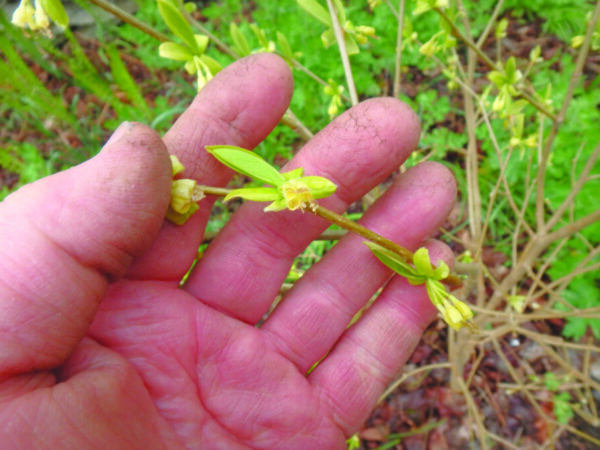
close-up, hand holding leatherwood blossom
Leatherwood blossom, close-up. Courtesy photo.

Forsythia is a nice yellow-blossomed shrub originally from Asia and eastern Europe. Michael Dirr, my woody plant guru, describes it this way: “Rank-growing, deciduous shrub, differentially developing upright and arching canes which give it the appearance that the roots were stuck in an electric socket; always needs grooming, one of the most overrated and overused shrubs; will sucker (slowly) to form large colonies.” That from his “Manual of Woody Landscape Plants,” my favorite text on trees and shrubs.

His remarks notwithstanding, I grew up with it and like it. It is a burst of yellow at a time of the year — April, here — when not much else has bloomed or even leafed out. My gardening Grampy had a large patch of it that had suckered and created a bed 10 feet wide, 50 feet long and 8 feet high or more. My sister Ruth Anne and I would crawl inside the patch of forsythia in the heat of summer for a cool respite — and to hide from grownups.

The trick to managing forsythia is to prune it hard and often. Keep the tips of branches off the ground as they will root in if touching the soil. One can keep it as a nice vase-shaped shrub, and it really does not take much work to do so. Cold-hardy varieties that will bloom in Zone 4 include New Hampshire Gold, Vermont Sun and Meadowlark, among others. Ask at your local independent nursery.

Forsythia forces easily. Cut some stems with flower buds now and place them in a vase, and place it in a sunny window. I shall cut some today and get them blooming in a couple of weeks or less. The key is to recognize the flower buds: they are pointy and often appear on clusters without stalks, right on the stems. Straight young stems that grew last year rarely have flower buds.

In contrast to the flamboyant forsythia is a nice native, leatherwood. This understated plant blooms just as it leafs out in March, April or early May, depending on where you are. It does best in full shade. Although Dirr’s book says it prefers a moist, dark soil, I have it in a dry location and it does just fine. The blossoms are pale to bright yellow, small, but plentiful. The bark is a handsome gray. But it is hard to find in a plant nursery. I bought one several years ago and have looked for others, but have not found another nicely shaped specimen. Look for it. Slow growing, it requires little or no care.

T.S. Eliot wrote in his poem “The Wasteland” that April is the cruelest month. I disagree; I think March is. Muddy roads and gray skies predominate. Flowers are scarce. We have April to look forward to, but if you pot up some daffodils next November for forcing, you can at least have some indoor blossoms now, in March.

Featured photo: Skunk cabbage has big leaves and grows in moist shade. Courtesy photo.

Stay in the loop!

Get FREE weekly briefs on local food, music,

arts, and more across southern New Hampshire!